

1. Introduction
Many financial institutions (either credit insurers or banks) employ credit limits that are based on par value or Exposure at default (EAD). These have the significant drawback that it is quite difficult to make them risk sensitive, however. Sensitivity to risk may only be achieved by introducing numerous limit categories that distinguish between ratings, maturities and asset classes. The resulting limit system is usually complicated, lacking in transparency and difficult to implement effectively.
The alternative is to base limits on the capital consumption of sets of exposure. Limits of this type allow, in a convincing manner, for the relative riskiness of different exposures. They also enable financial institutions to allocate ‘capital budgets’ to different business departments, facilitating corporate planning and business plan realisation.
The challenge in basing limit systems on capital consumption is that of solving the IT integration issues that it raises. For many institutions, limits are evaluated in large software systems primarily designed as Core Banking, Core Underwriting, Dealing or Loan Origination systems. These systems often have little scope for bespoke modification and may not be designed to host complex calculations such as those required to evaluate capital.
To cope with these challenges, one may devise connector software that links the system evaluating limits with a calculation module which computes either Regulatory or Economic Capital. Commonly, either Regulatory or Economic Capital computations cannot be performed for single exposures alone. For example, Basel II capital requires a concentration adjustment calculation which involves assessing the capital for the entire portfolio. Economic Capital as generated by a Monte Carlo, Credit Portfolio Model (CPM), generally involves simulating a full portfolio of exposures even to evaluate the capital contribution of a single additional exposure.
This note explains some innovative approaches developed by Risk Control that help to resolve these challenges. It describes how Risk Control’s own software, named RC-Limit System, may be integrated with a powerful CPM, RC-Capital Model, in order to facilitate the use of Economic Capital-based credit limits. The approach is built around (i) a Connector Application which sits between the two primary systems, facilitating their communication, and (ii) use of a proprietary algorithm called Deal Analysis.
Deal Analysis involves performing runs of a CPM for an entire portfolio, storing inputs and results from this calculation and then evaluating the capital for a single new exposure in a quasi-real-time way by performing a Monte Carlo of the exposure alone and combining results with the stored data. The marginal capital contribution of the single exposure is then identical to what would have been obtained if a run had been performed for the entire portfolio. This approach is extremely efficient and avoids the need to perform entireportfolio runs more than occasionally (for example, on an overnight basis).
The approaches here described may be modified if limits are based on Regulatory capital consumption or if the CPM or limit system employed are different. But the basic ideas and architecture are similar.
2. Limit and Capital Model Integration
Some financial institutions evaluate credit limits within Core Banking, Dealing or Core Underwriting systems. Other institutions employ standalone dedicated systems (often internally generated since they are often bespoke) for aggregating data across multiple data sources and evaluating limits.
In either case, a user working on a prospective deal must submit a request to evaluate a limit from whatever application they are using. Where the limit is based on capital, either Regulatory or Economic Capital, a request must be sent from the system the user is employing to an external application that computes the capital consumption.
This note explains how the RC-Limit System and the high performance CPM, RC-Capital Model, together with the connector, may be used by institutions wishing to operate Economic Capital-based limits conveniently. (Note that if the objective is to evaluate Basel-capital-consumption based limits, runs of a CPM may still be necessary to evaluate the Pillar 2 concentration risk charge.)
A challenge is that even if the limit system and the capital model are integrated in the sense that data can be sent to the capital model to evaluate a prospective exposure, typical whole-portfolio calculation times for Monte Carlo CPMs are slow (a matter of minutes) so checking a limit for a prospective exposure is likely to be inconveniently slow.
To resolve this issue, Risk Control employs a proprietary algorithm that permits very rapid evaluation of the capital for single exposures based on a Monte Carlo analysis of the single exposure alone combined with saved results and inputs from an earlier model run for the portfolio as a whole. Using this technique, one may obtain quasi-real-time evaluation of capital contribution for single exposures.
In practice, to use this technique involves the following two steps:
1. Periodically (overnight or more frequently) a run of RC-Capital Model may be triggered, generating a set of Economic Capital calculations for the portfolio as a whole. These runs can be scheduled and controlled from within the RC-Limit System.
2. When a loan officer wishes to evaluate the limits for a new deal or transaction they are considering, the RC-Limit System submits a request to the RC-Capital Model via the connector to evaluate the single deal (see Figure 1). The RC-Capital Model combines results from a very quick evaluation of the single deal with results from the portfolio-wide results to compute the capital contribution of the single exposure. This is used to check all applicable limits for the prospective deal.
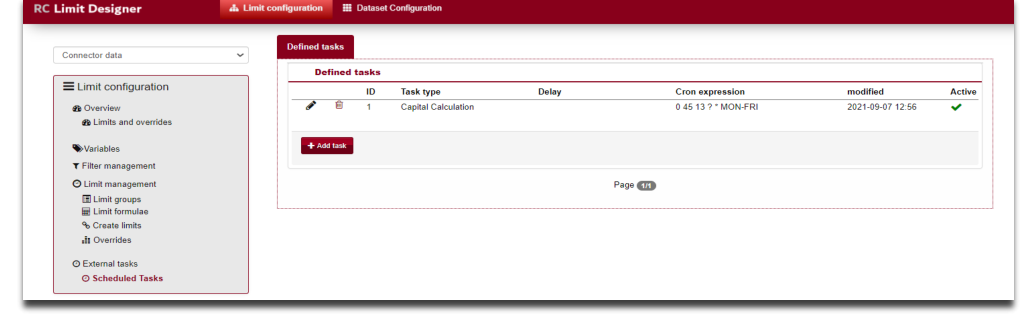
To explain Step 1 in the list above in more detail, the RC-Limit System comprises a) an interface for analysts called Limit Manager, b) an application for configuring limits called Limit Designer, and c) a backend REST server called Limit Engine. A scheduled task can be defined within Limit Designer (see Figure 2) that calls the connector to process data and triggers a run of the RC-Capital Model (see Figure 1). The user creates such a scheduled task by choosing a frequency, delay, or time of day for the task to run, and selecting the task type which runs the calculation. Once created, tasks can be edited or switched on and off and the system will recognise this as it occurs.
When the task is run, RC-Limit System makes a call to the connector. The latter reads the exposures from the limit portfolio, processes them into the format needed for the RC-Capital Model, and uploads them, triggering a run. When the model run has completed, the connector takes the results and uses them to create a request which it sends to the Limit Manager to update the exposure amounts in the portfolio.
To create the capital model exposures from the Limit Manager portfolio, the connector uses an “xml” file which can be modified by the user as and when required. This tells the application which column or default value to use for each field. It is able to use lookup tables or formulae to populate fields where necessary.
The results of the model run are then used to update the current portfolio data stored in the Limit System. To estimate capital for an exposure assessed between model runs, the connector is used to submit the exposure characteristics to the capital model and to return a result based on data corresponding to the last full portfolio run.
The Limit Designer module within the RC-Limit System is used to configure portfolios and limits. Limit Designer also allows the user to create scheduled tasks for communicating with outside applications. In particular, tasks can be created to call a capital model, run a calculation, and use it to update the exposure amounts in the portfolio linked to the RC-Limit System.
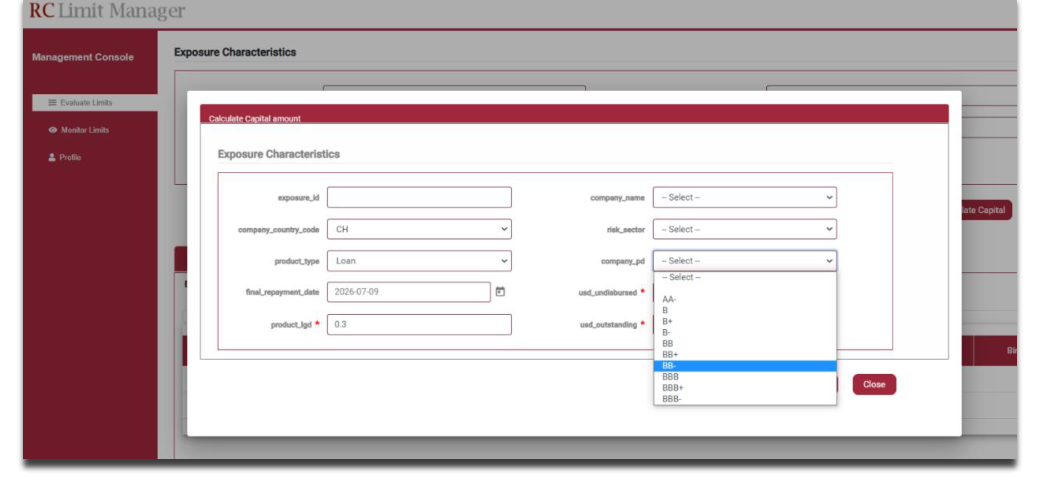
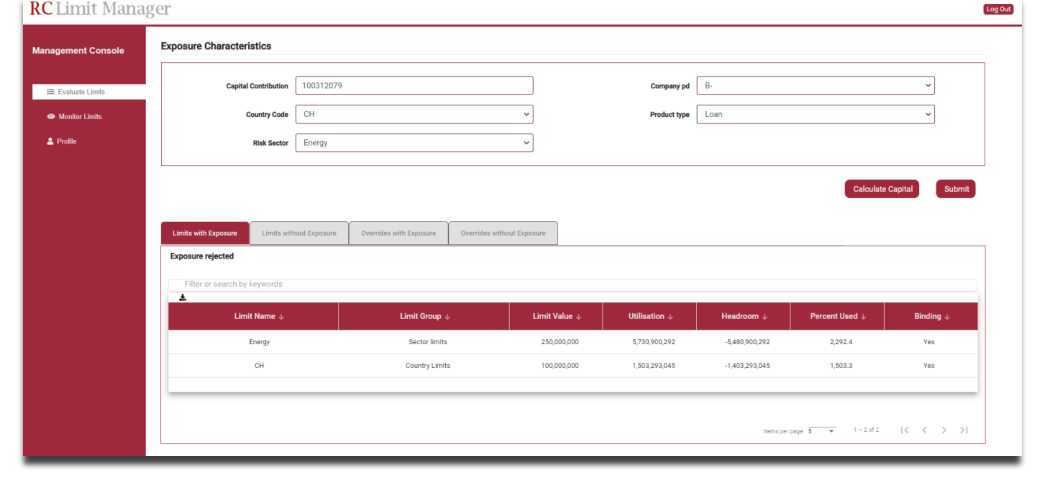
To explain Step 2 in the list above in more detail, once a run has been completed for a portfolio, it is possible to estimate capital for a new proposed exposure using data collected from that run. Where this is the case for the current dataset, an extra tab appears in the Limit Manager interface. Here the user is presented with a set of fields including all those needed by the capital model (see Figure 3). If all required fields are populated, the user can submit the data to get a capital estimation from the capital model (see Figure 4). This estimated figure can then be checked against limit utilisation using the same interface or API.
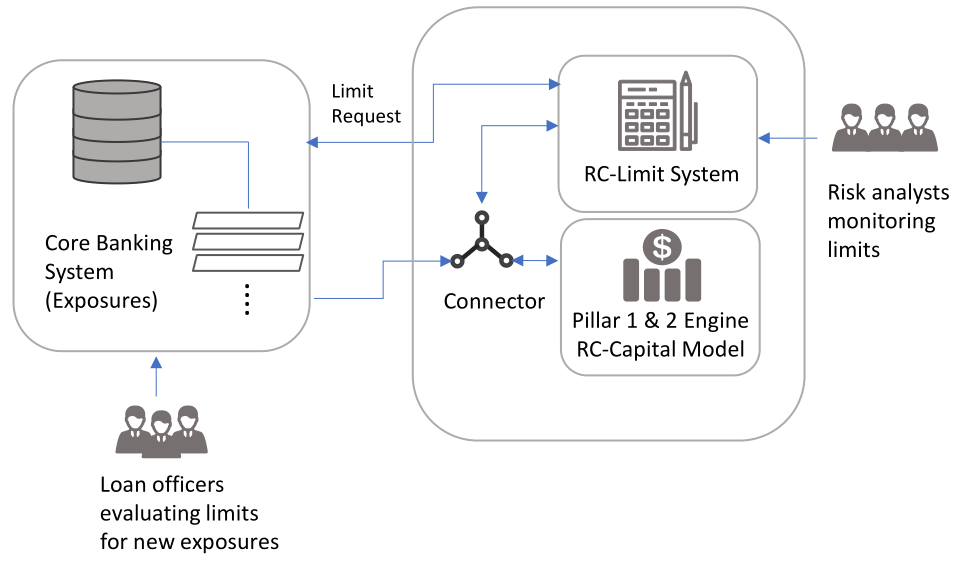
Note: The Capital Model component is shown here containing both Basel Pillar 1 and 2 capital and an Economic Capital model (i.e., the RC-Capital Model). The approach could alternatively use other capital computation methods such as insurance regulatory capital.
3. Conclusion
If credit limits are to be risk sensitive, they must differentiate between exposures of different rating, maturity and asset class. The resulting limits may be complex and opaque. A simpler approach which is close to the corporate planning techniques employed by many banks and insurers (which attribute ‘capital budgets’ to different business departments) is to base limits on the capital consumption of different sets of exposures. Capital consumption may be based on a Regulatory or Economic Capital definition.
Employing capital consumption-based limits is often challenging, however. Many institutions have disparate data on exposures spread across multiple systems. In good cases, the data is integrated in a Core Banking or Underwriting System but even then, information that is necessary for evaluating capital may be stored elsewhere and the Core System may be ill-suited to calculating Capital.
This note has set out techniques for addressing these problems. Part of the solution may be a dedicated software for evaluating limits. Some institutions have constructed such applications but often as bespoke software since the requirements of a limit system are often particular to the institution. Risk Control has devised a flexible and relatively light-weight standalone limit evaluation software which is here described.
Whatever the software that is used to evaluate limits, there remains the issue that if limits are to be based on capital consumption, the calculation of this capital must be performed as part of the limit evaluation. This calculation is rarely convenient or even possible within existing limit software. Hence, another application must be designed and integrated with the limit software.
This note explains how this has been done by Risk Control in the case of Economic Capital-based limits. The example provided includes approaches and ideas that may be applicable generally or if the capital consumption is based on Regulatory rather than Economic Capital.
Risk Control Limited 13-14 Dean Street London W1D 3RS +44 (0)203 307 0730 www.riskcontrollimited.com