

Multilateral Development Banks (MDBs) are mandated by their shareholder to help Emerging Market and Developing Economies (EMDEs) achieve the 2030 Sustainable Development Goals (SDGs) adopted by United Nations member states in 2015. Recently there have been even more urgent calls for MDBs to assist EMDEs in responding to the environmental emergency facing the world. How MDBs react to these challenges will significantly affect the economic prosperity and general well-being of much of the world’s population.
Executive Summary
Multilateral Development Banks (MDBs) are mandated by their shareholder to help Emerging Market and Developing Economies (EMDEs) achieve the 2030 Sustainable Development Goals (SDGs) adopted by United Nations member states in 2015. Recently there have been even more urgent calls for MDBs to assist EMDEs in responding to the environmental emergency facing the world. How MDBs react to these challenges will significantly affect the economic prosperity and general well-being of much of the world’s population.
To boost their financial firepower and expand their lending, MDBs are pursuing multiple avenues. One important such avenue is risk transfer. Through insuring risks on their balance sheets, MDBs can create room to lend more without reducing their own financial stability. Risk transfer can take many forms, including guarantees, securitisation, and credit insurance, for individual exposures, or at the level of portfolios. In all cases, external investors or insurers must evaluate the risk of the loan or loans in question, analyse the structure of the proposed contract and determine the price of taking this on. After a transaction has occurred, if the risky loans remain on the balance sheet of the original lender or continue to be serviced by the original lender, investors will require regular updates on the performance of the loans and information on any characteristics that have changed.
Information is key to this process. Investors need to be able to assess the credit quality of an institution’s loans by analysing their historical performance. They must have full information about the loans that they are to insure, and this information should be updated over the period of the insurance. The information should provide the data required (i) to analyse credit quality, (ii) to understand loan cash flows and, hence, price claims, assuming the structure of the risk transfer makes this material, and (iii) to analyse the Environmental, Social and Governance (ESG) characteristics and impact of the loans.
MDBs may seek to develop data formats and templates to convey the information just mentioned but a case may be made for adopting a common set of data templates. This made-in document describes the results of a project by Risk Control to devise such a data template. The single consideration guiding the design of this data template has been to provide information in a way maximally useful to investors in MDB risk transfers.
The project forms part of Risk Control’s work for the MDB Challenge Fund. The Fund was created in 2022 to sponsor activities that would help MDBs to implement the recommendations of the Independent Panel on MDB Capital Adequacy Frameworks, set up by the G20. The Risk Control team includes banking professionals with decades of experience in designing and implementing risk transfers on behalf of banks and risk specialists with extensive experience of risk and valuation analysis of MDB exposures.
An influential group of MDBs and Development Finance Institutions (DFIs), named the Global Emerging Markets Risk Database (GEMs) Consortium, has established common ways of recording credit-related loan information and combined their respective historical loan data in a database accessible to consortium members. Although the objectives of the GEMs Consortium may be evolving, the GEMs data was originally intended to facilitate risk model calibration and high-level reporting of MDB loan performance. The reports generated have only recently been made publicly available by the Consortium.
In our understanding, the data template proposed in this report, aimed at investor needs only, differs significantly from the GEMs template where the focus is principally on default and asset classes, countries and ratings. Among credit-relevant fields, the data template provides financial information that investors are likely to require on borrower, collateral, amortisation, spreads, and coupons, in order to make to make investment decisions. On non-credit aspects, it covers sustainability and ESG indicators.
The data template here described is influenced by investors' requirements for securitisation transactions (both synthetic and true sale) but the objective of the project is to develop a common way of describing loans that can support a wide range of risk transfer approaches including traditional guarantees and credit insurance and forms of risk transfer at origination such as syndication.
1. Introduction
This document presents the findings of a project to develop data templates for use by Multilateral Development Banks (MDBs) in risk transfer transactions. The project is being completed by Risk Control on behalf of the MDB Challenge Fund. The Fund aims to assist MDBs to implement the recommendations of the influential report of the G20 Independent Panel on MDB Capital Adequacy Frameworks (see CAF Panel (2022)). The Panel recommended that MDBs pursue Balance Sheet Optimisation activities to create additional headroom for lending, and suggested risk transfer among other strategies to achieve these objectives.
The climate emergency combined with the need to work towards the United Nations’ 2030 Sustainable Development Goals (SDGs), places considerable pressure on MDBs to lend more. Fiscal sustainability and the complexity of arranging general capital increases in multilateral organisations limit the scope for growth in the common equity of MDBs. Hybrid capital and shareholder guarantees are flexible alternatives that some MDBs are actively examining. However, an important alternative approach to boosting lending capacity is risk transfer.
This report presents a draft data template covering (i) sovereign and sovereign-guaranteed, (ii) corporate and financial institution and (iii) infrastructure and project finance loans made by MDBs. The templates proposed are influenced by earlier templates developed by central banks and regulators in the content of collateral management and market transparency, and also reflect criteria used by major rating agencies in evaluating the loan pools of securitisations. While securitisation data templates have played a significant role in the development of the proposed MDB risk transfer template, our objective has been to create ways of describing loans that can support a range of risk transfer instruments and activities.
Indeed, risk transfer can take many forms. Single-name risk transfers, examples of which are credit insurance and banking guarantees are traditional instruments that have been used by banks and other financial institutions for many years to adjust their exposure as credit limits begin to bind. More complex types of risk transfer include structured insurance or securitisation, both of which standardly involve the transfer of risk on portfolios of credit exposures. For commercial banks, this is considered as the most efficient way to transfer risk and reduce capital requirements. The cover supplied by protection providers is often ‘tranched’ in the sense that sets of investors or insurers provide cover for different ranges of possible losses. This approach enables the risk to be split between counterparties with different appetites for and expertise in the risk in question.
Several MDBs have made use of credit insurance to adjust their exposure to specific counterparties. Recently, MDBs have been exploring the use of more complex risk transfer instruments including exchange of exposure with other MDBs, securitisations and equity guarantees. The 2015 Toronto G20 meeting recommended that MDBs explore risk transfer including the securitisation of their Non-sovereign Obligor (NSO) loans. CAF Panel
(2022) went further by suggesting securitisation of Sovereign Obligor (SO) loans. For most major MDBs, the latter make up the bulk of their Development Related Assets (DRAs). Hence, engaging in SO securitisation is a step that could have major implications for MDB lending capacity.
Prominent MDBs have pioneered different types of transfers starting with the 2018 exposure exchange between major regional MDBs, the Room2Run (R2R) synthetic securitisation of Non-Sovereign Obligor (NSO) loans in 2018 and the subsequent Sovereign R2R of SO loans in 2022 by the African Development Bank (AfDB). The use of guarantees on SO loans by the Asian Development Bank (ADB) and the Inter-American Development Bank (IDB) were also important innovations in MDB balance sheet management.
Initiating risk transfer in MDB loans involves creating, in effect, a new asset class as far as the capital markets and the insurance industry are concerned. Achieving this requires convincing investors, insurers, rating agencies and internal MDB stakeholders of the sustainability of the activity and the quality of MDB loans. Only if investors recognise the excellent credit performance of MDB loans will the pricing of risk transfers be such that the transaction is financially advantageous for the MDB involved. MDBs benefit from Preferred Creditor Treatment (PCT) on their sovereign lending. This amounts to a de facto seniority granted to MDBs by their sovereign borrowers. Also, MDB’s expertise in evaluating and monitoring projects in challenging lending environments means that their NSO loans typically perform better than would be the case if the lender were a commercial bank.
All this makes the efficient flow of information to potential investors in MDB risk transfers key to generating significant volumes. Investors also value transparent and smooth risk transfer processes. Once investors are convinced enough to consider investing in principle, data must be mobilised to allow them to evaluate the pool of loans for which the risk transfer will operate. Finally, after the risk transfer has occurred, if the originator remains the lender of record and servicer of the loans (which is highly likely to be the case for an MDB risk transfer), the investors will require regular updates.[1] So far, we have focussed on credit-related information, but increasingly investors require to know the sustainability characteristics of the underlying claims and indeed their Environmental, Social and Governance (ESG) nature.
All this requires that careful attention be paid to the information that MDBs provide. Throughout the project, the focus has been on investor requirements. Risk Control collectively has more than 50 years of experience in working on securitisation transactions, risk analysis, and regulation. We have used this experience to construct a practical but comprehensive draft data template. Having generated a draft, we plan to consult with investors, insurers and MDBs themselves to refine and improve the templates here proposed.
A companion paper to this document, Risk Control (2023), provides a more wide-ranging discussion of the issues surrounding risk transfer-related data transfers and relates these to actual risk transfer business models.
The remainder of this document is organised as follows. Section 2 describes the general approach we take in devising risk-transfer-related data templates. We consider how data templates are employed and how these have been developed for different purposes by central banks and central regulatory repositories for securitisation data. In both these cases, the perspective is that of investors.[2] The overall organisation of the templates is clearly influenced by the nature of MDB portfolios. We do not, one should note, attempt to cover all MDB credit exposures.[3] Section 2 discusses issues of data anonymity and non-availability.
Sections 3, 4 and 5 introduce the templates for (a) Corporate and Financial Institution loans, (b) Infrastructure and Project Finance loans, and (c) Sovereign and Sovereign-Guaranteed loans, respectively. Section 6 discusses ESG fields. Section 7 introduces the template itself which is represented as tables in Microsoft Excel. Section 8 concludes.
2. The General Approach
2.1 Introduction
The approach to generating loan data templates builds on (i) the data templates we have encountered that are used by investment banks when arranging risk transfer transactions, (ii) data templates employed by central banks to collect collateral data from banks, and (iii) data templates to report securitisation transactions to central repositories as required by regulators to increase transparency for investors. The central bank data templates (ii) are relevant because they adopt, in effect, a loan investor point of view.
The approach we implement is also influenced by the methodologies that rating agencies employ in assessing specific asset classes. These methodologies identify key data that rating agencies require of lenders and securitisation issuers when analysing risk for investors in structured products. Finally, it was important to take account of the loan types offered by MDBs to reflect appropriately the specific nature of MDB lending and to propose data templates that would satisfy most investors while remaining close to the data that the MDBs already possibly collect or could set out to progressively collect in the future.
2.2 How Different Templates Are Used
2.2.1 Loan templates used by Central Banks
Central banks, such as the European Central Bank (ECB), and the Bank of England (BoE), have devised loanlevel templates for the data shared by banks on their exposures used as collateral for monetary policy operations. Financial institutions providing loan pools as collateral must supply loan-level data to satisfy the central banks’ due diligence and financial assessment processes. Since 2010, the ECB has also accepted as collateral Asset Back Securities (ABS), a type of transaction used by financial institutions for risk transfer. Bank of England has made similar arrangements in 2019 after Brexit and has its own loan-level data templates. Central banks typically perform a thorough risk assessment prior to accepting eligible collateral and also require a cashflow model and transaction documentation together with loan-level data for their analysis. After the transaction is accepted in the ABS purchase programme, the central banks require updated loan-level data files with a minimum quarterly reporting frequency. One may also note the existence of data templates used by some central bank regulatory authorities such as the US Federal Reserve System, in the context of stress testing exercises. Although not directly targeted to central banks' risks on their own assets, these are still relevant as investors in risk transfer transactions would typically perform stresses as part of their assessment process.[4]
The templates for Corporate loans (which are also used by central banks for financial institutions) are broadly similar across central banks. However, the Bank of England also employs a specific template for Private Finance Initiative loans which is useful when considering how to record information about Infrastructure and Project Finance loans which are clearly important for MDB portfolios. The ECB also provides specific templates for public sector exposures which include coverage of bonds issued by sovereigns.
2.2.2 Templates employed by Central Repositories of risk transfer transactions
In 2010, the ECB admitted Asset-Backed Securities (ABS), instruments typically used by banks for risk transfer purposes, as collateral in its monetary policy operations. The Eurosystem established a data warehouse for the processing, verification and transmission of ABS loan-level data, aiming in the process to facilitate investment and support transparency, integrity and to ensure investor access to comprehensive and standardised information across the European ABS market. In 2017, European Union (EU) regulations granted the European Securities and Markets Authority (ESMA) the authority to establish reporting requirements for issuers of securitisation exposures. The EU Securitisation Regulation (SECR) published in December 2017[5] and applicable as of 1 January 2019 to securitisation products, provides the provisions applicable to the main parties involved in a securitisation transaction and notably includes due diligence, risk retention and transparency requirements. According to Article 7 of the SECR, reporting entities (Originator, Sponsor and/or Securitisation Special Purpose Entity (SSPE)) are required to submit various transaction documents and data on the underlying exposures, investor reports, as well as inside information or significant events.
Additionally, data related to securitisation transactions that have drawn up a prospectus in compliance with Regulation (EU) 2017/1129 (the ‘Prospectus Regulation’) and are consequently classified as public securitisations under the SECR, must be made accessible through an ESMA-registered Securitisation Repository (SR) at Loan-level and according to templates developed by ESMA. The objective was to increase market transparency, and standardise loan -level data requirements, thereby enabling potential investors to undertake their own valuation and credit analysis with less reliance on credit rating agencies.
In 2019, the ECB decided that the loan-level data reporting requirements for Eurosystem collateral would converge towards the disclosure requirements specified in the EU Securitisation Regulation. Since October 2021, all ECB loan-level data templates for securitisation transactions have been superseded by the equivalent ESMA loan-level data templates. Some ECB loan-level data templates remain applicable for public-sector DECCs[6] and SME DECCs presented directly to the Eurosystem (i.e., not via marketable debt instruments) as collateral for central bank liquidity.
In this note, we refer to the following data templates from the ECB and ESMA:
• From ECB[7] for public sector DECCs, and
• From ESMA[8] for corporate loans (“Annex 4: Underlying exposures – corporate”) and ‘esoteric’ assets (“Annex 9: Underlying exposures – esoteric”) for comparison with infrastructure and project loans.
The ESMA Corporate template covers a wide set of asset classes that broadly encompasses the diversity of MDB lending. The EU technical standards on disclosure requirements include 14 reporting templates: residential real estate, commercial real estate, corporate, automobile, consumer, credit cards, leasing, esoteric, non-performing exposures, ABCP, and templates of investor reports for Asset-Backed Commercial Paper (ABCP) and Non- ABCP securitisations, and inside information or significant event information (e.g. portfolio sale and securitisation level transaction data) for Non-ABCP securitisation. The ESMA templates are oriented towards capital market investors, unlike other templates which were designed in priority for use by central banks. Since it is aimed at private sector investors, the design of the ESMA template is highly relevant for the current project which aims to devise a data template for MDB loans for use by private sector investors[9].
In this report, we focus on the main asset classes that are included in MDBs’ balance sheets: Corporate and Financial exposures, Infrastructure and Project Finance, and Sovereign loans.
The ESMA Corporate template is quite detailed (121 fields: 101 in the ‘Underlying exposures information section’ and 20 in the ‘Collateral-level section’). It is also very versatile and can be adapted efficiently to data sharing for MDB risk transfer by adding fields appropriately.
The ESMA Corporate template (as is true for ESMA’s other templates) is documented with:
• The latest Regulatory Technical Standards (RTS) in Commission Delegated Regulation (EU) 2020/1224 of 16 October 2019 enacting such securitisation RTS and defining the templates.
• The latest Implementing Technical Standards (RTS) in Commission Delegated Regulation (EU) 2020/1225 of 29 October 2019 enacting such securitisation ITS and defining the templates.
• A detailed Excel description of the template.
• An XML Schema Definition (XSD) file of the template.
The latest ESMA Corporate template has been used since September 2020 in the EU. In general, the ESMA templates have been used in many European transactions since 2015 to provide loan data tapes to investors on a regularly updated basis (at least quarterly during a transaction’s life). They have been designed in consultation with investors and have evolved using investors' feedback given to ESMA. The deal repositories which have the ESMA agreement can be used to derive loan performance at an asset class/country level, and, also, serve as the basis for monitoring the performance of transactions after the transfer of risk has occurred.
One important point is that the ESMA Corporate template is ‘anonymised’. Borrower confidentiality is maintained in that the data fields required to accurately identify borrowers are lacking. The approaches taken in the other templates reviewed provide examples of how such identification may be included.
2.3 Description of Central banks and Central repositories data templates
The following tables (
Table 2.1 to Table 2.3) summarise the data fields used in the ECB/ESMA, BoE and Federal Reserve (FR) templates.
The main templates summarised are as follows:
• the ESMA Corporate template (121 fields: 101 in the ‘Underlying exposures information section’ and 20 in the ‘Collateral-level section’),
• the Federal Reserve’s Corporate template (106 fields, no sub-categories),
• the BoE’s private finance initiative (PFI) loan template (71 fields: 55 mandatory fields and 16 optional fields),
• the ECB’s public sector DECC template (101 fields: 100 mandatory and 1 optional).
We have grouped the fields contained in the templates into three different categories, as a function of their purpose: obligor/borrower information, facility/loan data, and credit risk and performance data.
Table 2.1 summarises the obligor/borrower information requested. All central bank templates include detailed information permitting the borrower/obligor identification, its industry sector and geographical location.
Table 2.2 summarises the information about the loan facilities granted and any loan drawings from the facility. All templates contain detailed information about the facility and loan types, purpose, financial characteristics (redemption rules/profiles, interest rates) and any security/collateral provided.
ECB / ESMA template BoE template FR template Current Principal Balance Current Loan Balance Exposure At Default (loan amount) Amortisation Type Amortization Type Current Maturity Date Principal Grace Period End Principal Grace Period End (No amortization type Date* Date* requested, nor principal Principal Payment Interest Grace Period End payment amounts) Frequency Date* Interest Payment Principal Payment Frequency Frequency Payment Due (next one) Interest Payment Balloon Amount Frequency Next Payment Date Balloon Amount Current Interest Rate Current Interest Rate Interest Rate Variability Interest Rate Type Interest Rate Type Interest Rate Current Interest Rate Index Current Interest Rate Index Interest Rate Index Interest Rate Reset Interval Current Interest Rate Interest Rate Spread Current Interest Rate Margin Interest Rate Ceiling Margin Interest Reset Period Interest Rate Floor Interest Rate Cap Interest Cap Rate Interest Rate Floor Interest Floor Rate Prepayment percentage Prepayment Penalty Prepayment Penalty Flag allowed each year Prepayment Lock-Out End Date Prepayment Fee Prepayment Fee End Date Note: Securitisation specific fields are omitted as are fields relevant only to posting collateral to central banks. The BoE templates identify certain fields as optional. So do the ECB and ESMA templates with certain possibilities to report ‘no data available’. In this table, optional fields are marked with an asterisk.
Table 2.3 summarises the information requested about the credit risk and past performance of loans. All central bank templates include detailed information about the borrower/obligor's internal ratings or estimated PDs, and LGDs, and some request external ratings when available (in particular about sovereigns). The ECB and BoE template request data on loans about past events which are material for credit assessment – such as arrears and any restructuring, default, foreclosure, losses and recoveries – whereas the Federal Reserve template (which is for stress testing purposes) focuses on borrower’s financial ratios instead.
Overall, the data fields requested in the data templates from ECB/ESMA, the BoE and the Federal Reserve are broadly similar and consistent.
| Obligor/Counterparty | Borrower Identifier | Customer ID | (grouping |
|---|---|---|---|
| identifier | Borrower Name | level) | |
| Counterparty Name | Group Company Identifier* | Internal ID | (actual obligor) |
| Counterparty LEI (legal | Obligor Name | ||
| entity identifier) | Obligor LEI | (legal entity | |
| identifier) | |||
| Customer Type (new / | Obligor legal form / | Industry Code | |
| existing / affiliated?) | business type | Industry Code | Type |
| Counterparty Type | Obligor an affiliate? | (NAICS, SIC, | GICS) |
| NACE Industry Code | Customer segment (large, | Special Purpose | Entity |
| Enterprise Size* | mid, other corporate…) | (if an SPE) | |
| NACE Industry Code | |||
| Country of Obligor | Country | City | |
| Geographic Region - | Postcode | Country | |
| Obligor | Geographic Region | Zip Code | |
| Geographic Region | |||
| Classification | |||
| Obligor Postcode | |||
| fields are omitted as are fields | relevant only to posting collateral | to central | banks. The |
Note: Securitisation-specific fields are omitted as are fields relevant only to posting collateral to central banks. The BoE templates identify certain fields as optional. So do the ECB and ESMA templates with certain possibilities to report ‘no data available’. In this table, optional fields are marked with an asterisk.
| Debt Type | Asset (contract) type | Credit Facility | Type (e.g. | ||
|---|---|---|---|---|---|
| Seniority | Seniority | revolving credit, | term | ||
| Syndicated? | Syndicated? | letter of credit…) | |||
| Purpose (of loan) | Share of syndication | held | Credit Facility | Purpose | |
| Special (public | sector) | Purpose (of contract) | Participation | Flag (if | |
| scheme | Type of loan (term, | syndicated) | |||
| revolving, other) | Participation | Interest | |||
| Origination Date | Loan Origination Date | Origination Date | |||
| Maturity Date | Loan Final Maturity | Date | Maturity Date | ||
| Renewal Date | |||||
| Original Principal | Balance | Original Loan Balance | Committed | Exposure | |
| Total Credit Limit* | Original Loan Credit | Limit | Global | ||
| Currency Denomination | Loan Denomination | Utilized Exposure | Global | ||
| Currency | Credit Facility | Currency | |||
| Security Type | Security Type | Security Type | |||
| Charge Type | Ranking (of lien) | Lien Position | |||
| Guarantor Country | Corporate Guarantor | ID* | Guarantor Flag | ||
| Guarantor category | (type of | Corporate Guarantor | Guarantor | Internal ID | |
| public or private | sector) | Rating* | Guarantor Name | ||
| Last rating review | date* | Guarantor | Internal Rating | ||
| Collateral Type | Property / Collateral | Sub- | Collateral Market | Value | |
| Collateral Identifier | Type (real estate, | ||||
| Collateral Geographic | equipment, securities, | ||||
| Region | guarantee…) | ||||
| Collateral current | valuation | Collateral Code | (identifier) | ||
| amount | Collateral value | ||||
| Collateral current | valuation | Geographic Region* | |||
| date | Original Valuation | Amount | |||
| Collateral original | valuation | Original Valuation | Date | ||
| amount | Valuation Type | ||||
| Collateral original | valuation | Updated Appraisal | Value | ||
| date | Date of Updated | Appraisal* | |||
| Collateral currency | Guarantee Amount* |
| Credit risk / | For all loans: | For all loans: | For all loans: | ||
|---|---|---|---|---|---|
| Performance | |||||
| information | |||||
| Credit Impaired Obligor? | Bank internal | rating | Obligor Internal | Risk | |
| Probability of Default | Date of last | rating review | Rating | ||
| Public ratings (public sector) | Bank internal | LGD estimate | Probability of | Default | |
| Loss Given | Default (LGD) | ||||
| Date of Restructuring* | Interest Arrears | Amount* | (Plus various | data from | |
| Date Last in Arrears* | Number of Days | in interest | obligor’s financial | reporting | |
| Arrears Balance | arrears* | and ratios, for | financial | ||
| Number of Days in Arrears | Principal Arrears | Amount* | analysis purposes, | e.g.: | |
| Account Status (performing, | Number of Days | in | Operating income | ||
| restructured, in arrears…) | principal arrears* | Current Net | income | ||
| Cash & marketable | |||||
| Reason for default or foreclosure* | Default or | Foreclosure on | securities | ||
| Default Amount* | loan* | Current assets | |||
| Default Date* | Reason for | Default* | etc.) | ||
| Cumulative Recoveries* | Default Date* | ||||
| Allocated Losses* | Default Amount* | ||||
| Date Loss Allocated* (latest one) | Cumulative | Recoveries* | |||
| Allocated Losses* | |||||
| Date Loss | Allocated* (latest | ||||
| one) | |||||
| Note: Securitisation specific | fields are omitted as are fields | relevant only to | posting collateral | to central | banks. The |
Note: Securitisation specific fields are omitted as are fields relevant only to posting collateral to central banks. The BoE templates identify certain fields as optional. So do the ECB and ESMA templates with certain possibilities to report ‘no data available’. In this table, optional fields are marked with an asterisk.
2.4 Organisation of proposed data templates
Investors in risk transfer transactions typically find comfort in relying on clear and well-established processes, as exemplified by Freddy Mac/Ginnie Mae in the US Mortgage risk transfer market, or the EU Simple, Transparent and Standardised (STS) securitisation framework.
The data templates for MDB loans can be used in various phases of the risk transfer process. We have designed the templates to facilitate the following steps:
1. To collect loans for asset class performance analysis for investors and provide the investor market with more realistic feedback on the actual credit performance of MDB loans,
2. To provide initial loan-level information for risk sharing with partners, in an efficient format for portfolio analysis,
3. To perform a selection of a portfolio of loans corresponding to potential investors’ criteria and to allow investors to perform risk modelling,
4. To build a database of Risk transfer transactions,
5. To regularly monitor their timely credit performance post-investment: After risk transfer, the exposure may remain on the balance sheet of the originator or may be managed and serviced by the originator.
Note that step 1 (loan data for historical asset performance transparency to the market) and step 5 (investor regular monitoring of credit) would use the same data template, although step 1 requires fewer mandatory fields (asset class, geography, rating, sector, default and loss history). This report focuses on loan performance data requirements in the loan-level data template prior to a risk transfer transaction, in order for the potential investors to assess the transaction. It does not focus on periodic investor reports that would be regularly prepared for and communicated to the investors (which would require expected and actual cashflows of principal, interests and fees), nor does it describe data that would allow investors to assess risk at portfoliolevel/pool-level before a transaction with information such as portfolio historical default rates, historical losses, etc.
The data templates are not sufficient for investors to perform a full analysis and would need to be complemented by prospectus, contract details, loan documentation and market analysis done by the investors themselves. However, the templates would be the main source for step 1 to 5 in the process described above.
The templates we have designed are divided into the following high-level asset-class-based categories that compose the majority of the loans of MDB portfolios that might be candidates for risk transfer:
• Corporates and Financials,
• Infrastructure and Project Finance loans, and
• Sovereign loans.
In each of these three asset-class specific templates, we group the data fields into the following categories: A. Loan identifiers, B. Obligor / Borrower information, C. Project-specific information, D. Facility / Loan characteristics, E. Rating, F. Guarantee, G. Collateral, H. Loan performance, I. Loan in warehouse, securitisation, or compartment. An additional section is provided for ESG data which is to be used for each asset class.
The data in the different categories would be used in a differentiated manner depending on the phase in the risk transfer process, as illustrated in Table 2.4 below.
The scope of data fields expected by investors in phase 3 when they perform selection and risk modelling would be more extended and detailed than in phase 2 when the initial sharing of information is performed, thus with fewer mandatory and less detailed data fields. Similarly, data fields required by investors in phase 5 to monitor the performance of the loans they have invested in would be much more extended and detailed than data fields in phase 1 of general asset class performance disclosure.
| 1 | 2 | 3 | 4 | 5 | ||
|---|---|---|---|---|---|---|
| Asset class | Loan | Selection of | Build a | Regular | ||
| historical | information | loans | database of | monitoring | ||
| performance | to risk- | meeting | risk transfer | of post- | ||
| disclosure to | sharing | investors' | transactions | investment | ||
| the market | partners | criteria/risk | credit | |||
| modelling | ||||||
| A. | Loan identifiers | √ | √ | √ | √ | √ |
| B. | Obligor / Borrower information | √ | √ | √ | √ | √ |
| C. | Project specific information | √ | √ | √ | ||
| D. | Facility / Loan characteristics | √ | √ | √ | ||
| E. | Rating | √ | √ | √ | √ | √ |
| F. | Guarantee | √ | √ | √ | ||
| G. | Collateral | √ | √ | √ | ||
| H. | Loan performance | √ | √ | |||
| Loan in warehouse, | ||||||
| I. | √ | |||||
| securitisation, or compartment | ||||||
| J. | ESG Data | √ | √ |
2.5 How is Anonymity Treated?
As noted above, while designed to promote market transparency, the ESMA Corporate template attempts to preserve borrower anonymity. For the MDB loan data templates we propose here, anonymity could be treated as follows:
• For initial disclosure to a wide group of potential investors, anonymous identifiers of the obligors and loans are likely to be sufficient (with region-level location data where possible) given possible privacyprotection laws and/or confidentiality provisions in lending contracts.
• For sovereign, public sector and large corporate lending and for project/infrastructure finance, a country group or region may suffice. However, investors are likely to require the identification of obligors given their own country limits and the possible significant level of exposure.
• Non-anonymous obligor identification could be added to the data templates but shared with investors or potential investors only covered by NDAs and for the purpose of actual risk-sharing transactions (closed or in preparation).
In addition, it would be necessary to make certain data fields confidential prior to receiving NDAs or for actual risk-sharing transactions (closed or in preparation):
• Fields facilitating identification of the obligors (e.g. ISIN, Revenues together with Postcode and Sector)
• Commercially sensitive information (Revenues, EBITDA, Enterprise Value, Free Cashflow, …)
• For generic loan performance analysis by asset class, borrowers' information could be made anonymous.
2.6 How is Data Non-Availability Treated?
The draft data templates for MDB loans risk transfer are proposed with an indication of priorities and No-data options. The most important fields are identified as Priority 1 in the templates. Priority 2 fields are often more detailed data completing Priority 1 fields, and we have omitted any fields we ranked as a lower priority.
In addition, as it is not always possible to report all data fields, we propose to use similar principles as in the ESMA, ECB and BoE templates for No-data submissions on certain fields[10], as set out in Table 2.5 below.
For each data field where no data is reported, a No-Data indicator from ND1 to ND5 would be inputted instead, to explain the reason why no data is provided. Allowance or restriction on No-Data indicators may be proposed for every data field depending on the compulsory nature of the data and its availability in the MDB systems.
ND1 Data not collected as not required by the lending or underwriting criteria ND2 Data collected on underlying exposure application but not loaded into the MDB’s reporting system ND3 Data collected on underlying exposure application but not loaded into the MDB originator’s reporting system ND4-YYYY-MM-DD Data collected but will only be available from YYYY-MM-DD (YYYY-MM-DD shall be completed) ND5 Not applicable
3. Data Template for MDB loans to Corporates and Financials
3.1 Introduction
The sectors Finance and Other represented €232 Bn or 80% of exposures (and 86% of contracts) of lending to Private counterparts over 1994-2022 on data provided by 19 MDBs in the recent GEMs Recovery Statistics report.[11]
It is therefore beneficial to design a data template that can cover the general private lending by MDBs to financial institutions (or ‘financial corporates’) and non-financial corporates. This is the purpose of the data template for loans to Corporates and Financials.
This section explains how we designed a data template for general loans to Corporates and Financials. The template has been built from the ESMA loan-level template for Corporates (and Financials), removing some fields specific to the EU capital/securitisation markets, and, also, factoring in some fields inspired by corporate templates from the Federal Reserve, the BoE and the previous ECB corporate template, in particular in terms of identification of borrowers and credit rating data which are particularly relevant for larger loans.
3.2 Data Field Selection for the Corporates and Financials Template
Loans provided by MDBs to corporates and financial institutions can present specific characteristics owing, for example, to the development goals of MDBs, their global reach and a particular focus on exposures in EMDE countries. Selecting the data fields for the general MDB template for Corporates and Financials needs to take account of such characteristics together with the typical investor data requirements.
The data template for loans to Corporates and Financials has been built using the following approach:
• Using the Corporate template as a baseline starting point, among the various ESMA templates (required by EU regulations to report securitisation deals for market transparency vis-à-vis investors),
• Retaining the fields from this ESMA template which remain relevant to investors for exposures in EMDE countries,
• Removing EU specificities in the retained fields and their possible values,
• Completing with useful fields by reference to other international templates from the Federal Reserve, the BoE and our knowledge of risk data of loans to Corporates and Financials in EMDE countries,
• Focusing the fields retained on loans/exposures to larger borrowers (excluding specificities linked to SME lending),
• Completing the required identification fields relating to borrowers, borrower groups and guarantors,
• Adding the required fields relating to the credit quality assessment of exposures by investors (MDBs’ credit risk parameters, and external ratings when available).
3.3 Proposed Fields for the Corporates and Financials Data Template
Table 3.1 below summarises the proposed MDB data template for loans to Corporates and Financials. It includes 161 data fields at this stage: 117 fields classified as Priority 1, and 44 fields classified as Priority 2.
Obligor / Borrower Same base as for ESMA Corporate loan template
• Country of borrower
• New industry codes and sub-industry codes (GICS or specific to MDBs)
• Obligor Group (for portfolio concentration risk)
• Public sector obligor category
• Obligor Country
• Key Financial data about corporate obligors (Revenues, EBITDA, etc.) or financial institution obligors
Loan level data Same base as for ESMA Corporate loan template
• Facility type data (Maturity date, interest rate, etc.)
• Drawn amount, undrawn amount
• Is MDB lender of record
• Tranche (e.g. A/B loans)
Ratings • Ratings by 3 main rating agencies
• Ratings by other rating agencies
• Internal ratings and PDs, LGDs
Guarantor • Guarantor and Guarantor category
Collateral Data to be provided for each collateral (if any) securing the exposure:
• Collateral type and country
• Security/charge type
• Collateral value
• Collateral rating/grade
Loan performance • Arrears balance and number of days in arrears (if applicable)
• Dates of loan restructuring (if applicable)
• Default/foreclosure data (if applicable)
• Losses and recoveries (if applicable)
• Prepayments
Loan in a warehouse, Data to be provided when loans are part of a risk transfer transaction: securitisation or compartment • Transaction identifier and type
• Loan characteristics upon inclusion in the transaction
• Data when the loan exits the transaction
• Relevant hedges in the transaction and their characteristics (interest rate swaps, currency swaps)
4. Data Template for Infrastructure and Project Finance loans
4.1 Introduction
Infrastructure and Project Finance (I&PF) loans represented 22% of the exposure to Private and Sub-sovereign lending of MDBs and DFIs in the GEMs Consortium study published in 2023 and covering Private and Subsovereign Lending[12]. The credit quality of such loans is often complex in that the loans are commonly one of the liabilities of a Special Purpose Vehicle (SPV).
The cash flow rules of the SPV together with the nature of the collateral and the stage of their construction affect the credit performance in complicated ways. Credit evaluations of a project loan may require the preparation and analysis of a detailed financial model in the form of an Excel workbook. Embodying the information necessary to gauge the credit quality of such loans in a template is, therefore, challenging.
This section explains how we designed a data template for I&PF loans. The template has built on approaches taken in the ESMA Corporate loan template, the ESMA data template for esoteric underlying exposures[13] and the Bank of England template for Private Finance Initiative (PFI) loans.
4.2 Data Field Selection for the Infrastructure and Project Finance Template
Selection of data fields for project finance loans must allow for the specific characteristics of project finance for MDBs in EMDEs: ● Project finance loans are of a bespoke nature. ● They require a fairly complex assessment which may involve legal analysis of multiple contracts. ● Availability-based Public-Private Partnership (PPP) projects are less exposed to market risk. Public- Private Partnership (PPP) infrastructure projects often use special-purpose vehicles (SPVs) to enable non-recourse financing and insulate the sponsor’s balance sheet from project risk. ● The project risk is very different in nature between the construction phase and the operational phase. The template makes a distinction between the construction phase and the operational phase because the construction phase rating is not sufficient to capture the potential upward rating transition. ● In the construction phase, disbursement of principal may be dependent on the completion of phases of the project. ● The success of the project depends on multiple public and private expert partners to finance, design, implement and operate the infrastructure. The level of their expertise may impact drastically the outcome and the credit performance. ● Large infrastructure projects in the EMDEs are poised to be closely assessed by potential investors for their ESG impacts. The ES(G) data fields are particularly pertinent for these loans. (See paragraph 6 below).
The data template for Infrastructure and Project Finance loans has been built using: ● The ESMA templates required by the EU regulation to report securitisation deals in order to bring market transparency to investors. There is no specific ESMA template for Project Finance and infrastructure, therefore Annex-4 (Corporate loans) was used as a baseline comparison. It can be considered as a standard database for corporate loans in European risk transfer operations, ● The Bank of England Private Finance Initiative (PFI) Template used to report PFI loans to the PRA. This is a good base for loans in Public-private projects in the UK, ● Data available to investors on specific Risk transfer transactions involving infrastructure loans in EMDE countries, transferred to CLO-type portfolios of infrastructure loans, ● Rating agencies’ methodologies for project finance and infrastructure finance, ● Moody’s rating methodology for Project finance and Infrastructure Assets CLOs.
4.3 Proposed Fields for the Infrastructure and Project Finance Data Template
Table 4.1 below summarises the proposed MDB data template for Infrastructure and Project Finance loans. A substantial set of fields pertaining to the Obligor/borrower are inherited from the Corporate and Financial exposures template. The proposed template includes 182 data fields at this stage: 136 fields classified as Priority 1, and 46 fields classified as Priority 2.
Obligor / Borrower Same as for the Corporate and Financial exposures template
Project • Project Phase (Construction, Operations)
• Expected start date of Operational phase
• Sponsor
• Contractor
• Technical advisor
• Off-taker/Charterer
• Operator
• Country and region of project
• Type of project finance (PPP, availability-based)
• Project finance specific sectors and subsectors (Oil and Gas, Power Generation, Airport, etc.)
• Banks participating to consortium
• Debt: Equity split
Loan level data Same base fields as Loans to Corporate and Financial, plus:
• Specific purpose of project loan
• Facility type data (drawn amount, undrawn amount, …)
• Disbursement of principal conditional to completion of project milestones
• Result-based interest rate
Guarantor • Guarantor and Guarantor category (ECA, …)
Loan performance • Contract covenants and current covenant levels (DSCR, ISR, LLR…)
5. Data Template Information for Sovereign Loans
5.1 Introduction
Sovereign and Sovereign-guaranteed exposures contribute the greatest volume of MDB exposures. GEMs
(2023) reports that they constitute 73% of the total contract volume of GEMs Consortium members.[14]
MDB sovereign loans may be associated with specific projects. In this case, an investor may require information regarding the project even if the credit quality of the loan depends on that of the sovereign only.
5.2 Data Field Selection for MDB Sovereign Loans
MDBs provide Sovereign and Sovereign-Guaranteed loans to achieve several purposes:
• Special development
• Project loans, Policy based
• Sector development
• Financial intermediaries
MDB loans may take a conventional, non-concessional form or may contain grant or concessional elements. Non-concessional loans seem more likely candidates for risk transfer transactions than concessional loans.
The data template design here proposed for Sovereign and Sovereign-guaranteed loans is influenced by the following considerations:
• The ECB’s data template for Public sector exposures is used as a reference. The ECB template is used by the central bank for analysing and monitoring the public sector exposures that it receives as collateral in the Eurosystem Repo facility. The ECB uses the data to monitor the risk that these exposures create for the central bank’s balance sheet and, in this regard, has designed its template somewhat as an investor might. Some features of the ECB data templates are not retained as they are not relevant for MDBs. For example, characteristics of EU government bonds provided as collateral and some categorisation of bonds across countries or currencies are not useful for MDBs.
• The methodologies employed by rating agencies for assessing sovereign exposures influence some design choices.
• The sovereign loan products by some MDBs affect certain loan characteristics included. For example, some MDBs’ sovereign loans (termed result-based loans) have the feature that the disbursement of principal is contingent on the achievement of Key Performance Indicators (KPIs). Interest rate margins may depend on the borrower achieving specified objectives.
5.3 Proposed data fields for the Sovereign Loans data template
The proposed MDB data template for Sovereign and Sovereign-guaranteed loans is summarised in Table 5.1. The proposed template includes 175 data fields at this stage: 136 fields classified as Priority 1, and 39 fields classified as Priority 2.
Obligor/Borrower Same as for the Corporate exposures template Specific Sovereign and sub-sovereign categories
Loan level data Same base as for the Corporate loans, plus:
• Loan Purpose (e.g. project, policy-based, … )
• Type: Concessional / Grant
• Interest grace period, principal payment grace period
• Principal disbursement linked to policy results
• Interest rate margin linked to policy results
6. Additional fields for ESG Data
6.1 Introduction
Environmental, social and governance (ESG) reporting, also known as sustainability reporting, has developed very significantly over the past two decades. Investors’ expectations of sustainability disclosures from their investees have stepped up considerably given market and regulatory developments, in particular since the development of the SDGs and the Climate Paris Agreement in 2015, and the following UN Climate Change COPs.
In this context, investors are increasingly expected, or even required, to evaluate and disclose the sustainability aspects of their investments and portfolios. Consequently, there is a growing need for them to collect ESG data on their investments.
This section details the approach used to select ESG data fields for the MDB templates and design the ESG segments of these templates. It also gives an overview of the selected segments and data fields in the three key categories of Environment, Social, and Governance.
6.2 ESG Data Field Selection for the MDB Data Template
The recent short report “CLO Carbon and Climate Disclosures: Methods for Enhancing Transparency” from the European Leveraged Finance Association (ELFA) summarises well the current trend in its first section “The CLO Value Chain Will Create Growing Pressure for Disclosure – Aligning with Stakeholder Expectations is Key”. The trend is summarised in the paper’s chart titled “Value Chain and Climate Disclosure – Downwards
Pressure on Borrowers”:[15]
• Asset owners (such as pension funds, insurers, and banks), as well as asset managers, are under increasing pressure from beneficiaries and regulators to disclose climate impacts and additional ESG impacts/metrics.
• As a result, asset owners require more ESG disclosures from asset managers, who in turn require more ESG disclosures from products they invest in (e.g. CLOs) and their managers (e.g. CLO managers).
• Such disclosure requirements follow through progressively to borrowers, who could face less demand and higher borrowing costs, should they be less able than others to disclose ESG data or perform less well on ESG metrics.
The increasing pressure on asset owners and asset managers comes among others from recent regulations, such as: ● The EU Sustainable Finance Disclosure Regulation (SFDR) which went into effect in 2021 and applies to financial market participants (FMPs) and financial advisers established or operating in the EU (including asset managers, institutional investors, insurance companies, pension funds and banks), and requires them to disclose ESG impact and performance at both the entity and product levels, ● The EU Corporate Sustainability Reporting Directive (CSRD) which applies to disclosure from FY 2024 and requires large companies and listed companies to publish regular ESG disclosure, including reports on the Social and Environmental risks they face – and on how their activities impact people and the environment. At the same time as the CSRD, the EU started developing the European Sustainability Reporting Standards (ESRS) which are the standards required by the Directive, ● The recently updated UK Sustainable Disclosure Requirements (SDR) and investment labels, about which the FCA released its final rules and guidance in November 2023 and which apply to FCAregulated firms, investment managers and collective investment funds, ● The future UK Sustainability Disclosure Standards (SDS) which are expected to be published by the UK Department for Business and Trade (DBT) by July 2024. They will be UK-endorsed standards setting out corporate disclosures on sustainability-related risks and opportunities that companies face, and are expected to be closely based on the ISSB standards, ● In the US, the SEC’s sustainability disclosure requirements which are in the process of being updated, the SEC having proposed in March 2022 additional rules to include certain climate-related disclosures in registration statements and periodic reports. The SEC also indicated it is considering expanding its sustainability disclosure requirements to cover other ESG factors, such as human capital, diversity, and human rights. The SEC aims to provide investors with consistent, comparable, and decision-useful information for making their investment decisions, and to prevent greenwashing and misleading claims by companies/registrants. The SEC’s climate-related disclosure rules are currently expected to be finalised by spring 2024.
The increasing ESG disclosure requirements also come from global standards already developed or in the process of being developed, to which investors (asset owners and asset managers) can refer to set expectations and ask for increased ESG disclosures from borrowers and companies, and about products they invest in.
These global sustainability standards include among others: ● the sustainability reporting standards from the Global Reporting Initiative (GRI), established in 1999, which are the most widely used worldwide, ● the recommendations of the Task Force on Climate-related Financial Disclosures (TCFD) established by the G20 and the Financial Stability Board (FSB) at the end of 2015, ● the Greenhouse Gas Protocol (GHG) standards, first released in 2001 (which now include among others the GHG Protocol Corporate Accounting and Reporting Standard, the GHG Protocol for Community- Scale Greenhouse Gas Inventories – for cities and local governments – and the GHG Protocol Project Quantification Standard), ● the recommendations of the Taskforce on Nature-related Financial Disclosures (TNFD) launched in 2020, and ● more recently in 2023 the first two IFRS Sustainability standards finalised in June 2023 by the International Sustainability Standards Board (ISSB): IFRS S1 “General Requirements for Disclosure of Sustainability-related Financial Information” and IFRS S2 “Climate-related Disclosures”.
The ISSB launch by the IFRS Foundation end 2021 responded to strong demand from the markets, regulators and global standard setters, to establish a global baseline for sustainability disclosure standards. As such, the ISSB has built on the main global sustainability standards already established, including the first four mentioned above, and intends to continue building on them.
The ISSB standards have been designed to serve as a global baseline of sustainability disclosures for the capital markets. The ISSB has promoted interoperability of its standards with the main global standards above (such as the GRI standards) as well as with specific jurisdictional requirements developed on top of this global baseline (such as in the EU and UK)[16].
Consequently, the existing ISSB standards (currently limited to general requirements and climate-related disclosures), the TFND recommendations (for nature-related disclosures) and the GRI standards (for other ESG disclosures), constitute the main references from which to select ES(G) fields to be incorporated in the MDB loan-level data template.
Some MDBs have already started to disclose ES(G) data about themselves or their exposures, mainly based on the GRI standards and TCFD recommendations (e.g. the World Bank Group, IBD, IDB Invest and ADB). AfDB and IFRS Foundation have also partnered to promote sustainability disclosure practices in Africa[17].
For financed projects, MDBs focus on their contribution to the UN’s sustainable development goals (SDGs) and gather data pertinent to the SDGs indicators in the project assessment process, in particular Environment and Social indicators. They communicate selectively about such projects indicators and performance in their annual reports and on their websites, showing that such data is available to them (although not necessarily in easily query-able databases yet).
Note that MDBs focus mainly on E&S (Environment and Social) indicators and data when assessing projects and communicating about them. For this reason, we focus more on E&S fields for the MDB data template. However, we also include some limited governance-related fields for completeness.
To select ES(G) fields to be included in the MDB data template, the proposed approach is therefore as follows.
1. Firstly, it is important to select fields that will matter to investors. We therefore focus on key fields recommended to be disclosed in global standards (e.g. from ISSB and GRI). Such fields will help investors to disclose ES(G) data about their investments and comply with regulations applying to them. When available, these fields are also typically gathered and disclosed by ESG data providers.
2. Fields from such sustainability standards will matter progressively more and more to MDBs as sustainability disclosure requirements and the establishment of a global baseline (by the ISSB) continue to develop over the coming years.
3. For projects financed by the MDBs, it is helpful to compare data collected to assess their contributions to the SDGs with the main ES(G) fields recommended by global standards. When the fields are identical or similar, it should facilitate the collection and disclosure of the corresponding ES(G) project data by the MDBs.
As illustrated earlier, standards and practices of ESG disclosures have evolved considerably in recent years and will continue developing. For this reason, we have limited the ES(G) data fields proposed for the MDB data template to a selection of key data recommended by the main standards and regulations and that investors should be keen to find (when available) in the data disclosed on loans and loan portfolios.
The most important fields have been informed by the recent IFRS sustainability standards released by the ISSB and the ISSB’s Consultation on Agenda Priorities from May to September 2023, leading to a workplan for 2024- 2026 focused on the implementation of IFRS Sustainability standards S1 and S2.
In addition to climate-related disclosures, the main additional ESG disclosures identified as potential priorities by the ISSB for additional standards development in 2024-26 comprise[18]:
a) biodiversity, ecosystems and ecosystem services, and
b) human capital (i.e. typically workforce-related disclosures).
Factoring in the ISSB’s and GRI’s priorities and already existing practices and expectations of ES(G) disclosures, we set out the proposed fields split into the following categories[19]: ● in the Environment category: climate-related, water-related fields, waste-related fields, and biodiversity-related data; and ● in the Social category: workforce-related and human rights-related data.
We also included some limited governance-related fields for completeness, in relation to the financed borrower or project as appropriate, and split into the following sub-categories:
• governance-related, stakeholder engagement-related, anti-corruption-related and procurement-related data.
Finally, at the transaction level / portfolio level, some data fields indicate criteria that may justify the labelling of “green or sustainable securitisation” which some investors may be keen to invest in.
The sub-sections below summarise the data and fields proposed for the Environment, Social and Governance categories. They include 57 data fields at this stage: 31 fields classified as Priority 1, and 26 fields classified as Priority 2.
6.3 Environment-related Data
For climate-related data, we have selected fields consistent with recommended disclosures in the IFRS S2 standard about climate-related disclosures. As a result, the fields are also consistent with the TCFD recommendations.
For water-related, waste-related and biodiversity-related fields, IFRS sustainability standards have not been developed yet. We have therefore selected fields consistent with recommended disclosures in relevant GRI standards which currently are the standards most often used for such ESG reporting, including by MDBs.
Table 6.1 summarises the environment-related data and fields proposed for the MDB loan data template. They include 26 data fields at this stage: 13 fields classified as Priority 1, and 13 fields classified as Priority 2.
Such environment-related data has already been disclosed by MDBs about themselves or in selected communications about financed projects. They are consistent with data investors would need for their own climate-related investment assessments or disclosures, and with data reviewed by MDBs in the context of the sustainability reviews of financed projects.
Climate-related fields Based on the IFRS S2 standard about climate-related disclosures.
• existence of energy efficiency policies and emission reduction targets,
• emission reduction targets (horizon and target compared with current emissions),
• GHG emissions (total, and broken down between scope 1, scope 2 and scope 3 emissions),
• carbon footprint and GHG intensity
Water-related fields Based on the GRI standard 303 relating to Water.
• existence of water efficiency policies and targets,
• water withdrawal reduction targets (horizon and target compared with current withdrawals),
• total water withdrawal and freshwater withdrawal,
• recycled water.
Waste-related fields Based on the GRI standard 306 relating to Waste.
• existence of waste reduction initiatives,
• amounts of total waste and recycled waste per year,
• waste intensity (per million of revenues or per capita, as appropriate),
• ratio of recycled waste to total waste.
Biodiversity-related fields Based on the GRI standard 304 relating to Biodiversity.
• existence of biodiversity impact reduction policies,
• size of operational sites in or adjacent to protected areas (or areas of high biodiversity value),
• areas of sites with negative impacts (direct or indirect) on biodiversity,
• areas of sites with positive impacts (direct or indirect) on biodiversity,
• areas of habitats protected or restored.

6.4 Social-related Data
For social-related fields, IFRS sustainability standards have not been developed yet. We have therefore selected fields consistent with recommended disclosures in relevant GRI standards often used for such ESG reporting, including by MDBs.
Table 6.2 summarises the social-related data and fields proposed for the MDB loan data template. They include 15 data fields at this stage: 8 fields classified as Priority 1, and 7 fields classified as Priority 2.
Such social-related data has already been disclosed by MDBs about themselves or in selected communications about financed projects. They are consistent with data investors would need for their own social-related investment assessments or disclosures, and with data reviewed by MDBs in the context of the sustainability reviews of financed projects.
Workforce-related fields Based on the GRI Standard 405 relating to Diversity and Equal Opportunity.
• existence of a Diversity and Equal Opportunity policy,
• total number and turnover of employees,
• proportions of women employees, women managers and new women hired,
• gender pay gap percentage,
• targets relating to proportions of women employees and managers.
Human rights-related fields Based on the GRI standards: GRI 2 (General Disclosures 2021), GRI 408 (Child Labor 2016), GRI 409 (Forced or Compulsory Labor 2016) and GRI 411 (Rights of Indigenous Peoples 2016).
• existence of a policy about respecting human rights,
• existence of a policy about avoiding child labour,
• existence of a policy about avoiding forced labour,
• existence of a policy about respecting the rights of indigenous people.

6.5 Governance-related Data
The MBDs Environment and Social (E&S) project assessment frameworks often include aspects relating to certain governance policies or practices of the borrowers or projects financed.[20] As is usual for ESG disclosures provided to investors, we have proposed some limited governance-related fields for the data template – in relation to the borrower or project financed as appropriate – grouped in a Governance sub-section.
The selected fields take inspiration from governance-related disclosures in relevant GRI standards. They are also consistent with governance reviews and assessments performed by MDBs, as described in MDBs assessment frameworks or mentioned in MDBs GRI reporting.
Table 6.3 summarises the governance-related data and fields proposed for the MDB loan data template. They include 13 data fields at this stage: 8 fields classified as Priority 1, and 5 fields classified as Priority 2.
Such governance sections and data are voluntarily limited at this stage, given the current focus on environmental and social disclosures in the development of global standards and in MDBs' environmental and social assessment frameworks. They are meant to start developing a baseline of exposure-level governance data, compatible with the MDBs own assessments, in addition to environment and social-related data. When loans or exposures are linked to clearly allocated projects, the data should be provided in relation to the specific projects instead of borrowers.
The fields proposed remain consistent with data investors should need for their own investment assessments or disclosures relating to borrowers or projects, and fields often provided by ESG data suppliers.
20 See for example AfDB (2023), ADB (2024), IABD (2020), IDB Invest (2020a) and IFC (2012).
Governance-related fields Based on the GRI standard GRI 2 “General Disclosures 2021”.
• borrower or project corporate/organisation governance reviewed by the MDB (yes/no),
• latest date of such a review,
• borrower or project corporate/organisation governance is compliant with the MDB’s policies (yes/no).
Stakeholder-engagement Based on the GRI standard GRI 2 “General Disclosures 2021”. fields • borrower or project has a policy of meaningful engagement with stakeholders and communities reviewed by the MDB (yes/no),
• latest date of such a review,
• policy of engagement with stakeholders and communities is compliant with the MDB’s policies (yes/no).
Anti-corruption-related fields Based on the GRI standard GRI 205 “Anti-corruption 2016”.
• borrower or project has an anti-corruption policy reviewed by the MDB (yes/no),
• latest date of such a review,
• anti-corruption policy is compliant with the MDB’s policies (yes/no).
Procurement-related fields Based on the GRI standards GRI 2 “General Disclosures 2021” and GRI 204 “Procurement Practices 2016”.
• borrower or project has a procurement policy and practices reviewed by the MDB (yes/no),
• latest date of such a review,
• procurement policy and practices are compliant with the MDB’s policies (yes/no).

6.6 ESG risk transfer transaction-level data
Investors in risk transfer transactions from MDBs are likely to be interested in the sustainability of the transaction itself. Securitisations may be labelled as “sustainable”. The issuance of “green” or sustainable securitisation has increased significantly in the past few years, following the rapid growth of the green finance sector more generally.
The World Bank has recognised the potential impact green or sustainable securitisation may have in mobilising private finance to fund the climate transition.[21] Other international institutions such as the Glasgow Financial Alliance for Net Zero (GFANZ) have published similar positive comments on green securitisation.
Green securitisation represents 32% of 2019-2022 H1 green bond issuance in the US,[22] mainly on real estate, solar panels, renewable energy, efficiency and water improvement projects. In China, the share of green securitisation over the same period was 8%, and the green assets are broadly in the same categories as described for the US.[23] In Latin America, green securitisation initiatives from Innovative Finance for the Amazon, Cerrado and Chaco (IFACC)[24] and in Brazil[25] also include agricultural receivables. Green or sustainable securitisation transactions which allow mobilisation and risk transfer to the private sector have followed industry standards such as the ICMA Green Bond Principles and the Climate Bonds Initiative framework using the criteria broadly similar as follows:
(i) The cashflows come from “green” assets, or
(ii) The use of Proceeds from the transaction are allocated to green assets or green projects
(iii) In addition, the ESG characteristics of the transaction are reviewed by an external party
The EU regulators have also used similar principles to propose EU Green Bond Standards and sustainable securitisation.
ESG transaction-level data Based on the ICMA Green Bond principles and Climate Bonds Initiative fields principles
• Cash flows are from green/sustainable assets (yes/no),
• Use of Proceeds of transaction allocated to green/sustainable projects (yes/no),
• Name of external third-party reviewing compliance with ESG standards

7. Views of the Data Template
7.1 Template for MDB loans to Corporates and Financials
This section presents some extracts of the proposed MDB data template taken from the Excel flat file where it is fully outlined.
Figure 7.1: Screenshot of the Template for MDB Loans to Corporates and Financials
Figure 7.1 displays an extract of the data template for MDB loans to Corporates and Financials as described in Excel format.
• The template classes its fields by data categories such as Loan Identifiers, Obligor / Borrower, Facility / Loan data.
• Priorities have been proposed. For example, data fields for new identifiers are proposed as a priority 2 item which would be useful in the case of a change of the MDB system implying a change of identifiers in the database. Some data fields are specific to portfolio risk transfer, such as “Obligor Group Name”, which addresses the concentration/diversification risk.
7.2 Template for loans to Infrastructure and Project Finance
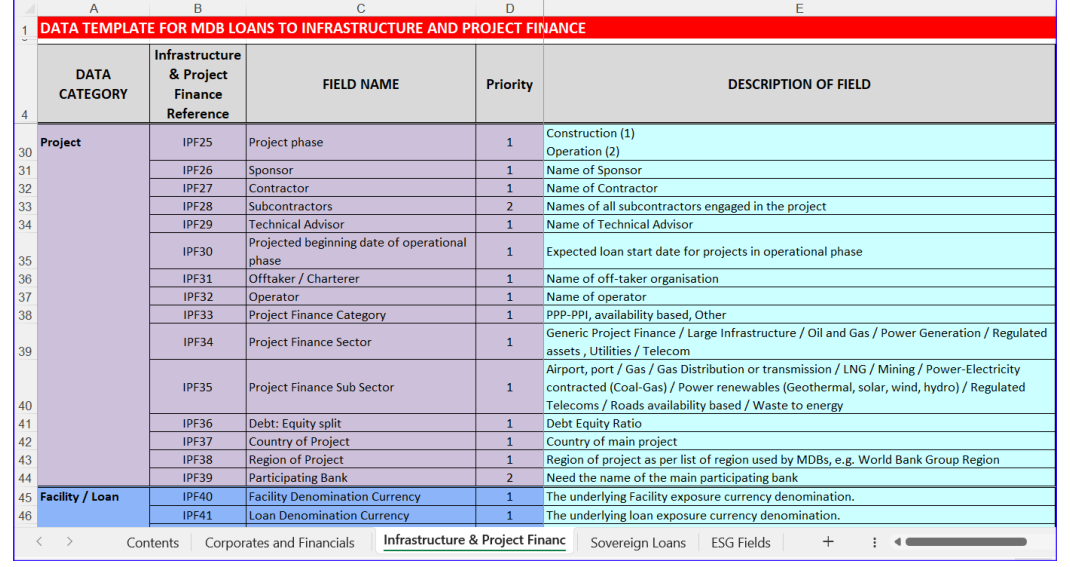
Figure 7.2 below displays an extract of the Infrastructure and Project Finance template as described in Excel format.
The Infrastructure and Project Finance template features a “Project” section with additional fields providing specific information which are critical for project assessment and would be welcomed by investors such as:
• Project Phase (Construction/Operation),
• Names of Contractor and Offtaker.
No-data options (to be discussed with MDBs) may be used in optional data fields or when it is not possible to input data, by entering ND1, ND2, .… or ND5 depending on the justification of No data.
7.3 Template for Sovereign loans
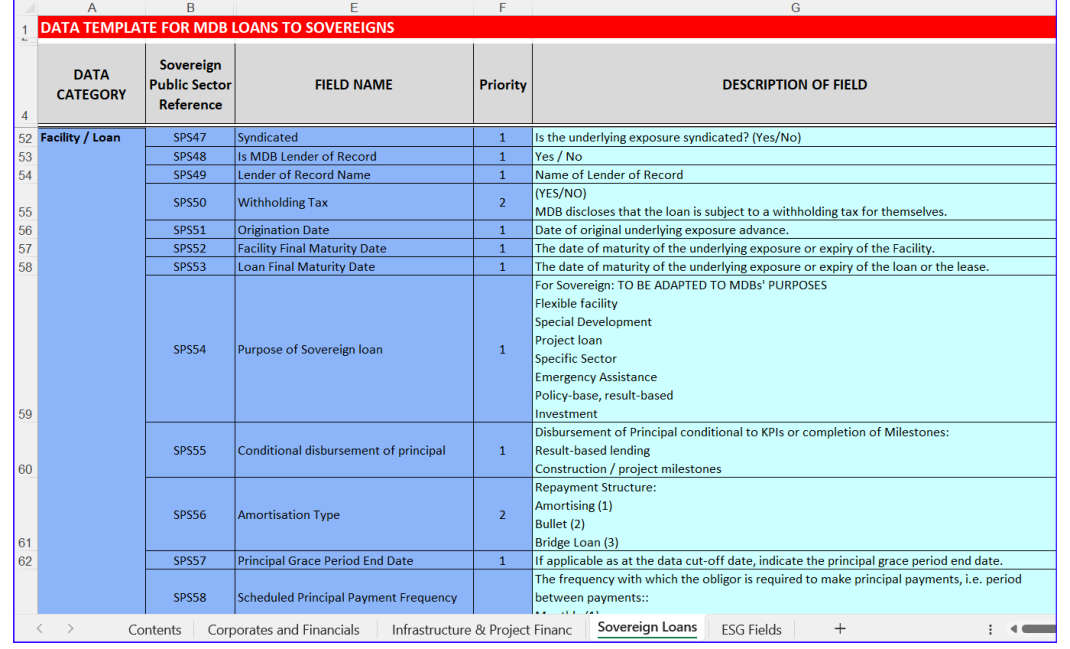
Figure 7.3 below displays an extract of the Sovereign loans template as described in Excel format.
The template for Sovereign and Public Sector loans proposes specific additional data fields for sovereign loans such as:
• “Purpose of Sovereign Loans”, “Conditional disbursement of principal” which may be used for Sovereign result-based Lending.
7.4 Fields Template for ESG Data
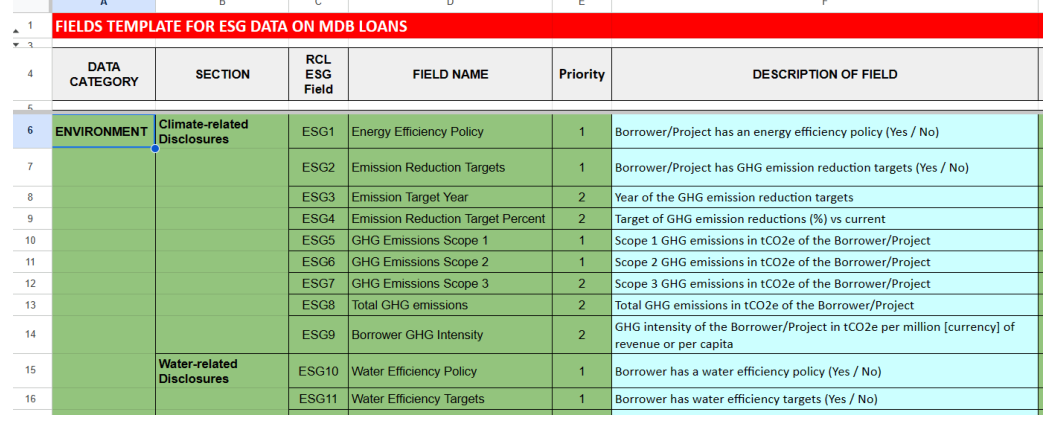
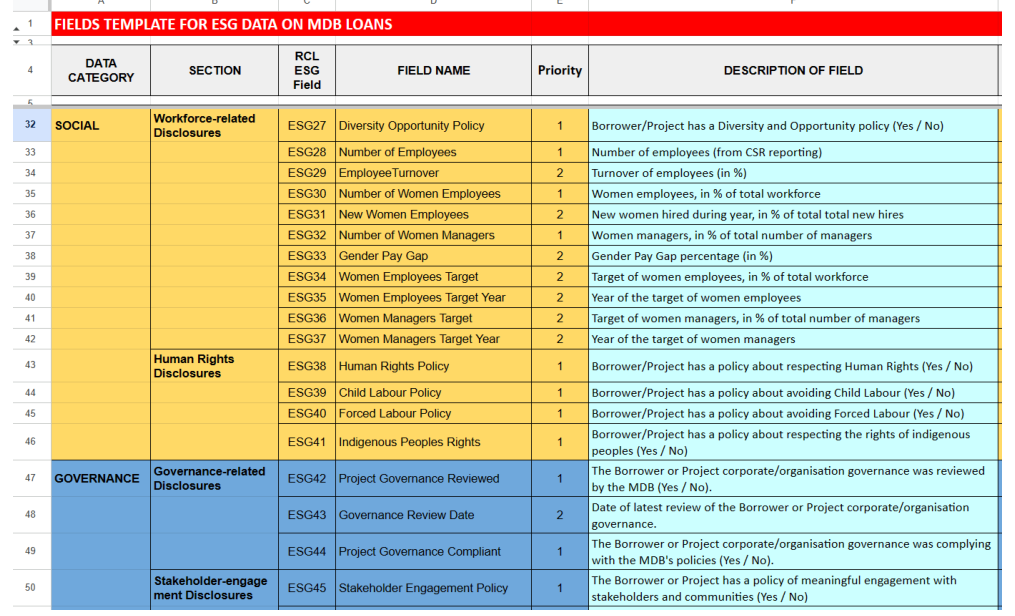
Figure 7.4 and Figure 7.5 below display two extracts of the proposed additional ESG fields, for each of the previous templates, as described in Excel format.
The proposed Fields are split into the three usual categories of ESG data: Environmental, Social and Governance-related data.
Each category of data is itself split into sub-sections which are function of the selection of underlying sustainability topics retained, at this stage, for the ESG fields:
• for Environment: climate-related, water-related, waste-related and biodiversity-related data,
• for Social: workforce/human capital-related and human rights-related data,
• for Governance: governance-related, stakeholder engagement, anti-corruption and procurementrelated data.
Priorities have also been suggested. For example, confirming the existence (or not) of a borrower’s GHG emission reduction targets could be considered a higher priority than being able to provide the target date and quantum.
The types of ESG data proposed include certain metrics, mostly for environment-related and workforce-related fields. For the other Social and Governance sustainability topics, the proposed fields are more focused on confirming the existence of relevant policies and practices and whether they comply with the MDBs policies.
More complete ESG disclosures and reports would feature extensive descriptions and comments on these topics. However, data templates providing loan-by-loan data to investors require more concise data such as such confirmation. Investors will then know what policies and targets exist and would be able to request more detailed information if relevant to their investment assessment process.
8. Conclusion
This document presents a proposed loan/exposure data template for potential use by MDBs engaged in risk transfer activities. The document has been prepared by Risk Control as part of a wider project to support MDB risk transfer and balance sheet optimisation on behalf of the MDB Challenge Fund.
The Challenge Fund has the objective of assisting MDBs in implementing the recommendations of the influential report by the G20 appointed Independent Panel on MDB Capital Adequacy Frameworks (see CAF Panel (2022)). Among other recommendations, the CAF Panel advised MDBs to use risk transfer to boost their lending capacity.
This paper and the associated detailed template are influenced by the ESMA template that European securitisation issuers are required to use under European regulations. An associated report, Risk Control
(2024b) describes in detail the expectations of regulators in five different jurisdictions, of which the EU is one, as regards data disclosures to investors by securitisation issuers. Risk Control (2024a) sets out business models and data policies that Risk Control believes MDBs should consider to permit large scale risk transfer.
References
African Development Bank Group (AfDB) (2023) “African Development Bank Group’s Integrated Safeguards System 2023,” May, available at: https://www.afdb.org/en/documents/african-development-bank-groupsintegrated-safeguards-system-2023.
Asian Development Bank (ADB) (2024), “Environmental and Social Framework,” policy paper, October, available at: https://www.adb.org/documents/environmental-and-social-framework-policy-paper.
Association for Financial Markets in Europe (AFME) (2022) “European Green Securitisation Regulatory State of Play,” December, available at: https://www.afme.eu/publications/reports/details/european-greensecuritisation-regulatory-state-of-play-obstacles-to-growth-and-opportunities-for-leadership.
Association for Financial Markets in Europe (AFME) (2024) “ESG Finance Report Q1 2024,” April, available at: https://www.afme.eu/publications/data-research/details/esg-finance-report-q1-2024.
Bank of England (2014) “Loan Level Data: Reporting Template for PFI Loan Portfolios,” available at: https://www.bankofengland.co.uk/markets/eligible-collateral.
Climate Bonds Initiative (CBI) (2019) “Securitisation as an enabler of green asset finance in India,” December, available at: https://www.climatebonds.net/resources/reports/securitisation-enabler-green-asset-financeindia-0.
Climate Bonds Initiative (CBI) (2021) "China green securitisation report – State of the market 2020,” September, available at: https://www.climatebonds.net/resources/reports/china-green-securitization-statemarket-2020-report.
Climate Bonds Initiative (CBI) (2023) “Brazil Sustainable Securitisation – State of the Market Q3 2022,” March, available at: https://www.climatebonds.net/resources/reports/brazil-sustainable-securitisation-statemarket-q3-2022.
European Bank for Reconstruction and Development (EBRD) (2019), “Environmental and Social Policy (ESP),” April, available at: https://www.ebrd.com/news/publications/policies/environmental-and-social-policyesp.html.
European Central Bank (ECB) (2024) “Public sector DECCs template,” ECB website, Data templates, available at: https://www.ecb.europa.eu/mopo/coll/loanlevel/transmission/html/index.en.html.
European Commission (2019a) “Commission Delegated Regulation (EU) 2020/1224 - Regulatory Technical Standards specifying the information and the details of a securitisation to be made available by the originator, sponsor and SSPE,” October, available at: https://eur-lex.europa.eu/eli/reg_del/2020/1224/oj.
European Commission (2019b) “Commission Implementing Regulation (EU) 2020/1225 - Implementing Technical Standards with regard to the format and standardised templates for making available the information and details of a securitisation by the originator, sponsor and SSPE,” October, available at: http://data.europa.eu/eli/reg_impl/2020/1225/oj.
European Commission (2022) “Commission Delegated Regulation (EU) 2022/1288 of 6 April 2022 supplementing Regulation (EU) 2019/2088 of the European Parliament and of the Council with regard to regulatory technical standards specifying the details of the content and presentation of the information in relation to the principle of ‘do no significant harm’, specifying the content, methodologies and presentation of information in relation to sustainability indicators and adverse sustainability impacts, and the content and presentation of the information in relation to the promotion of environmental or social characteristics and sustainable investment objectives in pre-contractual documents, on websites and in periodic reports,” March, available at: https://eur-lex.europa.eu/eli/reg_del/2022/1288/oj.
European Commission (2024) “Commission Delegated Regulation (EU) 2024/1700 of 5 March 2024 supplementing Regulation (EU) 2017/2402 of the European Parliament and of the Council with regard to regulatory technical standards specifying, for simple, transparent and standardised non-ABCP traditional securitisation, and for simple, transparent and standardised on-balance-sheet securitisation, the content, methodologies and presentation of information related to the principal adverse impacts of the assets financed by the underlying exposures on sustainability factors,” March, available at: https://eur-lex.europa.eu/legalcontent/EN/TXT/?uri=OJ:L_202401700.
European Investment Bank (EIB) (2022), “Environmental and Social Standards,” February, available at: https://www.eib.org/en/publications/eib-environmental-and-social-standards.
European Leveraged Finance Association (ELFA) (2023) “CLO Carbon and Climate Disclosures: Methods for Enhancing Transparency,” October, available at: https://elfainvestors.com/publications/ and https://elfainvestors.com/wp-content/uploads/2023/10/ELFA-Insights-39-CLO-Carbon-and-Sustainability- Reporting-Paper-1.pdf.
European Parliament (2017) securitisation regulation (SECR) “Regulation (EU) 2017/2402 of the European Parliament and of the Council of 12 December 2017 laying down a general framework for securitisation and creating a specific framework for simple, transparent and standardised securitisation,” December, available at: https://eur-lex.europa.eu/legal-content/EN/TXT/?uri=CELEX:32017R2402.
European Union Corporate Sustainability Reporting Directive (EU CSRD) (2022) “Directive (EU) 2022/2464 of the European Parliament and of the Council, as regards Corporate Sustainability Reporting,” available at: https://eur-lex.europa.eu/legal-content/EN/TXT/?uri=CELEX%3A32022L2464.
European Securities and Markets Authority (ESMA) (2020) “Guidelines on securitisation repository data completeness and consistency thresholds – Final Report,” July, available at: https://www.esma.europa.eu/document/guidelines-securitisation-repository-data-completeness-andconsistency-thresholds-0.
European Securities and Markets Authority (ESMA) (2024), “Disclosure requirements and templates – Technical standards on disclosure requirements – Annexes,” ESMA website, ‘Markets and Infrastructure / Securitisation’ section, available at: https://www.esma.europa.eu/esmas-activities/markets-andinfrastructure/securitisation.
Financial Conduct Authority (FCA) (2023) “FCA updates on its Sustainability Disclosure Requirements (SDR) and investment labels consultation,” March, available at: https://www.fca.org.uk/news/news-stories/fcaupdates-sustainability-disclosure-requirements-and-investment-labels-consultation.
Glasgow Financial Alliance for Net Zero (GFANZ) (2022) “The Potential For Country Platforms To Mobilize Capital For Net-Zero Transition In Emerging Markets And Developing Economies,” available at: https://assets.bbhub.io/company/sites/63/2022/07/GFANZ-Country-Platform-Private-Sector-Statement- July-2022.pdf.
Global Emerging Markets Risk Database Consortium (GEMs) (2023) Multilateral Development Banks and Development Finance Institutions – “Default statistics: Sovereign and Sovereign-guaranteed Lending 1998- 2020 - Volume 1,” March, available at: https://www.eib.org/en/publications/20220316-default-statisticssovereign-and-sovereign-guaranteed-lending-1998-2020-vol1.
Global Emerging Markets Risk Database Consortium (GEMs) (2023) Multilateral Development Banks and Development Finance Institutions – “Default statistics: Private and Sub-sovereign Lending 1994-2020 - Volume 2,” March, available at: https://www.eib.org/en/publications/20220317-default-statistics-private-andsub-sovereign-lending-1994-2020-vol2.
Global Emerging Markets Risk Database Consortium (GEMs) (2024) Multilateral Development Banks and Development Finance Institutions – “Recovery statistics: Private and Sub-sovereign Lending 1994-2022,” March, available at: https://www.gemsriskdatabase.org/#Recovery%20Statistics%20Publication.
Group of MDBs (2023) “Joint MDB Methodological Principles for Assessment of Paris Agreement Alignment of New operations,” June, available at: https://www.worldbank.org/en/publication/paris-alignment/joint-mdbparis-alignment-approach.
IDB Invest (2020) “Environmental and Social Sustainability Policy,” April, available at: https://idbinvest.org/en/sustainability.
IDB Invest (2020) “Managing a Portfolio for Impact,” July, available at: https://www.idbinvest.org/en/impactmanagement-framework.
IFRS (2021) “IFRS Foundation announces International Sustainability Standards Board, consolidation with CDSB and VRF, and publication of prototype disclosure requirements,” November, available at: https://www.ifrs.org/news-and-events/news/2021/11/ifrs-foundation-announces-issb-consolidation-withcdsb-vrf-publication-of-prototypes/.
IFRS (2023) “IFRS S1 Sustainability Disclosure Standard – General Requirements for Disclosure of Sustainability-related Financial Information,” June, available at: https://www.ifrs.org/issued-standards/ifrssustainability-standards-navigator/ifrs-s1-general-requirements/.
IFRS (2023) “IFRS S2 Sustainability Disclosure Standard – Climate-related Disclosures,” June, available at: https://www.ifrs.org/issued-standards/ifrs-sustainability-standards-navigator/ifrs-s2-climate-relateddisclosures/.
Independent Expert Panel convened by the G20 (“CAF Panel”) (2022) “Boosting MDBs’ investing capacity – An Independent Review of Multilateral Development Banks’ Capital Adequacy Frameworks,” October, available at: https://www.gihub.org/resources/publications/boosting-mdbs-investing-capacity-an-independent-review-ofmultilateral-development-banks-capital-adequacy-frameworks/.
Inter-American Development Bank (IDB) (2020) “Environmental and Social Policy Framework (ESPF) ,” September, available at: https://www.iadb.org/en/who-we-are/topics/environmental-and-socialsolutions/environmental-and-social-policy-framework.
International Capital Market Association (ICMA) (2021) “The Green Bonds Principles,” with June 2022 appendix, available at: https://www.icmagroup.org/sustainable-finance/the-principles-guidelines-andhandbooks/green-bond-principles-gbp/.
International Finance Corporation (IFC) (2012) “Performance Standards on Environmental and Social Sustainability,” January, available at: https://www.ifc.org/en/insights-reports/2012/ifc-performancestandards.
Joint Committee of the European Supervisory Authorities (JC-ESA) (2024) “Q&As relating to the Securitisation Regulation (EU) 2017/2402,” May, available at: https://www.esma.europa.eu/sites/default/files/library/jc_2021_19_jcsc_qas_on_securitisation_regulation.p df.
Klein, Mossinger, Pfingsten (2021) “Transparency as a remedy for agency problems in securitization? The case of ECB’s loan-level reporting initiative”, Journal of Financial Intermediation – Volume 46, April, available at: https://www.sciencedirect.com/science/article/abs/pii/S1042957320300073.
KPMG (2022) “Big shifts, small steps – Survey of Sustainability Reporting 2022,” October, available at: https://kpmg.com/xx/en/home/insights/2022/09/survey-of-sustainability-reporting-2022.html.
KPMG (2023) “Counting on it – Sustainability reporting in financial services,” June, available at: https://kpmg.com/xx/en/home/insights/2023/05/counting-on-it-sustainability-reporting-in-financialservices.html.
Moody’s (2024) “Rating Methodology – Project Finance and Infrastructure Asset CLOs,” February, available at: https://ratings.moodys.com/rmc-documents/415304.
Partnership for Carbon Accounting Financials (PCAF) (2022) “The Global GHG Accounting and Reporting Standard Part A: Financed Emissions. Second Edition,” December, available at: https://carbonaccountingfinancials.com/en/standard.
Risk Control Limited (2024a) “MDB Risk Transfer: Business Models and Data,” September, available at: https://www.riskcontrollimited.com/insights/mdb-risk-transfer-business-models-and-data/.
Risk Control (2024b) “Regulatory Data Requirements for Securitisation Investors,” December.
Task Force on Climate-related Financial Disclosures (TCFD) (2023) “Task Force on Climate-related Financial Disclosures – 2023 Status Report,” October, available at: https://www.fsb-tcfd.org/press/tcfd-publishes-finalreport-identifies-further-work-needed/.
Taskforce on Nature-related Financial Disclosures (TNFD) (2023) “Recommendations of the Taskforce on Nature-related Financial Disclosures,” September, available at: https://tnfd.global/publication/recommendations-of-the-taskforce-on-nature-related-financial-disclosures/.
The Investor Agenda (2022) “2022 Global Investor Statement to Governments on the Climate Crisis,” November, available at: https://www.unepfi.org/industries/investment/600-plus-investors-call-ongovernments-to-radically-raise-their-climate-ambition-at-cop27/.
UK Government (2023) “Guidance – UK Sustainability Disclosure Standards – Information on the UK government’s framework to create UK Sustainability Disclosure Standards (UK SDS) by assessing and endorsing the global corporate reporting baseline of IFRS Sustainability Disclosure Standards,” August, available at: https://www.gov.uk/guidance/uk-sustainability-disclosure-standards.
US Federal Reserve (2023) “Instructions for the Capital Assessments and Stress Testing information collection
- (Reporting Form FR Y-14Q),” June, available at: https://www.reginfo.gov/public/do/DownloadDocument?objectID=35296101.
US Securities and Exchange Commission (SEC) (2022) “SEC Proposes Rules to Enhance and Standardize Climate-Related Disclosures for Investors,” March, available at: https://www.sec.gov/news/pressrelease/2022-46.
World Bank (2023) “Mobilizing private capital for nature to meet climate and nature goals,” September, available at: https://climatechampions.unfccc.int/wp-content/uploads/2023/09/Nature-finance-paper.pdf.
Appendix 1: ESG Factors in Securitisation
A1.1 Introduction Institutional investors and portfolio managers are increasingly focusing on Environment, Social and Governance (ESG) impacts when deciding on their investments to meet their own net zero objectives, as well as to satisfy their clients’ growing expectations regarding sustainability. Regulations and legal frameworks are evolving towards ensuring cooperation between the finance industry and sustainable objectives. Industry initiatives from organisations such as the International Capital Market Association (ICMA) have facilitated the emergence of frameworks of analysis of ESG in fixed income scenarios. However, in Europe for example, specific ESG regulations for securitisation have not been fully implemented yet.
Figure A1.1: European ESG Securitisation Issuance by Asset Class
Note: The units on the vertical axis are in Euro billion. The source is AFME (2024).
In the securitisation market, ESG criteria are only starting to emerge in Europe, whilst in the US, “Green securitisation” issuance has represented 32.8% of securitisation in the period 2019-2022 H1. Over the same period, only 1.4% of the total European securitisations were “green issuances”. European ESG Securitisation issuance jumped to EUR 8bn in 2021 and fell in 2022 in line with the broader markets, reflecting the challenging macroeconomic conditions. The lack of clear ESG standards for securitisation and a shortage of eligible collateral continued to limit the growth of ESG securitisation. The current initiatives to refine and clarify ESG securitisations and, for example, the future application of the new European Green Bond Standard (EUGBS) to securitisation will help support ESG securitisation and address investors growing appetite.
Figure A1.2: European ESG Securitisation by Country
Note: The units on the vertical axis are in Euro billion. The source is AFME (2024).
This section focuses on the ESG aspects of a securitisation transaction. It looks at regulatory and industry initiatives and market expectations, and summarises the implications for an MDB engaged in a securitisation transaction.
A1.2 ESG Regulation and Industry Initiatives European ESG Regulations European regulators have published several documents on ESG and sustainability for the broader financial industry and for securitisation:
• Banks and corporates of size that fall under the scope of the EU Corporate Sustainability Reporting Directive (CSRD)have to comply with the EU Taxonomy regulation,
• Asset managers and other market participants have mandatory disclosures imposed by the Sustainable Finance Disclosure Regulation (SFDR) published in 2019. SFDR does not consider securitisation as a ‘financial product’ and therefore SFDR does not directly apply to securitisation. They are indirectly subject to SFDR, through the entity-level disclosure requirements (Principal Adverse Impact (PAI) indicators cover all investment decisions, including investments into securitisations) and when investments by financial products in securitisation positions result in investments in Taxonomy-aligned economic activities.
• In March 2024, the EU Commission adopted Regulatory Technical Standards (RTS) proposed by the European Supervisory Authorities (ESAs).[26] These provide an optional alternative for originators of Simple, Transparent and Standardised (STS) securitisations and broadly align with the SFDR on the disclosure of available environmental performance information. The scope of application of the RTS is STS securitisations (non-ABCP) and on-balance sheet securitisations for the residential mortgage, auto loan and auto lease asset types. Originators are required to use mandatory indicators of Principal Adverse Impact (PAI), as well as one of the additional social or governance indicators and one of the additional environmental indicators. The RTS on STS securitisations’ ESG disclosures was adopted recently, in June 2024.
• In November 2023, the European Parliament (EU) adopted the European Green Bond Standard (EUGBS), largely inspired by the ICMA Green Bond Principles. It includes among other things, mandatory impact monitoring and reporting, transparency and external review requirements.
• The European Banking Authority (EBA) does not recommend a specific framework for sustainable securitisation, as the EU Securitisation Regulation already imposes due diligence requirements for investors (articles 5 and 7) and investors’ ESG due diligence assessment will be facilitated by the transparency requirements of the voluntary EUGBS requirements. The EBA recommended that the EUGBS requirements apply at the originator level (instead of the issuer or securitisation special purpose entity (SSPE) level). The EBA proposed the extension of PAI disclosures to include non-STS securitisations and adjustments to the ESMA loan-level data templates for PAI of the transactions in the scope of the RTS. Under the Use of Proceeds approach, the originator would have to demonstrate that the proceeds of securitisation are used for 100% taxonomy-aligned assets (although there may be a 15% tolerance).
• In March 2024, ESMA opened a consultation on Technical Standards of the European Green Bond Regulation which closed in June. Based on the results of this consultation, ESMA will explore the possibility of incorporating climate-related metrics into the disclosure framework.
• The European Central Bank (ECB) will incorporate climate change considerations into the Eurosystem’s monetary policy operations and, from 2026, the Eurosystem will exclusively accept as collateral those assets issued by companies whose social and environmental disclosure are compliant with the Corporate Sustainability Reporting Directive (CSRD).
A1.3 Industry initiatives As the legal framework is not fully developed and implemented, market participants generally follow industry initiatives developed by the International Capital Market Association (ICMA) and by the Climate Bond Initiative (CBI):
• ICMA has developed the Green Bond Principles (GBP), the Sustainable Bond Principles (SBP) and the Sustainability Bond Guidelines (SBG),
• The CBI provides a green label for securitisation.
The EUGBS has drawn on these initiatives. Typically, three factors are considered in labelling ESG securitisations:
(i) The underlying asset portfolio: securitisation backed by ESG assets,
(ii) The key transaction counterparties: securitisations where the key counterparties commit to achieve sustainability KPIs, and
(iii) The use of proceeds (UoP) from the sale of the assets, for some ESG purpose by the originator.
For example, a securitisation could be labelled as sustainable when the underlying assets are considered ‘green’ (for example mortgages for energy-efficient properties, or loans for environmentally friendly projects) so, if the proceeds from the transaction are used to finance assets with ESG benefits, or when the key parties to the transaction align with governance objectives.
So far, mainly issuances of Residential Mortgage-Backed Securities (RMBS) and of auto loan/lease Asset- Backed Securities (ABS) have been considered as green:
• Green RMBS: when the properties are in energy efficient buildings or when the proceeds are to fund energy efficient buildings or climate friendly projects.
• Green auto loan/lease ABS: when the underlying vehicles are Electric Vehicles (EVs) or the underlying sellers are active in green sectors.
As a result, ‘green securitisation’ transactions would match the ESG appetite and requirements of many asset managers and could also appeal to the investors who want to invest into ESG projects. In AFME (2022), the Association for Financial Markets in Europe (AFME) together with S&P estimated that “securitisable green lending could exceed €300 billion annually by 2030.” Among these, €125 billion could come from gross green mortgage lending and €75 billion from lending for green home renovation, both being generated across 8 different European RMBS markets.[27]
A1.4 ESG data requirements The EUGBS requires a detailed factsheet pre-issuance, a periodic report for the use of proceeds by the issuer and a report on the environmental impact of the bonds’ use of proceeds. Specific to securitisation, the prospectus must include (on a best effort basis) disclosure about the alignment of the assets with the European taxonomy and the compliance with ‘Do no significant harm’ principles.
To comply with the EU securitisation regulation (SECR),[28] the originator of STS securitisation backed by residential mortgages and auto loans/leases should comply with STS transparency requirements by disclosing either the environmental performance of the assets through the ESMA templates (i.e. Energy Performance Certification details, which are mandatory only for STS), or the PAIs of the underlying exposures on ESG factors in accordance with the RTS methodology adopted via European Parliament (2024). In the consultation it opened until March 2024, ESMA proposed to extend the climate change risk metrics to non-STS securitisations: climate-related physical risks and transition risks related to the underlying assets, as well as carbon footprints, energy efficiency and other environmental factors.
Valuable metrics that should be provided to investors to assess transition risks include details regarding the energy efficiency and environmental impact of the collateral, such as Energy Performance Certificate (EPC) labels and Greenhouse Gas (GHG) emissions data. The potential vulnerability of real estate assets to physical risks, and information about the property’s location and physical characteristics would enhance the assessment of climate-related risks. Additional pertinent indicators for transition risks specific to corporate assets would be the proportion of key financial performance indicators (such as operational expenditures, capital expenditures, and turnover) aligned with the EU Taxonomy.
The ESMA Templates The ESMA templates for residential real estate already include the following loan-level data:
• Geographic Region
• Occupancy type
• Property type
• Energy Performance Certificate Value
• Energy Performance Certificate Provider Name
Note that these requirements are for RMBS.
The 2022 EU RTS on sustainability indicators[29] proposed indicators such as:
• Climate and Other Related Indicators
• Greenhouse Gas Emissions (scope 1, scope 2 and scope 3 emissions)
• Carbon footprint
• Energy performance
• Exposure to fossil fuels through real estate assets
• Exposure to energy-inefficient real estate
Although currently provided on a voluntary basis, these data may be expected in the future by investors.
In addition, most MDBs have their own requirements as regards ESG assessments and reporting on the projects they finance. For example, EIB and EBRD have Environmental and Social impacts (E&S) performance and reporting requirements (see EIB (2022) and EBRD (2019)).
Although the EU regulation on ESG requirements for securitisation is not finalised yet, the greater appetite from investors for ESG investments should make the securitisation of the loan books managed by MDBs appealing as the underlying assets could be considered as sustainable projects, and the use of proceeds is often climate-adaption and energy-transition projects. MDBs should record the ESG data they collect on their loans in an efficient manner to be able to disclose them to potential investors in risk transfer transactions relating to these loans.
Risk Control 8 Golden Square London W1F 9HY +44 (0)20 3307 0730 www.riskcontrollimited.com
Notes
[1] This report does not focus on investor reports that the issuer would periodically communicate.
[2] In the central bank case, this is because these institutions use the templates to track the quality of collateral banks provide in the context of repo and other short-term financing. And in the case of central repositories, the intent of regulators is to serve investors (and regulators themselves) by enhancing market transparency.
[3] For example, some MDBs are engaged in trade finance but we do not consider this for the moment as a likely subject of risk transfer and so do not seek to cover it here.
[4] For example, the EU regulation requires investors in securitisation to regularly perform stress tests on the cash flows and underlying collateral exposures (see European Parliament (2017), article 5).
[5] See European Parliament (2017).
[6] DECCs refer to non-marketable Debt instruments backed by Eligible Credit Claims.
[7] See ECB (2024).
[8] See ESMA (2024), in “Disclosure requirements and templates – Technical standards on disclosure requirements” section.
[9] A Consultation Paper (ESMA, December 2023) discusses specific securitisation disclosure templates requirements for private transactions. Feedback was received until mid March 2024; a document is planned for end 2024.
[10] See ESMA Guidelines on securitisation repository data completeness and consistency thresholds – Final Report (July 2020)
[11] See GEMs (2024) “Recovery statistics: Private and sub-sovereign lending 1994-2022.”
[12] Exposure to Infrastructure Finance accounted for EUR 59.8bn to Private counterparts, and EUR 29.4bn to Sub-Sovereign Counterparts in GEMs (2024) “Recovery statistics: Private and Sub-Sovereign Lending 1994-2022 -”.
[13] The Joint Committee of the European Supervisory Authorities (JC-ESAs) has indicated in a Q&A (May 2024) that project finance transactions should use the “esoteric template” of Annex IX of the “EU RTS on disclosure” (2019).
[14] GEMs Consortium (2023) reports a total contract amount (for its 24 MDB and DFI members) of EUR 979.5 billion of Sovereign and Sovereign-guaranteed lending and EUR 365.68 billion of Non-sovereign loans. The latter consisted of EUR 262,71 billion to Private counterparts and EUR 102.97 billion to Sub-sovereign counterparts (see GEMs (2023) “Default Statistics - Private and Sub-Sovereign Lending 1994-2020 Volume 2”).
[15] See ELFA (2023),
[16] For example, see EFRAG-IFRS (May 2024) “European Sustainability Reporting Standards (ESRS) – ISSB Standards Interoperability Guidance”, or GRI-IFRS (January 2024) “Interoperability considerations for GHG emissions when applying GRI Standards and ISSB Standards”.
[17] See “IFRS Foundation and AfDB to join forces to promote sustainability-related financial disclosures” (28 May 2024), available at: https://www.ifrs.org/news-and-events/news/2024/05/ifrs-foundation-and-african-development-bank-to- join-forces-to-promote-sustainability-related-financial-disclosures/.
[18] See IFRS Sustainability (June 2024) “Feedback statement – IFRS Sustainability Disclosure Standards – Consultation on Agenda Priorities”
[19] GRI has already completed standards human rights related (phase 1) and for Oil and Gas, Coal, Agriculture and Fishing, Biodiversity and Mining. For 2024-2026, it has prioritised standards for Labour (Employment practices and working conditions), Climate change, Economic impact and Financial services.
[21] See World Bank (2023) “Mobilizing private finance for nature to meet climate and nature goals.”
[22] See AFME (2022) “European Green Securitisation Regulatory State of Play.”
[23] See CBI (2021).
[24] See GFANZ (2022).
[25] See CBI (2023).
[26] See European Parliament (2024).
[27] The 8 different European RMBS markets considered are Belgium, France, Ireland, Italy, the Netherlands, Portugal, Spain and the UK (see AFME (2022)).
[28] SECR articles 22 and 26 (see European Parliament (2017).
[29] See European Commission (2022).