

This report assesses cliff effects in European securitisation capital rules. Capital cliffs create distortions and exacerbate instability in financial stress periods. Regulators work to remove such cliffs when memories of financial crises are fresh. But cliffs may creep back as the authorities fine-tune earlier decisions and recollection of stress conditions fades. Right now, European regulators, aware of the region’s investment needs, are considering adjustments aimed at reviving the securitisation market. This study argues that those designing the new rules should take steps to identify and remove cliff effects from the framework.
1 – Introduction
On 17th June 2025, the European Commission published the so-called “Securitisation Package”, a set of measures aimed at simplifying and improving the European Union (EU) securitisation framework. Part of the package[3] is a proposal to amend the Capital Requirements Regulation (CRR) which sets out how banks must calculate risk-weighted assets (RWA) for the securitisation positions (tranches) they hold.
The European authorities have made several attempts since the Great Financial Crisis (GFC) to adjust the regulatory framework for bank and insurer capital and liquidity rules for securitisation exposures. These have included the initial Basel[4]-led review of 2010-13, the subsequent design and introduction of less conservative treatment for ‘high quality’ securitisations (enacted in the EU as the Simple, Transparent and Standardised (STS) label) in 2013-16, the STS regulation on synthetic on balancesheet securitisation in 2021, and several rounds of recalibration for insurer capital held for securitisation exposures under the Solvency II framework.
The current review of securitisation rules reflects official concerns that the regulatory regime for securitisation has prevented a revival in Europe of securitisation, a financial instrument capable of boosting continent-wide investment financing by permitting banks to recycle their scarce capital resources. Challenged on multiple fronts and short of the financing necessary for green and digital transitions, let alone new investment in defence, the European economy needs a banking system that can respond flexibly and at scale to its financing requirements.
This study supports the determination of the European authorities to revive securitisation activity but signals caution about some aspects of the regulatory changes. Capital and liquidity rules should be designed to reinforce stability not to create additional volatility when it should be most avoided, i.e., in periods of financial stress. Cliffs in regulatory rules that sharply increase risk weights in stress conditions are exactly what financial institutions and their supervisors do not need. Several of the authors of this study worked in financial or regulatory institutions before and after the GFC and recall how such cliffs exacerbated the challenges that firms and supervisors faced.
As collective memory of the last crisis fade among both regulators and market participants, features are creeping into the capital rules that could in future stress periods generate instability. The current proposals to reform the securitisation framework therefore present a timely opportunity to eliminate existing regulatory cliffs and, importantly, to avoid introducing new ones.
Here, we study the effect of cliffs in European securitisation capital rules. We focus on the following examples of cliffs:
1. Ratings based cliffs
2. Capital formula cliffs
3. Label (STS and Resilience) cliffs
4. Unfunded risk transfer cliffs
5. Funded protection collateral treatment cliffs.
We distinguish between “static cliffs” in which exposures that closely resemble each other in risk characteristics receive sharply different capital treatments, and “dynamic cliffs” in which variation over time in the determinants of capital levels generates discontinuous changes in capital requirements, potentially exacerbating challenges firms and regulators face in stress periods.
Of the above listed examples, the ratings-based cliffs we examine are related to sharp changes in external rating agency criteria. The GFC provided examples of such changes when rating agencies took sudden administrative rather than evidence-based or data-driven decisions to downgrade and then, in some cases, upgrade segments of the securitisation market. Awareness of this issue did not spread outside the banks and supervisors that had to deal with the impacts but in our understanding, it substantially complicated the balance sheet management of banks with securitisation holdings and the efforts of supervisory authorities in managing stresses to the banking system. Most research studies of the rating agencies in the GFC emphasise their failure to identify weakness in US house-marketrelated loans but in our view a major additional problem was the volatility created as the rating agencies sought to restore their reputation for conservatism by downgrading segments of the market en masse. Similar effects were experienced during the Euro sovereign crisis, exacerbating the banksovereign nexus.
The second type of cliff we study is capital-formula-related cliffs. In a sense, this is the original capital cliff reflecting concerns of regulators post-GFC about the Supervisory Formula Approach (SFA). Banks with permission to employ the Internal Ratings Based Approach (IRBA) for pool loans were allowed to use the SFA for computing capital for securitisation positions. The SFA implied sharp decreases in Risk Weights (RWs) as tranche attachment points increased from low levels. This type of cliff also combines static and dynamic aspects.
The third type of cliff we study is label cliffs. Regulators have increasingly been tempted to introduce distinctions into the rules to incentivise the industry to follow approaches that the regulators have identified as prudent to rebuild trust in the market. The prime example of such a distinction, derived with additional burdens from Basel Simple, Transparent and Comparable (STC) guidelines, is the Simple, Transparent and Standardised (STS) category of securitisations which has become a central feature of European banking and insurer capital regulation. The June 2025 package included an additional distinction of Resilient/Non-Resilient position as well as differentiation between positions held by Originators or Sponsors versus those held by others (labelled “Investors”). Distinctions of this type can generate static cliffs if they are not based on the relative risk of the different categories adopted. They can also create dynamic cliffs if it is possible to shift from one category to another over time (with the so-called “ongoing basis” tests).
The fourth and fifth types of cliffs that we study are associated with the treatment of funded and unfunded credit protection in Significant Risk Transfer (SRT) deals. In this context, the proposals made by several parties to the current European bank securitisation capital review contain various trigger events and traps that could constitute either static cliffs (discouraging participation in transactions) or dynamic cliffs in which disruptions occur in stress periods when stable arrangements are important to banks and the whole market.
The study is organised as follows. Section 2 discusses regulatory cliffs in general, explaining when regulators have been concerned about such issues and why such features tend to arise. Sections 3 to 6 provide an analysis and discussion of the five types of cliff described above. Section 7 discusses cliffs in Funded Protection Capital Treatment. Section 8 concludes.
2 – Capital cliffs and financial stability
Banks and insurers are required by prudential rules to maintain capital resources above minimum levels prescribed by regulation. In practice, any financial firm regulated in this way maintains its capital levels somewhat above the regulatory minimum to avoid hitting the limit in the event of unanticipated shocks.
In normal times, managing the gap between actual capital resources and required regulatory capital is a key challenge for banks and insurers, in order to balance resilience and profitability. In stress conditions, it becomes an essential prerequisite for survival and a major preoccupation for supervisors who fear systemic effects as financial firms, under pressure, retreat from the market, leading to a credit or liquidity crunch or sharp increases in the cost of financial services for consumers, and ultimately, the potential need to bail-out financial institutions using tax-payers’ money.
These issues explain why both firms and financial regulators have been concerned about features of regulations that may exacerbate sudden shocks to capital. When Basel II rules linking capital to internal ratings were introduced,[5] policymakers and researchers examined the degree to which this could generate procyclicality, especially if Point-in-Time (PiT) rather than Through-the-Cycle (TTC) rating techniques were employed. In the event, regulators explicitly chose, at least in theory, a TTC approach and banks mitigated the problem by adopting rating models which emphasised slower moving explanatory variables in their internal ratings models.
The capital cliffs which are the subject of this study are a potentially pernicious source of procyclicality in which the rules themselves (or their reliance on drivers that can shift suddenly) imply significant discontinuities in capital requirements, and more broadly, affect market participants’ behaviour.
Regulatory institutions tasked with monitoring systemic risk are particularly vocal on capital cliffs. For example, the Financial Stability Board (FSB) and the European Systemic Risk Board (ESRB) have cited the dangers of capital cliff effects arising either from regulatory categories or rating agency judgments in several contexts. Here are some examples of their references to regulatory cliff effects:
1. FSB (2010) Ratings Reliance: In its principles on reducing regulatory reliance on Credit Rating Agency (CRA) ratings, the FSB noted “Reducing reliance [on CRA ratings in standards, laws and regulations] will reduce the financial stability-threatening herding and cliff effects that currently arise from CRA rating thresholds being hard-wired into laws, regulations and market practices.”
2. FSB (2021) Money Market Fund (MMF) regulations: In proposals for regulatory reforms for MMFs, the FSB stated: “Regulatory thresholds may cause investors to pre-emptively redeem to avoid the consequences of a fund crossing those thresholds (“cliff effects”)” and proposed a set of measures to reduce such effects.
3. ESRB (2022) Macroprudential Buffer Overlaps: The ESRB noted that, unless managed, combinations of different capital buffers (e.g., CCyB, O-SII) can cause "cliff effects" where requirements increase abruptly rather than smoothly, reducing buffer usability.
4. ESRB (2024) Downgrade Impacts: The ESRB warned that abrupt credit rating downgrades on corporate bonds can trigger sharp rises in capital requirements, causing cliff effects in bank portfolios.
5. ESRB (2025) Synthetic Securitisation Risk: The ESRB warned of a rating cliff when credit protection has been provided by insurers.
Various commentators have cited dangers of a capital cliff in the Fundamental Review of the Trading Book (FRTB) rules. If individual trading books experience hypothetical losses that exceed those implied by internal models, they may lose permission to compute capital for their positions based on the Internal Models Approach (IA).[6] Since the alternative Standardised Approach (SA) capital is much higher, a capital shock can arise.[7]
3 – Rating cliffs
Criticism of the rating agencies following the GFC focussed on their credit assessments of US subprime mortgage securitisations and re-securitisations. This led regulators, particularly in the United States, to reduce reliance on ratings in bank capital regulation. The issue was taken up by international regulators such as the FSB which published principles for reducing reliance on agency ratings (see FSB (2010)).
Regulators expressed concerns that investors and banks had come to rely on agency ratings in mechanistic ways rather than developing their own credit assessment approaches and that the agencies themselves in some circumstances (which may have been relevant prior to the GFC) could be subject to commercial pressures that might affect their judgments.[8] A stocktaking of just how extensively agency ratings had come to be present in financial regulations was provided by BCBS (2009). An early call for change of approach was published by Rosenkranz (2009). The challenges involved in removing ratings from regulation are discussed in Katz, Salinas and Stephanou (2009).
However, what contributed to the financial turmoil and pressure on bank capital ratios in 2007 was not just the inaccuracy of the agencies’ judgments but the fact that their ratings reassessments came in such a sudden wave. Ashcroft and Schuermann (2018) comment: “half of all downgrades of tranches in the history of Home Equity ABS were made in the first seven months of 2007. About half of these were made during the week of 9 July, when Moody’s downgraded 399 tranches. About two-thirds of these downgrades involved securitizations by four issuers [which] accounted for about one-third of 2006 issuance: New Century, WMC, Long Beach, and Fremont.”[9]
Duponcheele, Perraudin and Totouom-Tangho (2014) document the pressures created by sudden changes in rating agency methodologies. They state: “A particularly extreme example of the former type of methodology change is the default probability stresses for CLOs adopted by Moody’s in 2009 and then removed in 2011.”[10] This resulted in the pattern that appears in Figure 3.1.
A second example is provided by the counterparty risk criteria changes that Standard & Poor’s issued in December 2010. The agency had given the industry six months to take action to mitigate counterparty risks it had identified in securitisation transactions. Dissatisfied with progress, the agency put the ratings of 2,005 structured finance securities in 975 transactions on CreditWatch negative on 12th April 2011. This affected about 30% of the outstanding value of European transactions that the agency was then rating. Another 554 securities (involved in 225 transactions) avoided negative CreditWatch status because the agency took the view that “credible action plans” had been submitted to mitigate counterparty risk.
Duponcheele, Perraudin and Totouom-Tangho (2014) state that “By July 2011, after the 6-month time frame, S&P had lowered 1,090 ratings in 511 mainly European transactions by an average of 2.9 notches. CMBS and RMBS were the most affected asset classes. Downgrades were concentrated toward the top of transaction capital structures, especially among tranches previously rated in the range AAA to AA-. Even high-quality asset classes were impacted, such as Dutch RMBS [which] saw 27% of transactions with securities downgraded by a severity of 2.6 notches.”
In recent years, banks have been more highly capitalised and the severity of stress conditions has been much less than in the GFC (although at the time, the events of 2020 appeared to be a major crisis). The experience of sharp rating agency reassessments of whole market segments has continued, however, and in our view this remains an issue which could become problematic in a crisis.
To illustrate, we construct a quarterly time series of CLO rating actions (upgrades and downgrades) for Europe and the US, split by credit rating agencies (Standard & Poor’s, Moody’s, Fitch, and DBRS). The underlying source is AFME’s Securitisation Data Report, which reports structuredfinance rating actions by the major rating agencies and provides quarterly upgrades/downgrades breakdowns by collateral type and region. CLOs are identified using AFME’s “CLO / CDO” collateral category, and we extract the corresponding CLO/CDO line items from the rating-action tables for each agency and region.
Figure 3.2 shows the concentration of CLO rating actions over time. Clear peaks occur in both upgrades and downgrades in particular quarters. The two main drivers are:
1. Changes in CLO rating methodology, where a rating agency updates its CLO approach and then applies it across a large stock of outstanding deals. This can lead to a concentrated wave of rating actions and is often more visible in upgrades.
2. Reassessment of credit-conditions, where rating actions, especially downgrades, increase because the underlying environment weakens.
This interpretation is consistent with ESMA’s review of CLO credit ratings. ESMA notes that the major agencies apply global CLO methodologies, and it highlights that material methodological changes have occurred over time. ● Standard & Poor’s (2019): In 2019, Standard & Poor’s recalibrated the CLO scenario and breakeven default rates (its first recalibration since 2009). The change added macro/default data for 2009–2019, incorporated additional CLO performance data, and updated the “archetypal” pool used in modelling. The report also states that this reduced CLO parsubordination and allowed more cushion (and higher embedded leverage) at the same rating levels. ● Moody’s (2020–2021): In 2020, Moody’s changed how credit watches and outlooks feed into the obligor default probability rating used for CLOs: a negative outlook continued to imply a one-notch reduction, while “review for potential downgrade” changed from a two-notch reduction to a one-notch reduction; “review for possible upgrade” continued to imply a onenotch uplift. In 2021, Moody’s changed its approach to modelling the weighted average life of a reinvesting CLO. ● Fitch (2020–2021): Fitch’s material CLO methodology updates were published in 2020 and
2021. In 2020 (early Covid period), changes were mainly to recovery assumptions, including a 5% reduction to the applicable recovery assumption when no recovery rating/estimate was available. In 2021, Fitch updated base-case PD assumptions, default timing, and the portfolio risk horizon; this lowered default-rate scenarios for the base calibration (while maintaining high investment-grade stress settings), and the report states that this had a positive rating impact for some sub-investment-grade and some investment-grade levels.
These methodology changes fall within the period where Figure 3.2 shows the most visible upgrade peaks. Specifically, among the rating-agency series we collected, Fitch displays the most pronounced jump in EU upgrades in 2021-Q4 (from 27 to 287). This timing aligns with the Fitch 2021 methodology update described in the ESMA report, which is reported to have a positive rating impact for some rating levels, and therefore provides a relevant reference point when interpreting the sharp increase observed in the EU upgrade series.
Of course, there is nothing wrong with ratings agencies revising their methodologies as evidence accumulates that future risk drivers or risk patterns differ from those previously expected. Furthermore, many of the methodology changes discussed above (and highlighted in the ESMA report) imply higher ratings rather than downgrades. ESMA is more focussed here on the possibility of competitive pressures on ratings agencies encouraging methodologies that make rating methodologies less conservative which is why they are concerned with upgrades. Our primary concern is with downgrades which can suddenly boost required capital.
Rating changes occurring without methodology changes can be anticipated by rating watches and changes in rating outlooks and rarely result in more than one notch upgrade or downgrade. The impact of methodology changes, even if announced and explained, can be much more severe and difficult to estimate for rating users. What we seek to highlight in the above examples is the process surrounding methodology changes. We would expect that evidence-based revisions would be less abrupt and gradually implemented. This is particularly relevant nowadays, when the future risk drivers, risk patterns, interconnections, correlations and severities are surrounded by many uncertainties.
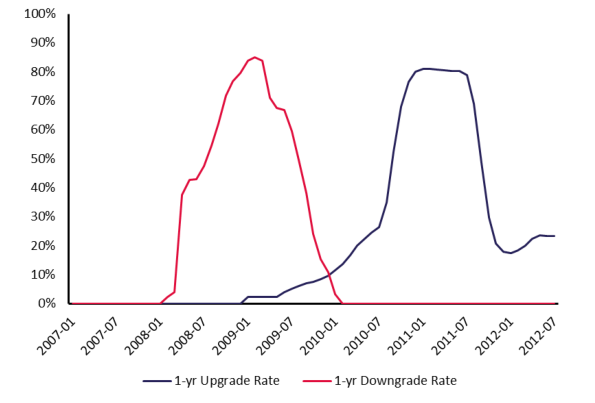
Note: Source: BNP Paribas and Moody’s
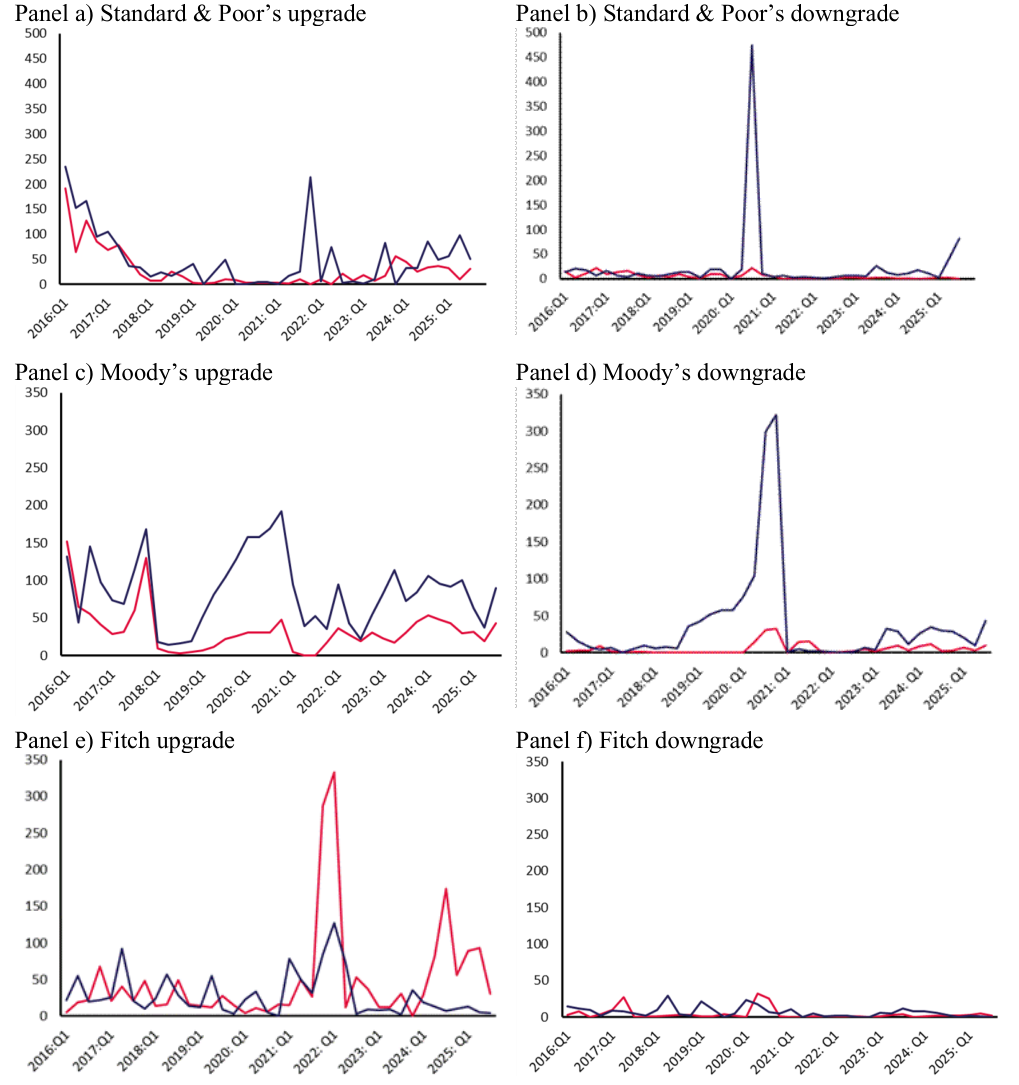
Note: Counts of upgrades and downgrades of CLO, reported by the major credit rating agencies (Moody’s, S&P, and Fitch) for Europe (red) and the US (blue). Source: AFME Securitisation Data Report (2016–2025).
4 – Capital formula cliffs
This section examines the cliff effects in securitisation which have been discussed by regulators for more than 20 years, namely those generated by the Basel II Supervisory Formula Approach (SFA) and subsequent, formula-based methods of computing securitisation regulatory capital. The SFA was introduced by Basel regulators as a means for banks to compute capital for tranched positions using a formula that took as its primary inputs the attachment and detachment points and the capital that the bank would have to maintain if it held the pool assets ‘on balance sheet.’
The SFA generated a cliff because the capital function declines sharply, as seniority increases, around the attachment point corresponding to the capital requirement of the underlying pool (KIRB). In stressed conditions, if the pool credit quality deteriorates, pool capital increases leading to relatively senior tranches being subject to much higher capital charges (a dynamic cliff). Also, the initial structuring of the deal (i.e., the positioning of tranche attachment and detachment points) is likely to be strongly influenced by the decrease in capital charges.
To mitigate this issue, subsequent regulatory approaches introduced smoothing mechanisms, notably through the parameter labelled the ‘p-factor.’ A high p-factor smooths the capital formula reducing the cliff effect. At the same time, within the basic design adopted by regulators, a high p-factor increases the conservatism or ‘non-neutrality’ of the framework. Here, conservatism is measured by the ratio of the capital implied by the formula if a bank held all the tranches (leaving aside the issue of RW floors and capital ceilings) to the capital required if it holds the pool assets on balance sheet.
Conversely, pushing the p-factor to low values (such as below p=0.3) introduces a cliff effect in that upper mezzanine positions may be riskier than the regulatory capital treatment suggests (a static cliff) and capital for senior tranches may be volatile in stressed market conditions (a dynamic cliff).
Among financial regulators, the UK authorities have historically been particularly dubious about the use of regulatory capital formulae exhibiting sharp declines in marginal capital close to the attachment point corresponding to pool capital. In 2011, the Financial Services Authority (FSA) published guidance requiring that, in general, rather than calculating capital for a retained senior tranche using the Supervisory Formula Approach (SFA), banks should obtain a public rating and compute their capital using the Basel II Ratings Based Approach (RBA) (see FSA (2011)).
The presence of cliff effects was also acknowledged during the development of the Basel III securitisation framework. The Basel Committee on Banking Supervision (BCBS, 2014)[12] identified the presence of sharp cliff effects in marginal capital charges as one of the major shortcomings of the earlier SFA framework. In particular, the Committee noted that the SFA did not adequately incorporate maturity effects. Under the SFA, the maturity of assets in the underlying pool is reflected in the KIRB parameter, when determining the capital requirement for securitisation positions.
EBA (2019)[13] also links the p-factor directly to the treatment of cliff effects in the securitisation framework. In its discussion of the revised hierarchy of approaches, the EBA explains that the framework includes non-neutrality correction factors to capture agency and model risk arising from the asymmetry of information between originators and investors as well as from the tranched structure of securitisations. The EBA notes that the potential for cliff effects is a significant concern, particularly for mezzanine tranches.[14]
In this context, the p-factor operates as a capital surcharge on securitisation tranches relative to the underlying pool capital requirement, while capital floors provide an additional lower bound for senior positions. The EBA further observes that, in some cases, the application of the current calibration can become disproportionate and therefore recommends reassessing the calibration of the securitisation methods, including the desirable level of the p-factor.
AFME (2024)[15] points out that the cliff-effect is aggravated by the interaction between the securitisation framework and the Basel output floor. In their response to the PRA’s discussion paper, they state that the output floor can generate substantial increases in the weighted-average risk weights of retained tranches even where the underlying assets’ pre-securitisation risk weights change only modestly. They further argue that this creates a form of regulatory discontinuity, because transactions that remain viable under SEC-IRBA may become uneconomic once recalculated through the standardised framework, particularly if the SEC-SA p-factor were to remain at 1.
More recent regulatory discussions have continued to focus on the role of the p-factor in shaping the capital function. The Bank of England (2023)[16] notes that the p-factor used in the SEC-SA approach also serves to mitigate cliff effects and cautions against reducing the parameter in a way that would unduly exacerbate such effects. Accordingly, the Bank of England has called on the Basel Committee to review the calibration of the formula. Similarly, the European Securities and Markets Authority (ESMA, 2022, p.78 onwards) highlights the potential for cliff effects arising from the p-factor in the Simplified Supervisory Formula Approach (SSFA).
Regulators have clearly targeted different goals and effects with the formula-based approaches. First, to reduce cliff effects. Second, to ensure a deduction of capital for tranches that detach at levels lower than pre-securitisation pool capital. Third, to avoid an unreasonable level of capital non-neutrality. One can achieve at most two of these three objectives with the current ‘halfpipe’ design. The second goal of capital deduction in combination with a low level of capital non-neutrality (third goal) leaves only a small mass to be distributed under the RW function beyond the capital deduction, which necessarily leads to a steeply falling RW function, which in turn violates the first goal of reduced cliff effects. There is a trade-off between these three goals, and their importance must be carefully assessed if one wishes to determine an appropriate shape for the RW function.
Industry bodies have also highlighted the practical implications of these issues. AFME (2025)[17] refers to concerns raised by the European Banking Authority in its Joint Committee Advice on the Review of the Securitisation Prudential Framework (EBA, 12 December 2022), noting that cliff effects arising from the calibration of the p-factor may have significant implications for securitisations executed and held by banks in practice.
AFME has questioned whether a low p-factor and a consequent sharp decline in the thin-tranche capital lines shown in Figure 4.1 really constitutes ‘a capital cliff.’ AFME argues that senior tranches in effect aggregate many thin tranches and so receive a gradual increase in capital charges if pool losses occur. Only mezzanine investors will experience a large increase in capital if losses build up. Thus, AFME asks: “Do banks face “a cliff effect” or rather a gentle slope?” and provide a numerical example.
To quantify the effects of capital formula cliffs, we begin with the representative portfolio of residential mortgages presented in Bennett et al. (2025), which reports the portfolio’s probability of default (PD) and loss given default (LGD). We take these characteristics as the base-case scenario. We then apply an A-grade stress based on Standard & Poor’s (2017), which provides calibrations used to estimate risk-adjusted capital.
According to the rating agency’s study, an A-grade stress applied to Residential Mortgage-Backed Securitisation (RMBS) portfolio results in a 46.3% increase in risk weights due to higher unexpected losses. Accordingly, we calibrate the A-grade stress so that the stressed PD and LGD produce a comparable increase in the IRB risk weight. The share of defaulted assets is assumed to be the midpoint between the base-case PD and the A-grade stress PD. Table 4.1 displays the stressed PD and LGD corresponding to an A-grade stress.
For the corporate asset class, stressed PD and LGD are calibrated using the same proportional increases applied to the RMBS portfolio. Base-case corporate risk characteristics are taken from Bennett et al. (2025), and the A-grade stress is constructed by applying the RMBS-implied proportional increases in PD and LGD to these values, thereby generating the stressed parameters for the corporate securitisation portfolio.
Using these portfolio characteristics, we estimate the capital requirements based on the IRB risk weight under both the current securitisation framework and the proposed framework (see European Commission (2025)).
Table 4.2 shows the increase in the capital requirement for a senior tranche under an A-grade stress scenario. The results indicate that, under the proposed framework, the capital requirement for the originator or sponsor may increase by a factor of 10 to 15 for RMBS. In contrast, under the current framework, the increase is more moderate, ranging from a factor of 6 to 8.
For corporate exposures, we find that the capital requirement of the senior tranche increases substantially under the A-grade stress scenario. The increase is particularly pronounced for STS securitisations retained by the originator or sponsor under the proposed criteria, where the capital requirement rises by a factor of up to twenty-nine.
The p-factor used in estimating the capital requirement for the senior tranche is inversely related to the IRB risk weight (RW) of the underlying pool. As shown in Table 4.3, the p-factor declines when moving from the base-case scenario to the A-grade stress scenario. This reduction partly offsets the increase in the capital requirement of the senior tranche.
We also estimate the capital requirement of the senior tranche using the Supervisory Formula Approach (SFA) for both the base case and the A-grade stress scenario. The attachment points are 1.85% and 4.55% of the pool for RMBS and corporates respectively, and the pool’s risk characteristics are derived from Table 4.1.
We observe a similar pattern for the corporate asset class, although the magnitude of the increase is substantially higher than for RMBS (see Table 4.4). Using the SFA approach, the ratio of the capital requirement for the senior tranche under the A-grade stress relative to the base case is 8.8 for RMBS and 18.7 for corporates.
The solution to these problems is not to boost the p-factor until the cliff effect is removed. That would make the capital formula profoundly non-neutral in the sense that total capital for all tranches after securitisation will be a very large multiple of total pool capital. Instead, in a series of studies Duponcheele and Perraudin (see for example Duponcheele and Perraudin (2025)) have argued for the adoption of a scaling factor on pool capital before it is introduced into the SEC-IRBA and SEC-SA formulae. This has the effect of pulling the cliff top to the left as shown in Figure 4.2, permitting larger p-factors without generating unreasonable non-neutrality.
Figure 4.2 illustrates the capital required for a thin tranche by an IRB bank, assuming an IRB risk weight of 17.58% (hence, pool KIRB= 0.08 × 0.1758=0.141), in two cases. In the first case, a p-factor of 0.2 is applied, corresponding to the proposed floor value for IRB banks, which results in a capital surcharge of 20%. In the second case, capital or KIRB is scaled by a factor 0.8 as it enters the regulatory capital formula. This implies a capital surcharge (i.e., the ratio of capital on all the tranches (ignoring the floor) to pool capital) of 20%[19] but with a much flatter capital formula, i.e., no cliff.
We accept that the introduction of a scaling constant is a substantial step for regulators who are partly assessed on the degree to which they adhere to generally agreed Basel approaches. But we trust that this 19 The calculation is −1 = 0.2, modification can be considered in future revisions of the framework. The European authorities have already announced that such a review will be conducted four years in the future.
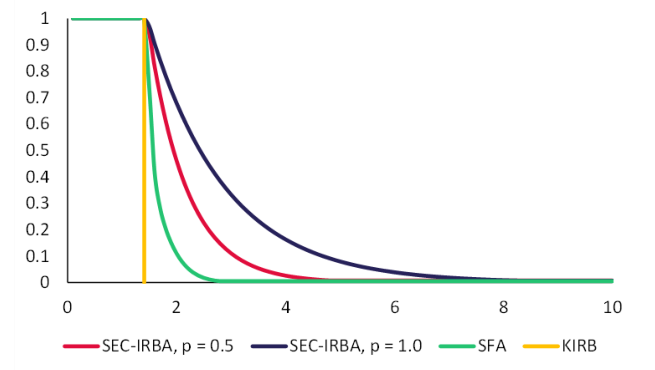
Note: Here the vertical axis represents the ratio of capital required by total pool exposure. The horizontal axis represents the attachment point, expressed in percentage. KIRB denotes capital required based on the IRB approach. The IRB RW and LGD parameters used in calculating SFA[11] and SEC-IRBA capital come from Table 4.1.
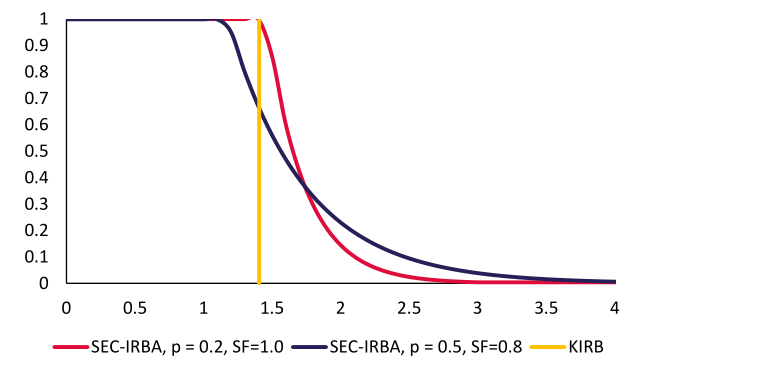
Note: Pool notional is assumed to equal 10. The pool IRB RW is 17.58% (as in Table 4.1) so pool KIRB= 10 × 0.08 × 0.1758=1.41). Here, SF denotes scaling factor. The vertical axis represents the capital required by thin tranche, and horizontal axis represents the attachment point of the thin tranche.
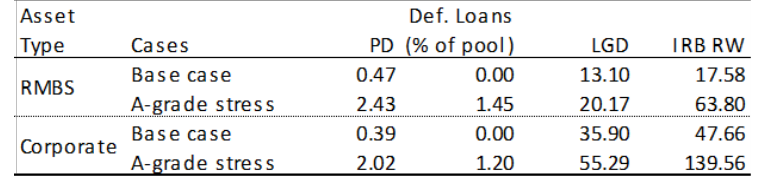
Note: All units are in percent. The IRB RWs shown reflect unexpected losses only.
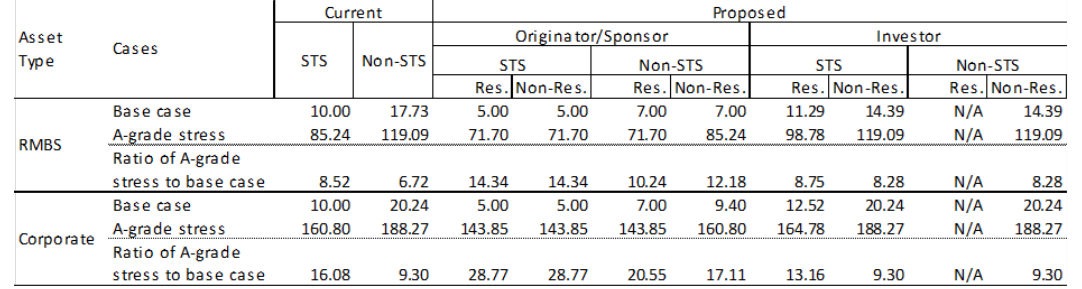
Note: All units are in percent. The attachment points for the senior tranche for RMBS and corporate asset types are 1.85% and 4.55% of the pool.[18]
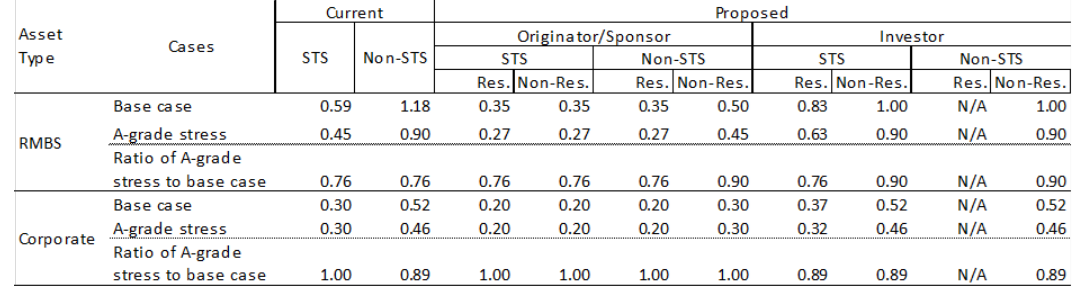
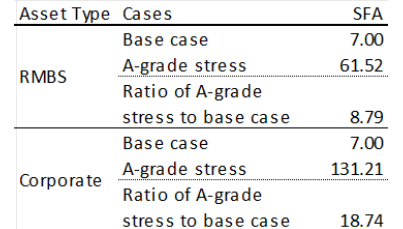
Note: Values are in percent.
5 – Label (STS and resilience) cliffs
5.1 – What are label cliffs?
Regulators in Europe have fine-tuned capital requirements by increasingly introducing distinctions between different categories of securitisation exposure. In 2012 European authorities sought to scale back on securitisation capital reforms that had been largely settled within the Basel framework[20] by advocating the introduction of a ‘high quality’ securitisation category that would receive lower capital charges and more favourable treatment in liquidity regulations.[21] Following an intervention by the European Central Bank and the Bank of England (see BoE and ECB (2014a)[22]), the Basel Committee on Banking Supervision and the International Organization of Securities Commissions (IOSCO) released in 2015 their criteria[23] for identifying simple, transparent and comparable (STC) securitisations, to assist in the financial industry's development of simple, transparent and comparable securitisation structures.
In Europe, this concept was implemented through the STS framework.[24] Recently, in the June 2025 Securitisation Package, the European authorities have further refined their distinctions by introducing the notion of resilient positions and by treating differently senior securitisation tranches depending on whether Originators or Sponsors hold them, or other institutions labelled as Investors.
We understand that regulators have followed the path of introducing high level classifications of this type because of their desire to (i) adhere to approaches developed at the Basel level while also (ii) improve deficient calibrations in the Basel formula. Therefore, a seemingly attractive solution is a carve out for some favoured sub-category while retaining Basel approaches for all exposures falling outside the favoured sub-category.
Problems arise, however, if the distinctions adopted are not evidence-based and the differences in riskiness of the various categories is not proportionate to the differences in capital required. This may distort markets in that some transactions may be disfavoured by the rules, while others, largely equivalent in risk terms, are not penalised. Furthermore, there may be situations in which transactions may lose favoured status as time passes, resulting in instability in capital levels.
We refer to such phenomena as label cliffs. In European regulations, label cliffs are present in bank and insurer securitisation capital rules and in bank liquidity regulations.
5.2 – Label Cliffs in Solvency II
Even before implementation of STS, European regulations for insurer securitisation capital charges as implemented in the Solvency Delegated Act (2015) defined two types of securitisations: Type 1 (an investment-grade-only securitisation predecessor of STS) and Type 2 (any securitisation which did not meet the criteria of Type 1 securitisation).
Under the Standard Formula, the insurance capital charges (before the effect of diversification) for both types per year of duration are represented in Figure 5.1.[25] Irrespective of the absolute value of the capital charge, the main issue for an investor was the effect of the Type 1 investment grade rating (Credit Quality Step (CQS) 3)[26] downgrade to sub-investment grade (CQS 4). Since there is no Type 1 sub-investment grade capital charge, the Type 2 would apply. For a one-year duration, the 3% capital charge would increase, suddenly, to 82%. This represents an increase of 27.33 times, i.e., a rise of 2,633%. It is therefore not surprising that Standard Formula insurance investors had little appetite for the product.
When the STS rules were implemented into the Solvency II Delegated Act (2018), the combined rating/Type 1 cliff was eliminated. However, another cliff appeared, a pure label cliff where the fiveyear senior AAA STS capital charge (5%) increases to the five-year AAA Non-STS capital charge (62.5%), representing a 12.5-fold rise, or a relative increase of 1150%.
In the recently adopted Solvency II Delegated Act (2026), the five-year senior AAA STS capital charge (3.5%) is to be compared with the five-year senior AAA Non-STS capital charge (13.5%), which remains 3.85 times higher, equivalent to a relative increase of 285%. In this case, while the senior AAA STS capital charge is now sufficiently well calibrated, the senior AAA Non-STS is not and results in this large label cliff.
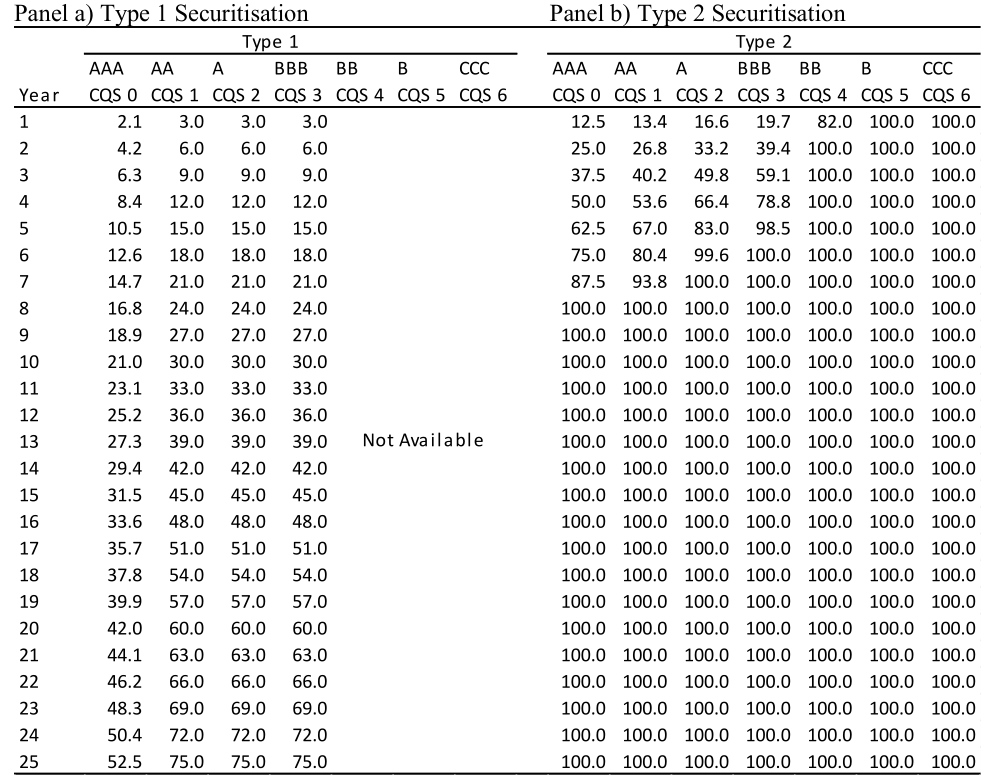
Note: All the capital charges are expressed in percentage.
5.3 – Label Cliffs in Bank Capital Rules
In this section, we examine whether label cliffs remain in European bank capital rules for securitisation exposures. We compare the levels of capital proposed by the European authorities for STS, non-STS, resilient, non-resilient, Originator/Sponsor owed versus Investor owned. Table 5.2 shows the impacts on senior tranche capital charges for different asset classes when STS status does not apply.
The first four rows of Table 5.2 present the risk weights (RWs) for senior tranches across different asset classes under both the current framework and that proposed in June 2025. We then examine how the RWs change when a senior tranche loses its STS classification. The final four rows of Table 5.2 show the effect of losing STS status. Our results indicate that the percentage increase in RWs under the current framework is smaller than under the proposed framework.
This occurs because the proposed June 2025 framework introduces lower RWs for STS tranches, mainly due to a reduced floor and p-factor. Consequently, when a tranche loses its STS status under the proposed framework, the resulting increase in RWs is more pronounced than under the current framework.
Are the results shown in Table 5.2 an issue because they introduce a static cliff or could a dynamic cliff arise when STS status is lost over time? Most requirements for a transaction to obtain STS status are applicable at inception only.[27] This suggests that STS-related label cliffs are unlikely to generate financial instability.
However, the new notion of resilience (which is somewhat related in definition to STS in that several requirements of resilient positions are also requirements of STS) does have the potential to generate dynamic cliff effects, since a tranche will lose its resilient status if the senior tranche is too thick relative to the structure. Therefore, as pool losses accumulate, a senior tranche may cease to be resilient in stress conditions.
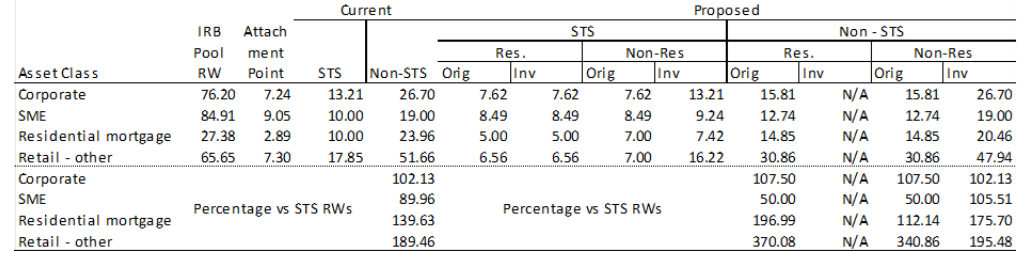
Note: All values are expressed in percentage. The risk parameters for the asset class are taken from Bennett et. al. (2025) for all credit type classification. The top four rows indicate the RWs for a senior tranche while the bottom four rows indicate the change in Risk Weights (RWs) when the tranche is classified from STS to Non-STS.
5.3 – Evidence on Label Cliffs
The above subsections document the very substantial gaps in capital charges for securitisations that European regulators designate to be high-quality relative to those not designated as high-quality. While we do not intend to calibrate these capital charges here (which would require a detailed study)[28], one may wish to understand whether there is clear empirical evidence for the capital charge discontinuities or label cliffs.
A simple exercise that sheds light on this question consists of computing the relative risk of STS and non-STS labels as shown by the relative return volatilities of traditional securitisations. Such an exercise to some extent mimics the calibrations that we believe insurance regulators implemented when Solvency II was initially designed (although no calibration results were published at the time).
We collected European securitisation deal information from Bloomberg for transactions issued on or after 1 January 2019 (the date at which securitisation transactions became eligible to receive STS status). The dataset is restricted to floating rate, Residential Mortgage-Backed Securitisation (RMBS) instruments for which (i) the country of risk is one of the EU 27 countries, (ii) the securities are rated, and (iii) price data are available. We focus on RMBS because other asset classes are either all non- STS (e.g., Collateralised Loan Obligations (CLOs) and Commercial Mortgage-Backed Securities (CMBS)) or overwhelmingly STS (at least in the sample we study) (e.g., non-mortgage, consumer loan-backed securities).
Using daily price data for the selected instruments from 1st January 2025 to 1st January 2026, to estimate annual price volatility, we estimate annualised return volatility through an overlapping window approach.[29] This approach can be used to estimate annualised return volatilities for securities that trade relatively infrequently.[30]
We average the estimated annual price volatilities for six distinct cases, defined by the instruments' rating, seniority, and STS classification. Also, we construct a weekly index return series for each case by aggregating returns across all relevant instruments, assigning equal weights to each instrument. Finally, we weight the index return volatilities to obtain estimates of Risk Weights (RWs) comparable to those employed in regulatory capital rules.[31]
The results (see Table 5.3[32]). show that, at the level of individual securities, the market risk associated with STS securitisations is higher (although one could say broadly equivalent) to the market risk associated with Non-STS. Thus, STS transactions are riskier by this measure.[33]
Of course, capital should be calibrated based on the risk of diversified portfolios rather than individual instruments. This is why we compute category specific index returns and estimate their annualised volatilities. From these latter, under simplifying assumptions, one may compute annualised Unexpected Losses, i.e., capital. On this basis, Risk Weights for STS are slightly higher than those for Non-STS.
These results may appear surprising, but they are in line with the understanding of a prominent broker we consulted who suggested than non-STS EUR-denominated RMBS include legacy securities that trade frequently in a liquid market while STS are, in many cases, relatively recently issued prime mortgage-backed securities. The latter can indeed exhibit higher volatilities.
We do not present these findings with the idea of convincing readers that STS deserve higher risk weights than non-STS. But we do think it important to underline the fact that the current capital framework with its substantial cliffs from STS to non-STS is not well based in empirical evidence and as such may be viewed as questionable ‘a priori rule setting’ by regulators. A more elaborate calibration might follow the approaches developed in Risk Control (2016) and (2022) but with data that distinguishes between STS and non-STS.
| AAA | Senior | AAA - | All | AA- | All | |
|---|---|---|---|---|---|---|
| STS | Non-STS | STS | Non-STS | STS | Non-STS | |
| Average Volatility | 0.57 | 0.53 | 0.56 | 0.52 | 1.67 | 1.06 |
| Index Volatility | 0.27 | 0.17 | 0.25 | 0.17 | 0.98 | 0.43 |
| Risk Weight | 10.28 | 6.67 | 9.57 | 6.39 | 37.86 | 16.47 |
| Counts | 72 | 49 | 82 | 51 | 48 | 66 |
Note: All units are expressed in percentages except for counts. Counts indicate the numbers of securities contributing to the volatility estimates presented. The annualised return volatilities are estimated based on the daily price data obtained from Bloomberg for the duration 1 January 2025 to 1 January 2026 but using an overlapping observation approach. This approach is robust to the presence of observations in which prices do not change and corrects for the statistical bias induced by overlapping observations. Here, ‘RW’ denotes Risk Weight and indicates annualised volatilities scaled to yield (Marginal-Value-at-Risk-based) capital relative to a standard 8% level. The scaling factor is based on the inverse Gaussian cumulative distribution function evaluated at 99.9%, divided by 0.08.
6 – Cliffs in unfunded credit protection
6.1 – Cliffs at ‘origination’ and ‘ongoing’
For several decades, providing cover to banks against the risk of non-payment on defaulted assets has been a usual line of business for credit underwriters – namely non-life insurers and reinsurers. While insurance contracts have traditionally covered individual exposures – so-called “single names” – they have increasingly moved to portfolio-based cover by underwriting the non-senior portion of a tranched portfolio (securitisation).
The first credit risk transfer (CRT) transaction in the US was executed in 2013 for a securitisation of a portfolio of residential mortgages issued by the government-sponsored enterprise housing platforms. Since then, a vibrant market has developed, with more than sixty global and local insurers having participated, and more than forty currently active in the US CRT market. The first significant risk transfer (SRT) transaction in Europe was undertaken in 2018 by an Irish insurer referencing a portfolio of assets from a German bank. Since then, Ireland has become a hub for credit underwriters serving EU banks in the Non-STS segment, given that, under the 2021 Capital Markets Recovery Package (CMRP), access to the STS segment is not available to them. There are about fourteen insurers currently active in the European Non-STS segment.[34]
Insurance companies do not normally collateralise their insurance contracts. Instead, insured counterparties rely on the capital strength of the insurer and its willingness to pay upon receipt of a claim (subject to assessment). The “willingness to pay” concept does not apply in unfunded credit protection provided to European banks in respect of synthetic securitisations, as there is a legal obligation to pay upon a claim. From the bank perspective, the counterparty risk resulting from the non-collateralisation is mitigated by the fact that (i) insurance policies are senior to financial debt in case of failure of an insurance company, (ii) counterparty credit risk is translated into a capital charge as part of the usual credit risk framework in CRR, and (iii) counterparty risk is capped by internal credit limits and regulatory large exposure limits.
From the first insurance-based SRT transaction in 2018 to the end of 2024, the securitisation rules that applied to insurers to determine their capital strength were provided by the CRR, the so-called CRR2. Since 1st January 2025, different rules apply, those of the new CRR, so-called CRR3. We will use “CRR2” or “CRR3” to provide context, rather than simply “CRR”.
The CRR2 Article 249(3)[35] set the constraint that applied to eligible providers of unfunded credit protection until the end of 2024. They needed to be at least CQS 2 at the origination date of the transaction (“at the time the credit protection was first recognised”). This obligation applies to insurers, as they fall within the scope of CRR2 Article 201(1)(g)[36] which applies to “other corporate entities”. Therefore, between 2018 and 2024, the European uncollateralised or unfunded Non-STS market developed with insurers that were all robust at the origination date or closing date of the synthetic transactions they underwrote.
6.2 – Old CRR2 249(3): Insurer rating cliff creating a capital cliff for banks
However, the same CRR2 Article 249(3) contained an “ongoing” test with the potential to create major capital cliffs for banks. It required the eligible credit protection provider to maintain, on an ongoing basis, a rating of at least CQS 3. While one might argue that non-regulated entities included in CRR2 Article 201(1)(g) should post collateral upon a downgrade below CQS 3 – given the absence of prudential oversight – that argument does not hold for regulated insurers. In other words, in the CRR2, insurers were inadvertently captured by rules intended for “other corporate entities”.
Failing to maintain CQS 3 – for example, falling to CQS 4 – has a detrimental impact from a financial-stability perspective: the entire capital relief previously recognised, following supervisory approval of the transaction, is suddenly nullified.[37] The rating agencies rather than the supervisor controls such outcomes.
In fact, this risk persisted only until the end of 2024; it has ceased to exist since the application of the new CRR, i.e., CRR3, from January 2025. Indeed, CRR3 changed the landscape for rating-trigger cliffs on unfunded credit protections provided by EU-regulated insurers.
In CRR3, Article 201(1) was restructured to align with Basel III, under which regulated financial sector entities are not subject to rating cliffs. A new point, denoted (fa), was introduced listing “regulated financial sector entities” as eligible credit protection providers. Since January 2025, insurers have been included in this category. Consequently, CRR3 Article 249(3)[38] no longer applies to insurers, and the capital cliff that banks faced when using regulated insurers has been removed. Financial stability in the European banking sector has therefore improved.[39]
6.3 – New CRR3 249(3): Attempts to reintroduce an insurer rating cliff
Over the last six months, however, through an apparent mis-interpretation of the law and a failure to recognise this by certain authorities, we are in a situation in which some regulators are pushing for a reintroduction of the cliff effect that has just been eliminated.
To explain, until October 2025, the EBA’s interactive single rulebook website was not updated to show the modified Article 201(1) of what we refer to above as CRR3.[40] In May 2025, apparently relying on the un-updated website, ESRB published a report arguing that permitting insurers to provide uncollateralised credit protection to banks via SRT deals could generate systemic risk because of a rating cliff associated with possible insurer rating downgrades.
This was true under CRR2 but not CRR3 and ESRB’s argument appears to reflect a mis-reading of the law attributable to use of the un-updated EBA website. (Incidentally, ESRB (2025) also argues that bank reliance for credit protection on too small a group of insurers could create ‘concentration risk’, a concern that would be aggravated, not reduced, by measures restricting insurer participation.)
The industry alerted ECB to the issue of the un-updated website in October 2025 and the following month ECB issued its own opinion, without acknowledging the problem with the ESRB’s position, and arguing that the CRR3 change in Article 201(1) should be reversed, i.e., that a capital cliff be introduced (whereupon, it might be argued that ESRB’s expressed concern was correct).[41]
The Council of the European Union’s final draft amending the Commission’s text, presented in December 2025, adopted ECB’s suggestion that the capital cliff be reintroduced and amended CRR3 Article 249(3) so that it would apply to point (fa) of CRR3 Article 201(1), and thus to insurers.
This change reintroduces a robustness requirement – namely, a minimum rating of CQS 2 for credit underwriters at origination – and, regrettably for European financial stability, also reintroduces a capital cliff by imposing an ongoing requirement to maintain CQS 3. Failure to do so would cause the bank to lose SRT recognition[42] (which would affect both the existing Non-STS market and the future STS market) and would therefore reintroduce a capital cliff.
During the legislative process, an MEP has tabled an amendment, which would also apply CRR3 Article 249(3) to insurers, but only at origination as it removes the ongoing requirement – thereby delivering systemic robustness.[43]
The irony of these developments is that what appears to be either a mis-reading of the law or a failure to fully reflect the implications of an already complex legal framework has provided the impetus for decision-makers to reintroduce a source of financial instability that had already been removed. At the same time, as we argue further below, others have used the uncorrected ESRB argument on rating cliffs to argue in favour of restrictions on insurer participation in SRT activity that will make the ESRB’s other point on concentration risk more valid than would otherwise be the case.
6.4 – New CRR3 243(4)(a): New ongoing capital cliff from Resilient status
The June 2025 Securitisation Package introduces the concept of a “Resilient securitisation positions” in STS and non-STS transactions. These positions meet criteria that regulators hope will imply low model and agency risk (although no evidence has been provided) and which can, therefore, in their eyes justify lower prudential capital requirements.
There are four criteria for a traditional securitisation and an additional fifth criterion for a synthetic securitisation. When all four (or five, as applicable) criteria are met, the senior position is deemed “Resilient.” For STS transactions, some of these criteria are already embedded in the STS framework, in which case they are implicit. For Non-STS transactions, in the case of a synthetic securitisation, all five criteria are explicitly described in the new CRR3 Article 243(4)(a).
We have previously assessed these five criteria (see Bennett et al (2025)) and consider that only three are credit-relevant: (i) the minimum granularity of the pool; (ii) the conditions governing sequential amortisation of the tranches; and (iii) the minimum attachment point of the senior position. A fourth criterion differentiates senior positions held by originators and investors, restricting the notion of a “Resilient position” to originators, which should be better addressed through prudential rules. We note, in this connection, the many amendments tabled to remove this fourth criterion.[44] The fifth criterion in CRR3 Article 243(4)(a) – requiring the collateralisation of Non-STS non-senior tranches under the STS standards for on balance-sheet securitisation in SECR 26e(8), (9) and (10) – is not supported by a compelling rationale (see Bennett et. al. (2025)), and we also note several amendments aimed at removing this fifth criterion.[45]
Of relevance to this paper is the fact that the five criteria are to be assessed on an ongoing basis, requiring banks to switch their capital-requirement calculation – more likely than not based on the risk-sensitive risk-weight floor – from “Resilient” to “Non-Resilient,” and, upon regaining compliance, back to “Resilient.” This introduces unnecessary complexity and operational burdens, with little prudential benefit. We also note many amendments[46], in favour of financial stability, tabled to ensure that an assessment of the criteria is performed at origination only: this would result in the removal of a new “label cliff”, in this case the ‘Resilient’ label cliff.
6.5 – New SECR Article 26e(8)(aa): New capital cliff from STS to Non-STS
As stated in Bell et al. (2025), the insurance business model fundamentally differs from that of investors in funded (i.e., collateralised) instruments (see Bell et. al. (2025b)). As a core principle, it is predicated on accumulating a diversified portfolio of largely uncorrelated risks. Multiline, non‑life (re)insurers exemplify this diversification, as credit-insurance premia account for only a small fraction (around 2.2%, see EIOPA (2023)) of their total gross written premium (GWP). These companies actively manage concentration risk by syndicating exposures with other insurers and capital-market investors, and by reinsuring tail risk. As evidenced by the IACPM Global SRT Insurance survey,[47] insurers in syndicates hold an average position of €31M before reinsurance.
Because (re)insurers’ assets must remain free of encumbrances to meet claims, their pricing and business models do not incorporate up-front collateralisation, the latter being rendered unnecessary by the benefits of diversification and reinsurance. More generally, insurance liabilities rest on robust, regulated balance sheets supported by uncorrelated premia, obviating the need for collateral and leading such contracts to be classified as “unfunded” under banking and securitisation regulations. In this regard, the collateralisation requirement in the EU’s 2021 synthetic STS securitisation framework (as part of the CMRP) – intended to address credit‑derivative counterparty risk – is not consistent with insurers’ business models and, in effect, excludes (re)insurers from participating in synthetic STS securitisations.
With the Securitisation Package, the European Commission has taken steps to address the exclusion of (re)insurers from participating in the STS SRT market by introducing point (aa) in the Proposed SECR Article 26e(8). This new provision enables insurers and reinsurers to be eligible unfunded credit protection providers, as long as four safeguards are satisfied on an ongoing basis. This ongoing requirement generates a “label cliff,” in this case the “STS-label cliff,” under which banks would lose the prudential benefits associated with the STS status, and the transaction would revert to Non-STS status. We note that several amendments[48] have also been tabled to ensure that eligibility is assessed at origination only, which, if adopted, would enhance financial stability.
If these amendments are not adopted in the final legislation, each safeguard, assessed individually, could become a source of a “capital cliff,” the magnitude of which for the bank holding the senior position would depend on the difference between the STS and Non-STS capital calculation. At the lower end, the cliff would arise where only the STS risk-weight floor is replaced by the Non-STS risk-weight floor. At the medium end, where the attachment point of the senior position is affected via the p-factor in the underlying capital formula (whether SEC-IRBA or SEC-SA), switching from the STS to the Non-STS p-factor. The worst-case outcome would be a failure to satisfy the SRT test, in which case the capital relief granted by the supervisor at origination would be entirely voided.
Nevertheless, the four safeguards do not contribute equally to the risk of triggering a “capital-cliff” event. According to the Commission’s text, the first safeguard (i) in SECR Article 26e(8)(aa) assesses whether an insurance undertaking is sufficiently sophisticated to underwrite SRT transactions. The proxy for this is the possession of a regulatory approved full or partial internal model for the creditunderwriting line of business – a status unlikely to vary with the economic cycle. It is, however, questionable that a bank should bear the consequences of an internal operational change in the protection provider’s risk-management approach if the provider were to decide that maintaining an internal model is not cost-effective. In this regard, amendments[49] that allow reliance on the standard formula with the no-objection of the insurance supervisor to underwrite SRT after its annual supervisory (ORSA) review would both broaden participation by credit underwriters and remove an unnecessary source of risk for banks.
The second safeguard (ii) in SECR Article 26e(8)(aa) concerns the capital strength of the insurance undertaking, which must comply with prudential capital requirements under EU rules (Solvency II) and rated at least CQS 3. The Commission’s text appears to imply that this rating requirement applies both at origination and on an ongoing basis.[50] That ongoing requirement is a potential source of capital volatility via an “STS-label cliff.” Of the four safeguards, this one has the most impact, even if its absolute probability remains low. To enhance financial stability, some MEPs have tabled amendments[51] to confine the rating test to origination only.
The third safeguard (iii) in SECR Article 26e(8)(aa) concerns the diversification of business lines for non-life (re)insurers, to ensure they are not monoline providers. The Commission requires that an undertaking effectively conducts business in at least two classes of non-life insurance. The Council has proposed an amendment to quantify what “diversity” means in this context, and several MEPs have tabled similar, though not identical, amendments[52] clarifying the term “effectively.” Although insurers are incentivised by prudential regulations to be active in several business lines, creating a diversification benefit in capital requirements, changes in the structure and underwriting practices of insurers might create a cliff effect if this safeguard is an ongoing requirement.
The fourth safeguard (iv) of SECR Article 26e(8)(aa) concerns the size of the undertaking. The Commission’s use of “assets under management” for this criterion is inappropriate for non-life insurers, and all relevant amendments replace it with the correct term, “total assets.” Nevertheless, the calibration at €20bn at the level of the undertaking would exclude all currently active participants in the Non-STS market; none would be eligible to underwrite STS-labelled transactions. Accordingly, most amendments[53] – both from the Council and from MEPs – permit assessment at the level of the parent undertaking.
Assuming workable drafting that yields a sufficient pool of eligible insurers, this safeguard is unlikely to be volatile at the parent level, but more likely to be volatile at the undertaking level as total assets vary depending on the level of premia and claims every year. Such volatility is idiosyncratic and could affect smaller groups with specialized business lines, whose EU subsidiary is an active market participant. However, if the assessment of the four safeguards were performed at origination only, as envisaged by amendments to the introductory part of the new point (aa), no such capital volatility would arise, even for smaller or more specialized participants.
7 – Cliffs in funded protection collateral treatment
7.1 – SECR 26e(10): Impact at ‘origination’ STS rating cliff for originators
In on-balance-sheet (synthetic) securitisations, the CMRP introduced in 2021 a collateral-quality requirement for STS transactions that carries a potential for systemic liquidity consequences within the banking sector. This requirement is embedded in SECR Article 26e(10)(b)[54], which stipulates that cash collateral provided by investors in non-senior tranches must be held with a third-party bank rated at least CQS 3. A derogation exists, allowing the originating bank to retain the cash collateral only if it is rated at least CQS 2 – i.e., subject to a stricter eligibility threshold. Originator banks executing synthetic SRT transactions for their own balance-sheet management are not inclined to channel their investors’ cash to competitor institutions. Therefore, those banks rated at least CQS 2 typically elect to retain the collateral themselves, even if the counterparty risk is featured in the coupon paid to investors.
The adoption of the CMRP immediately created challenges for Italian banks. At the time of the CMRP, it was well understood that Italian banks’ ratings were constrained by rating-agency methodologies linking institutions’ counterparty ratings to Italy’s sovereign rating (CQS 3) through the so-called “sovereign ceiling” framework. Legislators therefore inserted into the CMRP a provision[55] enabling a Member State’s national competent authority to request a waiver from the EBA for its domestic institutions. CONSOB made such a request in November 2023, following an assessment of Italian credit institutions which showed none qualify for CQS 1 and only one bank[56] met the CQS 2 threshold. In June 2024, the EBA issued an opinion (see EBA (2024)) agreeing that objective impediments in Italy justified granting the waiver. Italy thus became the only Member State whose bank originators (and affiliates) were permitted to retain investors’ cash collateral despite being rated only CQS 3.
We reproduce here the concluding paragraph of the EBA opinion, which encapsulates the mechanism by which systemic risk may arise and explains why a waiver would support the real economy.
“Finally, as concerns the Italian synthetic securitisation market, according to data provided by the Consob (as of June 2023), the non-STS securitisations amount to €92.5bn whilst there are no STS securitisations. Based on the data, it is evident that the impediments linked to credit quality step assigned to the Member State have systematically impacted the Italian synthetic securitisation market. In this respect, it is to be noted that should the waiver be exercised, it would contribute to the development of the synthetic STS market, which has proven to be a strong vehicle for the financing of the real economy. While the outstanding transactions would not benefit given that they would need to be restructured to be STS and this would entail a higher cost that the benefit that could be achieved, the new transactions could benefit and the Italian originators would be incentivised to structure on-balance-sheet securitisations that would be STS compliant.”
It is also worth noting that, although Italian banks were confined by the CMRP to issuing only synthetic Non-STS transactions, they were nonetheless able to access the SRT market thanks to insurers operating under the same market constraint. This illustrates the stabilising role that insurers can play in the market.
Nevertheless, the EBA agreement does not have the force of Level 1 legislation and could be theoretically withdrawn at a future time by the EBA. Consequently, in the context of the current negotiations on the June 2025 Securitisation Package, CRR Amendment 143 of the European Parliament[57] should likely be interpreted as an attempt to avoid recreating for “Non-STS Resilient” transactions – via the proposed Article 243(4)(a) – the same difficulties that Italian banks previously encountered under the STS regime.
A further consideration is that the objective of the Savings and Investments Union (SIU) and, within it, the securitisation reform package, is to foster the development of capital markets across all Member States. Although securitisation activity remains concentrated in core jurisdictions, the market has recently begun to expand to a wider set of Member States, with the European Investment Fund (EIF) playing a notable pioneering role. However, many banks operating in smaller Member States do not meet the CQS 2 criterion, which in practice limits their ability to access the STS segment of the securitisation market.
Thus, regulators might consider removing the country rating cap for all the banks which are under the oversight of the Single Supervisory Mechanism, or some other mechanism to cater for the needs of smaller Member States.
7.2 – SECR 26e(10): STS rating cliff for originators – Ongoing liquidity risk
While the case of Italian banks is well known, their problems arose from the application of the criteria in SECR Article 26e(10) “at the origination date”. The EU regulatory framework has created a potentially larger problem through the application of these criteria on “an ongoing basis.” What would happen in a Eurozone-crisis-style scenario in which the sovereign ratings of several countries were downgraded to a level such that bank originators were no longer CQS 2 but CQS 3 instead? What if those countries’ large banks had issued a substantial volume of “funded STS” transactions rather than Non-STS transactions? Such originators would no longer be able to hold the cash collateral, unless their national competent authority requested a waiver, as CONSOB did ‒ a process that lasted almost three years between the recognition of the issue and the waiver granted by the EBA.
If banks did not receive a waiver another part of SECR Article 26e(10) would apply[58], and bank originators would have a limited window of nine months from the downgrade to transfer the cash collateral to third-party banks in third-party countries. In other words, this provision has the potential to worsen the liquidity position of banks that have issued “funded STS” transactions at the worst possible point in time, creating a perfect example of bank-sovereign nexus, and amplifying the crisis. Paradoxically, banks that had issued Non-STS (whether “funded” or “unfunded”) transactions would not be subject to this potential liquidity risk.
The analysis of such a scenario also highlights a key source of confusion in the current policy debate. Transactions termed “funded credit protection” do not provide funding to bank originators; rather, they provide collateral against the risk of non-payment of losses arising from defaults of assets referenced in the securitised pools. Such collateral has to be segregated and cannot be used to fund other exposures. The policy debate – and the understanding of risks and mitigants – would have been simpler had “unfunded credit protection” been described as “uncollateralised credit protection.”
8 – Conclusion
This study examines a set of capital cliffs that constitute significant differences in capital requirement for exposures that differ relatively little in risk intensity. In some cases, these represent static cliffs which may discourage some financial activities and encourage other activities in ways that do not follow clearly from underlying risk considerations. In other cases, they constitute dynamic cliffs that may lead capital to jump up suddenly as drivers change over time. The latter may have financial stability implications as they may hamper the management of capital by firms in stress periods.
We illustrated the notion of capital cliffs with a series examples. The examples are diverse, ranging from the broad issue of reliance in capital regulation on rating agency assessments, to the distinctions that regulators have increasingly introduced into the rules as an alternative to simple recalibration. We end with a series of specific but important cliff effects associated with rule changes that the European authorities are currently considering as part of the review of securitisation capital regulations.
In European regulations, we observe in many contexts examples where regulators have successfully sought to avoid cliffs through smooth transitions from one rule to another. For example, in the SME correlation adjustment based on turnover, no shock occurs when the SME moves from ‘SME’ to Large Corporate thanks to the continuous adjustment of the correlation factor. In the current and proposed rules for the Securitisation External Ratings Based approach (SEC-ERBA), the capital increases gradually as a tranche is downgraded. The same applies for insurers, where capital required for counterparty risk on unfunded protection is also gradually increasing, step-wise, in the case of downgrades.
To summarise, cliffs matter because they distort incentives, encourage regulatory arbitrage, and may amplify systemic risk during stress periods. This study focusses on cliffs affecting regulatory capital. The Appendix discusses cliffs in bank liquidity regulations. In our view, European regulators should carefully evaluate their rules for cliffs even to the extent of creating an anti-cliff working group. The working group should be tasked with identifying, monitoring and mitigating cliff effects. Industry experts should be involved and the objective should be to mitigate or remove existing cliffs deemed problematic within a reasonable time horizon. This would greatly contribute to financial stability and improve efficiency of the regulatory framework.
References
Agarwal, Swapnil and William Perraudin (2024) “Calibration of a Securitisation Capital Floor,” July. (Here)
Antoniades, A. and N. Tarashev (2014) “Securitisations: tranching concentrates uncertainty,” BIS Quarterly Review, December, (Here)
Ashcraft, Adam B. and Til Schuermann (2008a) “Understanding the Securitization of Subprime Mortgage Credit,” Federal Reserve Bank of New York Staff Reports, March, No. 318, (Here)
Ashcraft, Adam and Til Schuermann, (2008b) “The Seven Deadly Frictions of Subprime Mortgage Credit Securitization,” The Investment Professional, Fall, 2-11.
Association for Financial Markets in Europe (2024) “AFME, UK Finance and CREFC Europe response to Discussion Paper 3/23 on securitisation capital requirements published by the Prudential Regulation Authority (the “PRA”) on 31October 2023,” January. (Here)
Association for Financial Markets in Europe (2025) “Solvency II and Bank Capital Impact Analysis,” March. (Here)
Bank of England and European Central Bank (2014a) “The Impaired EU Securitisation Market: Causes, Roadblocks and How to Deal With Them,” Bank of England and European Central Bank Joint Statement, March. (Here)
Bank of England and European Central Bank (2014b) “The Case for a Better Functioning Securitisation Market in the European Union: A Discussion Paper,” Bank of England and European Central Bank Joint Publication, May. (Here)
Basel Committee on Banking Supervision (2009) “Stocktaking on the Use of Credit ratings,” Joint Forum Working Group on Risk Assessment and Capital. (Here)
Basel Committee on Banking Supervision (2013) “Revisions to the Basel Securitisation Framework,” Consultative Document, March, (also known as BCBS 236). (Here)
Basel Committee on Banking Supervision (2014) “Basel Committee on Banking Supervision Basel III Document Revisions to the securitisation framework,” December (revised July 2017), D374. (Here)
Basel Committee on Banking Supervision (2015) “Criteria for identifying simple, transparent and comparable securitisations,” July, D332. (Here)
Bell, Ian, Michael Bennett, Georges Duponcheele, Tamar Joulia-Paris and Véronique Ormezzano,
(2025a) “Strengthening Financial Stability through Insurance-based Credit Risk Transfer,” Report, May. (Available on PCS (Here) and IACPM (Here) websites).
Bell, Ian, Michael Bennett, Georges Duponcheele, Tamar Joulia-Paris, and Véronique Ormezzano
(2025b) “Insurance-based Credit Risk Transfer: a resilient risk-bearing capacity untapped in the EU,” SUERF Policy Note, no 375, SUERF, September. (Here)
Bennett, Michael, Georges Duponcheele, Fernando González Miranda, Jérémy Hermant, Véronique Ormezzano, William Perraudin and Frédéric Zana (2025) “Making the Bank Securitisation Capital Rules Work for Europe,” Risk Control, October. (Here)
Carney, Mark (2014) “Regulatory work underway and lessons learned,” 29th Annual G30 International Banking Seminar, Washington D.C., Speech.
Congressional Research Service (2014) “Credit Rating Agencies: Background and Regulatory Issues,” April 9th, (Here)
Duponcheele, Georges, Alexandre Linden, William Perraudin (2014) “How to Revive the European Securitisation Market: a Proposal for a European SSFA,” Risk Control Research Report, November. (Here)
Duponcheele, Georges, William Perraudin and Daniel Totouom-Tangho (2014) “Reducing the Reliance of Securitisation Capital on Agency Ratings,” Risk Control Research Report, February. (Here)
Duponcheele, Georges, William Perraudin, Alexandre Linden and Daniel Totouom-Tangho (2014) “Calibration of the CMA and Regulatory Capital for Securitisations,” Risk Control Research Note, April. (Here)
Duponcheele, Georges, Marc Fayemi, Jérémy Hermant, William Perraudin and Frédéric Zana (2024a) “Rethinking the Securitisation Risk Weight Floor,” Risk Control Research Report, May. (Here)
Duponcheele, Georges, Marc Fayémi, Fernando González Miranda, William Perraudin and Alessandro Tappi (2024b) “European Competitiveness and Securitisation Regulations,” Risk Control Research Report, August. (Here)
Duponcheele, Georges, Marc Fayémi, Fernando González Miranda, William Perraudin and Alessandro Tappi (2024c) “Securitisation Reform to Boost European Competitiveness,” Policy Brief, no 976, SUERF, September. (Here)
Duponcheele, Georges and William Perraudin (2022) “Impact of the SA Output Floor on the European Securitisation Market,” AFME/Risk Control Research Report 22-65a. (Here)
Duponcheele, Georges and William Perraudin (2025) “How to Calibrate Securitisation Capital Rules”, Risk Control Research Report, April. (Here)
Ediz, Tolga, Ian Michael and William Perraudin (1998) “The impact of capital requirements on U.K. bank behaviour,” Economic Policy Review, Federal Reserve Bank of New York, vol. 4(Oct), pages 15-22. (Here)
Elul, Ronel, (2011) “Securitization and Mortgage Default,” Working Paper 09-21R, Federal Reserve Bank of Philadelphia, May. (Here)
European Banking Authority (2013) “Report on the pro-cyclicality of capital requirements under the Internal Ratings Based Approach,” December. (Here)
European Banking Authority (2019) “Opinion of the European Banking Authority to the European Commission on the Regulatory Treatment of Non-Performing Exposure Securitisations,” October. (Here)
European Banking Authority (2024) “Opinion of the European Banking Authority on Consob decision to grant the permission referred to in Article 26e(10) of Regulation (EU) No 2017/2402”, EBA/Op/2024/03, June. (Here)
European Commission (2025a) “Proposal for a Regulation of the European Parliament and of the Council amending Regulation (EU) No 575/2013 on prudential requirements for credit institutions as regards requirements for securitisation exposures,” June. (Here)
European Commission (2025b) “Proposal for a Regulation of the European Parliament and of the Council amending Regulation (EU) 2017/2402 of the European Parliament and of the Council of 12 December 2017 laying down a general framework for securitisation and creating a specific framework for simple, transparent and standardised securitisation,” June. (Here)
European Commission (2025c) “Impact Assessment Report, Review of the Securitisation Framework,” Commission Staff Working Document, June. (Here)
European Commission (2025) “Proposal for a regulation of the European parliament and of the council amending Regulation (EU) No 575/2013 on prudential requirements for credit institutions as regards requirements for securitisation exposures,” June. (Here)
European Insurance and Occupational Pensions Authority (2023) “European Insurance Overview 2023,” Report. (Here)
European Securities and Markets Authority (2022) “Joint Committee advice on the review of the securitisation prudential framework - Banking,” December. (Here)
European Securities and Markets Authority (2023) “EU CLO credit ratings – risk of conflicts of interests relating to methodology changes,” December. (Here)
European Securities and Markets Authority (2026) “Single Interactive Rulebook: Article 26e Requirements concerning the credit protection agreement, the third-party verification agent and the synthetic excess spread,” website. (Here)
European Systemic Risk Board (2020) “Procyclical impact of downgrades of corporate bonds on markets and entities across the financial system,” Letter to European Commission and ESMA, October. (Here)
European Systemic Risk Board (2022) “Review of the EU Macroprudential Framework for the Banking Sector March 2022,” March. (Here)
European Systemic Risk Board (2025) “Unveiling the impact of STS on-balance-sheet securitisation on EU financial stability,” May. (Here)
Financial Services Authority (2011) “Supervisory Formula Method and Significant Risk Transfer - Finalised Guidance,” September. (Here)
Financial Stability Board (2010) “Principles for Reducing Reliance on CRA Ratings,” October. (Here)
Financial Stability Board (2021) “Policy Proposals to Enhance Money Market Fund Resilience: Final report,” 11th October. (Here)
International Association of Credit Portfolio Managers (2025) “Global SRT Insurance Survey.” (Here)
Joint Committee (2022) “Joint Committee advice on the review of the securitisation prudential framework (Banking),” Joint Committee of the European Supervisory Authorities, December. (Here)
Joint Committee (2025) “Joint Committee Report on the implementation and functioning of the Securitisation Regulation (Article 44)”, Final Report, EBA, EIOPA, ESMA, March. (Here)
Katz, Jonathan, Emanuel Salinas, and Constantinos Stephanou, 2009, “Credit Rating Agencies: No Easy Regulatory Solutions,” World Bank Crisis Response Policy Briefs, Note Number 8. (Here)
Keys, Benjamin, T. Mukherjee, A. Seru and V. Vig, (2010) “Did Securitization Lead to Lax Screening? Evidence from Subprime Loans,” The Quarterly Journal of Economics, February.
Kiesel, Rudiger, William Perraudin and Alex Taylor (2000) “Estimating Volatility for Long Holding Periods,” Risk Control Research Report 0-1a. (Here)
Perraudin, William (2013) “Agency Cost Arguments for Non-Neutrality in Securitization Capital,” Risk Control Research Note, No. 13-81a, July.
Prudential Regulatory Authority (2023) “Securitisation: capital requirements,” Discussion paper 3/23, October (Here)
Risk Control (2015) “Comment on Antoniades and Tarashev,” Risk Control Research Note 15-18a, February. (Here)
Risk Control (2016) “Solvency II Capital Calibration for Securitisations,” Risk Control Research Report, July. (Here)
Risk Control (2022) “ABS and Covered Bond Risk and Solvency II Capital Charges,” Risk Control Research Report 21-161a, March. (Here)
Rosenkranz, Robert, 2009 “Let’s Write the Rating Agencies Out of Our Law,” 2009, Wall Street Journal, January 2, p. A15.
Standard & Poor’s (2024) “Default, Transition, and Recovery: 2023 Annual Global Financial Services Default And Rating Transition Study,” S&P Global, June. (Here)
Appendix – lcr da haircut cliffs & reform rationale
This appendix explains the European Commission’s rationale for reopening the Liquidity Coverage Ratio (LCR) Delegated Act (DA) as part of the June 2025 securitisation reform package, and why avoiding cliff effects is also important as regards banks as investors, when it comes to the management of their liquidity coverage ratio and high quality liquid asset (HQLA) portfolios.
The LCR is intended to ensure that banks hold HQLAs sufficient to withstand a 30-day liquidity stress. The definition of HQLA assets in the LCR DA therefore does not merely “classify” assets; it sets a price signal for bank treasuries and market makers. It does this by categorising assets in liquidity ‘buckets’ and more importantly, by setting haircut levels. This haircut calibration generates important spillovers.
While the LCR DA is a banking requirement, it materially influences the broader investor base by affecting banks’ willingness to act as buyers and market makers for senior securitisation tranches, and therefore the secondary market liquidity as perceived by the investors. Non‑life insurers, in particular, value traditional securitisation only if it can be monetised under “contingent liquidity” needs, i.e., rapid asset sales to fund large and unexpected claim payments (notably following natural catastrophes).
If LCR haircuts and HQLA categorisation remain overly conservative, banks’ balance‑sheet economics discourage them from providing secondary-market liquidity, weakening insurers’ ability to exit positions in stress. This reduces insurers’ ex‑ante appetite to invest in traditional securitisation at scale. Other types of institutional investors also see secondary market liquidity as essential to engage in a given asset class, as they need to rebalance their portfolios, or absorb drawdowns at any time, avoiding “fire sales” that would be detrimental to their end clients.
Therefore, LCR eligibility functions as a key liquidity signal for the entire market, not just for banks: instruments that are readily saleable to banks in stress tend to exhibit stronger liquidity and more resilient pricing. (This has a virtuous circle effect on primary market and on lending costs to the economy.)
The Commission’s rationale for reopening the LCR DA (as part of the June 2025 package) is that the current calibration contains “inconsistencies” and fails to deliver the stated goal of diversified liquidity buffers. The empirical symptom is striking: despite being theoretically eligible as HQLA, securitisations represent well below 1% of EU banks’ HQLA portfolios (HQLA around €5.6 trillion), levels consistent with structural disincentives rather than neutral prudential calibration.
The structural issues find their origin in a post-GFC context, when securitisation was seen as an instrument to punish rather than to foster for the European economy. While building a tighter framework (some parts of which were necessary), it overshot into excessive prudential penalties and operational burdens that were calibrated on practices “no longer relevant,” leaving securitisation subscale and unable to play its intended role in risk sharing and financing EU priorities.
For example, the 13th July 2018 revision to the LCR Delegated Regulation (applicable from 30th April 2020) did not elevate senior STS securitisations into higher HQLA tiers; instead, it entrenched securitisation in Level 2B with 25%/35% haircuts and, crucially, excluded Non-STS securitisations from LCR eligibility. This created a binary “eligibility cliff”. Newly labelled ‘STS’ traditional securitisation was expected to be an “upside” (a carrot) for the market, but the LCR DA redesign effectively turned the existence of the label into a “downside” (a stick) by removing Non-STS senior tranches from the treasury toolbox and by keeping STS tranches in a punitive category.
A further historical complication was the interaction between the DA’s securitisation-specific rating requirements and subsequent changes to credit quality step (CQS) granularity. The securitisation mapping was not updated coherently, leading to an unintended tightening in practice (a de facto “AAA-only” effect in some interpretations, which is particularly damaging in jurisdictions where ratings are constrained by sovereign ceilings).
The 2018/2020 framework also maintained a five-year maturity cap for LCR eligibility. This is a uniquely restrictive feature (not applied in the same way to other HQLAs) that affects RMBS especially: forcing notes to be callable within five years reduces the appeal of securitisation as matched funding for longer-dated mortgages, by significantly increasing flowback risk (as explained by ECB/ESRB), and thereby constraining issuance volumes and market depth. In short, supervisors worry about the potential materialisation of a flow back risk that the regulators themselves have created…
Making a side step, it is interesting to compare these regulatory positions with the way the ECB, on the monetary side, uses ABS in its collateral operations with banks, in their day-to-day real life liquidity management processes. This is often achieved through retained issuance, for which the CRR securitisation rules do not apply. This is because ECB haircuts on high-quality ABS have been materially lower than LCR haircuts (with ECB haircuts peaking around the sovereign crisis and falling to low single digits thereafter).
Such issues are not found in other instruments such as covered bonds, and there is no empirical reason to punish securitisation. While securitisation liquidity comparisons based on early-2010s data overstate covered bond advantages (which benefitted from strong central bank support), later evidence (including stress episodes) suggests senior ABS liquidity can be comparable to, and at times stronger than, covered bonds, undermining the case for systematically higher LCR haircuts (see Risk Control (2022)).
On 17 June 2025, alongside the draft amendments to SECR and CRR, the European Commission published draft targeted amendments to the LCR Delegated Regulation (EU) 2015/61. The draft explicitly frames the reform as a targeted recalibration of eligibility criteria and haircuts for traditional senior STS tranches. There are four key changes:
A. Broader rating eligibility (CQS) to reduce cliff effects and sovereign-cap constraints: the Commission proposes to restore eligibility for ratings CQS1 to CQS4 (broadly AAA down to AA-), reversing the post‑2022 outcome where the mapping change effectively restricted eligibility to AAA. It also proposes to extend eligibility further to CQS5-CQS7 (A+ to A-) to mitigate downgrade cliff effects and help address sovereign-cap limitations that can constrain eligible issuance in some Member States.
B. Removal of the EU-only 5‑year remaining WAL constraint: the Commission proposes to remove the EU-specific condition that eligible securitisations must have a remaining weighted average life (WAL) of less than 5 years, stating this constraint has no Basel equivalent and has limited relevance for longer-dated securitisations (e.g., RMBS).
C. Align underlying-exposure “homogeneity” requirements with SECR: the Commission proposes to streamline cumulative requirements by aligning the LCR homogeneity condition to the STS homogeneity requirements in SECR (Articles 20(8) and 24(15)), rather than layering separate LCR-specific criteria on top of SECR/RTS.
D. New haircut “staggering”, including a preferential bucket for “resilient” securitisations: the draft introduces a clearer haircut schedule inside Level 2B:
1. 15% haircut for “resilient” securitisations (subject to conditions), which applies where, a) the rating is CQS1-CQS4, b) the position meets CRR Article 243(3) “resilient” requirements, and c) the tranche issue size is at least EUR 250m.
2. 25% haircut for eligible STS traditional senior securitisations rated CQS1-CQS4 (general case).
3. 50% haircut for newly eligible STS traditional senior securitisations rated CQS5-CQS7. In addition, the Commission proposes to remove the EU-specific 35% haircut (previously applied to certain collateral types), aligning instead to a 25% minimum consistent with Basel for the core eligible set.
To summarise, the Commission’s proposal does reduce “haircut cliffs”, i.e., abrupt step-changes in eligibility or haircuts that can trigger disproportionate economic effects (especially around rating downgrades and category boundaries). Nevertheless, to have its intended effect, the absolute value of the haircut will matter, and those remain too high relative to covered bonds or to other high-quality assets. Also definitional choices, in particular what “resilient” means under CRR Article 243(3) may not capture meaningful market share to have an impact. But to opine on this, one must wait for the end of the Trilogue on the Securitisation Package, for the final Delegated Act to be adjusted and submitted to co-legislators.
Notes
[1] Michael Bennett is Chief Underwriting Officer at the Mortgage Division of Arch Insurance (EU) dac; Dr. Georges Duponcheele is a Senior Credit Portfolio Manager at Great Lakes Insurance SE (part of Munich RE); Tamar Joulia-Paris is Senior Advisor at the International Association of Credit Portfolio Managers (IACPM); Véronique Ormezzano is Director of VYGE Consulting; Dr. William Perraudin is the Managing Director of Risk Control Limited. All authors can be contacted via LinkedIn. The views expressed are the authors’ own and not necessarily those of their firms.
[2] The authors thank for their comments and assistance Swapnil Agarwal, Raffaela Baechler, Alexander Batchvarov, Jennifer Bearden, Patrick Cogan, Ralf Fischer zu Cramburg, Michael Heckl, Jérémy Hermant, Alexandre Linden, Sara Millard, Stephan Tilke and Ansgar West for their support, their contribution, their numerous and helpful comments. The views expressed are the authors’ own and not necessarily those of their firms nor of those with whom the authors had discussions or their firms. Any errors remain the authors’ own.
[3] The Securitisation Package is made up of proposed changes to the Capital Requirements Regulation (CRR), the Securitisation Regulation (SECR), the Liquidity Coverage Ratio (LCR) Delegated Act, and the Solvency II Delegated Act. It is a holistic review aimed at addressing both supply and demand issues. In this paper, we address issues pertaining to CRR and SECR (and LCR DA in the Appendix), as they relate to banks’ prudential regime.
[4] We use the term “Basel” when referring to the Basel Committee on Banking Supervision (BCBS).
[5] Even before Basel II, the dynamics of loan losses and provisioning could affect the buffer between actual capital and the regulatory minimum, as discussed and examined empirically by Ediz, Michael and Perraudin (1998).
[6] The FRTB includes in its Internal Models Approach (IMA) a requirement on individual trading desks to monitor and report both their hypothetical P&L (HPL), produced by revaluing positions using daily mark-to- market, and their Risk Theoretical P&L (RTPL). Desks may be obliged to switch from IMA to more conservative Standardised Approaches if HPL and RTPL measures appear misaligned.
[7] It is interesting to note that in its Notice of Proposed Regulation on the finalisation of Basel III, the US agencies provide for broad supervisory powers to “unplug” this mechanism when circumstances require. (Source: “Statements on Bank Capital Proposals by Vice Chair for Supervision Michelle W. Bowman”, Federal Reserve, March 19th, 2026). This same NPR also reduces the cliff effect linked to the G-SIB buffer by making its annual adjustment translate into 10bps steps, instead of the current 50bps, which represents an abrupt increase in capital requirement.
[8] See Congressional Research Service (2014) for a contemporary account of post-GFC regulatory concerns.
[9] They continue: “Note that 86% of the downgraded tranches were originally rated Baa2 or worse, which meant that the notional amount downgraded was only about $9 billion. However, the ratings action affected just under
[50] percent of 2006 first-lien deals and almost two-thirds of 2005 second-lien deals, and the mean downgrade severity was 3.2 notches.”
[10] They record that: “The details of Moody’s actions in this are as follows. In 2009, the agency included a 30% stress on the PDs of all pool assets included in CLOs it was rating. This was announced in a February 2009 press release (see Moody’s (2009a) page 1). This was then also included in the updated criteria paper that was published in August 2009 (see Moody’s (2009b), page 5, section 2.2.1.4). In 2011, the agency removed the stresses. Initially, this was proposed in their Request for Comment (RFC) from March 2011 (see Moody’s (2011a) pages 1 and 2 – also in the associated press release). The finalised new criteria were published in June
[2011] (see Moody’s (2011b) with no mention of the stress anymore.”
[11] The SFA formula could be found in the Duponcheele, Linden and Perraudin (2014) study.
[12] BCBS (2014): “One of the major shortcomings of the SFA identified by the Committee is the sharp cliff effects in marginal capital charges. This is driven in part due to the lack of an adequate incorporation of maturity. Under the SFA, the maturity of assets in the underlying pool is only partially considered – through KIRB – when calculating capital requirements.”
[13] EBA (2019): “Hence, the potential for cliff effects as referred to above is a significant concern, namely for the mezzanine tranches.” “[...] the (p) factor, a capital surcharge on the tranches relative to the underlying pool’s capital intended to produce a higher capital charge for an investment in the securitisation tranches than a direct investment in the underlying. [...]” “[...] the capital floors, by virtue of which the lowest risk weight that may be assigned to the senior securitisation tranche may not be less than 15% [...]” “[...] the disproportionate impact of the framework’s non-neutrality (p) correction factor when applied on the grossed-up capital requirements derived from the SEC-SA and the SEC-IRBA [...]”
[14] This concern is raised by Antoniades and Tarashev (2014) although Risk Control (2015) provides counter- arguments.
[15] AFME (2024): “[...] the CRR3.1 output floor has a disproportionate impact on securitisations, compared with its impact on non-securitised exposures, [...]”. “The significant increases in capital (for no underlying change in fact pattern) flowing from the output floor de-link the prudential treatment of securitisations from their inherent risks and appear disproportionate to any prudential benefits achieved.”
[16] Bank of England (2023): “[...] the p-factor in the SEC-SA also serves to mitigate cliff effects. The PRA would not want to unduly exacerbate cliff effects by reducing the p-factor. [...]”
[17] AFME (2025) states: “the concerns flagged by the EBA in its report, dated 12/12/22, The Joint Committee Advice on the Review of the Securitisation Prudential Framework (Banking) in relation to “cliff effects” arising from “p” are relevant when applied in the real world to securitisations executed and held by banks.”
[18] The attachment point is 1.1 times the modified KIRB which is the minimum attachment point required for the senior tranche to be a resilient position in the proposed framework (see European Commission (2025)). Here, the modified KIRB is the sum of the expected losses times the weighted average life of the initial securitised portfolio and unexpected losses. KIRB×0.8×1.2 KIRB
[20] The 2012 BCBS calibration was based on US securitisation market and not reflecting EU performance.
[21] This has been the motto, but it was never really achieved. The rule remained the same for STS and became worse for Non-STS.
[22] A joint Bank of England-European Central Bank paper published in May 2014: “Potential impediments to [the revival of activity in public securitisation markets in Europe include] […] structural factors, such as regulatory treatment of securitisation […].” (BoE and ECB, 2014b). In October 2014, Mark Carney, Governor of the BoE, said “As the Bank of England [and] the ECB have argued, there is a strong case for differentiating between securitisations that are simple, transparent and consistent, and those that are not. The regulatory treatment of those securitisations should reflect their lower risk profile” (Carney (2014)).
[23] See BCBS (2015) D332.
[24] STS is much more prescriptive tan STC; most STC rules apply in the EU to Non-STS as well.
[25] As explained in Duponcheele and Perraudin (2025), they were the results of a patchwork of different methodologies and calibrations using different time horizons and different definitions of what a high-quality securitisation might be.
[26] The regulatory categories of CQS 1, 2, 3 and 4 may be mapped to (i) strictly higher than A+/A1, (ii) A+/A1 to A-/A3, (iii) BBB+/Baa1 to BBB-/Baa3, and (iv) BB+/Ba1 to BB-/Ba3.
[27] There are exceptions such as the cases in which UK securitisations lost STS status when Brexit occurred.
[28] Calibrations of Solvency II capital charges based on securitisation returns data were performed by Risk Control (2016) and (2022).
[29] We adjust for autocorrelation bias using the technique described in Kiesel, Perraudin and Taylor (2003).
[30] This results in some observations in which prices remain unchanged from the previous day biasing volatilities measures and others in which day to day price changes implicitly reflect information that has accumulated over multiple days. The approach taken here is to estimate volatility using multi-day price changes with overlapping periods and then to adjust for the statistical bias that is introduced by using overlapping observations.
[31] Under the assumption of Gaussian returns, Value-at-Risk-based capital equals volatility multiplied by the inverse, Gaussian Cumulative Distribution Function (CDF) evaluated at a confidence level (0.999 in the case of Basel). Multiplying by 12.5 converts capital to RWs (i.e., capital relative to the conventional level of 1/12.5=0.08). While on may object to the assumption of Gaussian returns over a daily horizon, over longer periods (such as here, a 1-year horizon), returns are much closer to Gaussianity.
[32] In this context, instruments designated as CLOs are excluded from the analysis.
[33] The data employed is based on all rated securitisations for which price data are available on Bloomberg excluding CLOs.
[34] See IACPM (2025).
[35] CRR2 Article 249 (Recognition of credit risk mitigation for securitisation positions). Point (3) states: “[…] the eligible providers of unfunded credit protection listed in point (g) of Article 201(1), shall have been assigned a credit assessment by a recognised ECAI which was credit quality step 2 or above at the time the credit protection was first recognised and is currently credit quality step 3 or above.”
[36] CRR2 Article 201(1)(g): “other corporate entities, including parent undertakings, subsidiaries and affiliated corporate entities of the institution, where either of the following conditions is met: (i) those other corporate entities have a credit assessment by an ECAI (ii) in the case of institutions calculating risk-weighted exposure amounts and expected loss amounts under the IRB Approach, those other corporate entities do not have a credit assessment by a recognised ECAI and are internally rated by the institution”
[37] Unless collateral is posted. But this would defeat the purpose of unfunded credit protection, and create liquidity constraints at the worst possible point in time.
[38] This improvement is not confined to securitisation; other sections of CRR3 have also removed rating cliffs that previously applied to regulated insurers. CRR3 Article 201(1)(g) states: “where the credit protection is not provided to a securitisation exposure, other undertakings, that have a credit assessment by a nominated ECAI, including parent undertakings, subsidiaries or affiliated entities of the obligor where a direct exposure to those parent undertakings, subsidiaries or affiliated entities has a lower risk weight than the exposure to the obligor;” Point (g) was modified towards the end of the legislative process for CRR3, in which it was decided that non- regulated entities (i.e., those not in (fa)) would not be able to provide unfunded credit protection to securitisation positions. At that point CRR3 Article 249(3) that applies to securitisation positions became moot and should have been removed from the text altogether.
[39] For example, CRR2 Article 202 has been repealed entirely in CRR3.
[40] Dated screenshots of the website demonstrate this.
[41] In our previous papers, we highlighted that the ESRB was warning against a non-existent cliff effect. Nevertheless, the ECB’s November 2025 Opinion on the Securitisation Package considered the possibility of revisiting CRR3 Article 249(3), suggesting that it should apply to regulated financial sector entities – a step that, if it re-imposed an ongoing eligibility rating, would recreate a cliff.
[42] Unless the bank has proactively replaced the downgraded insurer by another CQS 2 insurer. However, there is no grace period (such as the 9-month period for the collateral quality criterion of SECR 26e(10)) to implement such a change in a controlled manner.
[43] CRR amendment 185 tabled by Markus Ferber MEP that proposes to replace the existing subparagraph 1 of CRR3 Article 249 (3) by the sentence “By way of derogation from paragraph 2 of this Article, the eligible providers of unfunded credit protection listed in point (fa) of Article 201(1), shall have been assigned a credit assessment by a recognised ECAI which was credit quality step 2 or above at the time the credit protection was first recognised.” The part of the sentence requiring the ongoing test (reintroduction of the cliff) is no longer present in this amendment.
[44] Amendments supportive of extending the criterion to entities other than originators – namely the deletion of proposed CRR3 Article 243(4)(a)(5) – have been tabled by the following MEPs: #17 (Ralf Seekatz), #149 (Gilles Boyer, Stéphanie Yon-Courtin, Billy Kelleher), #150 (Markus Ferber), #151 (Giovanni Crosetto, Mariateresa Vivaldini, Denis Nesci, Francesco Ventola, Marco Squarta).
[45] Amendments supportive of insurers’ business model – namely the deletion of proposed CRR3 Article 243(4)(a)(2) – have been tabled by following MEPs: #140 (Markus Ferber) and #141 (Regina Doherty). These amendments remove the proposed STS‑style collateralisation requirement for the existing Non‑STS market in transactions whose senior position is designated “Resilient.” A further amendment, #142 (Angelika Winzig), would achieve the same quantitative outcome, but does not address the point of principle that collateralisation is incompatible with insurers’ business model (see the section on SECR Article 26e(8)). Specifically, Amendment #142 ensures that robust insurers operating in the Non‑STS space – i.e., those meeting two of the four STS safeguards, namely high rating quality (ii) and multi‑line status (iii) – can continue to access their existing market. In this sense, Amendment #142 functions as a compromise: it attains the correct practical objective without openly challenging the misconceived demand for collateralisation of regulated insurers.
[46] Amendments supportive of financial stability propose deleting the phrase “and on an ongoing basis thereafter” from the introductory clause of CRR3 Article 243(4)(a). These amendments have been tabled by the following MEPs: #14 (Ralf Seekatz), #135 (Markus Ferber), #136 (Tomáš Kubín), #137 (Giovanni Crosetto, Mariateresa Vivaldini, Denis Nesci, Francesco Ventola, Marco Squarta), #138 (Auke Zijlstra) and #139 (Gilles Boyer, Stéphanie Yon-Courtin, Billy Kelleher). It is to be noted that amendment #135 is tabled with a justification: “Removal of ‘ongoing basis’ test in order to avoid volatility of capital requirements”. Which is exactly right.
[47] See IACPM (2025).
[48] SECR amendments supportive of financial stability propose to add explicitly that the assessment of the STS- eligibility criteria be done at origination only, and not on an ongoing basis, these amendments have been tabled by the following MEPs: #39 (Ralf Seekatz) and #231 (Billy Kelleher).
[49] SECR amendments supportive of extending the internal model requirement to insurers using the standard formula, provided that their supervisor (national competent authority) does not object have been tabled by the following MEPs: #40 (Ralf Seekatz), #233 (Regina Doherty) and #234 (Billy Kelleher). A further amendment, #232 by Lidia Pereira, removes entirely the safeguard (i) requiring an internal model, and is one of the rare amendments tabled with a justification, dixit: “The robustness of an insurer is not based on whether its finance department for the purpose of determining its regulatory own funds, uses a capital model using the full (112) or partial (113) “internal model” vs. the standard formula (excluded).”
[50] By requiring for STS a credit quality step that is lower than the CRR2 Article 249(3) is additional evidence that the European Commission knew that this article no longer applies to insurance companies under CRR3.
[51] SECR amendments supportive of financial stability by requiring the solvency and rating safeguard in 26e(8)(aa)(ii) to be assessed at origination only, and not on an ongoing basis, have been tabled by the following MEPs: #41 (Ralf Seekatz), #235 (Regina Doherty) and #236 (Billy Kelleher). In fact, this amendment is a ‘belt and brace’ situation with the amendments requiring all four safeguards to be assessed only at origination.
[52] SECR amendments supportive of defining what ‘effectively’ means in the context of STS criteria for business line diversity have been tabled by the following MEPs: #42 (Ralf Seekatz) and #237 (Regina Doherty). Interestingly, none of those amendments look at diversification at parent level (where the true diversification takes effect) but at the undertaking level (which will create an invisible barrier to entry in this market for new entrants).
[53] SECR amendments conducive to establishing a pragmatic size safeguard, enabling several STS-eligible credit protection providers among current active market participants, have been tabled by following MEPs: #43 (Ralf Seekatz), #238 (Billy Kelleher), #239 (Regina Doherty), #240 (Angela Winzig), and #242 (Auke Zijlstra, Pierre Pimpie). There are currently fourteen active market participants in the Non-STS market; our estimate is that there would be nine qualifying under #43, probably eleven or twelve under #238 and #239, probably thirteen or fourteen under #240, and only two under #242. A further amendment, #241 (Lidia Pereira), attempts to increase the number of STS-eligible insurers, but would not be workable as it uses the incorrect terminology ‘assets under management’, that is relevant for life-insurers but not for non-life insurers. Credit underwriting is only authorised as a regulatory class of business for non-life insurers. The language used in #241 (the same as the Commission’s language) would result in no active market participants being eligible.
[54] See ESMA (2026) which states: SECR 26e(10): “[…] (b) collateral in the form of cash held with a third-party credit institution with credit quality step 3 or above in line with the mapping set out in Article 136 of Regulation (EU) No 575/2013. By way of derogation from the first subparagraph of this paragraph, subject to the explicit consent in the final transaction documentation by the investor after having conducted its due diligence according to Article 5 of this Regulation, including an assessment of any relevant counterparty credit risk exposure, only the originator may have recourse to high quality collateral in the form of cash on deposit with the originator, or one of its affiliates, if the originator or one of its affiliates qualifies as a minimum for credit quality step 2 in line with the mapping set out in Article 136 of Regulation (EU) No 575/2013. […]”
[55] SECR 26e(10): “[…] The competent authorities designated pursuant to Article 29(5) may, after consulting EBA, allow collateral in the form of cash on deposit with the originator, or one of its affiliates, if the originator or one of its affiliates qualifies for credit quality step 3 provided that market difficulties, objective impediments related to the credit quality step assigned to the Member State of the institution or significant potential concentration problems in the Member State concerned due to the application of the minimum credit quality step 2 requirement referred to in the second subparagraph can be documented. […]”
[56] The subsidiary of a French group qualifying for CQS 2.
[57] Amendment 143 by MEPs Giovanni Crosetto, Mariateresa Vivaldini, Denis Nesci, Francesco Ventola, Marco Squarta, to modify new CRR 243(4)(a)(2) such that the text from the Commission “the requirements of Article 26(e)8, 9 and 10 of Regulation (EU) 2017/2402” becomes “the requirements of Article 26(e)8 and 9 of Regulation (EU) 2017/2402”. Note the Commission’s text contains a typo and 26(e)8 refers instead to 26e(8)…
[58] SECR 26e(10): “[…] Where the third-party credit institution or the originator or one of its affiliates no longer qualifies for the minimum credit quality step, the collateral shall be transferred within nine months to a third- party credit institution with credit quality step 3 or above or the collateral shall be invested in securities meeting the criteria laid down in point (a) of the first subparagraph. […]”