

A new market is emerging in securitisations by Multilateral Development Banks (MDBs). The origins of this development lie in the pioneering Room2Run synthetic securitisation by the African Development Bank in 2018 profiled by Risk Control on behalf of the Bank and the specialised debt fund Mariner which provided mezzanine protection (see Risk Control (2019)).
Key findings
- MDB securitisation is still, at present, a specialist market and MDBs need individually and collectively to publicise their issuance activities.
- The very earliest, pioneering transactions remain the most visible and talked about deals among market participants.
- Some of the most innovative recent deals are less familiar to private sector survey participants than one might expect.
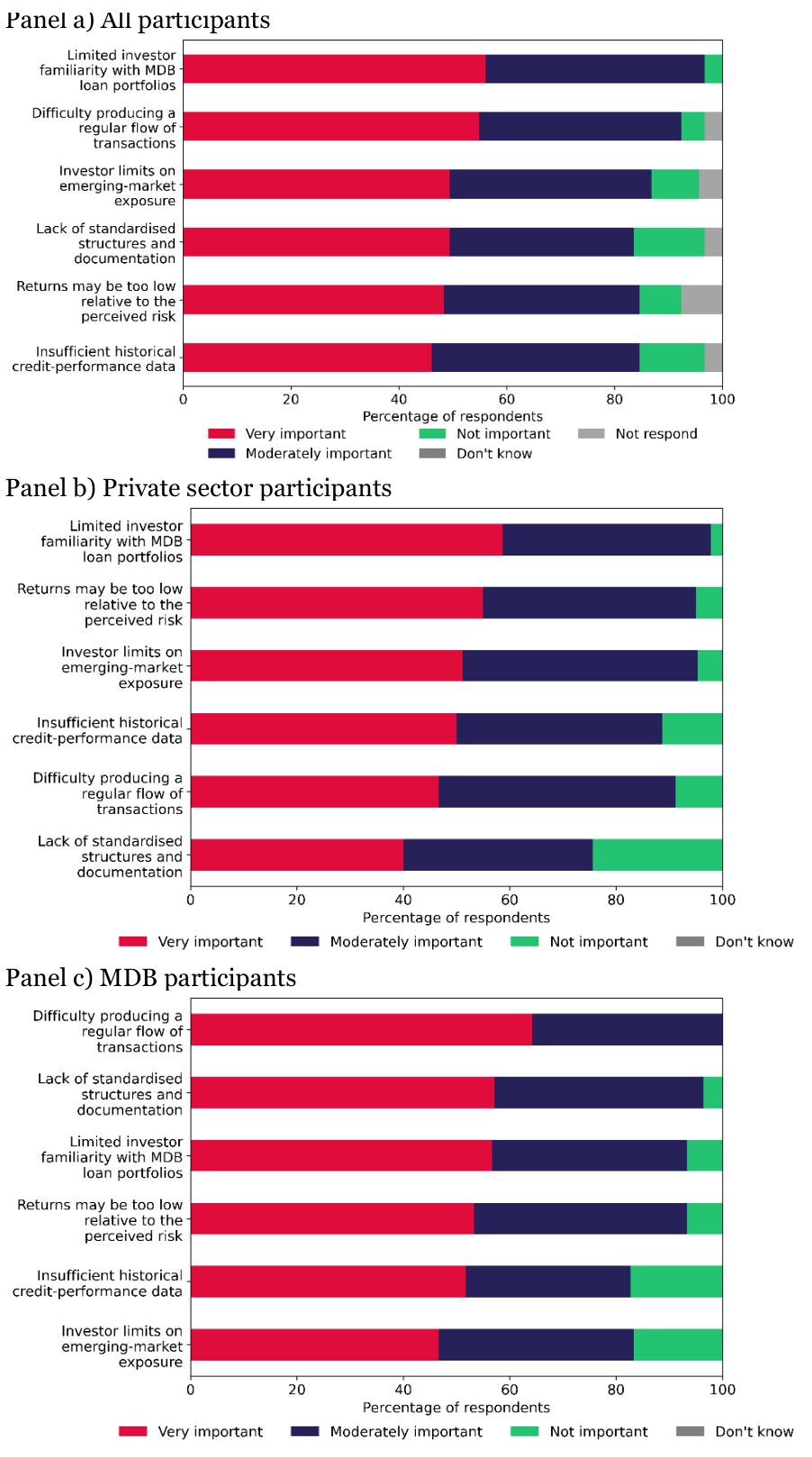
- Some obstacles that private sector participants emphasise that may impede progress are lack of investor familiarity with MDB portfolios, returns perceived to be low relative to risk, and difficulties in generating regular issuance programs.
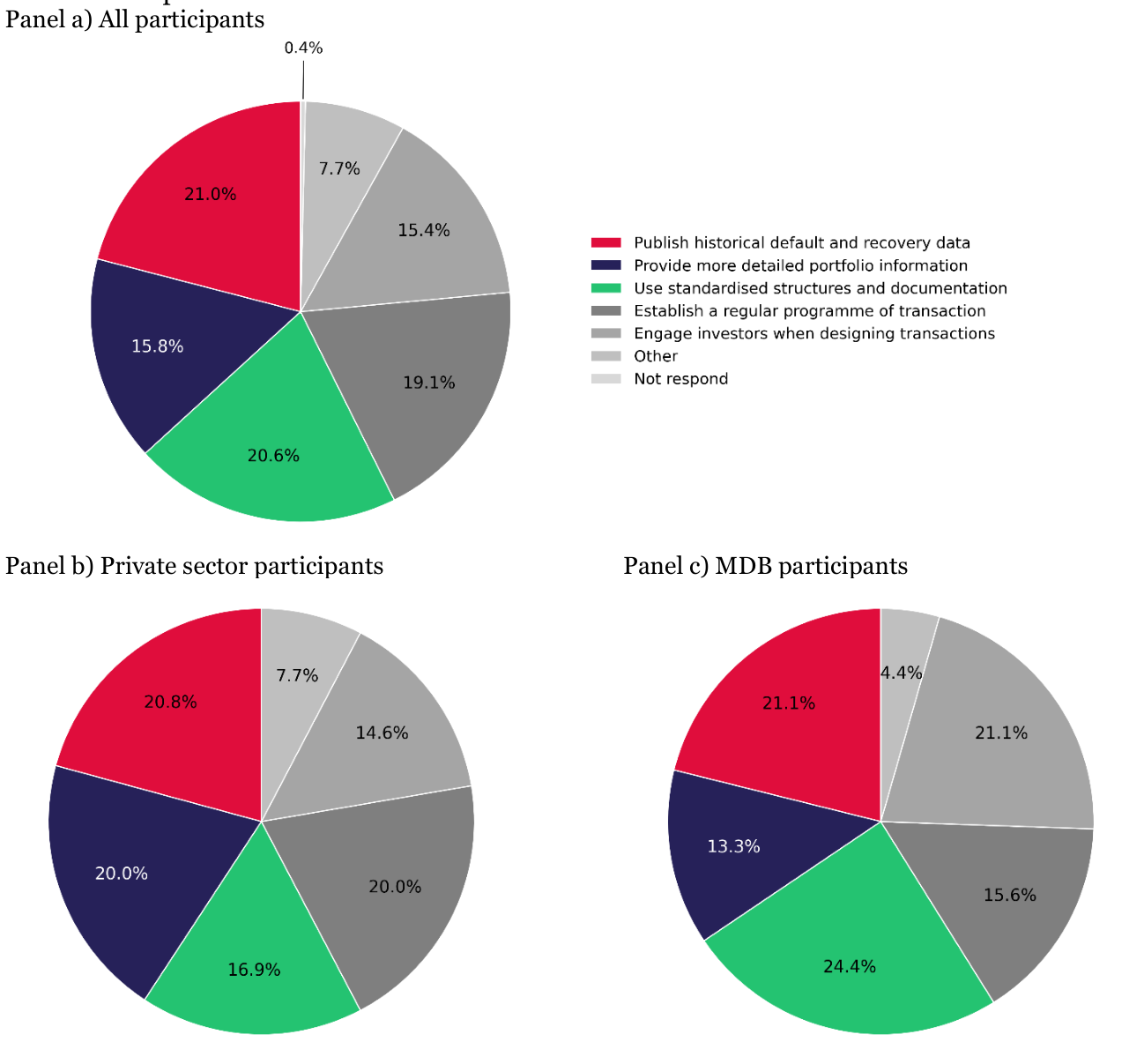
- Actions that private sector respondents recommend MDBs take to boost the market include greater disclosure of historical default and LGD disclosure, greater transparency regarding portfolios and establishing programs of regular issuance. Some MDBs regard the publication by the GEMs consortium of aggregate multilateral lender loan performance data as resolving the data needs of investors but GEMs reports are only the first step. A minimum investor data pack at the level of the individual MDB and transaction pool is the natural next step.
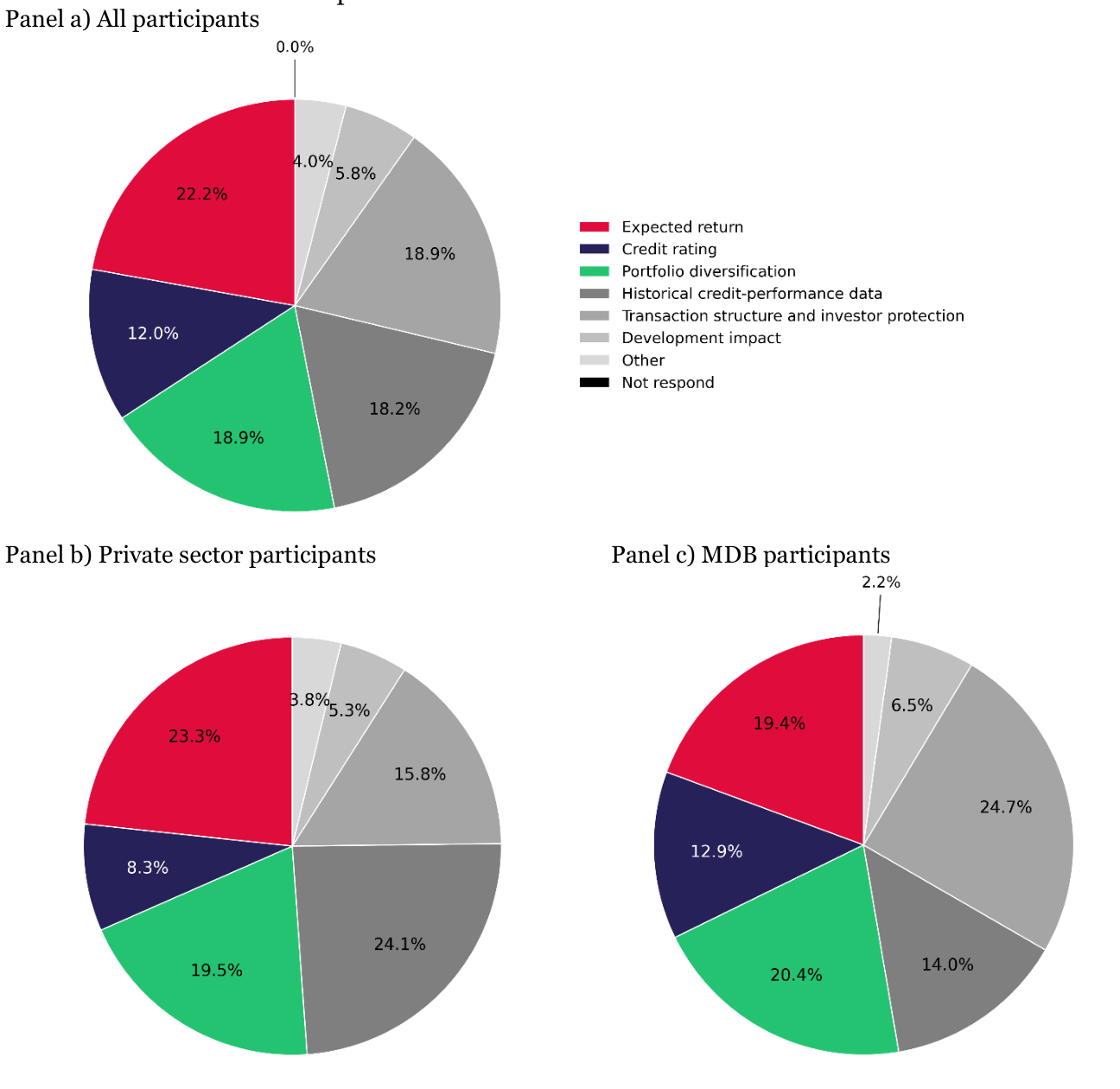
- Private sector respondents also emphasise that their willingness to participate in deals depends on expected returns, portfolio diversification and historical credit performance.
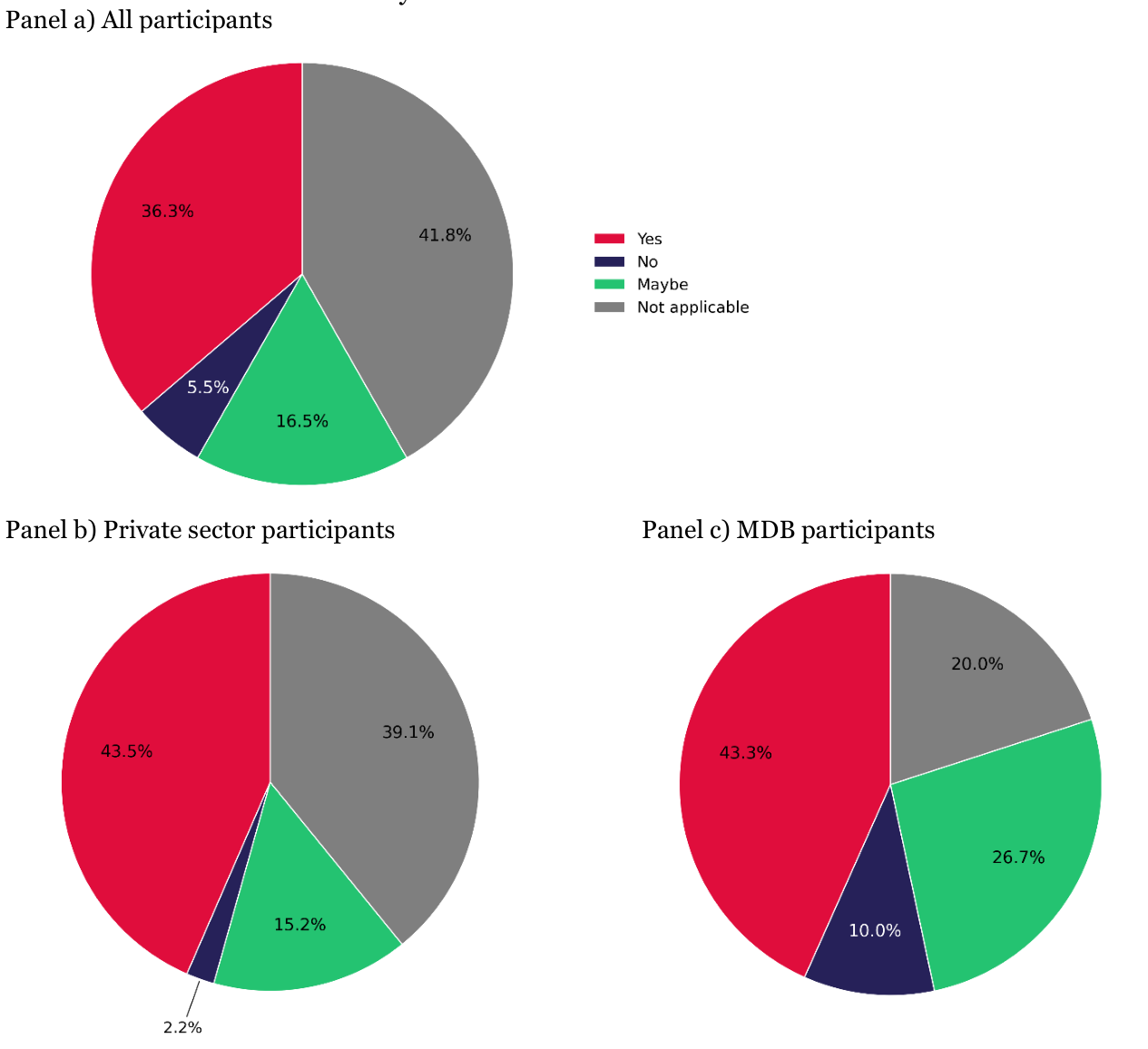
- Around 58.7% of the private sector participants questioned said that their organisations ‘were likely to’ or ‘maybe would’ participate in MDB securitisations in future (43.5% ‘likely to’ and 15.2% ‘maybe’), although respondents are likely to be drawn disproportionately from those already well-disposed towards MDB credit.
Executive Summary
A new market is emerging in securitisations by Multilateral Development Banks (MDBs). The origins of this development lie in the pioneering Room2Run synthetic securitisation by the African Development Bank in 2018 profiled by Risk Control on behalf of the Bank and the specialised debt fund Mariner which provided mezzanine protection (see Risk Control (2019)).
For innovative transactions to generate follow-on deals, they must be economically viable for all parties, be straightforward to implement and the transactions and their successful execution must be visible to other market participants. These characteristics are explored in Risk Control (2024) and (2026a) which analyse the demonstration effects that innovative financial deals can have.
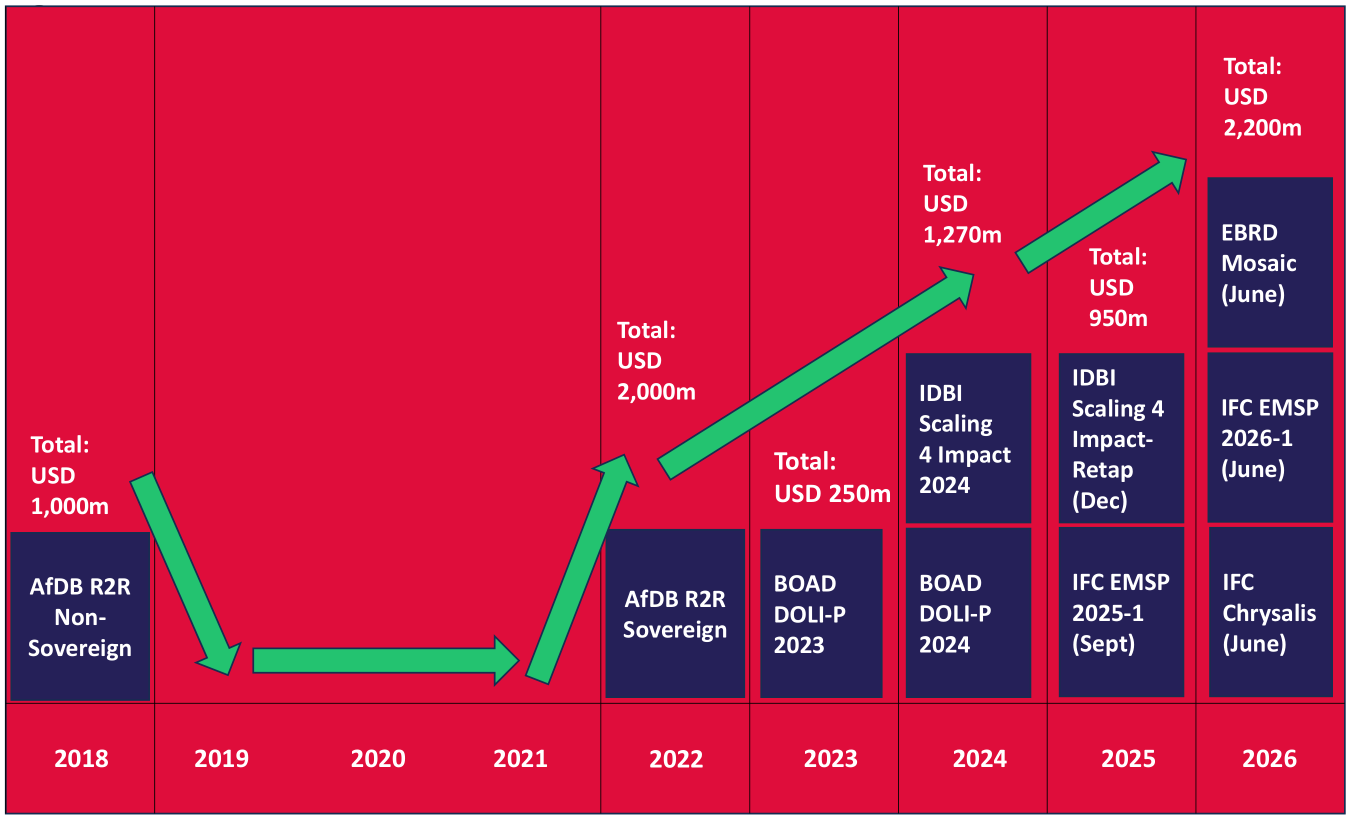
Now, the pace of development in MDB securitisation is accelerating. Figure ES1 shows the upward trajectory in deal numbers. Ten securitisations (including one retap[1]) have been completed with a face value exceeding $7.5 billion. Five MDBs have participated. The long gap between the first pioneering deal by the African Development Bank (AfDB) in 2018 and the same bank’s subsequent 2022 sovereign loan transaction has now ushered in four years of progressively increasing activity. This is likely to continue as several issuing MDBs have announced programs of transactions stretching into the future and proposals are emerging for multi-MDB securitisation platforms.
The pace of progress will nevertheless depend on the visibility of these transactions and how they are regarded by the market. This study examines market awareness of MDB securitisations and asks what obstacles to growth do market participants see? Growth could permit MDBs to realise a significant change in the development and climate-transition impact on the borrower countries they serve and so, the stakes are high. Securitisation is, in general, scalable as a source of risk capacity and financing since it permits issuers to tap deep pockets of investor interest in international capital markets, matching risk appetite and funding availability across savings institutions worldwide.
The three data sources on which this study draws are:
1. A survey of market awareness in which private sector market participants, MDB staff and others are asked to report their awareness of different transactions and their views on what factors will ensure the success of the emerging market in MDB securitisations.
2. Public statement analysis in which all available documents that mention MDB securitisations are investigated for what they reveal on market participant sentiments.
3. Interviews with market practitioners including investment firms, investment banks, insurers, ratings agencies and MDBs. Covering many aspects of MDB securitisation, including interviewees’ views on the obstacles that MDBs face, these interviews contribute to a deeper understanding of where the new market stands and what are its prospects for success.
Based on the results of these three lines of inquiry, this study’s primary conclusions are:
• MDB securitisation is still, at present, a specialist market and MDBs need individually and collectively to publicise their issuance activities.
• The very earliest, pioneering transactions remain the most visible and talked about deals among market participants.
• Some of the most innovative recent deals are less familiar to private sector survey participants than one might expect.
• Some obstacles that private sector participants emphasise that may impede progress are lack of investor familiarity with MDB portfolios, returns perceived to be low relative to risk, and difficulties in generating regular issuance programs.
• Actions that private sector respondents recommend MDBs take to boost the market include greater disclosure of historical default and LGD disclosure, greater transparency regarding portfolios and establishing programs of regular issuance. Some MDBs regard the publication by the GEMs consortium of aggregate multilateral lender loan performance data as resolving the data needs of investors but GEMs reports are only the first step. A minimum investor data pack at the level of the individual MDB and transaction pool is the natural next step.
• Private sector respondents also emphasise that their willingness to participate in deals depends on expected returns, portfolio diversification and historical credit performance.
• Around 58.7% of the private sector participants questioned said that their organisations ‘were likely to’ or ‘maybe would’ participate in MDB securitisations in future (43.5% ‘likely to’ and 15.2% ‘maybe’), although respondents are likely to be drawn disproportionately from those already well-disposed towards MDB credit.
1. Introduction
This report examines the degree to which market participants are aware of the emerging market in securitisations by Multilateral Development Banks (MDBs) and what views they have on factors that will ensure its future growth. Five MDBs have started using securitisation as a tool (a) for balance sheet optimisation and
(b) for mobilisation of private sector investment in Emerging Market and Developing Economy (EMDE) loans[2].
The background to these developments is the fact that MDBs face growing pressure to expand lending while preserving capital adequacy, maintaining strong credit ratings and limiting reliance on additional shareholder capital. Securitisation and other risk transfer mechanisms may help MDBs release capital, recycle existing exposures and increase lending headroom by transferring selected risks to private-sector investors. However, the MDB securitisation market is still at an early stage, and private investor participation has been cautious and concentrated among a relatively small group of specialised or impact-oriented institutions.
MDB-originated assets are generally regarded as high-quality exposures with strong historical credit performance. Nevertheless, MDB securitisations often differ materially from the established structures with which mainstream securitised credit investors are familiar, particularly collateralised loan obligations and other standardised private-sector risk transfer products.
MDB transactions may involve heterogeneous portfolios, preferred creditor status, bespoke legal and guarantee arrangements, concessional pricing considerations and institution-specific governance requirements. Limited transaction disclosure, infrequent issuance and weak secondary market liquidity may further complicate investor analysis, relative-value assessment and comparison with conventional market benchmarks.
As with any new market in financial instruments, the degree to which information is available to investors and potential issuers is a key factor in ensuring the volumes grow. The factors associated with the successful emergence of new markets are examined in two earlier studies, Risk Control (2024) and (2026a). Innovative transactions encourage follow on deals in which other market participants adopt similar financing approaches. If market participants are aware of MDB securitisations, the volume of such transactions is more likely to grow.
The analysis of market awareness and views of MDB securitisation presented in this paper draws on three sources of evidence:
1. A survey of market participants,
2. Public statement analysis, and
3. Stakeholder interviews.
On the survey, questions were asked of market participants approached directly or encouraged to respond through coverage in specialist publications. The survey was short and contained questions concerning respondents’ knowledge of MDB securitisation transactions so far completed, what respondents regard as obstacles to growth and whether respondents’ organisations were likely to participate in such deals?
On public statement analysis, all public domain documents that could be identified commenting on the ten MDB transactions so far completed were searched for direct quotes revealing approval/disapproval, views on success factors, and forecasts of growth. This approach resembles the sentiment analysis commonly used by asset managers and hedge funds to evaluate possible investments except that the output was not a machinelearning based approval/disapproval score but a more revealing set of actual, on-the-record public statements.
On interviews, a range of specialists with understanding of securitisation markets, MDB financing and capital needs, completed MDB securitisations, and broader experience in investor appetite for securitisation in general were contacted and interviewed. All statements were treated as confidential and anonymous which was known to interviewees in advance.
The report is organised as follows. Section 2 concisely describes the ten MDB securitisation transactions so far completed. Section 3 explains the survey questions and summarises findings. Section 4 provides sentiment analysis. Section 5 presents answers to key questions, combining the interviewee responses with the earlier analyses. Section 6 provides information on industry awards and Section 7 concludes. Supporting information is provided in appendices.
2. MDB Securitisation Transactions
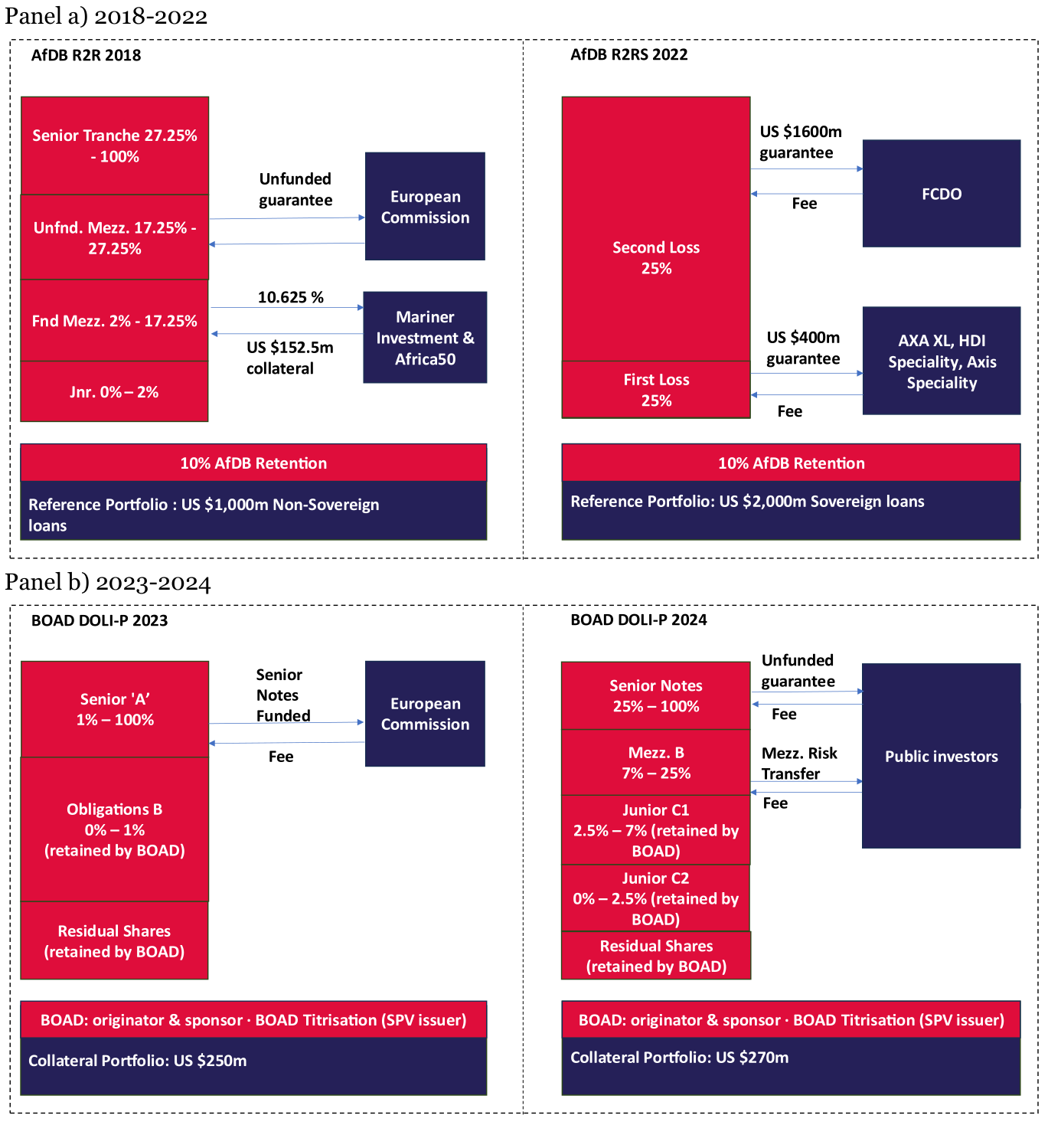
This section summarises the ten MDB securitisation transactions so far implemented. Five MDBs have done these deals which in dollar terms involve $7.5 billion of MDB loans. The ten transactions fall into two categories. Six are synthetic risk transfers, in which the underlying loans stay on the originating bank's balance sheet and credit risk on a defined reference portfolio is passed to as in AfDB’s two Room2Run transactions, IDB Invest's Scaling4Impact and its retap, EBRD's Mosaic and IFC's Chrysalis. The other four are funded note issues, in which a special purpose vehicle sells securities backed by a collateral portfolio, as in BOAD's two DOLI-P transactions and IFC's two Emerging Market Securitisation Programme (EMSP) transactions.
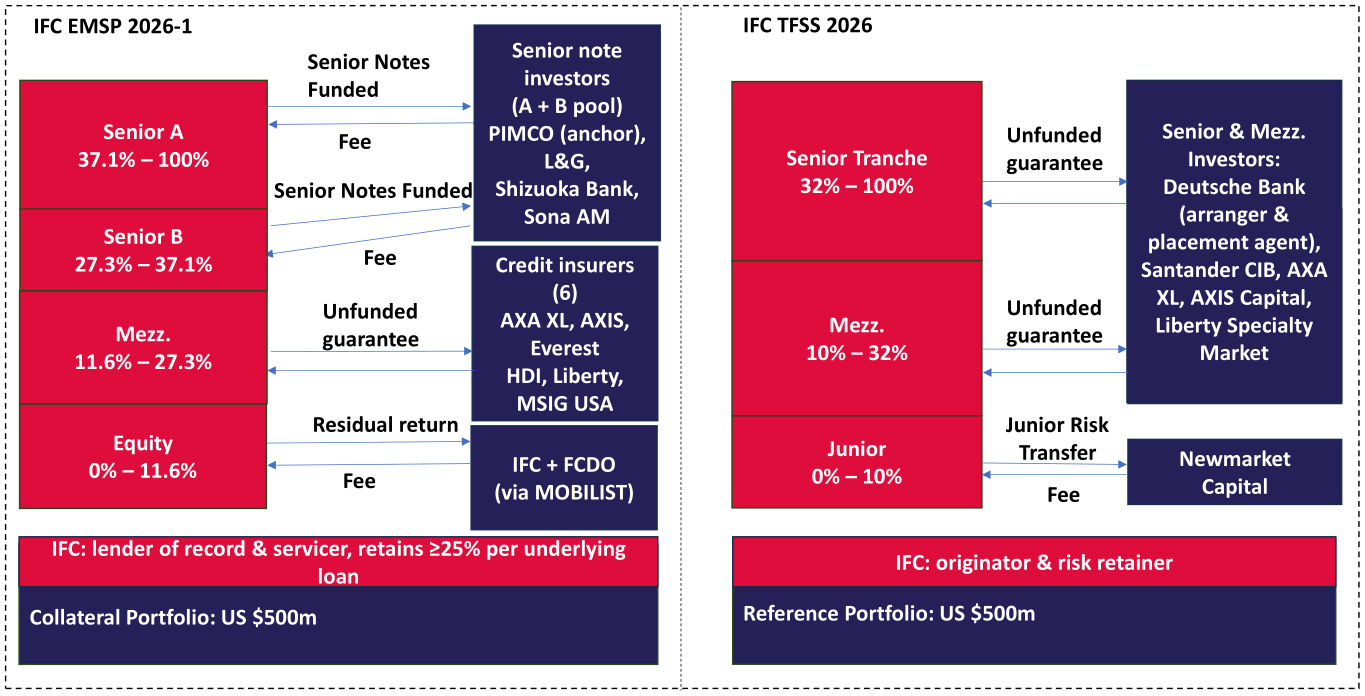
The structures are compact, carrying three or four tranches on average within a range of two to five. The typical stack pairs a thick senior tranche, which takes the last losses and accounts for most of the pool at between roughly 63% and 99%, with a thin mezzanine that carries the bulk of the transferred risk at 10% to 25%, and a first-loss or equity layer beneath it. That first-loss layer varies more than the rest of the stack, from around 2% to 3% in the AfDB, IDB Invest and EBRD synthetic deals to close to 12% in IFC's true-sale programme (see IFC (2026), Risk Control (2026b)). Portfolios are modestly sized, averaging around US$0.8 billion but with a median of only US$0.5 billion, the mean lifted by AfDB's US$2 billion sovereign programme and EBRD's €1 billion Mosaic and reduced by BOAD's US$250 million debut at the lower end.
Panel c) 2024-2025
Panel d) 2025-2026
EBRD Mosaic 2026 IFC EMSP 2025-1
Senior note Senior Notes Senior A (funded) investors Senior Tranche 37.25% – 100% (placed 16.5% – 100% privately) (retained by EBRD) SOFR +130bps coupon 3 PGGM (funded) + Mezz. Risk AXA XL + ~10 credit Mezz. Unfunded insurers Transfer AXIS + 11.76% – 37.25% guarantee (consortium) Mezz. Liberty Mutual 2% - 16.5% (insured) Fee IFC + MOBILIST First-loss equity (FCDO) Equity Junior 0% – 2% MOBILIST 0% – 11.76% Fee $25m (retained by EBRD)
≥ EBRD retains senior & junior tranches loan
Reference Portfolio: US $1,200m Collateral Portfolio: US $500m
The investor base is narrow and often consistently similar across deals, reflecting the fact that this is a market still concentrated among specialists. A small group of credit insurers recurs across almost every deal, with AXA XL and AXIS Capital each named in six of the ten transactions and Liberty and HDI appearing more than once, generally providing unfunded or insured protection on the mezzanine. Newmarket Capital, together with its Mariner predecessor, is the most frequent funded investor, taking mezzanine or junior risk in the AfDB, IDB
Invest and IFC structures, while the FCDO, through MOBILIST, has co-held the first-loss equity in IFC's programme.
37.1% – 100% L&G, Senior Tranche guarantee Investors: 32% – 100% Deutsche Bank Senior Notes Funded Shizuoka Bank, (arranger & Sona AM Senior B Fee 3 PGGM (funded) +placement agent), 27.3% – 37.1% Credit insurers Santander CIB, AXA XL +
(6) Unfunded XL, AXIS Capital,XIS + Unfunded AXA XL, AXIS, Mezz. Liberty Specialty Mezz. guarantee Everest 10% – 32% guarantee Liberty Mutual Market 11.6% – 27.3% (insured) HDI, Liberty, MSIG USA Residual return Junior Risk Equity IFC + FCDO Junior Transfer Newmarket 0% – 11.6% Fee (via MOBILIST) 0% – 10% Fee Capital
≥ IFC: originator & risk retainer loan
Reference Portfolio: US $500m Collateral Portfolio: US $500m
Broader institutional names appear only from 2025, with PGGM anchoring EBRD's mezzanine and PIMCO, Legal & General and others taking IFC's senior notes, an early sign that participation may be widening beyond the specialist core. Retention by the originating banks is correspondingly high. In the synthetic deals the MDB keeps both ends of the stack, holding the senior tranche and the first-loss piece and transferring only the mezzanine, so that IDB Invest and EBRD each placed no more than about 10% to 15% of their portfolios with private investors. IFC retains at least 25% of every underlying loan as lender of record to preserve its preferred creditor treatment, and AfDB held no vertical slice of the Room2Run portfolios, instead retaining the senior and first-loss tranches. Because the mezzanine thickness effectively sets the private capital mobilised, the external funding raised per transaction has so far remained limited.
3. Survey Results
Risk Control launched a survey of Market Awareness of MDB Securitisations in July 2026. The survey was hosted on Survey Monkey and posed a series of 6 substantive questions (see Appendix A1.3 questions 4 to 9) to market participants including investors, insurers, investment bankers, academics and staff from rating agencies, MDBs, bilateral DFIs, governments. The results are presented in a series of charts below.
In each case, responses are shown from (i) ‘All participants’, (ii) ‘Private sector participants’ and (iii) ‘MDBs’. Here, (ii) and (iii) are distinguished to identify relatively homogeneous groups and the union of (ii) and (iii) is not the same as (i). The questions posed are listed in Appendix 1, Subsection A1.3.
The survey included 91 respondents from 64 institutions. Of these, 46 are classified as private-sector participants, 30 are from MDBs, while the remaining 15 are drawn from other sectors (academic, non-MDB public sector and Non-Governmental Organisations). A finer segmentation by role (for example, existing MDB securitisation investors, mainstream CLO and ABS investors, emerging market debt investors, insurers and banks, and advisers) would be informative but is not feasible with a sample of 46 private-sector respondents; it would be a natural extension of future surveys.
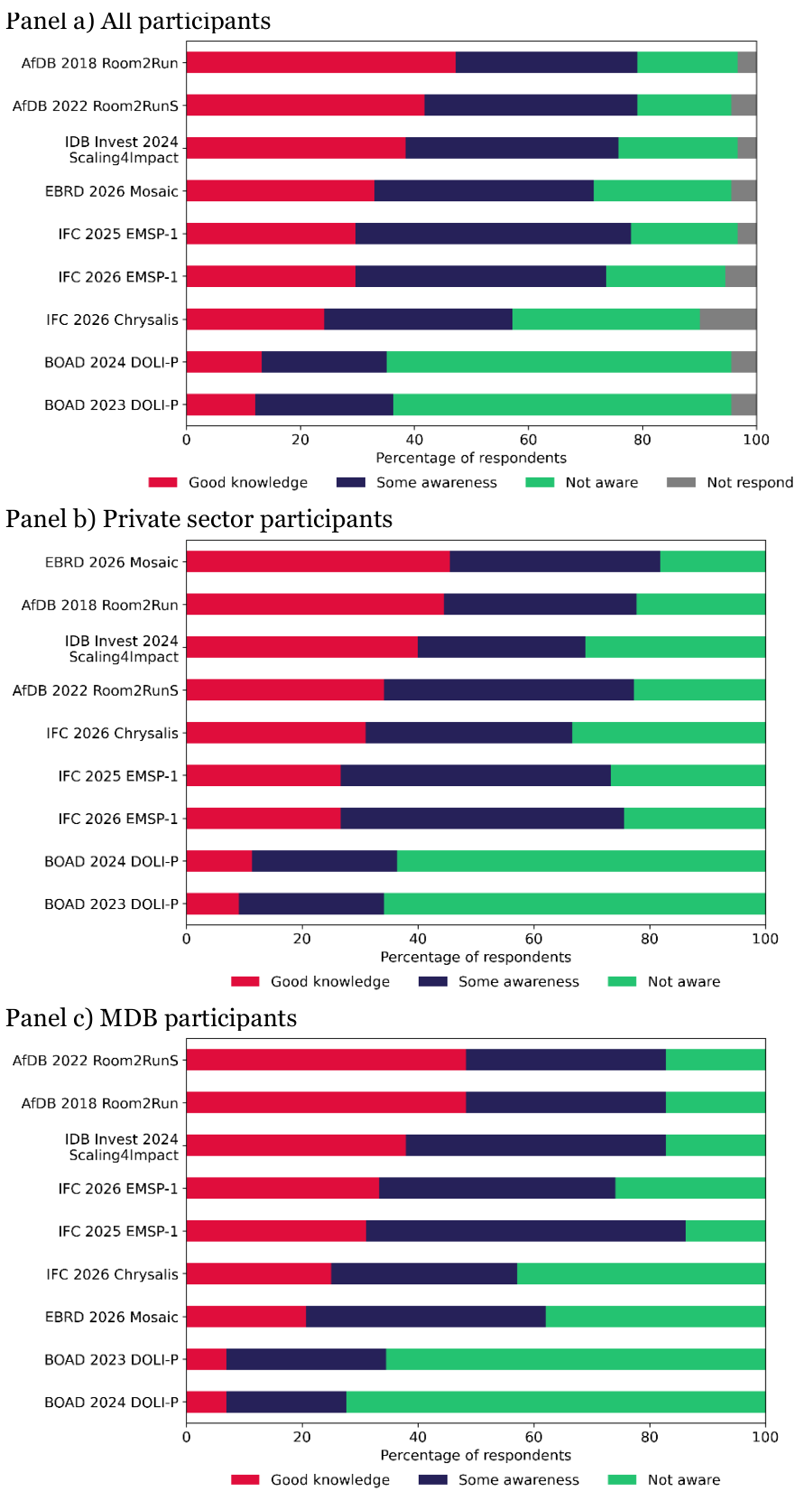
Question 1 asks: “Have you heard of any of the following transactions?” listing the ten deals shown in
Figure 3.1. Figure 3.1 shows that awareness of MDB securitisation transactions varies substantially across deals and respondent groups. Across all participants, the AfDB Room2Run transactions are the best known, with a relatively high proportion of respondents reporting good knowledge or some awareness. IDB Invest’s
Scaling4Impact is also comparatively well recognised. Awareness is lower for the more recent IFC and EBRD transactions (in part perhaps because they are recent), while BOAD’s DOLI-P transactions are the least familiar, with most respondents indicating that they are not aware of them.
The breakdown by respondent type reveals some differences. Private-sector participants display relatively strong awareness of AfDB’s Room2Run, IDB Invest’s Scaling4Impact and EBRD’s Mosaic, while familiarity with the BOAD transactions remains limited. Among MDB participants, awareness is particularly strong for the two AfDB transactions and Scaling4Impact. The IFC transactions receive more mixed levels of recognition, whereas awareness of both DOLI-P transactions is again comparatively low. Overall, the results suggest that market awareness remains concentrated around a relatively small number of prominent MDB securitisation transactions, with newer or more regionally focused transactions having achieved less visibility.
Question 2 asks: How important are the following obstacles to the development of MDB securitisation? Private sector participants emphasised lack of familiarity with MDB loan portfolios. MDB participants viewed this as somewhat less important with the challenges of sustaining loan origination emphasised more. MDB respondents were much more concerned with standardised structures and documentation than private sector participants reflecting the fact that the latter are used to the variety of approaches employed by commercial banks.
Question 3 asks: Which actions would be most helpful in developing the MDB securitisation market? Please select up to three.
Figure 3.3 shows that respondents favour a combination of better information, greater standardisation and a more regular transaction pipeline to support development of the MDB securitisation market. Across all participants, publishing historical default and recovery data and using standardised structures and documentation receive the strongest support, followed closely by establishing a regular programme of transactions.
There are some differences between respondent groups. Private-sector participants place relatively greater emphasis on historical performance data and detailed portfolio information, while MDB participants give the highest weight to standardised structures and documentation. Both groups also attach importance to regular issuance and investor engagement.
Question 4 asks: Which factors would be most important when deciding whether to participate in an MDB securitisation? Please select up to three. Figure 3.4 shows that expected return, portfolio diversification and historical credit-performance data are the factors most frequently identified as important when considering participation in an MDB securitisation. Across all respondents, expected return receives the highest share, followed closely by portfolio diversification and historical performance data.
Private-sector participants place particularly strong emphasis on expected return and historical creditperformance data, while MDB participants assign relatively greater importance to transaction structure and investor protection. Credit rating matters somewhat for both groups but ranks below several of the other factors considered.
Question 5 asks: Would your organisation consider participating in an MDB securitisation or risktransfer transaction within the next three years? Figure 3.5 indicates substantial potential interest in participating in MDB securitisation or risk-transfer transactions over the next three years. Among privatesector participants, 43.5% respond positively and a further 15.2% indicate that they may participate, while 39.1% say participation is not applicable to their organisations. MDB participants are somewhat more cautious: 43.3% respond positively and 26.7% answer “Maybe”, while 10.0% indicate that they would not participate, while 20.0% say participation is not applicable.
These results should be interpreted with care. The main limitation of the survey is that those who respond are more likely to be predisposed to invest in MDB credit risk than market participants in general, and some asset managers remain barely familiar with MDBs. Responses of ‘Maybe’ are also likely to be conditional on the pool, structure, rating, disclosure, spread and market conditions, and neither a positive nor a ‘Maybe’ response is equivalent to an approved order. The results should therefore be read as showing that reasonably knowledgeable market participants remain well-disposed towards MDB securitisation after the first transactions, rather than as a measure of executable demand.
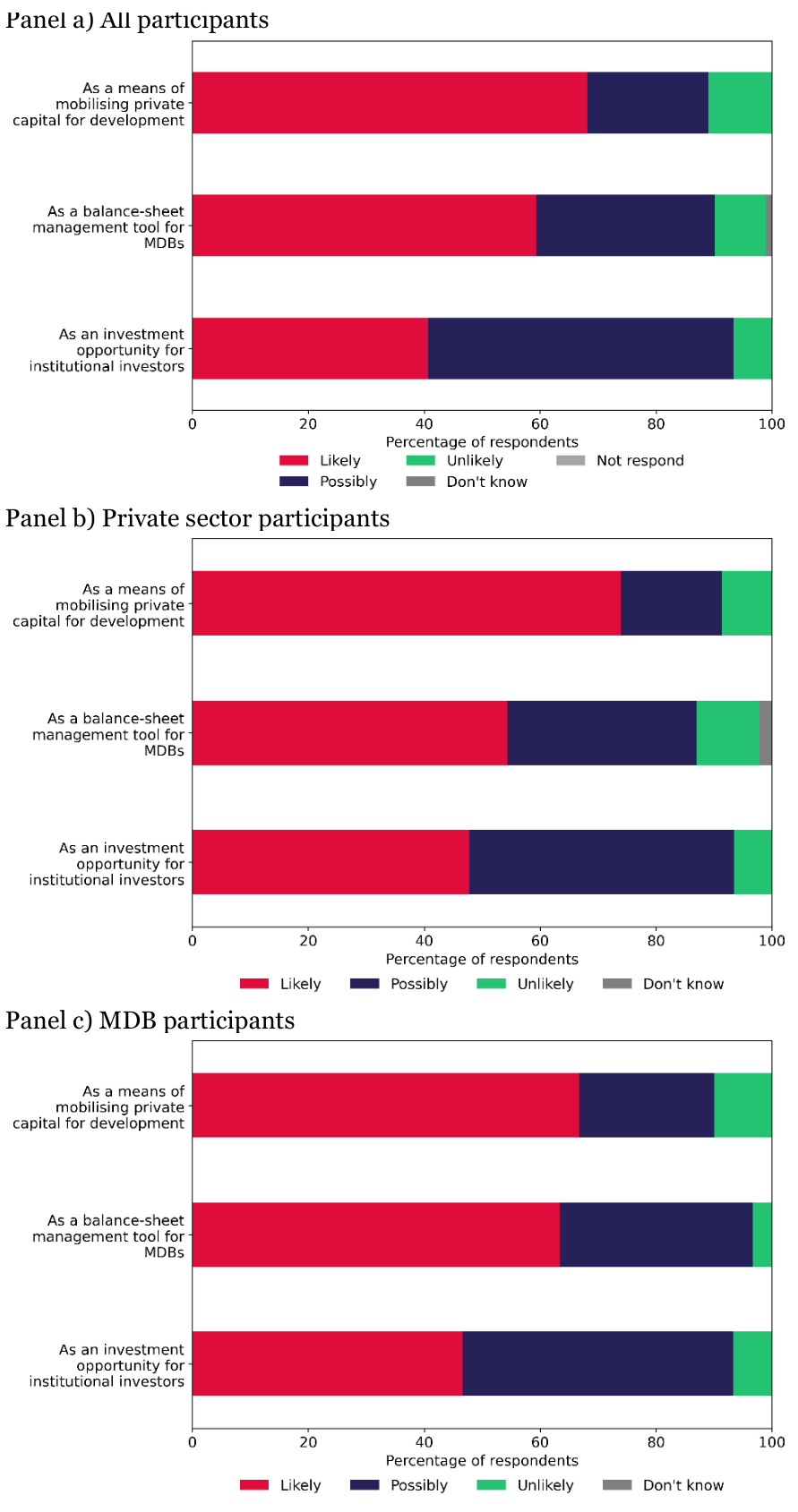
Question 6 asks: How likely is MDB securitisation to become significant during the next five years? Figure 3.6 indicates a generally positive outlook for MDB securitisation over the next five years.
Respondents are most optimistic about its role in mobilising private capital for development and as a balancesheet management tool for MDBs.
4. Public Statement Analysis
The second of the three strands of evidence mentioned in the introduction (along with the survey and stakeholder interviews) is what we call ‘public statement analysis’. By this we mean a form of ‘sentiment analysis’ of the public commentary that accompanied each transaction. While the interviews capture private views on an anonymised basis and the survey measures them at scale, the sentiment analysis draws on the public record: the statements, press coverage and analytical commentary published around each deal. Its purpose is to establish how each transaction was received by the wider market, and by whom.
For each transaction, the publicly available material was assembled, including the originating institution's own announcements, coverage in the specialist and trade press, statements from participating investors, insurers, arrangers and advisers, and commentary from development-finance analysts, think tanks and published case studies. A central step was to separate the issuing MDB's own statements from independent, third-party voices. Issuer material is promotional by design and tends to present every transaction as a success, so commentary published by parties other than the originator provides the more reliable guide to genuine market reception. Sceptical and critical assessments were retained in full, so that the analysis reflects the full range of views rather than only favourable ones.
Table 4.1 presents, for each transaction, the third-party commentary gathered in this way, identifying the source and the speaker or organisation behind each quotation. Read together, the entries describe a market whose independent commentary remains concentrated among a familiar group of specialist investors, insurers, advisers and trade publications, and in which the pioneering transactions attracted noticeably more attention, and more critical scrutiny, than the follow-on deals that came after them.
The section deliberately reports quotations directly rather than summarising them, so that the reader hears the original voices of market participants without our interpretation standing in between. Public statements are useful evidence of how transactions were received and of institutional objectives and intended demonstration effects. Being positively selected, however, they say less about market-clearing spreads or the breadth of executable demand, which would require transaction-level information on allocations, subscription levels and pricing that is rarely published.
In Table 4.1, the integer in brackets after each quotation identifies the source in the ‘Transaction related reference’ part of the bibliography at the end of the report.
“Room2Run answers the call of the G20 for private sector participants to step in and facilitate development finance, providing a template for attracting significant private sector capital into urgently needed projects in developing economies.” – Investor (1)
“Room2Run provides an innovative and commercially viable solution to the African Development Bank’s risk management and lending objectives, while paving the way for commercial investors to support and benefit from the growth of infrastructure on the continent.”
- Investor (1)
“Room2Run is an innovative solution to a long- standing challenge.” – A Minister of Finance (1)
“AfDB’s leadership through this transaction has now set the stage for broader adoption of the instrument throughout the MDB community.” – Structuring Adviser (1)
“These assets have performed pretty well.”- Investor (2)
“Mariner is very much interested in doing more.” – Investor (2)
“This deal may be the first step in a major shift in how MDBs manage their finances to expand lending capacity.” – Senior Research Associate (27)
“Other MDBs and their member shareholders have followed the deal with great interest.”
– Senior Research Associate (27)
“The AfDB deal did in the end require some official support, in this case from the European Commission, to get it over the line, but future deals may well be done on a fully market basis as investors and rating agencies get more comfortable with the concept.” – Senior Research Associate (27)
“The AfDB’s landmark transaction is a great first step, but needs to be followed up with more concerted action by other MDBs and their government shareholders.” – Senior Research Associate (27)
“But perhaps most exciting is the development of a whole new issuer base, in the shape of multilateral development banks, following the landmark ‘Room2Run’ deal between the African Development Bank and Mariner Investment Group.” – Senior Research Associate (13)
“But the presence of public sector institutions on both sides of the trade is curiously circular.” -Lead Finance Journalist (13)
“There could be some political reasons why the AfDB transaction was so successful — they demonstrated increased credit capacity, the increase in lines to certain countries, but not so much at the cost of buying the protection.” – Head of Origination (13)
“We argue that the transaction, while modest in size, opens the way for Multilateral Development Banks (MDBs) and specialist private sector funds to channel investment from private sector buy- side investors to Emerging Market (EM) infrastructure projects.” – Independent Industry Leader (31)
“R2R opens the possibility of a pipeline of new non-sovereign origination that escapes the normal constraints placed on MDB lending by ratings agency criteria.” – Independent Industry Leader (31)
“It set a precedent for future transactions and contributed to systemic change in how rating agencies assess MDB risk.” – Independent Industry Leader (26)
“R2R led to updates in rating agency methodologies, helping establish MDB synthetic securitisation as a viable asset class.” – Independent Industry Leader (26)
“Room2Run provides a template for attracting private capital from institutional investors into developing economies in a commercially viable way, which should help increase investment in the infrastructure and productive sectors of those economies.” – Investor (4)
Panel b) AfDB Room2Run – 2022 “This $2 billion guarantee reflects the UK’s commitment to investing in climate related projects, driving clean growth and delivering global climate ambitions.” – Minister of State for Development (3)
“AXIS is proud to play a leading role in AfDB’s Room to Run Sovereign program, aligning the strength of our specialist underwriting with the London insurance industry’s ability to collaborate to support positive change.” – Insurer (3)
“We are excited to support this landmark policy between the AfDB, the UK Government, and private insurers. The combination of an MDB’s unique lending capabilities and private insurer coverage can help unlock large amounts of capital to further assist countries and sectors in need of finance.” – Insurer (3)
“This important transaction is further evidence of the importance of mobilisation by DFIs of unfunded insurance capacity from the private sector to support climate, mitigation and adaptation finance in Africa.”
– Broker (3)
“The AfDB deal is particularly noteworthy because it involves commercial investors taking a stake in a portfolio of sovereign loan risk – a first in the MDB space.” – Senior Research Associate (28)
“While the pricing meant that this deal made sense for AfDB as a financially efficient way to create more lending headroom, it does not necessarily follow that the pricing fairly reflected the strength of AfDB’s PCT.” – Senior Research Associate (28)
“The insurance firms may very well be getting an excellent deal.” – Senior Research Associate (28)
“However, if a substantial share of the repayment risk of sovereign loans is no longer held by the MDBs, but rather by a private investor, the basis for PCT could erode.” – Senior Research Associate (28)
“MDBs might come to be perceived as dealmakers for investors rather than as official development agencies.” – Senior Research Associate (28)
“Now, the political and intellectual climate among MDBs is supportive of financial innovation again, and the African institutions are leading the way.” – Lead Corporate Finance Journalist (14)
“Shedding the risk on sovereign assets is harder than on private sector loans because they yield much less and investors could often buy the countries’ risk in the bond market if they wanted to.”
– Lead Corporate Finance Journalist (14)
“But the capital relief is extremely valuable — the AfDB will be able to do up to $2bn of fresh climate projects.” – Lead Corporate Finance Journalist (14)
“The Room2Run transaction, brokered by Texel, is an example of the balance sheet optimization objectives of AfDB and how the insurance sector can support private sector mobilization through blended finance.” – Global Head of Insurance (7)
“The 2022 sovereign transaction improved AfDB’s Risk Capital Utilisation Rate by 5.1% and created $2 billion in additional lending headroom.” – Independent Industry Leader (26)
Panel c) BOAD DOLI- P – 2023 “It should be noted that, given the quality of the issuer’s AAA-rated signature, the subscription operation may be closed early at any time.” – Independent Press (21)
“In recent years, within the BOAD DOLI-P securitisation programme, the company has closed the largest non-sovereign securitisation deals in WAEMU for a total amount of USD 500 million and has introduced for the first time a structure entirely aligned with international standards.”
– Leading Global Thinktank (30)
“Recent transactions by the AfDB and BOAD have shown how securitisation can both free up capital for additional lending and act as a demonstration, building skills and awareness.”
– Independent Press (6)
“Institutions such as the AfDB, IFC, and BOAD (through its securitisation arm, BOAD Titrisation) have played leading roles in advancing the asset class.” – Independent Press (6)
Panel d) BOAD DOLI-P – 2024 “The innovative structuring was a key element of its success, showing that the region’s market is ready for advanced financial instruments.” – Lead Manager (10)
“This operation demonstrates that the West African financial market is not only ready for sophisticated financial instruments, but also capable of mobilizing significant resources for long-term development projects.” – Management CEO (10)
Panel e) IDB Invest Scaling4Impact – 2024 “Scaling4Impact is an incredibly exciting transaction and a new pathway for investor participation in development finance.” – Investor (19)
“We believe Scaling4Impact will catalyse other multilateral lending institutions to utilise the power of SRT transactions to improve their balance sheets while serving as a template for crowding in more capital from private market participants.” – Investor (19)
“The larger story is the reigniting of MDB focus on balance sheet optimisation, significantly improved clarity from the rating agencies on how MDBs can use this tool, and the inclusion of private sector unfunded mezzanine insurance.” – Investor (15)
“IDB wanted it to be catalytic — to show the MDB universe that these transactions can be done in a much more efficient way than Room 2 Run was, so we are hopeful that there is a lot more to come in this space.”
– Investor (19)
“AXA XL is proud to be a key risk partner in this innovative transaction. Our involvement in Scaling4Impact shows our commitment to working with global multilateral organisations like IDB Invest, leveraging our political risk and credit expertise to drive progress and protect what matters.” – Insurer (19)
“AXIS has a long and successful history of insuring multilateral development banks across a wide range of asset classes in developing countries.”- Insurer (19)
“IDB’s $1bn risk transfer expected to encourage other MDBs.” – Lead Corporate Finance Journalist (15)
“The AfDB’s [earlier Room2Run] deal was criticised in development finance circles as expensive.” – Lead Corporate Finance Journalist (15)
“Their participation enhances risk- sharing mechanisms and signals private investors’ growing confidence in MDB-backed transactions.” – Leading Global Thinktank (29)
“It serves as a model for future MDB-private sector partnerships, reinforcing the role of synthetic risk transfers (SRTs) in scaling development finance.” – Leading Global Thinktank (29)
“In a financial landscape where traditional concessional funding remains constrained, such innovative structures offer a replicable pathway to mobilising substantial private investment for development.” – Leading Global Thinktank (29)
“Firm represents the alternative asset manager in the first synthetic securitization focused on Latin America and the Caribbean with multilateral development bank assets for private investors.” – Legal Adviser (22)
Panel f) IDB Invest Scaling4Impact Retap – Dec 2025 “This tap reaffirms the powerful role of SRT transactions in helping multilateral lending institutions continue to expand their critical lending work.” – Investor (20)
“I’m excited to see this expansion of the original Scaling4Impact transaction, which is, a testament to the importance of long-term partnerships in creating new pathways for private market investors to participate in development finance.” – Investor (20)
“The deal marks the first retap of a securitisation executed under an originate-to-share model by a multilateral development bank. – Senior SRT Reporter (33)
“The repeat deal highlights increasing investor appetite for repeatable risk-transfer structures and diversified development assets.” – Independent Press (33)
“$450m add-on makes deal more efficient.” – Independent Press (17)
Panel g) IFC EMSP 2025-1 “The IFC has been known to be contemplating a full capital stack securitization since at least last year, an approach that puzzled some market participants, who wondered how the deal could be worthwhile if the IFC was having to pay investors at every level.” – Lead Corporate Finance Journalist (16)
“IFC’s first securitisation transaction aims to mobilise private capital, but at what cost?” – Independent Press (5)
“Operation increases IFC lending capacity, but questions about development impact remain.” -Independent Press (5)
“The Bank’s latest move to mobilise private finance will undoubtedly be met with scepticism regarding its value to achieving development objectives such as the Sustainable Development Goals (SDGs), and indeed economic transformation.” – Independent Press (5)
“Others have also questioned the difference between privatisation and securitisation, when both require public entities to surrender control over assets.” – Independent Press (5)
“This is exactly the kind of innovative approach we need – using British expertise through our MOBILIST programme and the UK’s world-leading position in global finance to help countries develop and grow, ultimately reducing their need for aid.” – UK Minister (24)
“The deal is the first of its kind in the development finance industry and effectively creates a new investible asset class, paving the way for pension funds and other sources of private finance to invest in emerging markets.” – Co-investor (24)
“By offering investors exposure to a diversified portfolio of emerging market credits across sectors and regions, EMSP challenges assumptions about the risk profile of these markets.” – Independent Industry Leader (25)
“It also demonstrates our modern development approach in action, moving from donor to investor, and draws on the UK’s financial expertise to help connect mainstream private investors with opportunities like this that can grow development finance at scale.” – Co-investor (35)
“The organisation believes that expanding access to institutional capital through market-based instruments can help direct funding toward businesses with the greatest potential to generate economic growth and create jobs.” – Independent Press (8)
Panel h) EBRD Mosaic – 2026 “We are proud to be the first anchor investor in the EBRD’s risk-sharing programme; establishing a relationship with a leading and likeminded multilateral development bank where sustainability objectives are embedded in all financing activities.” – Anchor Investor (9)
“The landmark deal establishes a scalable framework to share risk with private investors and insurers, helping optimise the EBRD’s balance-sheet capacity to support additional development lending initiatives.”
– Structuring & Placement Adviser (32)
““Mosaic” also represents a significant step forward in the evolution of risk and capital management solutions within development finance, reinforcing the growing role of SRT structures in mobilising private capital toward emerging economies.” – Lead Investor (32)
“The European Bank for Reconstruction and Development has carried out its first significant risk transfer (SRT) deal... looking to scale up private-sector investment in emerging markets and make greater use of its balance sheet.” – Independent Press (11)
“A managing director at one institution forwarded the press release to a colleague with a single line: “This is the future.” – Independent Press (23)
“Inside the MDB world, it landed like a starting gun.” – Independent Press (23)
“Mosaic became the first major proof that this shift was real.” – Independent Press (23)
“Even enthusiasts acknowledge that synthetic risk transfer cannot solve MDB financing constraints on its own.” – Independent Press (23)
“But the EBRD moved first with a transaction large enough to command attention across the industry.”
– Independent Press (23)
“A new asset class is emerging at the intersection of development finance and structured credit.”
– Independent Press (18)
“Mosaic is being read across the market as a proof of concept: it shows how securitisation can mobilise private capital for development finance while freeing up an MDB’s balance sheet for further lending.”
– Independent Press (18)
“If other multilateral development banks follow the EBRD’s lead, this could evolve into a genuinely scalable new market segment — one with implications for how institutional investors think about emerging-market risk exposure.” – Independent Press (18)
Panel i) IFC Chrysalis Synthetic Securitization – 2026 “The International Finance Corporation (IFC) has signed its first-ever synthetic risk transfer (SRT) deal covering a broad, US$500mn portfolio of trade finance assets.” – Independent Press (12)
“Use of SRTs by banks has grown strongly in recent years, propelled in Europe by a clear regulatory structure. They usually encompass longer-term assets such as real estate and corporate loans.”
– Independent Press (12)
“The deal is also the first to utilise a three-tiered capital stack, a structure that the parties believe provides a blueprint for other MDBs to follow.” – Senior SRT Reporter (34)
“Trade finance has historically been difficult to scale through synthetic securitisation structures, despite its relatively short duration and diversified risk profile.” – Independent Press (34)
“The deal may therefore signal growing investor appetite for emerging markets trade risk, particularly as development finance institutions seek new ways to expand lending capacity without materially increasing balance sheet usage.” – Independent Press (34)

5. Questions and Answers
5.1 Interview findings
This section resumes the findings of the interviews conducted in the context of this project by addressing a series of questions about how market participants (including investors, insurers, securitisation arrangers, investment bankers, academics and MDB staff) regard MDB securitisation, the obstacles it faces, how MDBs are addressing these and what are the prospects for further growth in the market.
5.2 How do investors perceive recent MDB securitisations?
Investors generally perceive recent MDB securitisations as attractive in principle, but still specialised and not yet a mainstream asset class. MDB assets are viewed positively because of MDBs’ strong credit culture, preferred creditor status, development mandate, and historical performance. However, interviewees stressed that these advantages are not automatically understood or priced by the wider market.
The strongest appetite appears to come from specialist investors, insurers, reinsurers, and impact-oriented asset managers. Insurers were repeatedly described as a natural investor base because they already understand MDBs and emerging-market credit. One senior manager in a leading bank securitisation arranger interviewed for the project said: “When you bring these types of SRT transactions to the insurers, they’re pretty much kind of uniformly pro these transactions.” An SRT team head in a prominent insurer said: “These MDB securitizations generally… are such a natural home for insurers because we… have familiarity with EM credit.” Broader funded investors are more cautious, especially where transactions are unrated, illiquid, bespoke, or difficult to compare with standard CLO, ABS, or commercial-bank SRT products.
Overall, the interviews suggest that MDB securitisations are seen as promising but still immature. Investors want stronger disclosure, more standardised data, clearer rating treatment, repeat issuance, and greater liquidity before the market can broaden beyond specialist participants. A senior rating agency staff member when interviewed said: “I thought things were going to evolve much faster… and the truth is that’s not been the case.”
5.3 How do MDB structures differ from standard private-sector transactions?
MDB securitisations are shaped by MDB mandates, portfolio characteristics, and rating constraints. In contrast, commercial bank securitisation is motivated by regulatory capital optimisation only. In commercial-bank SRTs, the objective is usually clear: reduce regulatory capital usage at an acceptable cost (see Cortes et al. (2025)). For MDBs, the economic case is more complex because transactions must balance capital recycling, mobilisation, development mandate, rating agency headroom, preferred creditor status, and institutional income. One interviewee noted that MDBs do not have a simple regulatory-capital framework where transaction benefits can be easily measured against costs.
The underlying assets are also less standardised. MDB portfolios often include emerging-market sovereign, non-sovereign, infrastructure, financial institution, or project finance loans, many of which are unrated, bespoke, and supported by MDB-specific features. One interviewee referred to “very unusual features or payment holidays” and “highly tailored exposures,” which make MDB portfolios harder to analyse than standard CLO, ABS, or commercial-bank SRT pools.
In addition, investors must understand the MDB’s role as lender, including local presence, government relationships, and preferred creditor or transfer-risk advantages. This makes MDB securitisations more reliant on investor education, data disclosure, and rating-agency interpretation than standard private-sector transactions.
Do these differences result in MDB securitisation structures that deviate from those used in commercial bank securitisation? A leading investment bank expert in securitisation noted: “We divide the market in three categories. True sale, cash, synthetic funded and synthetic unfunded.”
A senior manager in a leading bank securitisation arranger said: “There’s not a huge difference between the way they approach these deals and a commercial bank deal.” This is certainly true for synthetic SRT securitisations. But the global head of securitisation for a leading commercial bank noted: “There’s so many legal inhibitions from being able to do a true sale transfer of [MDB] loans.” The head of the credit protection team head in a prominent insurer said of participating in true sale deals: “We’re not just looking at credit risk… we’re also looking at all the cash flow analysis you need to do for a proper CLO.”
5.4 What features are important for wider market participation?
Wider market participation will require MDB securitisations to become more standardised, transparent, and easier to compare with existing securitised credit products. Interviewees consistently highlighted the importance of robust loan-level data, clear portfolio disclosure, historical default and recovery information, consistent internal rating mappings, and standardised documentation. One interviewee noted that investors need enough information to understand “what is the track record and performance,” while another stressed that MDBs need to provide a clear “data package with all the relevant data,” including historical statistics and a detailed portfolio snapshot.
Market participants also emphasised the importance of structural familiarity and repeat issuance. Funded and rated transactions are likely to be more accessible to a broader investor base, especially if they are listed, supported by credible rating treatment, and designed with sufficient liquidity. Wider participation is likely to depend on a movement from bespoke one-off deals toward programmatic issuance with clearer pricing benchmarks, familiar structures, meaningful credit enhancement, and enough investor education to explain MDB-specific features such as preferred creditor status and transfer-risk mitigation. A leading investment bank expert in securitisation involved in large volume transactions said: “If it’s funded and rated, it becomes much more accessible” while demand for unrated transactions is more limited. A senior rating agency staff member said: “Without volume and without standardization… it’s hard to develop an asset class.”
5.5 What factors drive or limit investor demand?
Investor demand is driven by MDBs’ strong credit profile, preferred creditor status, emerging-market expertise, and historically strong portfolio performance. Interviewees noted that MDB transactions can offer investors exposure to diversified EMDE assets through institutions with strong underwriting, local knowledge, and borrower relationships. This is particularly attractive to specialist investors, insurers, reinsurers, and impactoriented asset managers. A senior manager in leading bank securitisation arranger said: “Maybe this is good diversification… I’m buying all this French and Italian and English and American corporate exposure through SRT.”
Investor demand is limited by unfamiliarity, limited standardisation, data gaps, liquidity concerns, and pricing uncertainty. MDB portfolios can be heterogeneous, with exposures across countries, sectors, currencies, and borrower types, making them harder to assess than standard CLO, ABS, or commercial-bank SRT pools. Senior manager in a leading bank securitisation arranger said: “You need to factor in who the lender is.” Some investors also struggle with country risk, unrated assets, limited secondary-market liquidity, and the lack of repeat issuance. One interviewee noted that investors had to be educated on “what was a multilateral development thing” and “what is the track record and performance.” A leading investment bank expert in securitisation said: “Most of the synthetic transactions funded or unfunded… have not been rated. So that effectively precludes many investors from participating.”
Making investors familiar with MDBs and their loan portfolios remains a challenge. The head of investment team in asset manager said: “We spent so much time educating our investors about what was a multilateral development bank… and what is the track record and performance.” MDBs are making significant efforts. One MDB securitisation specialist said: “We gave them historical performance, so that meant the fall, the vintages, recoveries… historical defaults.” An MDB staff member involved in their institution’s securitisation forecast that progressively: “There’s going to be more awareness about what we do, how we do it, this kind of dual mandate, impact development and financial sustainability.” However, an MDB securitisation specialist noted: “The data [provided to ratings agencies and investors] was not as extensive probably as a global bank would give.”
5.6 How do credit rating agencies assess MDB securitisations and the implications?
CRA treatment remains central to scalability. Clearer methodologies, stronger data, and more transparent recognition of MDB-specific features are needed before securitisations can reliably translate into rating or capital benefits.
Credit rating agencies assess MDB securitisations, first, in the context of assessing the MDBs’ own supranational rating and, second, if they are asked to rate securitisations in the context of their structured finance methodologies. On the supranational rating frameworks, the agencies’ analysis focuses on whether genuine risk transfer has occurred, how the retained tranches should be treated, whether the transaction improves capital adequacy, and whether it has any adverse effect on the MDB’s overall credit profile. Key inputs include portfolio composition, internal rating mappings, sovereign-risk linkages, concentration risk, recovery assumptions, guarantee structures, and the strength of the MDB’s capital and income position.
The implications for the MDB’s own supranational ratings are therefore mixed. MDB securitisations can support rating strength if they are recognised as effective risk-transfer tools and improve capital headroom, but rating agencies may give limited benefit if the structure is too small, poorly evidenced, unrated, or difficult to analyse. One interviewee explained that if a securitisation is very small relative to the MDB’s balance sheet, the agency may simply ask the MDB to “keep us in the loop” because it is unlikely to “lift the dial one way or the other.”
On rating MDB securitisations, rating agency interviewee noted that the analysis involves “global structured finance rating criteria.” Agencies pay attention to whether the same standards are met for historical data and loan-level information. In the absence of agency ratings on the underlying loans, agencies must rely on internal MDB ratings. The head of supranational ratings for a rating agency said: “There will be a need for us to map the assets from their internal rating scale to ours.” This makes the rating process longer and more data-intensive. The head of supranational ratings for a rating agency said: “We need to go on site, visit their data room, interview their credit analysts, the risk managers… look at fair number of files.”
5.7 How have MDBs designed securitisations to avoid negative rating impact?
MDBs have so far engaged in limited scale of transactions, retaining meaningful exposure, and structuring deals so that they are seen as balance-sheet optimisation tools rather than evidence of weakening asset quality. Several transactions have used first-loss retention, donor or MDB junior participation, guarantees, or mezzanine protection to demonstrate that risk transfer is controlled and that incentives remain aligned. MDBs have focused on performing portfolios and have sought to show that securitisation does not remove only the best assets or materially reduce future income generation.
MDBs have also sought to give rating agencies sufficient comfort through data, portfolio transparency, and structural simplicity. This includes providing loan-level information, internal rating mappings, historical default and recovery data, and clear evidence of how the transaction affects capital adequacy. Where assets are unrated, agencies may require extensive mapping to their own rating scales, making data quality central to rating recognition. One interviewee noted that MDB portfolios often require a detailed “mapping exercise” because many loans are unrated, while another explained that rating agencies look for historical data and loanlevel information when applying structured finance criteria. Overall, MDBs avoid negative rating impact by preserving alignment of interest, maintaining strong retained capital, and presenting the transaction as a disciplined, transparent risk-management exercise.
5.8 How do internal MDB constraints shape MDB securitisation design, structure, pricing?
Unlike commercial banks, MDBs do not have a simple regulatory-capital metric to demonstrate the benefit of a transaction, so they must justify deals through rating headroom, capital recycling, mobilisation, portfolio-limit management, and development impact. One MDB interviewee noted that securitisation can help “free up headroom” against internal portfolio limits, while another emphasised the difficulty of preparing the necessary historical and loan-level data for investors and rating agencies. These constraints have encouraged MDBs to favour carefully sized, often synthetic or hybrid structures that preserve lender-of-record status, avoid unnecessary legal transfer issues, and maintain alignment with their development mandate.
Internal MDB constraints have significantly shaped securitisation design, structure, and pricing. A central constraint is that many MDB loan portfolios carry relatively low spreads, especially sovereign or concessional exposures, making it difficult to pay market-clearing investor returns without eroding institutional income. One interviewee noted that, from the MDB issuer perspective, the premium paid on a synthetic risk-transfer transaction may “gobble up most, if not all” of the interest income on the loans. This pushes MDBs toward structures that minimise cost, use donor or retained first-loss support, or focus on higher-spread non-sovereign assets where transaction economics are more viable.
5.9 Have recent innovations made MDB securitisations competitive, scalable, replicable?
Recent innovations have succeeded in proving that MDB securitisations are feasible, but they have not yet made the market fully scalable or mainstream. (A senior rating agency staff member said: “Without volume and without standardization… it’s hard to develop an asset class.”) Transactions such as synthetic risk-transfer structures, donor-supported first-loss positions, insurer-wrapped mezzanine tranches, hybrid truesale/synthetic approaches, and listed funded notes have helped MDBs address specific constraints around capital relief, investor comfort, and mobilisation. One interviewee noted that different structures attract “a different investor base and different appetite,” suggesting that innovation has widened the range of potential investors. Another described MDB securitisations as “such a natural home for insurers,” showing that some structures have successfully matched MDB risk with an appropriate investor base.
However, the interviews suggest that these innovations remain at a proof-of-concept stage. Scalability is still limited by low underlying loan spreads, bespoke MDB loan documentation, limited standardisation, data challenges, rating agency complexity, and the absence of regular issuance. One interviewee argued that MDBs still face “strong difficulties to get clear answer” on portfolio data templates, while another noted that recent activity has “not been as fast” as expected because volume, information availability, and standardisation remain constraints. Overall, recent innovations have improved competitiveness and demonstrated replicability in selected cases, but broader scale will require programmatic issuance, standardised data, clearer rating treatment, and more predictable pricing benchmarks.
5.10 What are private investor perceptions and requirements for MDB securitisations?
Private investors generally perceive MDB securitisations as attractive but specialised products. They value the quality of MDB-originated assets, the MDBs’ preferred creditor status, strong underwriting standards, emerging-market expertise, and historical performance. However, these benefits are not always automatically understood by the broader market. Several interviewees noted that MDB securitisations require investor education because investors need to understand not only the portfolio, but also the MDB’s role as lender, including its local presence, borrower relationships, and potential transfer-risk advantages.
Investor requirements are therefore centred on transparency, standardisation, structural clarity, and credible risk-return compensation. Investors need robust loan-level data, historical default and recovery information, clear internal rating mappings, country and sector breakdowns, and documentation that allows them to compare MDB transactions with familiar CLO, ABS, or SRT products. A credit protection team head in a prominent insurer said: “We always ask them to be granular and get the details of the exact size of their experience, number of contracts, everything.”
Requirements also differ by position in the capital structure. Senior investors tend to focus on rating stability, credit enhancement, liquidity and regulatory treatment, whereas mezzanine and junior investors focus more on attachment points, stress losses, correlation, recovery timing, control rights and relative value. This is consistent with the investor base observed so far (see Section 2), in which credit insurers and specialist funds have taken mezzanine and first-loss risk, while broader institutional investors have only recently begun to buy senior notes.
Investors prefer structures with clear attachment points, meaningful retained exposure, appropriate credit enhancement, reliable rating treatment (a leading investment bank expert in securitisation said: “Most of the synthetic transactions funded or unfunded… have not been rated. So that effectively precludes many investors from participating”), and, for some investors, listing or liquidity features. Overall, private investors see MDB securitisations as promising, but wider participation will depend on stronger disclosure, repeat issuance, and more standardised transaction formats.
5.11 What features are needed to build confidence, comparability, investor participation?
To build confidence and comparability, MDB securitisations need stronger standardisation of portfolio data, documentation, and analytical assumptions. Investors and rating agencies require loan-level data, historical default and recovery information, vintage performance, internal rating mappings, country and sector concentrations, and clear definitions of default and loss. One interviewee stressed the need for a “data package with all the relevant data,” including historical statistics and a clear portfolio snapshot, while another noted that investors need to understand “what is the track record and performance.” A prominent investment bank securitisation arranger said: “Increasing the diversification of the portfolio… would… improve the economics to get some kind of flagship program.” An MDB securitisation specialist expressed some optimism: “There’s going to be more awareness about what we do, how we do it, this kind of dual mandate, impact development and financial sustainability.”
Structurally, investors need familiar and transparent features: clear attachment and detachment points, meaningful first-loss retention, robust credit enhancement, straightforward waterfalls, and predictable treatment of guarantees or insurance wraps. For mainstream participation, funded and rated instruments are generally more accessible, particularly where there is listing, liquidity, and documentation that investors can compare with CLO, ABS, or SRT benchmarks. One interviewee noted that funded and rated transactions have the broadest potential investor base, while unrated deals remain more limited. Overall, mainstream participation depends on making MDB-specific credit strengths understandable within structures and documentation that private investors already recognise.
GEMs data support market-level confidence in MDB loan performance but do not replace information on the specific MDB and transaction pool. MDBs could usefully agree a minimum investor data pack covering internal ratings and their mapping to agency scales, rating migration, country and sector concentration, maturity and amortisation, spread, security, arrears, restructurings, recoveries and servicing arrangements.
6. Awards
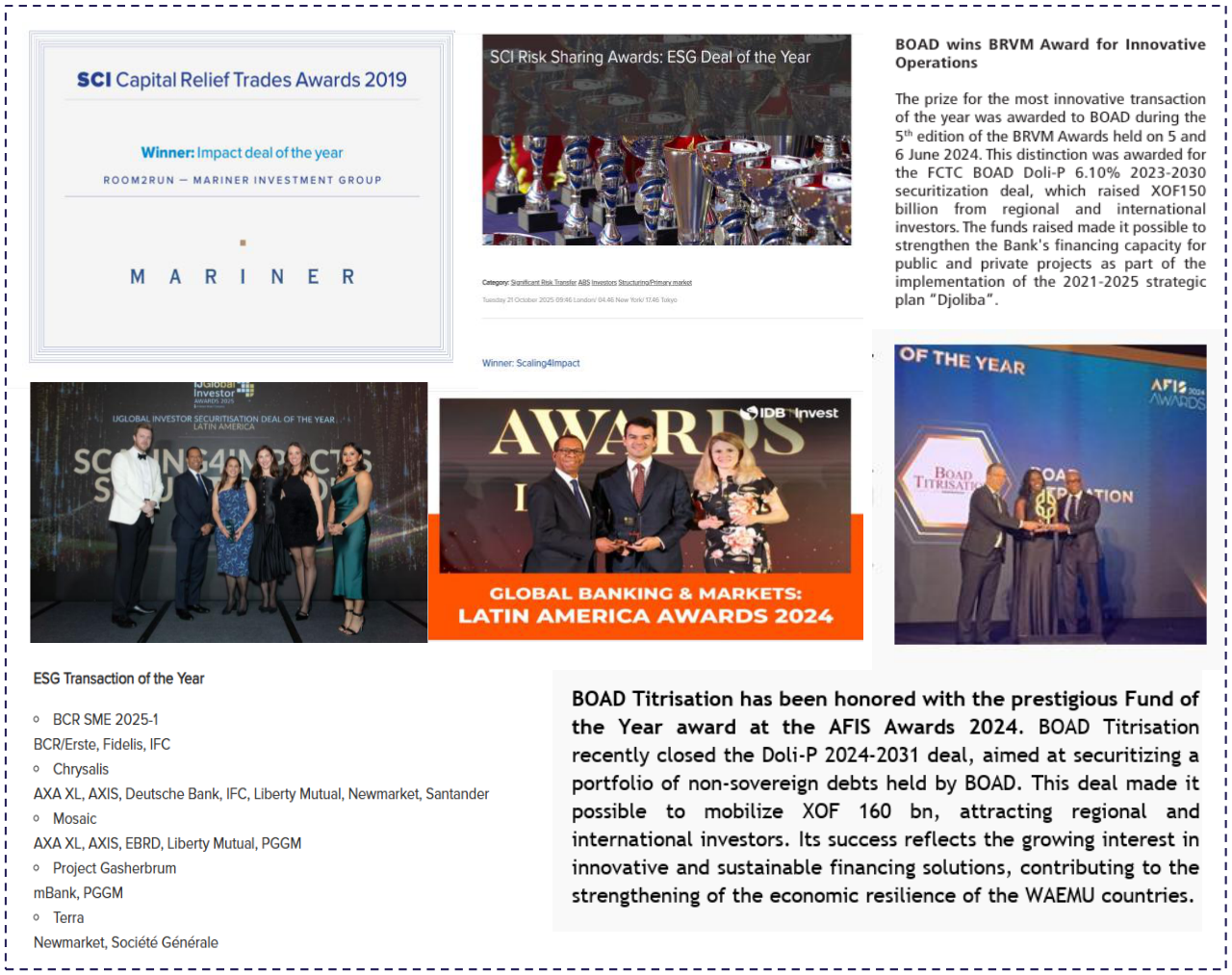
Industry awards are an important source of visibility for innovative financial transactions. Annual competitions are conducted for securitisation transactions by specialist industry publications Global Capital and Structured Credit Investor. Whether a transaction is shortlisted depends on investor rather than sponsor nominations but energetic promotion by an issuer or its advisors may make it more likely that a transaction is shortlisted.
The 2018 AfDB Room2Run transaction won Impact Deal of the Year and Innovation of the Year at Structured Credit Investor’s inaugural Capital Relief Trade Awards in 2019.
IDB Invest Scaling4Impact
1. ESG Deal of the Year: Awarded at the 2025 SCI Risk Sharing Awards hosted by Structured Credit Investor (SCI)
2. Securitization Deal of the Year, Latin America: Awarded at the 2025 IJGlobal Investor Awards.
DOLI-P 2023 obtained the Innovative Transaction Award (Prix de l'Opération Innovante) at the 2024 BRVM Awards, hosted by the regional stock exchange.
IFC’s Chrysalis deal has been shortlisted for the Structured Credit Investor October 2026 ESG Deal of the Year and Innovation of the Year.
7. Conclusions
This document provides a snapshot as of September 2026 of how familiar market participants are with the ten securitisation transactions implemented by MDBs. There is a growing market for such transactions and, as for any new asset class, visibility and awareness is an important factor in whether the market grows. Risk Control
(2024) and (2026a) examine demonstration effects in innovative financial transactions and emphasise the significance of whether the wider market can understand what has been done and whether the transaction was economically successful for the various participants. As well as awareness, the data presented in this report shows what factors different market participants regard as important for (i) whether the new market expands,
(ii) what contribution securitisations will make to MDBs and investors and (iii) whether there is willingness by investors and MDB sponsors to engage in future deals.
The study’s primary conclusions are:
• MDB securitisation is still, at present, a specialist market and MDBs need individually and collectively to publicise their issuance activities.
• The very earliest, pioneering transactions remain the most visible and talked about deals among market participants.
• Some of the most innovative recent deals are less familiar to private sector survey participants than one might expect.
• Some obstacles that private sector participants emphasise that may impede progress are lack of investor familiarity with MDB portfolios, returns perceived to be low relative to risk, and difficulties in generating regular issuance programs.
• Actions that private sector respondents recommend MDBs take to boost the market include greater disclosure of historical default and LGD disclosure, greater transparency regarding portfolios and establishing programs of regular issuance. Some MDBs regard the publication by the GEMs consortium of aggregate multilateral lender loan performance data as resolving the data needs of investors but GEMs reports are only the first step. A minimum investor data pack at the level of the individual MDB and transaction pool is the natural next step.
• Private sector respondents also emphasise that their willingness to participate in deals depends on expected returns, portfolio diversification and historical credit performance.
• Around 58.7% of the private sector participants questioned said that their organisations ‘were likely to’ or ‘maybe would’ participate in MDB securitisations in future (43.5% ‘likely to’ and 15.2% ‘maybe’), although respondents are likely to be drawn disproportionately from those already well-disposed towards MDB credit.
It is important to distinguish between proof of concept and evidence of scale. The completed transactions demonstrate that execution is feasible, which is a significant result in itself. A scalable market would additionally show repeat issuance, broader commercial participation, repeat buyers, larger tranches, more stable new-issue pricing and some evidence of secondary-market liquidity. On these measures, the market has made a start, for example through IDB Invest’s retap of Scaling4Impact and the purchase of IFC’s senior notes by mainstream institutional investors, but it has not yet reached scale.
This study has sought to shed light on the visibility of MDB securitisation and what market participants believe is needed for it to grow more. New markets such as that in MDB securitisations benefit from the ‘oxygen’ of publicity and market awareness. Other institutions engage in follow on deals if the nature of the economic outcome of early transactions is known to market participants. Risk Control (2024) and (2026a) characterise features of transactions that ‘catch on’ in the wider market, generating what MDBs prize as larger volumes of private sector capital mobilisation. This study aims to contribute to the transparency of the emerging market in MDB securitisation.
As explained above, this study was completed by Risk Control as part of a research project for the United Kingdom’s Foreign, Commonwealth and Development Office (FCDO) and Switzerland’s State Secretariat for Economic Affairs (SECO). Other studies that contribute to this project include Risk Control (2026c) (which examines how the rating agencies view securitisation by Multilateral Development Banks) and Risk Control
(2026d) which analyses internal obstacles to MDB securitisation and what are the ultimate benefits in higher capital accumulation and lending.
The research in this and the companion studies supports the objectives of FCDO’s MOBILIST program (sponsored by FCDO and SECO) by identifying practical approaches through which MDBs and other development finance institutions can broaden institutional investor participation and establish securitisation as a more regular balance sheet management and mobilisation tool. Finally, note that the views expressed here are those of Risk Control and not necessarily those of FCDO or SECO.
References
Cortes, F., Fernandez Dionis, G., Li, Y., Ramirez, S. and Zhang, X. (2025) “Recycling Risk: Synthetic Risk Transfers,” IMF Working Paper WP/25/200, available at: https://www.imf.org/- /media/files/publications/wp/2025/english/wpiea2025200-source-pdf.pdf
International Finance Corporation (2026) “Emerging Markets Securitization Program,” available at: https://www.ifc.org/en/what-we-do/sector-expertise/syndicated-loans-and-mobilization/ifc-emergingmarket-securitization-program
PGGM (2025) “Standard Chartered and PGGM executed the first risk-sharing deal receiving capital relief in Singapore,” PGGM, available at: https://www.pggm.nl/en/press/standard-chartered-and-pggm-executed-thefirst-risk-sharing-deal-receiving-capital-relief-in-singapore
Risk Control (2019) “Room2Run: the AfDB's Approach to Sharing Risk with the Private Sector,” Risk Control, 19-73a, available at: https://www.newmarketcapital.com/wp-content/uploads/2021/11/Room-to-Run_Risk- Control.pdf
Risk Control (2024) “Innovative Deals in Development Finance: Originate to Demonstrate (O2D),” August, 24- 66a, available at: https://www.riskcontrollimited.com/wp-content/uploads/2024/09/Innovative-Deals-in- Development-Finance-O2D-24-66a-19-8-24-v73.pdf
Risk Control (2026a) “Ex Post Evaluation of Financial Demonstration Effects,” Research Report, May.
Risk Control (2026b) “IFC’s EMSP 2025-1: Implications for MDBs and Market Building,” Research Report, July.
Risk Control (2026c) “MDB Securitisation and the Rating Agencies,” Research Report, August.
Risk Control (2026d) “How to Make a Success of MDB Securitisation,” Research Report, August.
Transaction-related references
1. African Development Bank (2018) “African Development Bank, Mariner Investment Group, and Africa50 Price Landmark $1 Billion Impact Securitization,” AfDB, available at: https://www.afdb.org/en/news-and-events/african-development-bank-mariner-investment-groupand-africa50-price-landmark-1-billion-impact-securitization-18494
2. African Development Bank (2019) “African Development Bank and partners' innovative Room2Run securitization will be a model for global lenders,” AfDB, available at: https://www.afdb.org/en/newsand-events/african-development-bank-and-partners-innovative-room2run-securitization-will-be-amodel-for-global-lenders-18571
3. African Development Bank (2022) “African Development Bank, United Kingdom and London Market Insurers enter new risk transfer partnership for climate action,” AfDB, available at: https://www.afdb.org/en/news-and-events/press-releases/african-development-bank-unitedkingdom-and-london-market-insurers-enter-new-risk-transfer-partnership-climate-action-55664
4. Africa50 (n.d.) “Room2Run Synthetic Securitization,” Africa50, available at: https://www.africa50.com/our-funds/projects/room2run-synthetic-securitization/
5. Bretton Woods Project (2025) “Securing a role for the private sector: IFC's first securitisation transaction aims to mobilise private capital, but at what cost?,” Bretton Woods Project, available at: https://www.brettonwoodsproject.org/2025/12/securing-a-role-for-the-private-sector-ifcs-firstsecuritisation-transaction-aims-to-mobilise-private-capital-but-at-what-cost/
6. British International Investment and FSD Africa (2025) “The role of securitisation in developing capital markets in Africa,” BII and FSD Africa, available at: https://assets.bii.co.uk/wpcontent/uploads/2025/10/10092130/The-role-of-securitisation-in-developing-capital-markets-in- Africa-BII-and-FSD-Africa.pdf
7. Convergence (2023) “Insurance for Scaling SDG Investments in Emerging Markets,” Convergence, available at: https://www.convergence.finance/news/4OI6O5osq4S3JhMUgXifZC/view
8. Devdiscourse (2026) “IFC expands emerging markets investment platform with $509 million deal,” Devdiscourse, available at: https://www.devdiscourse.com/article/business/3935692-ifc-expandsemerging-markets-investment-platform-with-509-million-deal
9. European Bank for Reconstruction and Development (2026) “EBRD launches inaugural €1 billion securitisation transaction,” EBRD, available at: https://www.ebrd.com/home/news-andevents/news/2026/ebrd-launches-inaugural--1-billion-securitisation-transaction.html
10. Financial Afrik (2024) “BOAD Titrisation clôture avec succès l'opération « Doli-P 2024-2031 »,” Financial Afrik, available at: https://www.financialafrik.com/2024/08/29/boad-titrisation-clotureavec-succes-loperation-doli-p-2024-2031-mobilisant-160-milliards-de-fcfa-grace-a-la-titrisation-dunportefeuille-de-creances-non-souveraines-detenu-p/
11. Global Banking & Finance Review (2026) “EBRD agrees inaugural significant risk transfer deal for €1 billion,” Global Banking & Finance Review, available at: https://www.globalbankingandfinance.com/ebrd-agrees-inaugural-significant-risk-transfer-deal-1/
12. Global Trade Review (2026) “IFC inks landmark synthetic risk transfer for trade finance,” Global Trade Review, available at: https://www.gtreview.com/news/global/ifc-inks-first-broad-based-syntheticsecuritisation/
13. GlobalCapital (2018) “Risk transfer market readies new frontiers,” GlobalCapital, available at: https://www.globalcapital.com/securitization/article/28mtq2tbssdo3lfs0qigx/clos-cdos/risk-transfermarket-readies-new-frontiers
14. GlobalCapital (2022) “Creative tension set to shake up MDB financing,” GlobalCapital, available at: https://www.globalcapital.com/article/2b08boh6phtkdarwmydq8/ssa/creative-tension-set-to-shakeup-mdb-financing
15. GlobalCapital (2025a) “IDB Invest brings securitization back to major MDBs after long gap,” GlobalCapital, available at: https://www.globalcapital.com/globalmarkets/article/2dxe0hrr1wv8c72ezo2yo/ssa/idb-invest-bringssecuritization-back-to-major-mdbs-after-long-gap
16. GlobalCapital (2025b) “IFC brings rare MDB securitization including triple-A notes,” GlobalCapital, available at: https://www.globalcapital.com/globalmarkets/article/2fgwjs1dlojlrwhgtagox/emergingmarkets/ifc-brings-rare-mdb-securitization-including-triple-a-notes
17. GlobalCapital (2025c) “IDB Invest becomes first MDB to tap its securitization,” GlobalCapital, available at: https://www.globalcapital.com/article/2fr7bfypm5jxgqhyl4uf4/ssa/idb-invest-becomes-first-mdbto-tap-its-securitization
18. HedgeThink (2026) “7 Trends Reshaping the Market in 2026: What's Driving the Future of Securitisation?,” HedgeThink, available at: https://www.hedgethink.com/7-trends-reshaping-themarket-in-2026-whats-driving-the-future-of-securitisation/
19. IDB Invest (2024) “IDB Invest Launches Landmark $1 Billion Securitization in Latin America and the Caribbean,” IDB Invest, available at: https://idbinvest.org/en/news-media/idb-invest-launcheslandmark-1-billion-securitization-latin-america-and-caribbean
20. IDB Invest (2025) “IDB Invest Retaps Originate-to-Share Award-Winning Securitization,” IDB Invest, available at: https://idbinvest.org/en/news-media/idb-invest-retaps-originate-share-award-winningsecuritization
21. Invest Afrique (2023) “Emprunt obligataire : La BOAD recherche 148,500 milliards FCFA sur le marché financier de l'UEMOA,” Invest Afrique, available at: https://investafrique.info/2023/03/20/emprunt-obligataire-la-boad-recherche-148500-milliards-fcfasur-le-marche-financier-de-luemoa/
22. Latham & Watkins (2024) “Latham Advises Newmarket Capital on Inter-American Development Bank's Portfolio Risk Transfer,” Latham & Watkins, available at: https://www.lw.com/en/news/2024/10/latham-advises-newmarket-capital-on-inter-americandevelopment-banks-portfolio-risk-transfer
23. MDB Jobs (2026) “The Deal That Changed the Conversation,” MDB Jobs, available at: https://www.mdbjobs.com/p/the-deal-that-changed-the-conversation
24. MOBILIST (2025) “MOBILIST invests in breakthrough IFC securitisation programme,” MOBILIST, available at: https://www.mobilistglobal.com/news-views-events/mobilist-invests-in-breakthroughifc-securitisation-programme/
25. MOBILIST (2026a) “IFC Emerging Markets Securitisation Programme (EMSP),” MOBILIST Securitisation, available at: https://securitisation.mobilistglobal.com/case-study/ifc-emergingmarkets-securitisation-programme-2/
26. MOBILIST (2026b) “Synthetic Securitisation by the African Development Bank,” MOBILIST Securitisation, available at: https://securitisation.mobilistglobal.com/case-study/afdb-case-study/
27. ODI (2018) “African Development Bank's landmark deal opens door to scaling up multilateral lending,” ODI, available at: https://odi.org/en/insights/african-development-banks-landmark-deal-opens-doorto-scaling-up-multilateral-lending/
28. ODI (2022) “AfDB's new Room2Run highlights opportunities and questions about MDB risk transfer,” ODI, available at: https://odi.org/en/insights/afdbs-new-room2run-highlights-opportunities-andquestions-about-mdb-risk-transfer/
29. OECD (2025a) “The Inter-American Development Bank's Scaling4Impact synthetic risk transfer,” OECD Blended Finance Case Studies, 7760f600-en, available at: https://www.oecd.org/en/publications/blended-finance-case-studies_2fb90b9a-en/the-interamerican-development-bank-s-scaling4impact-synthetic-risk-transfer_7760f600-en.html
30. OECD (2025b) “West African Development Bank's KEUR SAMBA,” OECD Blended Finance Case Studies, 73472533-en, available at: https://www.oecd.org/en/publications/blended-finance-casestudies_2fb90b9a-en/west-african-development-bank-s-keur-samba_73472533-en.html
31. Santander Corporate & Investment Banking (2026) “Santander CIB Advises EBRD on the Structuring and Placement of ‘Mosaic’, its Inaugural Significant Risk Transfer Transaction,” Santander CIB, available at: https://capital-riesgo.es/en/articles/santander-cib-advises-ebrd-on-the-structuring-andplacement-of-mosaic-its-inaugural-significant-risk-transfer-transaction/
32. Structured Credit Investor (2025) “Major MDB retaps SRT as it adds US$450m to flagship deal,” Structured Credit Investor, available at: https://www.structuredcreditinvestor.com/srt-marketupdate/capital-relief-trades/84476/major-mdb-retaps-srt-as-it-adds-us$450m-to-flagship-deal
33. Structured Credit Investor (2026) “IFC teams up with six institutions on historic trade finance SRT,” Structured Credit Investor, available at: https://www.structuredcreditinvestor.com/srt-marketupdate/capital-relief-trades/84788/ifc-teams-up-with-five-institutions-on-historic-trade-finance-srt
34. World Bank (2026) “Second Emerging Markets CLO Advances World Bank Group Push to Mobilize Private Capital for Jobs,” World Bank, available at: https://www.worldbank.org/en/news/pressrelease/2026/06/15/second-emerging-markets-clo-advances-world-bank-group-push-to-mobilizeprivate-capital-for-jobs
Appendix 1: Sources
A1.1 Public statement analysis The public statement analysis was conducted by:
• collecting through ‘by-hand’ web-based search as many published documents referring to one or more of the ten securitisation transactions that MDBs have so far implemented as possible and then rejecting documents produced by MDB sponsors themselves
• requesting a Large Language Model (LLM) to identify any statements in these documents that reflects a favourable or unfavourable judgment on the transaction or a forecast or statement regarding the implications of the transaction for the MDB or the wider market.
A1.2 Interviews The analysis is informed by a series of semi-structured interviews with senior representatives of MDBs, privatesector investors, arrangers, advisers and credit rating agencies. The interviews were designed to assess investor perceptions of MDB securitisation, understand the treatment of MDB transactions by credit rating agencies and identify the institutional, structural and pricing constraints that affect transaction design and scalability. The interviews followed a common thematic framework but were adapted to reflect the role, experience and knowledge of each interviewee.
For investors and other private-sector market participants, the discussions focused on investor appetite, return requirements, transaction structures, portfolio characteristics, liquidity, disclosure, documentation and the relative attractiveness of true-sale, funded synthetic, unfunded synthetic and guarantee-based transactions. For credit rating agencies, the interviews focused on applicable rating methodologies, portfolio credit analysis, recovery assumptions, sovereign-risk linkages, preferred creditor status, risk-transfer recognition and the treatment of MDB-specific structural features.
For MDB representatives, the discussions focused on transaction objectives, portfolio selection, internal capital frameworks, governance and policy constraints, pricing limitations, data availability, investor engagement and lessons drawn from completed or contemplated transactions. The principal themes explored across the interviews included:
1. market perceptions of recent MDB securitisation and risk-transfer transactions;
2. the extent to which MDB securitisations remain bespoke or could develop into a recognised and standardised market;
3. differences between MDB transactions and established private-sector CLO, ABS and significant risktransfer structures;
4. the investor groups most likely to participate;
5. the factors that drive or constrain investor demand;
6. investor requirements regarding returns, disclosure, documentation, portfolio data and liquidity;
7. the influence of credit rating agency methodologies on transaction structure and tranche design;
8. MDB-specific constraints affecting portfolio selection, pricing and risk transfer;
9. lessons from recent transactions and structural innovations; and
10. changes required to make MDB securitisation more replicable, programmatic and scalable.
Interview findings were analysed thematically rather than treated as statistically representative of the wider market. Views were reported on an anonymised basis and were compared across stakeholder groups to identify areas of agreement, divergence and uncertainty.
A1.3 Survey The survey was designed to assess market awareness of MDB securitisation and to obtain views on the factors that may support or constrain the development of the market. It was implemented using SurveyMonkey and targeted institutional investors, securitisation market participants, MDB staff and other relevant stakeholders.
The survey was distributed through several channels with the aim of reaching both specialist securitisation participants and the wider development finance and institutional investor community. It was promoted through an article in Structured Credit Investor (SCI) and discussed in a podcast with SCI. The survey was also publicised through an article in GlobalCapital. In parallel, Risk Control circulated the survey directly through its own mailing list and professional network.
The survey was administered on a confidential basis. Firm names and contact details were collected principally to support data-quality checks, while the results were analysed and presented in aggregated and anonymised form. Responses were subsequently divided between private-sector and MDB participants to examine whether perceptions differed between potential market investors and issuers or other development-finance institutions.
The questions asked in the survey were:
1. What is the name of your firm?
2. Please provide a contact email address.
3. Are you aware that Multilateral Development Banks (MDBs) have started to use securitisation to optimise their balance sheets?
4. Have you heard of any of the following MDB securitisation transactions?
5. How important are the following obstacles to the development of MDB securitisation?
6. Which actions would be most helpful in developing the MDB securitisation market? Please select up to three.
7. Which factors would be most important when deciding whether to participate in an MDB securitisation? Please select up to three.
8. Would your organisation consider participating in an MDB securitisation or risk-transfer transaction within the next three years?
9. How likely is MDB securitisation to become significant during the next five years?
10. Which of the following best describes your primary professional role?
Notes
[1] In a ‘retap’, rather than setting up a new legal framework, the issuer pulls more assets into the current structure and raises more capital from investors.
[2] This study is an independent research paper prepared by Risk Control. The analysis and conclusions it contains do not necessarily represent the views of FCDO or SECO which commissioned the research.
[3] The numbers in parentheses after each quote refer to the corresponding entry under Transaction-related References (see below).