

Research Paper
Securitizations in Basel II
Date:2006 Reference Number:6/2
SECURITIZATIONS IN BASEL II
William Perraudin Imperial College and Risk Control Limited
April 2006∗
Abstract
This article describes the Basel II capital rules for securitization exposures, explaining (i) the considerations that influenced regulators’ decisions, (ii) the approaches for calculating capital and how banks will apply them, (iii) the financial engineering that underlies the different approaches and (iv) the likely impact of the new system.
1 Introduction
In this chapter, we consider the rules governing regulatory capital for structured products[1] in the new Basel II proposals.[2] We look at the motives that have influenced regulators in designing the rules, review the different approaches banks will be required to follow, discuss the financial engineering that underpins the main approaches and consider the likely effects of the new Basel II system on the structured product market. To ensure that the discussion is self contained, we briefly review some relevant features of the market in this introduction.
Growth in structured products began in the 1980s with the emergence of the residential mortgaged backed security (RMBS) market in the US. In the 1990s, substantial asset backed security (ABS) markets emerged in auto loans and credit card receivables. Since the late 1990s, there has been major growth in different types of Collateralized Debt Obligations (CDOs) in which the SPV pool is made up of illiquid bonds or loans by banks to large corporate borrowers.
Recently, the range of collateral types included in structured product pools has widened further as issuers have created securitizations based on trade receivables of different kinds, equities, commercial property, utility receivables, and even energy derivatives. Issuers have realized that, in principle, any assets that represent claims to future cash flows can be securitized
As well as classic securitizations in which assets are transferred to an SPV, banks have made extensive use of structures in which offbalance sheet conduits issue commercial paper and use the proceeds to purchase revolving pools of assets. Such Asset Backed Commercial Paper (ABCP) conduits are particularly important in the US.
Also common are synthetic securitizations. In these, the SPV provides a bank with credit protection on its loans (often in the form of Credit Default Swaps (CDS)). At the same time, it issues notes to the market and invests the proceeds in high credit standing bonds such as Treasuries. The premiums the SPV receives from the bank on the CDSs plus the coupons on the Treasuries provide it with income it uses to pay coupons on the notes. Such structures are often cheaper to create than traditional structured products since the legal complication of transferring ownership of the underlying assets is avoided.
The impact of structured products has been substantial for issuers and investors alike. Structured products have provided investors with a broader and more liquid range of debt instruments in which they can invest, permitted issuers to manage better their balance sheets risks, and opened up new sources of funding for banks. As early as 1998, one estimate suggested that 40% of the non-mortgage loan books of the 10 largest US bank holding companies had been securitized.
2 The Regulators’ Objectives
This section reviews the broad objectives regulators have had in framing the Basel II rules for structured products. The treatment of securitizations is a key part of Basel II. This is not just because of the sheer volume of securitization exposures in bank portfolios but also because banks have made widespread use of securitization to circumvent regulatory capital requirements through so-called capital arbitrage. Indeed, the prevalence of such capital arbitrage has been one of the major reasons that regulators have felt obliged to has replace the simple rules of the 1988 Basel Accord with the more complex, risk-sensitive regulatory capital requirements of Basel II.
Examples of how securitizations may be used for capital arbitrage are provided by Jones (2000). Consider the following example. Suppose a bank possesses a loan pool worth $100. The chance of losses exceeding $5 might be negligibly small. In this case, the bank could create a securitization and retain a junior tranche with par value of $5. It thereby retains all credit risk in the transaction.
The maximum capital charge that the regulatory authorities can charge is 100%. Hence, the bank which would have had to hold capital of $8 under Basel I if the exposures were held on balance sheet now has to hold no more than $5 in capital even though its risk position has not changed.
Under Basel I, even lower regulatory capital charges may be achieved if the pool exposures are actually originated by the SPV. In this case, the bank may provide the SPV with a credit enhancement like a subordinated loan so that it effectively bears the credit risk associated with the pool of assets. Under Basel I, the subordinated loan in this case just attracts an 8% capital charge.
In the light of these examples, one may understand how important it has been for bank regulators designing the Basel II system to come up with rules likely to reduce the incentives banks face to engage in capital arbitrage.
To achieve this, regulators have tried, first, to design regulatory capital charges for loans that are aligned with the capital that banks would themselves wish to hold. Second, they have aimed to create a system of capital charges that preserves on and offbalance sheet neutrality, i.e., the capital banks must hold should be the same whether they hold a pool of loans on balance sheet of if they securitize it and retain all the tranches. Third, they have sought to ensure that the individual capital charges attracted by the different tranches in a structure are consistent with the relative distribution of risks between the tranches.
The new system of capital charges will inevitably have an impact on the securitization market. One of the major objectives of Basel II after all is to reduce the volume of transactions motivated by capital arbitrage considerations. Nevertheless, an important objective has been not to impede activity unreasonably in particular segments of the market especially where the transactions are clearly aimed at effecting genuine transfer of risk offthe issuer’s balance sheet.
As we shall see, in certain key areas, regulators have felt obliged to include additional flexibility to prevent the new regulations having a prejudicial effect upon market segments. In particular, the impact of Basel II on suppliers of liquidity and credit enhancement facilities in the ABCP market has been of great concern to the US regulators because of the importance of this market to US companies.
Given these general objectives, regulators have provided a menu of different approaches that should permit banks to calculate capital for the very diverse range of securitization exposures in their books in a risk sensitive fashion.
The different approaches permitted in the menu is heavily influenced by the question of how much information one may expect banks to have about the securitization exposure they hold. For example, as arms-length investors, a bank may hold substantial securitization exposures about which they have only hazy information. Typically, they will only have a broad notion of the composition and credit quality of the underlying asset pool. On the other hand, if a bank has originated and continues to manage the securitized assets, it will have very detailed information about the securitization.
An intermediate case occurs when a bank acts as the sponsor of a commercial paper programme. The sponsoring bank may supply credit enhancements and liquidity facilities to the programme that will then represent exposures subject to the Basel II securitization framework. The underlying assets will in most cases have been bought in from other originators and so the sponsor will only have limited information about them.
The two possible ways in which securitization capital charges might be calculated are either (i) to base charges on the ratings attributed to securitization tranches by external credit rating agencies, or (ii) to base charges on a formula supplied by supervisors into which the regulated bank can substitute parameters describing features of the tranche in question.
A ratings-based approach is attractive for its simplicity and the fact that it recognizes the key role that rating agencies play in the securitization market. Agencies are relied on heavily by investors evaluating the credit quality of securitization tranches after issue and strongly influence by their assessments the form that many deals take at issuance. (In the run-up to an issue, issuers often effectively have to negotiate with the rating agencies on such features as the degree of credit enhancement a tranches must enjoy if it is to obtain a particular target rating, for example.)
Also, the principle of basing capital charges on ratings has been widely applied in the Basel II rules for conventional credit exposures like bonds on ratings. (In some cases, the ratings employed are internal and in others are agency ratings.) One might be concerned, however, that the relationship between capital and ratings is more complex in the case of structured products than in the case of traditional credit exposures such as bonds or loans. In which case a bottom up approach to capital calculation based on a stylized model may be an attractive option.
3 Capital Calculation by Banks Under Basel II
These objectives and considerations have led regulators to devise a system comprising the following menu of different approaches:
1. The Standardized Approach This approach consists of a look-up table of capital charges for different rating categories for exposures with long- or shortterm ratings. The ratings in question come from designated ratings agencies and are not internally generated by the banks. Banks are required to employ this approach for a particular structured exposure if and only if they use the corresponding “Standardized Approach” in their Basel II calculations of capital for the predominant assets in the structured exposure pool.
The Standardized Approach look up tables are shown in Tables 1 and 2. The numbers in the table are expressed in terms of “risk weights”. To convert these into percentage capital charges, one must multiply by 0.08, i.e., the standard Basel I capital charge.[3] To take an example, the 50% risk weight for a BBBrated exposure translates into a 4% capital charge. A risk weight of 1250% translates into a 100% capital charge, i.e., in effect deduction of the exposure from capital.
The risk weights are highly conservative in the Standardized Approach. An long-term AAA-rated tranche attracts a risk weight of 20% and so a capital charge of 1.6%. The default probability of such an exposure may be very close to zero, so this is very conservative.
2. The Ratings Base Approach (RBA) The RBA consists of a slightly more elaborate pair of look-up tables for long-term and short-term rated tranches (see Tables 3 and 4). The risk weights for tranches of a given rating vary according to:
(a) Granularity. A pool is said to be highly granular if it contains a large number of exposures none of which contributes a large part of the total risk. A measure of granularity is the statistic
i EADi)[2] P N = (P (1) i i EAD[2] where EADi denotes the exposure at default of the ith exposure in the pool. In the RBA, tranches rated above BBB+ attract risk weights higher than the base weights if N < 6 (see the fourth column of Table 3).
(b) Seniority If a tranche is the most senior in its structure and is rated BBB or above, it attracts a lower risk weight than the base case so long as N > 6 (see the second column of Table 3). Lastly, as a late amendment to the RBA, a risk weight of 6% has recently been introduced for super senior tranches.
Such tranches are defined as tranches that have tranches junior to them that would attract a weight of 7% if they were the most senior.
3. The Supervisory Formula Approach (SFA) This consists of a bottom up approach to calculating capital in which a set of parameters reflecting the pool credit quality and features of the cash flow waterfall of the structured product are plugged into a formula to yield the capital for a particular tranche.
The formula in question depends on five bank-supplied inputs:
(a) KIRB The capital charge the bank would have had to hold against the pool exposures if they had been retained on balance sheet and the bank was using the Internal Ratings Based (IRB) approach as specified under Basel II.
(b) L The attachment point or credit enhancement level of the tranche, i.e., the sum of the par values of more junior tranches.
(c) T The tranche thickness.
(d) N The effective number of exposures in the pool.
(e) LGD The exposure-weighted loss given default of the pool defined as: P i PLGDi EADi LGD = . (2) i EADi
The SFA capital charge for the tranche is:
max {0.0056 T, S(L + T ) − S(L)} (3)
where the supervisory formula S(L) is defined as:

S(L) = KIRB + K(L) − K(KIRB)+ (4)
![Equation: dKωIRB 1 − exp[ω KIRB−L] when L > KIRB](/api/media/file/eq-242-300x32.png?prefix=media)
where
h = (1 − KIRB/LGD)N (5) c = KIRB/(1 − h) (6)
v = (7) N ((LGD − KIRB)KIRB + 0.25(1 − LGD)KIRB) v + KIRB[2] f = − c[2] + (1 − KIRB)KIRB − v (8) 1 − h (1 − h)τ (1 − c)c g = − 1 (9) f a = gc (10) b = g(1 − c) (11) d = 1 − (1 − h)(1 − Beta(KIRB; a, b)) (12) K(L) = (1 − h) ((1 − Beta(L; a, b))L + Beta(L; a + 1, b)c) . (13)
Here, Beta(x; p, q) denotes the cumulative beta distribution evaluated at x and with parameters p and q. The parameters τ and ω are set at τ = 1000 and ω = 20. The underpinnings of this approach are explained at greater length below.
The practical use of these different approaches is best explained by reviewing the flow chart shown in Figure 1. This flow chart shows the sequence of questions that a bank must answer in deciding what capital to hold against a given securitization exposure.
1. Is it a securitization? The definition of a securitization in the EU’s draft Capital Requirements Directive (Article 4, 36) is: “A transaction or scheme, whereby the credit risk associated with an exposure or pool of exposures is tranched, having the following characteristics: (a) payments in the transaction are dependent upon the performance of the exposure or pool of exposures; (b) the subordination of tranches determines the distribution of losses during the life of the transaction or scheme.”[4]
2. Supposing that the exposure is a securitization, the bank must decide whether it is held as part of the trading or the banking book. In the former case, the capital charge will be based on the usual trading book rules.
3. For the bank to apply the above securitization capital approaches, it must satisfy two sets of conditions: (i) risk transfer requirements if the bank is an originator of the securitized assets, and (ii) implicit support requirements if it is either an Originator or a Sponsor[5] of the securitization. If either of these sets of conditions is not satisfied, then the bank must calculate capital for the pool exposures as though they are held on balance sheet.
4. If it satisfies these conditions, the bank must use the Standardized Approach as described above if it uses the Standardized Approach for on balance sheet assets of the same type as those that predominantly make up the securitization pool.
5. If the bank uses the Internal Ratings Based (IRB) approach for the assets that predominantly comprise the pool, then it must employ either the RBA or the SFA. If the exposure is rated by an external agency recognized by the bank’s national supervisor, the bank must employ the RBA. This is also true if the exposure is unrated but the bank may infer a rating for the exposure by taking the rating of a more junior tranche with an equal or longer maturity.
6. If an external rating is not directly available and cannot be inferred, then the bank must decide whether the Internal Assessment Approach (IAA) is applicable. This approach applies only to eligible liquidity and credit enhancement exposures to Asset Backed Commercial Paper (ABCP) facilities. In effect, banks are able for this narrow set of exposures to calculate their own internal ratings. In so doing, they must devise a rating process that broadly mimics the approach followed in rating exposures to similar deals by a recognized rating agency.
7. If the IAA is applicable, the bank may choose to employ this approach or it may decide to use the SFA instead. If it implements the IAA, the bank determines its capital charges from the RBA look up tables based on the the IAA-generated ratings. In general, the bank must adopt a consistent principle in choosing whether to use the SFA or the IAA/RBA.
8. If the IAA is not applicable or if the bank opts not to implement it, it must either use the SFA if that is feasible or otherwise deduct the exposure from its capital, i.e., apply a 1250% risk weight.
The sticking point for implementing the SFA in many cases is likely to be the bank’s ability to calculate the inputs to the formula. These include most notably KIRB, the capital that the bank would have to hold against the pool of assets backing the securitization if it held the pool on balance sheet. Basel II places rather tight restrictions on the information and data that banks must possess if they are to calculate KIRB. A concession was made in the informational requirements for calculating KIRB for portfolios of purchased receivables at quite a late stage in the Basel II process specifically because it was felt that otherwise many securitization exposures in bank portfolios that embodied relatively little risk would otherwise have to be deducted, disrupting reasonable market activity in several areas.
The IAA requires a substantial investment in procedures and systems by a bank. The idea is that banks will be able to rate tranches themselves in one quite circumscribed area of the securitization market, ABCP, but it must adopt an approach that resembles an approach employed by a recognized rating agency. The bank’s procedures have to be audited thoroughly and authorized by the regulators. Banks are allowed to choose which of the SFA or the IAA combined with RBA look-up tables they wish to employ for non-rated ABCP liquidity and credit enhancement facilities. But they must adopt a consistent policy of using one approach or the other and not hop and change between different deals.
The implicit support and risk transfer requirements are an important part of the rules. The former are intended to ensure that originators maintain a clean break with their securitized assets. (Originators are able to support their past securitizations but only if this support is formally implemented as an exposure against which capital can be levied.) The risk transfer requirements contain potential for some ambiguity.
4 The Financial Engineering of the RBA and SFA
Regulators have been very keen to ensure that the Basel II rules will reduce banks’ incentives to engage in capital arbitrage. The only way to achieve this is to maintain a reasonable level of neutrality between the on and offbalance sheet treatment of exposures and to make sure that capital charges are similar in absolute level to what a bank would wish to hold as economic capital.
Decisions about the levels of structured product capital charges in Basel II was informed and influenced by financial engineering studies performed by analysts at the Federal Reserve Board and the Bank of England. This section provides a brief summary of these studies. Key contributions are (i) Peretyatkin and Perraudin (2004) on the RBA and (ii) Gordy and Jones (2003) and Gordy (2004) on the SFA.
On the RBA, devising a set of capital charges for structured products based on ratings can be viewed as a significant challenge. Indeed, at an early stage in the Basel II process, some regulators disputed whether it could be achieved at all. To understand the issues, one needs some background about the capital treatment of other exposures like bonds and loans in Basel II.
The IRB charges for traditional, on balance sheet credit exposures in Basel II are based on measures of marginal Value at Risk (MVaR) for exposures with given probabilities of default over a one year horizon. The default probabilities may be mapped into ratings by associating with each rating the historically observed oneyear default probability. Hence, the approach may be thought of as one of basing capital charges on ratings. (The Standardized Approach to on-balance-sheet credit exposures is explicitly framed in terms of ratings rather than default probabilities in any case.)
A justification for linking capital to ratings is that analysis using simple industry standard models suggests that when there is a single common risk factor driving a portfolio of loans, the MVaRs for individual exposures within a large portfolio are a function of the default probability.[6] Other influences on the MVaR for a given exposure are the expected LGD, the degree of correlation between the claim in question and the single common risk factor and the maturity of the claim. If regulators are prepared to specify reasonable correlation values for each different market segment, suitable capital curves may be deduced.[7]
Turning to capital charges for structured products, one may be concerned that the mapping from default probability/rating to capital will be more complex, dependent, for example, on tranche thickness, correlation of the factor risk in the pool and the factor risk in the bank’s wider portfolio and the maturities both of the pool and of the structure.
Peretyatkin and Perraudin (2004) examine how MVaRs for tranches in a large set of stylized transactions are related to default probabilities and expected losses. (Moody’s base their structured product ratings on target expected losses. Standard and Poor’s and Fitch use target default probabilities when they attribute ratings to structured product tranches.) They conduct their analysis by calculating capital (i.e., MVaRs) within the simple analytical models proposed by Pykhtin and Dev (2002a), Pykhtin and Dev (2002b) and surveyed by Pykhtin (2004) and then examining the mapping from tranche default probability and expected loss to this MVaR.
The Pykhtin-Dev model yields MVaRs for tranches within structures that have the same maturity as the holding period of the VaR calculation. Peretyatkin and Perraudin (2004) also devise and employ a Monte Carlo model within which one may calculate portfolio VaRs and MVaRs on tranches in structures when the VaR holding period is less than the maturity of the structure. This is clearly the more realistic case as CDO maturities are often 10 years or more while the VaR horizon used by almost all banks is one year.
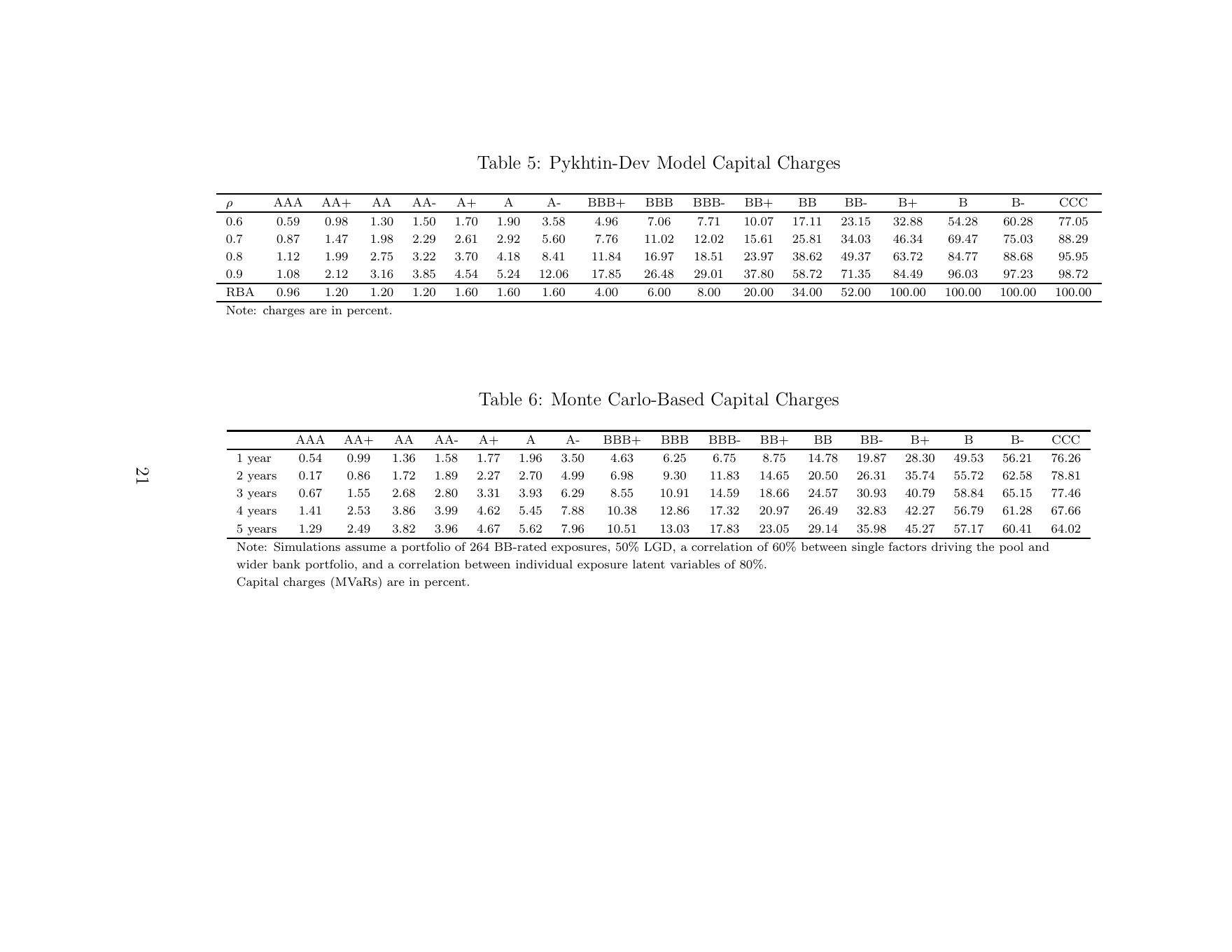
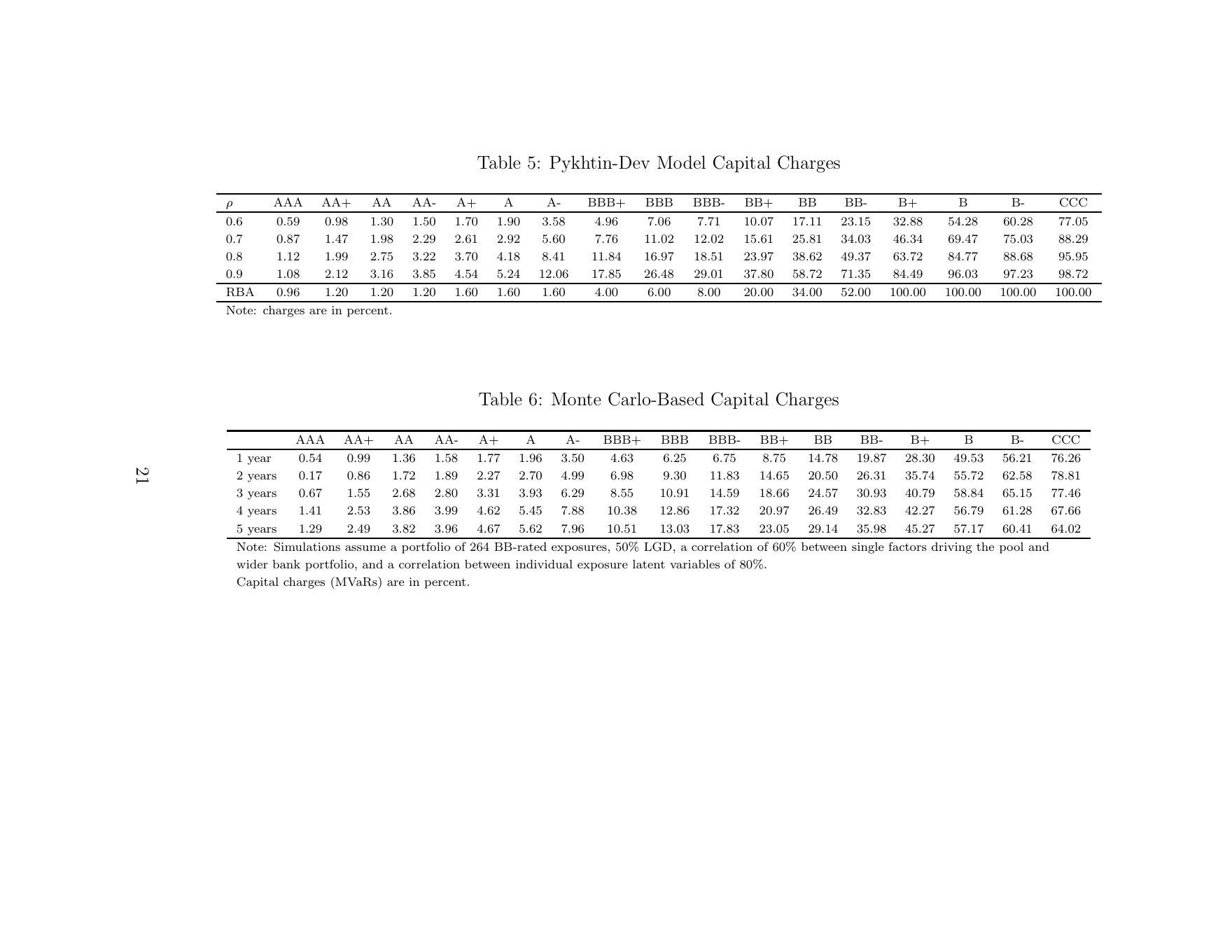
An example of the calculations performed by Peretyatkin and Perraudin (2004) appears in Table 6. The table shows percentage capital charges based on MVaRs for tranches with different ratings and for different values of ρ, the correlation coefficient between the single common risk factor assumed to drive the credit quality of the bank’s wider portfolio and the risk factor driving the exposures in the structured exposure pool. The calculations are performed assuming a highly granular pool of BB-rated underlying exposures. The holding period and confidence level of the VaR are one year and 0.1% and the maturity of the underlying pool exposures is also taken to be one year.
As one may see from the Table 6, the results depend significantly on the value of the correlation parameter ρ, the correlation between the pool and the wider bank portfolio risk factors. When ρ = 0.6, the capital charges are broadly similar to those required under the RBA. These latter appear in the bottom row of Table 5.
The importance of the correlation parameter shows that capital charges for structured product exposures should be distinctly higher if the exposure has underlying pool assets similar to exposures that predominantly make up the bank’s wider portfolio. It is perhaps obvious that a bank that invests in a credit card ABS tranche needs to hold more capital against it if much of its on balance sheet risk is associated with down-turns in the retail credit market that if it is primarily exposed to large corporate lending. But the differences in the rows shown in Table 6 underline the point.
Peretyatkin and Perraudin conclude that some other aspects of the structured product have only a second order effect on the appropriate capital charges. For example, the degree to which the underlying pool exposures are correlated with each other or are non-granular leads to relatively small changes in capital. The reason is that when the riskiness of the pool is increased, the rating agencies tend to downgrade the the more senior tranches so capital increases even without a direct rise in the capital charge for tranches with a given rating.
On the other hand, Peretyatkin and Perraudin find that maturity again has a first order effect on the capital charges for particular rating categories. Using a novel Monte Carlo technique, they are able to calculate MVaRs and hence capital for structured products of different maturities. The results are shown in Table 7. The capital more than doubles when one considers relatively senior tranches with the same rating but a maturity of four years rather than one year.
As described above, the RBA in Basel II provides simple look-up tables for risk weights (and hence implicitly capital charges) by rating category. No distinction is made between tranches (i) backed by different underlying assets (e.g., credit cards versus large corporate loans), (ii) of different maturities, or (iii) backed by assets similar or dissimilar to exposures predominant in the bank’s wider portfolio. While there are reasons for believing that (i) is not a serious drawback as factors that affect the riskiness of the securitization pool may have second order effects on capital, (ii) and (iii) may be more serious. These might have been dealt with through Pillar II requirements but Basel II did not take that approach.
Lastly, one may be critical of the RBA on the grounds that agencies assign ratings to securitization exposures taking into account complex sets of factors that they perceive to drive the risk of the transactions. These factors include the probability that the issuer will be able to meet principal and interest payments, the structure of the cash flow waterfall, the type of assets in the pool, other risks such as market, legal and counter-party risks, and credit and liquidity enhancements of various sorts. The different rating agencies also employ significantly different procedures in assigning ratings. Expecting all of this to be satisfactorily summarized in a stylized calculation of expected losses on tranches as was performed in the parameterization of the RBA is somewhat ambitious.
The counter-argument to the above criticism is that the different rating agencies seem over time to be converging in the approaches they take to rating structured products in that they are increasingly using comparable Monte Carlo methods to simulate pool performance and payoffs to tranches. The RMA parameterization may be viewed as employing a stylized version of these simulations for representative transactions.
The financial engineering background to the SFA is set out in Gordy and Jones
(2003) and Gordy (2004). To calculate a bottom up formula for capital on a structured product tranche, the most obvious approach might be to employ the single asymptotic risk factor model used elsewhere in Basel II as the basis for capital curves linking default probabilities to capital for on balance sheet assets. This model is described in Gordy (2003).
The problem with this approach in the context of securitization tranches is that when the pool is perfectly granular, the implied capital charges turn out to equal 100% for junior tranches. For thin tranches, at a certain level of protection[8], the capital charge drops abruptly from 100% to 0%. This implication of the model makes the model unappealing as a basis for capital calculations as it implies that a bank might have a portfolio of mezzanine tranches against which it was not required to hold any capital but which would obviously be subject to credit risk.
Gordy and Jones therefore devised a model that effectively smooths out the step function for capital charges. In principle, various different approaches could be followed as the basic aim was just to incorporate some smoothing of capital charges as the level of protection varies. The Gordy-Jones approach consists of assuming that the protection level for a given tranche is uncertain. They argue that in practise, the complexity of typical cash-flow waterfalls means that one cannot be sure of the exact level of protection enjoyed by a given tranche. Assuming a Wishart distribution, they derive a formula.
Figure 2 shows the capital for marginally thin tranches implied by the single asymptotic risk factor model plotted against protection as a step function. (Note that the protection level at which the capital jumps to 0% equals KIRB, i.e., the capital that the bank would be obliged to hold against the asset pool if it retained it on balance sheet.) The Gordy-Jones smoothing approach yields a reverse S-shaped curve. Their model contains a parameter ω that reflects the degree of uncertainty about the level of protection. The figure shows capital plotted for different levels of ω. The Basel II Supervisory Formula is based on an ω value of 1000.
The Supervisory Formula Approach is not based solely on the Supervisory Formula just described, however, as it includes additional overrides that build in greater conservatism. In particular:
1. Capital charges are constrained to equal 100% for any protection level up to KIRB.
2. For protection levels greater than KIRB, the capital curve for thin tranches is then allowed to approach the Supervisory Formula smoothly based on an exponential smoothing.
3. Capital is constrained to be no less than 0.56% (corresponding to a risk weighting factor of 7%) even for high levels of protection.
These additional overrides yield the SFA formula that appears in Figure 2. The overrides may in some cases significantly increase the capital charges. Table 8 shows capital implied by the SFA for all the tranches in a structure as a fraction of KIRB. When there are 100 underlying exposures, the total capital for all the tranches is just 8% higher than KIRB. However, when the effective number of exposures is small such as 10 or 2, total SFA capital is 19% or 42% higher than the on balance sheet capital, KIRB. To understand what drives this result, one may examine Figure 3 which shows the SFA calculated for different effective numbers of exposure, N. As N decreases, the SFA curve becomes flatter so the effect of overriding the basic inverted-S shaped Supervisory Formula by imposing that capital be 100% for protection levels less that KIRB has a sizeable impact.
5 Likely Consequences of the New Framework
Discussions with banks suggests that the IRB institutions will employ the RBA where possible and in a limited number of cases the SFA. Widespread use of the RBA is likely to put originators under greater pressure to obtain agency ratings for more tranches. In some markets, for example, Japan, one might expect there to be a significant reduction in the currently large number of unrated securitization exposures. In the past there was considerable concern that large numbers of exposures would not fit into any of the approaches permitted. The less restrictive informational requirements for calculating KIRB with purchased receivables and the introduction of the IAA has calmed these concerns.
Initially, many in the industry were anxious that the securitization market would be impaired by the reduction in capital arbitrage related deals that the Basel II regulations would bring. However, the scope for securitization is likely to be significantly increased when banks have developed the systematic approaches to measuring and managing portfolio credit risk required by Basel. The nature of the market is likely to shift therefore with more transactions being motivated by genuine risk transfer and funding considerations and fewer by regulatory capital arbitrage.
In any case, if regulatory capital on individual securitization exposures is high, capital arbitrage between the banking and trading books may provide a safety valve. The boundary between the trading and banking books has been reconsidered by regulators following the 2005 review of the trading book completed by the Basel Committee and the International Organization of Securities Commissions (IOSCO). Exposures can be classified as trading book exposures if they “arise out of a financial instrument or commodity” and “are held with trading intent or to hedge elements of the trading book”. An increasing number of securitization exposures are sufficiently actively traded to be eligible for such treatment.
The capital charges that securitization exposures attract in a trading book context will be depend on the volatility and correlations of market-wide factors driving spread and on specific risk charges. Perraudin and Van Landschoot (2004) show that the volatility of ABS exposures may be low but that sudden and dramatic increases in risk may occur if shifts occur in the credit quality of particular market segments. To the extent that internal risk models employ relatively short return and spread change data series, the possibility of regime shifts in volatility may not be fully allowed for and capital may be too low.
Under the new rules, securitizations that would attract a 1250% risk-weight under the securitization framework or would be deducted will face equivalent charges in the trading book. This will reduce the scope for capital arbitrage between banking and trading books for equity tranches. It may remain for mezzanine tranches, however.
This chapter has focussed on the Pillar 1 part of Basel II, i.e., the rules governing minimum regulatory capital requirements. But other parts of Basel II will affect the securitization market. In particular, Pillar 3 covers rules on disclosure that banks will have to follow. For example, banks will have to reveal to the market qualitative information such as the aims of their securitizations, the regulatory capital treatment adopted and which rating agencies they employ to rate their securitizations.
They will also have to supply quantitative information about the bank’s total outstanding volume of securitized exposures with a breakdown by type, and by whether the securitizations are traditional or synthetic,[9] and with information on the volume of impaired assets that have been securitized. They will also have to publish information about their aggregate holdings of securitization exposures. These substantial disclosures will reveal a lot about what directions are being taken in securitizations by individual banks and the market as a whole.
Bibliography
1. Basel Committee on Banking Supervision 2005 Basel II: International Convergence of Capital Measurement and Capital Standards: a Revised Framework Bank for International Settlements: Basel, November.
2. Gordy, Michael B. 2003 A Risk-Factor Model Foundation for Ratings-Based Bank Capital Rules. Journal of Financial Intermediation, 12, 199232.
3. Gordy, Michael B. 2004 Model Foundations for the Supervisory Formula Approach, in William Perraudin (editor), Structured Credit Products: Pricing, Rating, Risk Management and Basel II, Risk Books: London, 307-328.
4. Gordy, Michael, B. and David Jones, (2003). Risk, March, 78-83.
5. Peretyatkin, Vladislav and William Perraudin 2004 Capital for Structured Products, in William Perraudin (editor) Structured Credit Products, Risk Books: London, 329-362.
6. Perraudin, William and Astrid Van Landschoot, 2004 How Risky Are Structured Exposures Compared with Corporate Bonds?, in William Perraudin (editor) Structured Credit Products, Risk Books: London, 283-303.
7. Pykhtin, Michael and Ashish Dev (2002a) Credit Risk in Asset Securitizations: Analytical Model, Risk March, S26-S32.
8. Pykhtin, Michael and Ashish Dev (2002b) Credit Risk in Asset Securitizations: The Case of CDOs, Risk, May, S16-S20.
9. Pykhtin, Michael 2004 Asymptotic Model of Economic Capital for Securitization in William Perraudin (editor) Structured Credit Products, Risk Books: London, 215-244.
Table 1: Standardized Approach with Long-Term Ratings
AAA to A+ to BBB+ to BB+ to B+ and AA A- BBB- BB- below Risk weight 20% 50% 100% 350% 1250%
Table 2: Standardized Approach with Short-Term Ratings
A-1/P-1 A-2/P-2 A-3/P-3 Other Risk weight 20% 50% 100% 1250%
Table 3: RBA for Long-Term Ratings
Risk weights Risk weights for External for senior Base risk tranches backed by rating positions weights non-granular pools AAA 7% 12% 20% AA 8% 15% 25% A+ 10% 18% 35% BBB+ 12% 20% 35% BBB 20% 35% 35% BBB+ 35% 50% 50% BBB 60% 75% 75% BBB- 100% 100% 100% BB+ 250% 250% 250% BB 425% 425% 425% BB- 650% 650% 650% Other rated 1250% 1250% 1250% Unrated 1250% 1250% 1250%
Table 4: RBA for Short-Term Ratings
Risk weights Risk weights for External for senior Base risk tranches backed by rating positions weights non-granular pools A-1/P-1 7% 12% 20% A-2/P-2 12% 20% 35% A-3/P-3 60% 75% 75% Other rated 1250% 1250% 1250% Unrated 1250% 1250% 1250%
Table 7: Total Capital Under the SFA
Effective number of 2 10 100 exposures in the pool Total Capital 1.42 1.19 1.08
Figure1:FlowChartforStructuredProductCapital
Figure 2: SFA Capital Charges
0.8
0.6
0.4 Marginal Capital Charge 0.2
0 0.5 1 1.5 2 Attachment Point Divided by Kirb
Figure 3: SFA with Different Granularities
0.8
0.6
0.4 Marginal Capital Charge 0.2
0 0.5 1 1.5 2 2.5 3 3.5 4 Attachment Point Divided by Kirb
Notes
∗The author thanks Patricia Jackson and Ralph Mountford of Ernst of Young for valuable dis- cussions and Robert Lamb for research assistance. 1We use the terms “structured product” and “securitization” interchangeably. 2See Basel Committee on Banking Supervision (2005). 3Under Basel, a bank must maintain capital at a level no less than 0.08 times its Risk-Weighted Assets (RWA). The RWA is obtained by summing the bank’s notional exposures weighted by risk weights like those in Table 1. 4This definition encompasses both traditional and synthetic securitizations and is simpler than the definition in Basel Committee on Banking Supervision (2005). 5An Originator is either of the following: An entity which, either itself or through related enti- ties, directly or indirectly, was involved in the original agreement which created the obligations or potential obligations of the debtor or potential debtor giving rise to exposure being securitized; An entity which purchases a third partys exposures onto its balance sheet and then securitizes them. A Sponsor is a firm other than an Originator that establishes and manages an asset-backed commercial paper programme or other securitization scheme that purchases exposures from third parties. 6See Gordy (2003). 7This has been the approach followed under Basel II so there are a set of capital curves or functions for five different credit exposure asset classes (C%I loans, SME loans, revolving retail exposures, other retail and residential mortgages.) See Basel Committee on Banking Supervision (2005). 8The protection of a tranche here denotes the sum of the par value of more junior tranches tranches. It is also sometimes called the attachment point of the tranche. 9Where no exposures are retained, this information will have to be disclosed in the first year only.