

Securitisation Purchases by the ECB - What is “Senior Enough”[1]?
Date: 23-09-2014 Number: 14-81a
Introduction
The ECB will soon adopt a set of eligibility criteria for its planned ABS purchase programme.[2] These criteria are likely to include a restriction based on agency ratings. The inclusion of dependence on agency ratings in yet another area of official or regulatory policy is regrettable and is inconsistent with the frequently expressed intention of European policy-makers.
In another paper,[3] we have documented the very unfortunate effects of rating agency actions on the European securitisation market, including the use of sovereign ratings caps, counter-party risk criteria and methodology changes adopted and then subsequently reversed.
The ECB could signal to the market its desire to reduce reliance on ratings by adopting a formula-based criterion on seniority. This note sets out a simple way in which the attachment point of a securitisation tranche may be assessed and deemed “Senior Enough” or “Not”. This criterion could be employed in conjunction with a rating-based criterion during a “bedding-in” period if desired, the latter to be dropped if it were subsequently found to be redundant.
The formula-based criterion builds on advances in analytic assessment of risk for tranched positions made by the Basel Ratings and Securitisation Workstream (RSW) (see BCBS (2012)) and by the AFA Quant group, a group of industry risk experts specialising in securitisation risk and capital (see Duponcheele et al (2014b)).
The formula we suggest has a number of sector-specific inputs that would be set by the ECB. A candidate calibration is provided in our earlier paper.[4] The methodologies employed in calibrating the formula are available on request.
The “Senior Enough” Criterion
Here, we describe the criterion we propose. Figure 1 shows the capital for thin securitisation tranches implied by the Conservative Monotone Approach (CMA), the securitisation capital model exposited in detail by Duponcheele et al (2014b). This model is closely related to that developed by the RSW in BCBS (2012) and reportedly taken into account (after some changes in assumptions) in the calibration of the IRBA contained in BCBS (2013b). The CMA has the major advantage that it is closed form and hence may be implemented by directly evaluating explicit formulae.
To judge if a tranche is “Senior Enough”, we check to see if the risk weights of the most junior tranchlet contained in the discretely thick tranche in question merits capital no greater than a given target level. To ascertain this involves tracing a line across from a target capital level on the vertical axis in Figure 1 until one hits the capital curve and then down to an appropriate attachment point on the horizontal axis. Per dollar of par value, the capital for a discretely thick tranche will be much lower than the capital attracted by the first thin tranchlet that contributes to it[5] so the approach is, in this sense, clearly conservative.
To take a specific example, one may consider granular SME-loan-backed tranche. The securitisation in question involves Spanish SME loans. The deal was issued on 01/06/2006. The tranche we examine is the most senior in the structure and was rated A- as of 01/01/2014.
Using the figure as described above, one may infer the attachment point that the tranche would have to have, according to the CMA, if the most junior tranchlet in the tranche were to achieve a risk weight of 7%. (This implies the target capital level is 0.56bps.) We view the 7% risk weight as comparable to a rating of AAA. As mentioned above the actual rating of the tranche at the start of 2014 is A-. Using our target attachment point formula, we obtain an attachment point of 24.14%. This is less than the actual attachment point which is 38.72%. So, the tranche successfully passes the attachment point criterion but fails to satisfy the rating criterion.
To evaluate the criterion for “Senior Enough” mathematically, one may compare the tranche’s actual attachment point with the following target attachment point: ( ) ( ) √ ) = ( ) ( √
Here, is the delinquency ratio, capital for the pool’s delinquent assets, the pool’s performing ) is the standard normal function, ( ) is its assets, the capital for the pool’s performing assets, ( inverse, and is the minimum capital level of the thin tranche’s attachment point . The formula adjusts over time to deteriorating economic conditions (increase in capital requirement or increase in delinquent assets or both). Suggested values for , , and by asset class may be found in Duponcheele et al (2014b). We set = where is the pool capital under the Basel II SA adjusted for delinquencies.
How the “Senior Enough” Criterion Compares to Ratings
We have examined how this criterion performs using data on 913 European RMBS and granular SME securitisation tranches.[6]
Figure 2 shows histograms of the implied attachment points for the 789 RMBS tranches and 124 granular SME tranches in our sample. The distribution of “investment grade like” target attachment points is centred around 10% for RMBS tranches and just over 20% for the granular SME tranches.
The tables in Figure 2 provide comparisons between attachment point and ratings criteria for the RMBS and granular SME tranches in our dataset. The four tables correspond to attachment points inferred from our equation based on target risk weights of 7%, 20%, 50% and 100%. We assess how the four inferred attachment point criteria compare to the following four ratings criteria: (i) AAA, (ii) rating no lower than AA-,
(iii) rating no lower than A-, and (iv) rating no lower than BBB-.
The upper part of Table 1 shows results for low risk weight residential mortgage backed tranches. Of the 789 such tranches in the sample, 50 are both AAA-rated and have attachment points at least as high as the formula-implied target. Only 6 tranches fail to satisfy the attachment point criterion and are AAA-rated. More tranches satisfy the attachment point criterion but not the ratings one (142). But, still, the majority of non- AAA-rated tranches also fail to satisfy the attachment point criterion.
The lower part of the table shows that only 5 SME-loan-backed tranches are AAA rated and all satisfy the attachment point criterion. A large fraction of the total (61) satisfies the latter attachment point criterion but they are less than AAA-rated. This suggests that the methodology employed by the ratings agencies in assessing SME-backed pools is more conservative for SME-loan-backed tranches than for RMBS.
The lower section of Table 1 shows the numbers for the most senior tranches and other tranches that satisfy both criteria.[8] One may observe that only 2 non-senior tranches satisfy both criteria, whereas the most senior tranches are split more evenly with 53 satisfying both criteria and 90 failing to do so.
In Tables 2, 3 and 4, we provide additional comparisons of how the tranches in our sample perform using the “Senior Enough” attachment point criterion and a corresponding ratings criteria.
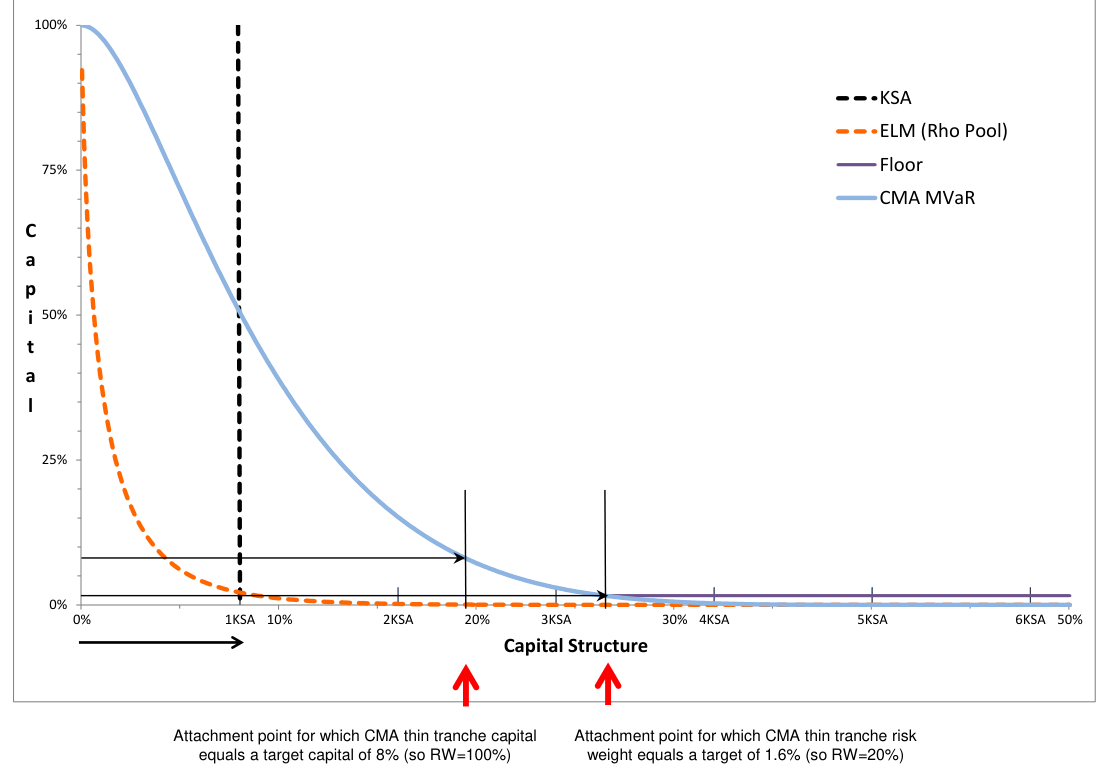
Note: the figure shows thin tranche capital (blue line) and expected losses (red line) implied by the Conservative Monotone Approach (CMA), which is based on a rigorous two-factor portfolio credit risk model calibrated using data from multiple banks. The target attachment point for a tranche is read off by following the horizontal line from the target capital level (say 8%) across to the blue line and then down to the horizontal axis (corresponding to 19%).
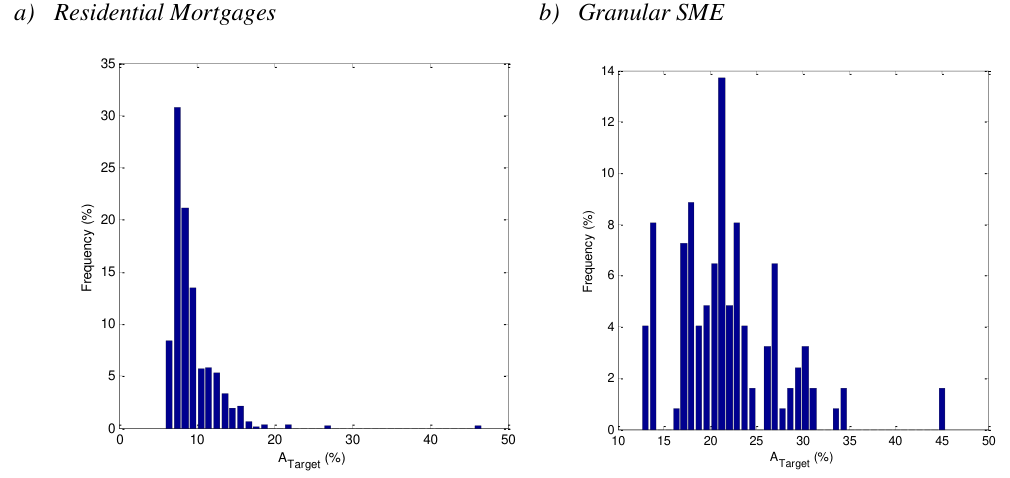
Note: the figure shows the distributions of target attachment points for the tranches in our dataset. These are the attachment points that a thin tranche would have to have in order to achieve Risk Weights of 100%[7].
| Low | RW Residential | Mortgages | ||
|---|---|---|---|---|
| Assumed Risk | ||||
| Weight target=7% | Rating | = AAA | Rating < AAA | Total |
| AP>=A_Target | 50 | 142 | 192 | |
| AP<A_Target | 6 | 591 | 597 | |
| Total | 56 | 733 | 789 | |
| Granular SME | ||||
| Rating | = AAA | Rating < AAA | Total | |
| AP>=A_Target | 5 | 61 | 66 | |
| AP<A_Target | 0 | 58 | 58 | |
| Total | 5 | 119 | 124 | |
| RMBS and | SME Satisfying | Both Criteria | ||
| Senior | Non-senior | Total | ||
| Satisfies Both Criteria | 53 | 2 | 55 | |
| Doesn’t Satisfy | 90 | 768 | 858 | |
| Total | 143 | 770 | 913 |
| Assumed Risk | |||
|---|---|---|---|
| Weight target=20% Rating > | = AA- | Rating < AA- | Total |
| AP>=A_Target | 89 | 119 | 208 |
| AP<A_Target | 40 | 541 | 581 |
| Total | 129 | 660 | 789 |
| Granular SME | |||
| Rating > | = AA- | Rating < AA- | Total |
| AP>=A_Target | 9 | 58 | 67 |
| AP<A_Target | 0 | 57 | 57 |
| Total | 9 | 115 | 124 |
| RMBS | and SME Satisfying | Both Criteria | |
| Senior | Non-senior | Total | |
| Satisfies Both Criteria | 67 | 31 | 98 |
| Doesn’t Satisfy | 76 | 739 | 815 |
| Total | 143 | 770 | 913 |
| Low Assumed Risk | RW Residential | Mortgages | |
|---|---|---|---|
| Weight target=50% Rating | > = A- | Rating < A- | Total |
| AP>=A_Target | 168 | 59 | 227 |
| AP<A_Target | 97 | 465 | 562 |
| Total | 265 | 524 | 789 |
| Granular SME | |||
| Rating | > = A- | Rating < A- | Total |
| AP>=A_Target | 46 | 25 | 71 |
| AP<A_Target | 0 | 53 | 53 |
| Total | 46 | 78 | 124 |
| RMBS | and SME satisfying | both criteria | |
| Senior | Non-senior | Total | |
| Satisfies Both Criteria | 119 | 95 | 214 |
| Doesn’t Satisfy | 24 | 675 | 699 |
| Total | 143 | 770 | 913 |
| Low | RW Residential | Mortgages | |
|---|---|---|---|
| Assumed Risk | |||
| Weight target=100% Rating > | = BBB- | Rating < BBB- | Total |
| AP>=A_Target | 214 | 34 | 248 |
| AP<A_Target | 177 | 364 | 541 |
| Total | 391 | 398 | 789 |
| Granular SME | |||
| Rating > | = BBB- | Rating < BBB- | Total |
| AP>=A_Target | 62 | 11 | 73 |
| AP<A_Target | 4 | 47 | 51 |
| Total | 66 | 58 | 124 |
| RMBS | and SME Satisfying | Both Criteria | |
| Senior | Non-senior | Total | |
| Satisfies Both Criteria | 131 | 145 | 276 |
| Doesn’t Satisfy | 12 | 625 | 637 |
| Total | 143 | 770 | 913 |
Conclusion
As argued above, the ECB should consider implementing a formula-based “Senior Enough” tranche criterion rather than relying on agency credit ratings.
As the agencies have struggled to restore their reputation, agency ratings have had a baleful influence on the European securitisation market since the crisis. Agencies have tightened rating criteria and then in some cases relaxed them, generating big pro-cyclical fluctuations in regulatory capital, with no explanation. A persistent issue is the extremely conservative approach that the agencies use in evaluating SME securitisations, treating them, in the conservatism of the rating criteria, as equivalent to Leveraged Loans. Sovereign rating caps have led to sudden fluctuations in the capital associated with entire national markets and reduced the transparency and informativeness of ratings.
Recent developments in analytical risk and capital modelling generated by researchers, both in the official and industry sectors, have opened up the possibility of using a formula-based approach. This note makes a case for the ECB to employ such formula in its eligibility criteria for securitisation purchases.
In fact, a formula-based “Senior Enough” criterion would expand the universe in which the ECB could execute its purchases while ensuring that the purchased securities are protected by a prudent degree of credit enhancement. As can be seen from the tables, an important beneficiary of such criteria would be SME securitisations.
References
Basel Committee on Bank Supervision (2012) “Revisions to the Basel Securitisation Framework,” Consultative Document, Bank for International Settlements, December (BCBS 236).
Basel Committee on Bank Supervision (2013) “Revisions to the securitisation framework,” Consultative Document, Bank for International Settlements, December, (BCBS 269).
Duponcheele, Georges, William Perraudin and Daniel Totouom-Tangho (2014a) “Reducing the Reliance of Securitisation Capital on Agency Ratings,” mimeo, February, http://www.riskcontrollimited.com/public/Reducing_the_Reliance.pdf.
Duponcheele, Georges, William Perraudin, Alexandre Linden and Daniel Totouom-Tangho (2014b) “Calibration of the CMA and Regulatory Capital for Securitisations,” mimeo, April. http://www.riskcontrollimited.com/public/Calibration_of_CMA.pdf.
Duponcheele, Georges, William Perraudin, and Alexandre Linden (2014c) “Capital Rules and Revival of the European Securitisation Market,” mimeo, forthcoming.
Notes
[1] This note is authored by William Perraudin, Director of RCL and Adjunct Professor of Imperial College, London.
[2] In his recent speech to the European parliament (22nd September, 014), Mario Draghi stated: “Under our ABS purchase programme (ABSPP) we will soon start purchasing simple and transparent securities with underlying assets consisting of claims against the euro area non-financial private sector.” He further specified: “Under the ABS purchase programme we will be purchasing senior and guaranteed mezzanine tranches. Regarding senior securities, we would buy only those assets that are eligible for Eurosystem operations. So, we have ample experience with managing and understanding the risks associated with this asset class. The assets to be purchased would satisfy high standards of transparency and simplicity and are also characterised by low default risk. The large degree of credit enhancement that originators have to build into a structured financial transaction for its senior tranches to attract the high rating that will make it eligible under our programme will function as a further protective layer against losses. As for the guaranteed mezzanine tranches, their intrinsic credit risk would be comparable to that of the guarantor, be it a national or supranational entity.” (See https://www.ecb.europa.eu/press/key/date/2014/html/sp140922.en.html.)
[3] See Duponcheele et al (2014a).
[4] See Duponcheele et al (2014b).
[5] Capital for exposures that are small in their contribution to total portfolio risk is additive. So the capital for a thick tranche equals the sum of the capital for a set of thin tranchlets that make up the thick tranche.
[6] A detailed description of the dataset from which this data is drawn may be found in a forthcoming paper, Duponcheele et al (2014c).
[7] A 100% RW corresponds in SA to tranches rated at least BBB-, investment grade like threshold.
[8] It is interesting to focus on the most senior and the other tranches because the ECB’s purchase scheme seems likely to be restricted to the most senior tranches, unless European governments provide guarantees against losses by the ECB on mezzanine purchases.