

Front matter
This report is the product of the Expert Panel tasked with the Independent Review of Multilateral Development Banks’ Capital Adequacy Frameworks and reflects broad agreement among its participants. This does not imply agreement with every specific observation or nuance. Members participated in a personal capacity, and their participation does not imply the support or agreement of their respective institutions. The report does not represent the views of the G20 membership or of the Italian and Indonesian G20 Presidencies. It also does not represent the views of Multilateral Development Banks, Credit Rating Agencies, or any other external party consulted in the course of the Review.
How to cite this report: Boosting MDBs’ investing capacity. (2022). An Independent Review of Multilateral Development Banks’ Capital Adequacy Frameworks.
We are grateful to the Italian and Indonesian G20 Presidencies for their support
Panel Composition 03
Acknowledgements 04
List of Abbreviations 05
Executive Summary 06
Chapter 1 11 Introduction
Chapter 2 15 Understanding MDB Capital Adequacy
Chapter 3 23 Challenges and Policy Options for MDB Capital Adequacy
Recommendation 1: Redefine the Approach to Risk Appetite in Capital Adequacy Frameworks Recommendation 2: Incorporate Uplift from Callable Capital into MDB Capital Adequacy Frameworks Recommendation 3: Implement Innovations to Strengthen MDB Capital Adequacy and Lending Headroom Recommendation 4: Assess CRA Methodologies and engagement Recommendation 5: Improve the Enabling Environment for Capital Adequacy Governance
Chapter 4 51 Action Plan on MDB Capital Adequacy
Conclusions 64
Bibliography 66
Annexes 73
Annex A – Glossary Annex B – Governance of the Review Annex C – External Engagement Annex D – Terms of Reference
Expert Chair Expert Panel
Ms Frannie Léautier Mr Ahmed Al-Mohsen Ms Paulina Beato Mr Chris Humphrey Mr René Karsenti
Mr Ekrem Keskin Mr Hans-Peter Lankes Ms Nancy Lee Mr Mike Muldoon
Mr Hiroshi Naka Ms Betsy Nelson Ms Arunma Oteh
Mr Jens Ulrich Mr Jinkang Wu
We are honored to have been tasked with such an important duty by the members of the G20 and would like to express our gratitude to the Italian and Indonesian G20 Presidencies for their steadfast support for this project.
We also thank all the officials from G20 countries, including their Executive Directors, who have spent time with us sharing their priorities and perspectives on the work of the Panel. We are grateful to the co-chairs of the International Financial Architecture Working Group for helping us steer this report through G20 discussions.
The work of the Panel would not have been possible without the collaboration of the Multilateral Development Banks (MDBs) included in the scope of the Review. We would like to thank the staff at Asian Development Bank (ADB), African Development Bank (AfDB), Asian Infrastructure Investment Bank (AIIB), Development Bank of Latin America (CAF-DBLA), Caribbean Development Bank (CDB), European Bank for Reconstruction and Development (EBRD), European Investment Bank (EIB), Inter-American Development Bank Group: Inter-American Development Bank (IDB) and Inter-American Investment Corporation (IDB Invest), Islamic Development Bank (IsDB), New Development Bank (NDB) and World Bank Group: International Bank for Reconstruction and Development (IBRD), International Development Association (IDA), International Finance Corporation (IFC) and Multilateral Investment Guarantee Agency (MIGA), for being generous with their time, reflections and insight. We particularly wish to note the efforts of the credit risk officers – network and of the GEMs team, with special thanks to Stefania Ciraolo. In our considerations, we also benefited from case studies from some MDBs that were not included in our Terms of Reference, such as the Trade and Development Bank.
We would also like to thank the major credit rating agencies for their interest in this exercise and willingness to hold open discussions, with particular acknowledgements to Louis Arnaud of Fitch Ratings, Alexander Ekbom of Standard and Poor’s and Kathrin Muehlbronner of Moody’s.
The Secretariat of the Basel Committee on Banking Supervision provided technical advice in accordance with our Terms of Reference, thanks to Verena Seidl’s excellent liaison activity. We are grateful to the external experts who agreed to be interviewed for the report, in particular Tim Turner, formerly of the African Development Bank and now with the Trade and Development Bank, ILX founder and CEO Manfred Schepers, Marie-Anne Birken and Cecilia Akintomide, the Paris Club Secretariat, IMF staff and Erik Berglof, who shared with us his experience from the Eminent Persons’ Group (EPG).
The Rockefeller Foundation supported our research and the production of this report and generously hosted us in its Bellagio Centre for the convening where our recommendations took shape. Pilar Palacia and Nadia Gilardoni provided an unrivalled environment for our discussion. Denise Sommer and Lucia Del Zotto, of Ahoy Design, helped us illustrate our messages and are responsible for the report’s design. The ODI also supported our research, with special mentions to Jessica Pudussery and Annalisa Prizzon. William Perraudin and his team at Risk Control, Prof. Eva Lutkebohmert-Holtz and her research team at the University of Freiburg, and Chris McHugh of Southampton Business School were valued collaborators.
Finally, we were supported in our work by the CAF Secretariat – Maura Cravero, Flavia Bottoni, Raffaela Giordano, Rossella Malinconico and Francesca Pupa. We are also grateful to Liam Maxwell and Christoph Wopperer for their analytical contributions and to Gardiner Harris for editorial advice.
ADB EBRD IBRD NDB Asian Development Bank European Bank for International Bank for New Development Bank Reconstruction & Reconstruction and AfDB Development Development OECD African Development Organisation for Bank ECB IDA Economic Co-operation European Central Bank International and Development AIIB Development Asian Infrastructure EIB Association PCS Investment Bank European Investment Preferred Creditor Status Bank IDB ATI Inter-American PCT African Trade Insurance ESG Development Bank Preferred Creditor Agency Environmental, Social Treatment and Governance IDB Invest BCBS Inter-American PPPs Basel Committee on ESM Investment Corporation Public-Private Banking Supervision European Stability Partnerships Mechanism IFC BSO International Finance RAC Balance Sheet FSB Corporation Risk Adjusted Capital Optimization Financial Stability Board IFFEd S&P CAF G20 EPG International Finance Standard and Poor’s Capital Adequacy G20 Eminent Persons Facility for Education Frameworks Group SDGs IIF Sustainable CAF-DBLA G20 FCBD Institute of International Development Goals Corporacion Andina de Finance and Central Finance Fomento – Development Bank Deputies SDRs Bank of Latin America IMF Special Drawing Rights G20 FMCBG International Monetary CDB G20 Finance Ministers Fund TDB Caribbean Development and Central Bank Trade and Development Bank Governors IRB Bank Internal Ratings Based CET1 G20 IFAWG ToRs Common Equity Tier 1 G20 International IsDB Terms of Reference Financial Architecture Islamic Development CFO Working Group Bank WB Group Chief Financial Officer World Bank Group GCIs IPSAS 19 CRAs General Capital International Public Credit Rating Agencies Increases Sector Accounting Standards CRO GDP Chief Risk Officer Gross Domestic Product MDBs Multilateral Development CUR GEMs Banks Capital Utilization Rate Global Emerging Markets Risk Database MIGA DFIs Multilateral Investment Development Finance Guarantee Agency Institutions
consider potential adaptations [...] to maximise the MDBs’ financing capacity’ (see ToRs at Annex D). turbulent times with a The Panel recommends strategic shifts in five areas to maximize the impact of MDB capital, which should be seen as a coherent and interdependent package of initiatives to allow MDBs to stretch themselves further while mitigating the associated risks:
Adapt approach to defining
risk tolerance
the capacity of the Most MDBs and shareholders allow rating agency assessments considerable influence in determining risk tolerance, de facto Multilateral development banks (MDBs) are uniquely embedding rating agency methodologies placed to respond to these challenges. They need to into internal policies. Shareholders and MDBs make the most efficient use of the scarce public should further reflect on their approach to resources under their stewardship and more effecti- defining risk tolerance with evidence-based, vely attract additional capital from market sources. realistic assessments of the risks posed by MDB operations, using rating agencies The hard realities of the past two years—global as an external evaluation tool. The Panel pandemic, major international armed conflict, recognizes the great importance for the increasingly visible impacts of climate change and business models of MDBs of maintaining rising macroeconomic imbalances—make clear superior financial strength as reflected in that this is a time to move past discussion to action. AAA ratings, and, to that end, make use of Success will require concerted and coordinated an enhanced dialogue with CRAs and clear efforts from shareholders and MDBs. public statements of shareholder support. Moreover, specific numeric leveraging This Panel was convened by the G20 to ‘provide targets should be removed from MDB credible and transparent benchmarks on how statutes and integrated into capital adequacy to evaluate MDB Capital Adequacy Frameworks frameworks. (CAF) […], enable shareholders, MDBs and Credit Rating Agencies (CRAs) to develop a consistent understanding, […] and enable shareholders to involvement of a greater variety of players,
Give more credit to callable capital
Callable capital is a powerful instrument including shareholders. A standalone expressing the commitment of shareholders structure could provide continuity and to stand behind MDBs. MDBs should independence to this work and a space for incorporate its financial benefits in MDB dialogue for collective and coordinated capital adequacy assessments, as is already action. the practice in some MDBs and in credit rating agency methodologies. In the view of this Panel, MDBs and their shareholders can take the necessary decisions and begin implementation on a series of reforms, such
Expand uses of financial
that MDBs are able to start increasing their lending
innovations
Proven innovations to create more capacity over the next 12-24 months. The expected usable capital or shift loan risks to willing potential scale of the increase is substantial, likely counterparties should be used more widely to be several hundreds of billions of dollars over and frequently by MDBs, mobilizing financial the medium term. The increased lending capacity markets as sources of development finance varies between MDBs and depends on the depth and potentially freeing billions of dollars in and scale of execution. It is not possible at this additional financing. stage to provide precise numbers, which would require detailed work at the level of individual MDBs; the estimated benefits provide a sense of
Improve credit rating agency
magnitude, or scale. Much depends on which
assessment of MDB financial
combination of reforms are pursued and how they
strength
Clarity from G20 and shareholders more are implemented. broadly on their support for MDBs is important for how rating agencies and The reforms do have risks associated with them, markets view MDBs. At the same time, there but the Panel believes that these can be mitigated may be scope for rating agencies to refine effectively. The risks are far outweighed by the methodologies to better account for the dangers of not fully deploying the unique strengths unique mission, track record and financial of MDBs to help address the daunting development strength of MDBs. challenges that affect us all.
Increase access to MDB data and analysis
More accessible and comparable data and analysis, as well as regular capital reviews, will support shareholders, rating agencies and market participants in their assessment of MDB strength and demystify their financial model. Ensuring the right access to information and expertise by MDB boards will support shareholder consistency between strategic priorities and financial management. Coordination arrangements across MDBs can be improved, with the
Box 0.1
Defining Capital Adequacy for Multilateral Development Banks
Capital adequacy measures a financial Unlike other financial institutions, MDBs are institutions’ ability to honor its financial not regulated and shareholders have sole obligations if its debtors are unable to pay authority over MDB capital adequacy policy. back what they borrowed. Measures can be In practical terms, MDBs must contend with risk-based (e.g., using risk-weights) or focus three different sets of capital adequacy on financial leverage, which considers an considerations: MDB’s capital and non risk-adjusted assets. In the case of an MDB, the relevant assets are the portfolio of loans it has made for •Internal capital adequacy policies defined developmental purposes, plus liquid assets by MDB shareholders and management held in its treasury portfolio. to manage the risks posed by the specific operational realities and developmental An MDB, as any financial institution, should mandates of each institution. have an “adequate” amount of capital to absorb losses in case borrowers stop repaying •Statutory rules written into the founding loans or if the market value of liquid assets agreements of MDBs as a high-level falls. This gives security that the MDB will have precautionary limit to help ensure long-term sufficient resources to repay bondholders and financial sustainability. other creditors. The riskier an MDB’s assets are, the more capital is needed to support them. •Rating methodologies used by credit rating agencies to evaluate the creditworthiness of MDB bonds, which are a key factor in shaping access to capital market funding.
CAPITAL ADEQUACY FRAMEWORKS PANEL REPORTCAPITAL ADEQUACY FRAMEWORKS PANEL REPORT 8
The reforms proposed by this Panel are aimed at MDB capital adequacy is highly complex: it is the making MDB capital adequacy policy fit to face intersection of many factors that interact in ways the challenges of today and tomorrow. The Panel that are not immediately obvious. This leads to five has sought to go back to first principles, question key strategic considerations: long-held assumptions and historical patterns, and think anew about how to make the best use of Capital adequacy reforms and innovations shareholder capital to achieve development goals. would be most effective as part of a structured program of MDB actions The five recommendations are derived from the enjoying a degree of consensus among diverse expertise of the Panel, who carried out the G20 and other shareholders. Enacting extensive consultations with MDB management, financial reforms as one component of a shareholders and credit rating agencies; a broader agenda would improve how they are benchmarking of capital adequacy frameworks and received by external stakeholders, including related policies across MDBs; a “deep dive” into the financial markets. methodologies of credit rating agencies; and the results of four external studies commissioned for Shareholders have a central role to play in this Review. MDB capital adequacy. Financial capacity issues at MDBs can be portrayed as technical Implementation will require hard work by all problems requiring technical solutions by parties, including shareholders, but the potential MDB management. This is true in some upside is very high. The turbulence facing the cases. But the root issues are often located world and the urgency for action present a unique at the level of shareholder governance, and opportunity to engage in reforms that will better in particular the disjunction between the position MDBs to play their countercyclical role and development goals shareholders set for the also contribute to achieving internationally-agreed MDBs, the capital and budgetary resources development goals. they provide and the degree of risk they are willing to accept. Shareholders must face The applicability of these recommendations varies that reality if they wish to enact meaningful across the 15 MDBs assessed in this Review, and capital adequacy reforms. they cannot be implemented in a uniform fashion or with uniform results. A focus on private sector These reforms are interdependent and versus sovereign financing, scale of balance indeed can reinforce one another when sheet and region of operation, available financing enacted as part of a coherent reform instruments, AAA or sub-AAA bond ratings, package, rather than as individual “menu” shareholder mandated mission and more will all options. They are designed as a mediumshape how shareholders and MDBs approach these term action plan to help MDBs make the recommendations. They are not one size fits all. most efficient use of scarce share capital. It is critical that they are perceived as such, rather than as an easy fix to boost lending capacity.
Coordinated implementation and The final Recommendations (engagement with communication by a substantial number rating agencies and enabling environment for of MDBs would be beneficial to market capital adequacy) can be pursued without delay perceptions, as rating agencies use peer and irrespective of the G20’s view on the other comparisons across MDBs as a key part recommendations. They pose relatively low of their evaluations. Such coordinated political and technical challenges and require action should avoid moving to the lowest modest resources. Potential gains in lending common denominator with respect to risk capacity are indirect, would materialize only over management standards and practices. the medium term and are not readily quantifiable. The proposed reforms would improve the way If reforms increase lending capacity, G20 MDBs and shareholders manage capital adequacy shareholders need to ensure adequate and decide capital needs now and in the future. budgets and resources to support and Risks are minimal and are far outweighed by risks sustain high quality operations, including of inaction. early groundwork by finance, risk and legal departments to prepare for such reforms. Taken together, these recommendations would allow MDBs to materially increase their firepower The first two Recommendations (defining with very manageable changes to risk tolerance. shareholder risk tolerance and recognizing the This is an essential component of a more farbenefit of callable capital) go to the core of MDB reaching reform agenda to better position MDBs capital adequacy. They have the potential to for the coming decades. increase lending headroom substantially and can be accomplished mainly, though not exclusively, through board-level policy changes. They require shareholders to consider their own approaches to risk appetite and will be watched closely by market participants, and hence must be done deliberately and be supported by a clear communication strategy.
Recommendation 3 (innovations) includes several options that have been piloted and appear technically viable. Implementation complexity varies, but headroom benefits are potentially substantial, depending on the scale of implementation. By scaling up partnerships with private investors and donors, some innovations carry the risk of influencing MDB missions, although this risk can be mitigated with strong shareholder governance and management oversight.
safeguarding the planet from an accelerating
A perfect storm of long-term
climate crisis requires substantial investments,
needs, proliferating crises, rising
particularly in sustainable infrastructure.
debt levels and paralyzing fiscal
The financing needs are daunting.[3]
constraints
Currently, the globe is facing an unprecedented Multilateral development banks need for investment to build a socially,
are central to facing these global
environmentally and economically sustainable
challenges
path forward—essential to achieve the Sustainable Development Goals (SDGs) and face the increasingly urgent climate emergency. Founded from the ashes of World War II, the The Covid-19 global pandemic was a once-in-a- World Bank has been joined by a constellation century shock costing developing countries an of sister organizations whose multilateral nature, estimated 5% of their Gross Domestic Product financial strength and technical skills have made (GDP) in 2020, unraveling decades of development them trusted and efficient development partners. achievements and pushing at least 100 million MDBs not only provide substantial investment people back into extreme poverty.[1] Before most financing themselves—with gross operations in countries could fully recover, the onset of the Low and Middle-Income countries of US$167.5 Ukraine conflict in February 2022 contributed billion in 2019—but also influence the trajectory to further increase food and energy prices of development policies and orient the efforts of accentuating a dangerous inflationary trend with many other stakeholders.[4] MDBs issue bonds on far-reaching economic and social consequences.[2] international capital markets to raise most of their Constraints to supply chains have caused real resources, which they lend out for development challenges for food security in many countries. projects at favorable financial terms. Their finance Recovery from these multiple crises while to the private sector supports investments yielding
1. Source: Gerszon Mahler et al. (2021).
2. Source: Kammer et al. (2022).
3. External financing needs for developing countries are projected by the International Monetary Fund (IMF) to have increased by up to US$700 billion a year through 2025 as a result of the Covid crisis, of which around US$450 billion is needed in low-income countries, while the investments needed to face the spin-off effects of the Ukraine crisis are at this point still uncertain. This is on top of the roughly US$2.5 trillion of additional financing a year until 2030 needed to reach the Paris climate goals and achieve the SDGs.
4. Source: AfDB et al. (2021).
both financial returns and development impact. capital contributions through private sector bond But many public sector projects—including rural issuance is determined, in part, by their capital electrification, maternal health care and social adequacy frameworks. To safeguard share capital protection—are unlikely to attract private investors and maintain strong continuous access to capital even though they are essential for poverty markets, MDBs have traditionally managed their reduction, climate resilience and inclusive growth. finances with the main purpose of obtaining a AAA Recent estimates put the need for financing from rating from the three main rating agencies. Since MDBs to meet the SDGs and the Paris Agreement 2015, MDBs have explored measures to expand goals at three times the current level by the middle capacity as part of the G20 Action Plan on Balance of the decade.[5] Sheet Optimization (BSO). External sources have identified potential opportunities for a substantial boost in MDB investment capacity by revising their
The power of the MDB
capital adequacy policies, while preserving their
financial model
current credit ratings.[7]
Because of their financial model, MDBs require relatively small amounts of shareholder capital from taxpayers.[6] Their ability to leverage shareholder
1,366 1,972 503 35 309 Sources: Fitch Connect, Standard & Poor’s (S&P) Supranationals 2021 *Liquid assets/adjusted total assets **Total Long-term funding = senior unsecured debt, subordinated borrowing, covered bonds and other Long-term funding
5. Source: Bhattacharya et al. (2022).
6. For example, 189 shareholder countries contributed a grand total of $19.2 billion capital to the World Bank’s main IBRD lending window over its entire history from 1944 to June 2021. With that capital, IBRD has thus far extended over $750 billion in loans. IBRD income from loan interest payments as well as treasury revenue has generated nearly $30 billion in retained earnings, $23 billion in grants to the poorest countries and covered the costs of the most comprehensive body of global development data and expertise in existence.
7. Sources: S&P (2017); Settimo (2019); Munir and Gallagher (2018).
| DEVELOPMENT | TOTAL | SHAREHOLDERS | LIQUID ASSETS | BONDS | |
|---|---|---|---|---|---|
| ASSETS | ASSETS | EQUITY | RATIO* | OUTSTANDING** | |
| YEAR/UNIT | 2020/BN$ | 2020/BN$ | 2020/BN$ | 2020/% | 2021/BN$ |
| AfDB | 34 | 51 | 11 | 32 | 35 |
| ADB | 133 | 272 | 53 | 18 | 134 |
| AIIB | 8 | 32 | 20 | 73 | 19 |
| CAF | 29 | 47 | 13 | 31 | 26 |
| CDB | 1 | 2 | 1 | 30 | 1 |
| EBRD | 41 | 85 | 22 | 45 | 56 |
| EIB | 552 | 678 | 90 | 19 | 565 |
| IDB | 106 | 152 | 34 | 26 | 113 |
| IBRD | 211 | 297 | 40 | 29 | 260 |
| IDA | 168 | 199 | 168 | 18 | 28 |
| IDB Invest | 4 | 6 | 2 | 33 | 2 |
| IFC | 47 | 96 | 25 | 48 | 56 |
| ISDB | 25 | 35 | 13 | 30 | 22 |
| NDB | 7 | 19 | 10 | 61 | 14 |
Capital adequacy constraints An independent review
Capital adequacy is a critical driver of MDB financial Recognizing the important role of capital adedecision-making. Enhanced clarity surrounding ca- quacy, G20 finance ministers and central bank pital needs should support debates among member governors launched an independent review of MDB countries on MDB capacity and the resources they capital adequacy frameworks (G20 Communique, need to pursue their mandates. Shareholders and April 2021). The Review builds on existing and management of every MDB would benefit from ongoing G20 work on balance sheet optimization. transparent, objective and consistent metrics not In accordance with its Terms of Reference (ToRs— necessarily attached to credit rating metrics to Annex D), the Review was tasked with providing assess capital adequacy. Such metrics would be recommendations to optimize MDB capital adeinvaluable for strategic decisions impacting capital quacy methodology while maintaining robust creutilization. Better tailored information and analysis dit ratings (i.e. AAA) and preferred creditor status. are needed to reflect the unique characteristics of The Review aims to help MDBs better serve clients MDBs. by making the most efficient and effective use of shareholder capital, while respecting each MDB’s individual mandate, governance arrangements and policies. Beyond capital adequacy,
a range of challenges Defining capital adequacy for
MDBs must strike a difficult balance between set-
self-regulated entities
ting strong environmental, social, and governance standards and transaction efficiency important to both governments and private sector borrowers. Due to their status as international institutions, Despite efforts to improve coordination between MDBs have no regulator or oversight body other MDBs and with other development stakeholders, than their Board of Governors who delegate the this remains a bottleneck, as pointed out by the daily routine work to the Board of Executive Directors. G20 Eminent Persons Group (G20 EPG).[8] Some MDBs have struggled to find their optimal role in a Their unique attributes make capital guidelines defast-changing development landscape of commer- veloped for commercial banks inadequate. Hence, cial impact investors, export credit agencies, aid decisions about when to inject more share capital donors, quasi-commercial development finance or whether and how to undertake balance sheet institutions, philanthropic investors, and more. In optimization are difficult. The Review does not short, MDBs must change beyond capital adequacy seek to impose a regulatory framework, but recompolicies to optimize their efficiency and impact. mends reaching a shared understanding on capital adequacy frameworks to increase lending capacity and improve discussions on capital adequacy. Shared understanding serves shareholders, MDBs, credit rating agencies, private investors and other development finance institutions.
8. Source: G20 EPG (2018).
Develops the key elements towards a shared
The aim of the panel is twofold
understanding of MDB Capital Adequacy Frameworks. The analysis is based on a First, to take stock of existing approaches to MDB variety of evidence as well as the Panel’s capital adequacy and benchmark them against one judgment. The benchmarking exercise in another. Second, to develop proposals that G20 CHAPTER 2 this chapter gathered information provided shareholders may consider to improve the consi- by individual MDBs across a range of issues stency and efficiency of MDB approaches to capital related to capital adequacy. adequacy. Proposals include the design and implementation of capital adequacy itself and policies, procedures and instruments that have an impact Presents the challenges and recommended on capital adequacy and efficiency. policy options for capital adequacy. The Review held intensive discussions with MDB officials on relevant topics and would like to recognize their cooperation and
Neutrality on MDB capital needs
time commitment. The Review held further discussions with the major credit rating The recommendations do not pre-empt future capital agencies about their evaluation of MDBs, adequacy measures at individual institutions but and their cooperation and time are gratefully cover how MDB capital adequacy frameworks could CHAPTER 3 acknowledged. A wealth of secondary be generally assessed and strengthened regardless sources was consulted to develop the main of differing mandates, geographic or sectoral scope. recommendations, including both academic The Review did not examine, and is not intended and policy research on MDB finances. The to comment on, the question of general capital diverse and complementary expertise of the increases. Panel was an invaluable resource on which to base judgments.
MDB project capacity and
Outlines the path to implementation for the
borrower demand are not
Panel’s recommendations, setting out key addressed. strategic considerations in introducing the proposed changes as well as highlighting CHAPTER 4 The key task of the Panel is to consider the rela- interactions, risks and mitigation strategies. tionship between MDB capital stock and headroom to provide development finance. Many other issues must be addressed when considering how Concludes, setting the recommendations MDBs might deploy financial headroom, including within the broader context and against project origination, implementation and oversight the scope of the Review, and also covers capacity on the one hand and borrower demand limitations and areas not considered by the CHAPTER 5 and absorptive capacity on the other. The Panel Review. recognizes the critical importance of those issues, but notes that they fall beyond the Review’s terms of reference.
Capital adequacy compares the risk capital of a financial institution to its assets. A financial institution should have an “adequate” amount of risk capital on hand to meet financial obligations in the event its assets deteriorate. This Review’s Capital adequacy is assessed by different terms of reference request the panel to “provide techniques employed by institutions, regulators credible and transparent benchmarks on how to and rating agencies. Although approaches differ evaluate MDB CAFs” to enable shareholders, MDBs in whom they aim to protect (shareholders, and ratings agencies “to develop a consistent depositors, bond holders) or in their assumptions understanding of MDBs capital adequacy and methodologies, all answer three basic frameworks.” MDB CAFs are complex in part questions: How much capital is required, because they do not derive from well-understood how much is available and how good is the regulatory guidance, such as the Basel Committee management of risks? on Banking Supervision (BCBS)’s guidelines for commercial banks. Required capital
CAFs have an outsized impact on the strategy Potential losses can be divided into expected and of financial institutions and can be likened to an unexpected losses. Financial institutions provision institution’s “engine room.” Capital provides the for expected losses, which are losses based on fuel for operations, and the parameters of the CAF the historical experience of assets with a similar can shift its gears. Small variations in risk tolerance profile; they hold capital against unexpected loss, can have large effects on the size of an institution’s which is when things turn out worse than expected balance sheet for any given level of capital. A clear but excluding extreme (tail) risk beyond a specified understanding of the concepts, parameters and threshold; and accept a certain amount of residual assumptions that underpin MDB CAFs, including risk—the potential for losses above the risk benchmarks that allow putting these features into tolerance threshold. At its core, capital adequacy is perspective, is central to MDB governance. about setting risk tolerance levels and calculating the amount of capital to be held against potential unexpected loss in the portfolio, judging from past performance and making assumptions about the distribution of risk (Box 2.1).
Box 2.1
How much capital should be held against risk?
Risk and risk appetite are quantified through These weights are either standardized confidence levels around risk distributions. and given by the regulator, or they can be The chart below sets different levels of internal ratings based (IRB) when financial potential loss on an asset, on the horizontal institutions meet certain capacity and risk axis, against the frequency with which management quality conditions. MDBs today empirical (and modelled) evidence suggest use IRB approaches to better reflect their such losses might occur. The potential specific circumstances. Like commercial loss that one is willing to buffer through banks, most MDBs have embraced so-called capital and provisions determines the risk “economic capital” models in their internal tolerance threshold beyond which one risk management in order to quantify essentially accepts default. For instance, Basel unexpected loss, generally to a very high level Framework risk weights for credit exposures of confidence. MDBs would, for instance, reflect a standard default tail risk of 0.1%, calculate economic capital against a tail risk which means they are calibrated for a risk of 0.03% or less over a three-year horizon, tolerance approximately equivalent to a single which they expect to be consistent with A rating on the S&P scale. maintaining a AAA rating.
100% MINUS CONFIDENCE LEVEL FREQUENCY
POTENTIAL LOSSES
EXPECTED LOSS (EL) UNEXPECTED LOSS (UL)
Capital must be held against various types of risk The risk-weighted headline metrics are supplemenexposures. These include credit exposures as well ted by nominal, non-risk-based leverage ratios that as counterparty, market, operational and other set capital against overall exposures. The Basel risks. For instance, the ADB holds capital against Committee sets a minimum leverage requirement eight types of risk, while others have more or less of 3% for CET1 as a share of all on- and off-balance granularity. Of these, credit risk in the operations sheet exposures, while some national regulators portfolio contributes by far the largest share to set higher requirements. MDBs typically have required capital. statutory constraints on leverage including a broad concept of capital (paid-in and callable). Available capital comes in layers of differing quality reflecting their risk-bearing capacity. Regulators Governance and risk management standards are recognize Common Equity Tier 1 (CET1) capital, another crucial dimension of capital adequacy. Low which consists mostly of common shares, retained standards can undermine confidence in a financial earnings and accumulated reserves, and Tier 2 institution’s ability to assess and deal successfulcapital, which refers to subordinated instruments ly with risks when they materialize. Policies and that provide loss absorption in a debt work-out practices such as the internal limits framework to scenario. Regulators and rating agencies make mitigate risk concentration, sophistication of stress adjustments to reported capital to reflect its value testing, level of provisions and reserves as well as under conditions of stress. In the internal risk-ba- internal supervision and controls must also be consed capital adequacy frameworks of the MDBs, sidered. Capital is not a substitute for inadequate available capital comprises paid-in capital and re- control or risk management. tained earnings and reserves, but excludes callable capital. Funding and liquidity are inseparably linked to capital adequacy frameworks. When markets seize Required and available capital are combined in up, such as during the Asian financial crisis, even headline capital adequacy metrics for purposes well capitalized institutions find it difficult to meet of monitoring and targeting. These include Basel their obligations without readily available liquid asrisk-based capital metrics, S&P’s Risk Adjusted sets. Regulators set (and CRAs monitor) standards Capital (RAC) ratio and various capital utilization including liquidity coverage ratios and criteria for ratios of the MDBs. These ratios reflect different high-quality liquid assets. As per the Basel Comconcepts and assumptions and cannot be direct- mittee, commercial banks are expected to hold ly compared. Most MDBs have headline capital sufficient high-quality liquid assets to survive a utilization ratios in which required capital is divi- significant stress scenario and associated net cash ded by available capital.[9] MDB policy is typically outflows for 30 days. Conditions for high credit for the capital utilization ratio not to exceed 100% ratings would tend to be far tighter. Unlike most of minus various buffers, such as buffers to enable a the MDBs under review, with the exception of EIB, countercyclical crisis response (as highlighted by commercial banks can access liquidity insurance the Review’s benchmarking exercise, incorporated or funding windows at their national central banks as an Annex with limited distribution). Most MDBs for emergency liquidity needs. build AAA-equivalent risk tolerance thresholds into their models for calculating required capital.
9. An important exception is the IBRD, which uses an income- rather than a solvency-based approach to measuring capital adequacy.
MDB CAFs have broadly the same objectives other public goods, and responding to crises. As and are designed around the same fundamental result, shareholders are likely to support the MDBs components as those of other financial institutions: in stress situations, which is an important factor capital utilization and leverage ratios, in assessments by both credit rating agencies and methodologies for measuring required and bond investors. But ensuring that MDBs have the available capital, governance and risk management capacity to respond in a countercyclical manner standards and prudent liquidity and funding to future crises also implies that they must hold policies. However, there are also important more capital than their level of operations would differences between MDB CAFs and commercial otherwise dictate. banks that generally add to MDB capital strength but also to the complexity of assessing it. Preferred creditor status
Self-regulation Due to the unique nature of MDBs, borrower governments have generally granted MDBs MDBs are not subject to regulation or supervision, “preferred creditor treatment” (PCT). This means either nationally or internationally. Where that sovereign borrowers will continue to repay commercial banks anchor their CAFs on the MDBs even if they go into default or delay calculation of minimum regulatory capital under repayment to other creditors. In addition, MDBs Pillar 1 of the Basel Framework, MDBs develop typically do not reschedule, restructure or write their own technical variants. Instead of normative off sovereign loans. PCT is a key factor explaining guidance under the supervisory review process of why the sovereign loan books of MDBs have an Pillar 2, MDB CAFs are governed by their Boards. extremely low record of loan non-accruals and While many base their economic capital on Basel economic losses. Private sector MDBs are also principles, the absence of a common anchor expected to benefit from PCT in convertibility and reduces transparency and can make it hard to read transferability preference. PCT is reinforced by across MDB CAFs. lending into arrears and arrears clearance policies relating to IMF and MDB lending and by exclusion Policy relevance of MDB debt from Paris Club restructurings. However, PCT is informal, with no binding statutory MDBs play a significant role as policy tools, or contractual status, making it difficult to quantify enabling shareholders to leverage scarce fiscal in MDB capital adequacy frameworks, or credit resources for development, tackling climate and rating agency methodologies.
Callable capital Centrality of ratings
Unique to MDBs, callable capital shares vary AAA credit ratings from all the major CRAs are enormously by institution. Valuing callable capital the explicit goal of most MDB CAFs. It is worth is fraught in part because it has never been utilized underlining just how rare such ratings are. No by the main MDBs;[10] it only comes into play during financial institution apart from the MDBs meets this MDB insolvency scenarios, for which there is no test, with a few state-backed exceptions. Prime precedent. The processes governing the response ratings allow MDBs to access markets safely and to a call differ significantly across shareholders, at low cost even during times of stress, to pass many of whom would require legislative approval. on the benefit to borrowers, support liquidity Ratings agencies acknowledge that some portion management by minimizing collateral needs and of callable capital contributes to MDB capital bolster net income from treasury operations. At the strength, but MDBs manage their business to same time, the fact that these ratings anchor the reduce the probability of a call and with few risk tolerance of MDB CAFs means that the design exceptions their internal CAFs do not factor in and clarity of rating agency frameworks, which callable capital (see benchmarking tables in vary over time and across agencies, are unusually confidential annex). important factors when considering how MDBs manage their capital adequacy. Exposure concentration Business model MDBs lending mainly or entirely to governments have loan portfolios that are structurally Most MDBs began life when there were few concentrated in a small number of borrowers. As of alternative sources of long-term development June 2021, IBRD had only 78 sovereign borrowers, finance. So their default approach is to fully fund while for the regional MDBs numbers range from and hold loans to maturity, which is very capital 16 to 39. A handful of large borrower governments intensive. As private capital moved into direct tend to account for a considerable share of MDB development financing in recent decades, MDBs portfolios. A portfolio that is concentrated in just experimented with co-financing/syndication and a few borrowers is riskier than one that is not, and innovations such as risk transfers and new classes hence requires more risk capital to support it. At of capital, but these efforts remain a relatively small the same time, this concentration is inherent in the percentage of aggregate project funding by MDBs nature and mandate of MDBs and is a characteristic and are mainly conducted by their private-sector they have all had from their inception.[11] Evaluating arms or windows where market-oriented spreads how much “penalty” risk capital an MDB should facilitate mobilization at scale.[12] carry as a result of this concentration is unclear.
10. Moody’s noted to the Panel that the only capital call they were aware of was by the Gulf Investment Corporation that had to call capital in an emergency situation in 2008.
11. This differs radically from the assumptions underlying, for instance, the Basel IRB risk-weight functions, which derive from an asymptotic model where portfolios are finely-grained and individual loans “portfolio-invariant”, i.e., individual exposures do not contribute to or deduct from aggregate portfolio risk.
12. In 2020 the MDBs covered by this review directly mobilised only 14 cents for every dollar of own-account investments, most through their private sector arms (source: MDB Task Force on Mobilization (2021).; excludes CDB, CAF-DBLA and NDB).
In addition to these factors, MDBs operate subject to statutory constraints on their lending that few other institutions face. This includes, in particular, nominal leverage ratios that constrain the overall frameworks loan portfolio volume to a multiple of capital (including callable), in most cases 1:1. The Panel proposes to describe MDB CAFs by Some of the factors that make MDB CAFs combining regulatory categories, those of the distinctive are more relevant for MDBs lending to major rating agencies as well as the MDB-specific sovereigns compared to MDBs more focused on features discussed above. Benchmarking is useful private sector operations, in particular EBRD, IDB only to the extent that the information is comparable. Invest and IFC. PCT and single-name concentration are less salient, since private sector exposures Concepts are generally similar across the MDBs but remain subject to commercial risk and the client not strictly the same, due to varying definitions or base is far larger. IDB Invest and IFC[13] have framing. In some cases, including the key capital no callable capital. Their business models are utilization metric, MDBs have significantly divergent generally far more geared towards private finance approaches. A clear and well-specified MDB CAF mobilization than those of sovereign-focused and associated policies would be expected to: MDBs.
• Define risk tolerance, reflecting risk appetite of In sum, MDBs have unique features that make the shareholders, and the relevant metrics for portfolio risk assessments difficult, creating monitoring capital adequacy; uncertainty that may contribute to a conservative approach in financial planning and capital • Comprehensively quantify sources of risk to assessments. be covered by capital, based on best practice modelling standards;
• Identify all risk-bearing capital and the income strategy for meeting future capital needs;
• Clarify the trajectory of nominal leverage ratios in relation to risk capital, including relevant statutory provisions;
• Implement a high-quality governance and risk management framework with the necessary expertise;
• Set out liquidity and funding targets that are aligned with high prudential standards.
13. Several other MDBs also have private sector operating assets on their balance sheets. However, their balance sheets are dominated by public sector exposures (e.g., in 2020 these represented 76.5% for AfDB, 93% for ADB, 91% for AIIB, 90% for CAF-DBLA, 94% for CDB etc.; source S&P Supranationals Report 2021).
As part of a transparent approach to support • MDBs tend to target and monitor a bespoke comparability and benchmarking, such a risk capital utilization ratio, but some rely on framework and associated policies would explain the standard Basel or S&P methodologies, one and / or provide analytical support for: uses an income rather than a solvency measure (expressed through an equity-to-loan ratio) and
• The incorporation of preferred creditor one has no single headline indicator. treatment in the calculation of exposure risk weights, based on the empirical evidence; • The way these indicators are constructed and the modeling assumptions they incorporate
• The consideration of callable capital as part differ in their impact. For instance, preferred of the CAF, with reference to procedures and creditor treatment of sovereign exposures shareholder risk tolerance; is sometimes reflected in a granular way in calculations of probabilities of default and loss-
• The treatment of exposure concentration given-default in MDB economic capital models; risk, including whether and how portfolio in other cases, it is more judgement-based and concentration and diversification are captured categoric, or not reflected at all. The impact of in the risk weights. concentration risk and portfolio diversification benefits depends on (economic) model The panel has benchmarked these CAF components specifications, which are highly technical and as well as rating agency views in a confidential annex can be hard to trace. with limited dissemination. Table 1.2 presents an overview, excluding however the CRA commentary • Available risk capital is more uniformly and liquidity and funding, where further work is defined. Despite huge variation in capital required. structures, MDBs generally disregard callable capital in their capital adequacy formulae.[14] Large differences in MDB business models are Statutory lending constraints are also reflected in these CAF profiles. The EBRD, IDB Invest remarkably similar, but some of the more and IFC finance predominantly or exclusively the recently-created MDBs offer more flexibility. private sector, IDA is still virtually all equity-funded and MIGA’s business model cannot be easily compared • Financial management practices, and with the other MDBs. Nevertheless, the basic CAF specifically single or top borrower limits, vary building blocks are the same, and some of the ben- significantly across MDBs in a reflection of chmarking and conclusions carry across institutions. their mandates.
The emerging picture is one of similarities in broad The benchmarking tables remain partly incomplete architecture of MDB CAFs with variation in the details. and there is scope for further refinement. This is an area of future work covered in more detail in
• The MDBs generally aim for AAA ratings Chapter 3. Nevertheless, the benchmarking helps from the credit rating agencies as well as for inform the following sections of this report. avoiding the need for a call on callable capital. However, certain MDBs set a lower bar.
14. The IDB considers callable capital in calibrating its target standalone credit rating, taking into account that highly-rated callable capital is factored into the issuer ratings by the CRAs. The IBRD’s income-based capital adequacy framework takes implicit account of callable capital since the underlying rationale is that insolvency is highly unlikely.
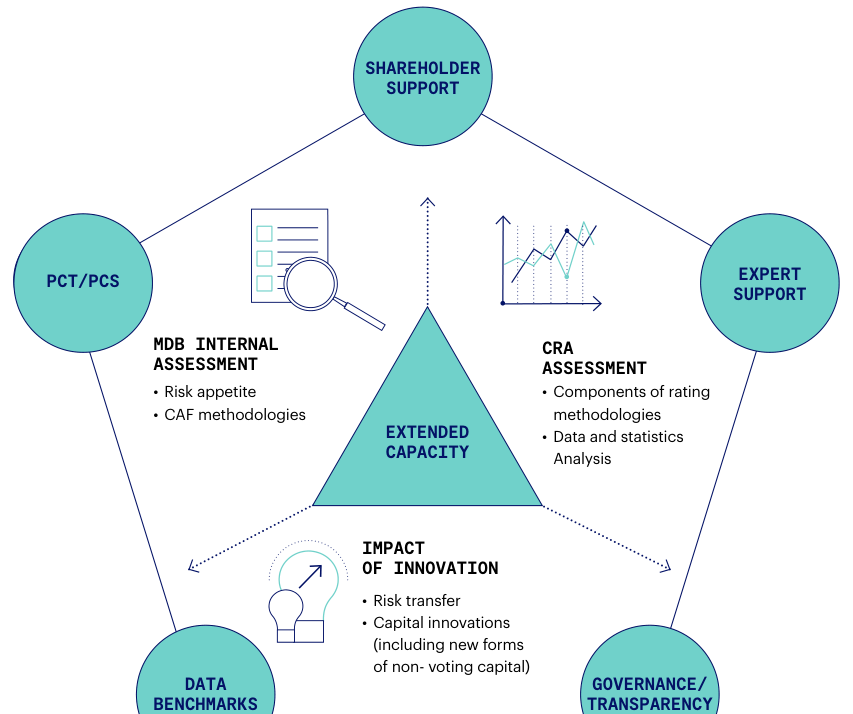
MDBs and shareholders face important challenges (see Figure 3.1) in developing recommendations that in efforts to maximize available development can drive increased MDB financing capacity while financing capacity within prudential capital ensuring their financial strength and stability. Each adequacy frameworks. This Review conceives of of these areas includes additional subtopics and four overarching areas and a set of enabling factors related recommendations.
| Policy Targets and | Policy Target: Generally | preserve | AAA rating while | minimizing |
|---|---|---|---|---|
| Principal Metrics | the probability of | having to draw | on callable capital | |
| Principal Metric: For | most, the | Capital Utilization Rate | (CUR) = | |
| Total required | capital/Total available | capital | ||
| Hard Ceiling: CUR | 100% with | buffers and triggers | at lower | |
| Required | Required Capital: | Typically economic | capital modeling | of both |
| Capital | purpose-related and | treasury | exposures with confidence | level |
| aligned with AAA | rating target. | Operational risk via | Basel II | |
| Basic Indicator Approach | ||||
| Lending Activities: | Important | differences among | MDBs with | |
| respect to private vs | sovereign and | sub-sovereign | finance as | |
| well as country/regional/product | concentration of | exposures | ||
| Available | Available Capital: | Paid-in capital, | retained earnings | and |
| Capital | reserves, with minor | adjustments | for payment schedules | etc. |
| Capital Structure: | Both paid-in | and callable capital, | with | |
| wide differences in | the relative | shares but callable | capital | |
| generally dominant. | Share of callable | capital from | highly-rated | |
| shareholders differs | significantly | across MDBs | ||
| Statutory | Lending Limit: Total | nominal | exposures < total paid | in and call- |
| Provisions | able capital and | reserves | ||
| Policy | Institutional Support: | Typically | demonstrated through | track |
| Relevance | record of capital | injections, public | statements such | as around |
| policy importance in | crises, callable | capital allocations | and | |
| shareholder commitments | ||||
| Preferred Creditor | Status (PCS): | Approaches include | calibrating | |
| obligor-specific | probabilities of | default and setting | facility- | |
| specific assumptions | for loss/time | in default | ||
| Financial | Limit Framework/Concentration: | exposure limits | (nominal or | |
| Management | risk adjusted) for single | names, | countries, sectors & | products, |
| with significant variation | in limits | across MDBs | ||
| Stress Testing | Framework: MDBs | test sensitivity to | severe | |
| shocks and simulate | portfolio | against rating agency | ||
| benchmarks | ||||
| Credit Performance: | Very low rate | of sovereign default, | ||
| with some long-duration | nonaccruals | but typically | limited | |
| loss-given-default; | higher and | varying impairment | ratios for | |
| non-sovereign exposures | ||||
| Income and Pricing | Policy: Generally | sovereign | business has | |
| very low margins | (passing on low | funding costs), with | varying | |
| degrees of flexibility | to use sovereign | pricing to support | ||
| income. Net income | split between | allocation to reserves | and to | |
| other purposes, | typically with | reserves taking priority. | Pricing | |
| of private sector | exposures generally | market-oriented | and an | |
| important source of | capital over | time |
Box 3.1
Overview of MDB Capital Adequacy Policy Formulation
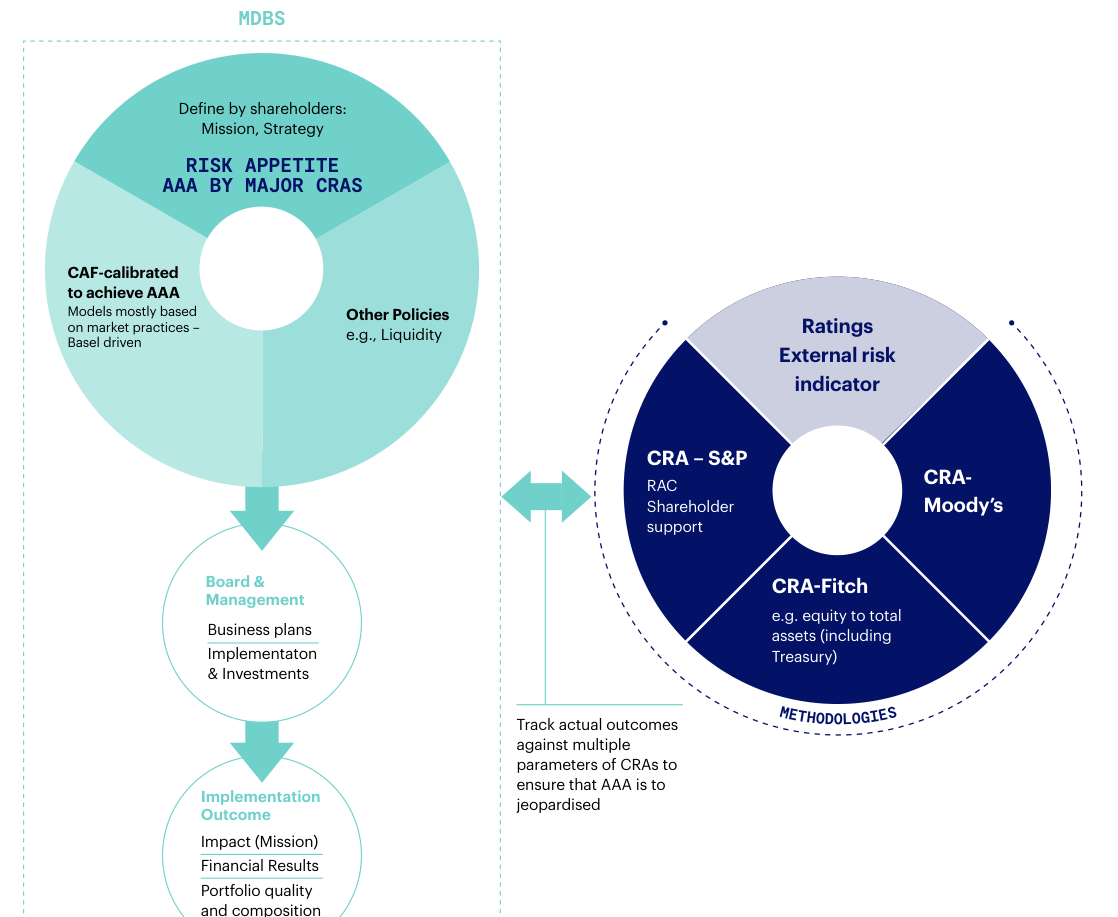
By defining overall risk appetite for their Numerous players are involved in defining MDBs, the shareholders set the scene for the MDB capital adequacy (Figure 3.2). How they development of MDB policies, business plans interact with each other and the aspects and investments. The Credit Rating Agencies of capital adequacy they affect in such considers factors and the outcomes of them, interactions are key subjects of the analysis and in determining their ratings of the MDBs. recommendations presented in this chapter.
Each MDB has a mission and strategy, both defined Credit rating agencies are key independent by shareholder countries. MDB shareholders indicators of the financial health of the MDBs. Rating and management work together to draw up a methodologies do not define MDB capital adequacy, business plan, which is based on this strategy. but rating criteria are factors in helping to define risk MDB management then implements this plan. The appetite and are reflected in financial policies and business plan and implementation are modified in targets. response to real-world events. The end objective is to achieve development impact in line with the The views of rating agencies together with shareholder-defined mission. shareholder support are also key in shaping financial market perceptions of MDBs as an Member countries are the owners of MDBs’ asset class and as co-financing partners. There is capital and must specify the risk appetite they generally a positive predisposition of investors to have for an MDB’s financial operations. This risk participating in development finance alongside appetite statement is an essential input to allow MDBs, including through syndication, Public-Private MDB management to design appropriate financial Partnerships (PPPs), guarantees and risk transfer policies. techniques as a means to improve MDB portfolio structures and diversify sources of financing. Based on guidelines and board approval, MDB financial management teams define the capital All of this highlights the fundamental importance adequacy framework, which is set in response of shareholders in discussions of MDB risk appetite to the risk appetite statement articulated by and capital adequacy. Shareholders define MDB shareholders. This is the basis on which MDBs define objectives, supply share capital and define the limits the capital components and assess how much of risk that they are willing to tolerate. These are the capital they have and what limits or targets are set three main levers defining operational capacity. for an adequate level of capital. The risk appetite statement frequently includes target credit ratings as objectives.
As business plan implementation proceeds, MDB management must monitor capital adequacy through key risk indicators, including portfolio quality, leverage ratios, concentrations, capital utilization ratios and more. Management must also regularly undertake stress tests and build in appropriate capital buffers to cope with extreme events. These activities ensure that capital adequacy is fit for purpose and aligned with shareholder risk appetite.
Redefine the Approach to Risk Appetite for MDB Capital Adequacy Frameworks
Incorporate Uplift from Callable Capital into MDB Capital Adequacy Frameworks
Implement Innovations to Strengthen MDB Capital Adequacy and Lending Headroom
Improve Credit Rating Agency Assessment of MDB Financial Strength
Improve the Enabling Environment for Capital Adequacy Governance
RECOMMENDATION 1 Redefine the Approach to Risk Appetite for MDB Capital Adequacy Frameworks
MDBs are not subject to prudential regulation and supervision. They are overseen solely by their shareholders. Shareholders want MDBs to have ready access to low-cost funding from bond markets and avoid the extreme situations which would lead to a call on callable capital. Shareholders also want MDBs to maximize development impact, use their capital more catalytically and efficiently and expand operations in poorer and more fragile countries—all of which have risk management implications.
In the face of these goals and the complexity of estimating the financial risks posed by MDB operations, shareholders have elected to reference MDB bond ratings as a shorthand to express their risk appetite. Nearly all MDBs have policies binding them to a top bond rating with the major rating agencies. Because each rating agency uses a different methodology, the most stringent components of each effectively define the limits of MDB financial policies. This can lead MDBs to build excessive buffers to cope with uncertainty and widely divergent criteria in the three rating agency methodologies. As a result, MDBs manage themselves to a level of risk appetite that can effectively be even lower than that represented by a AAA rating.
One of the key issues highlighted after the 2008/09 global financial crisis is over-reliance on bond ratings at the expense of in-house risk analysis, as noted by the Financial Stability Board (FSB).[15] The goal of the FSB Principles is to provide incentives for firms to develop their own capacity for credit risk assessment and due diligence.
Recommendation 1a
Define MDB risk appetites prioritizing shareholder-specified limits rather than external criteria
Shareholders and MDB management should define risk appetite more explicitly, based on a sound evidence base, institutional goals and impacts, the specific financial risks posed by MDB operations and shareholder risk tolerance. Guidance on risk appetite by shareholders should align with their guidance on operational priorities and strategies. MDB financial teams can calibrate their capital adequacy frameworks based on this internal definition of risk appetite. The risk appetite level can grow out of the same type of statistical confidence interval associated with a AAA risk, but it would not be dependent on the specific methodologies of the ratings agencies. The goal is to anchor capital adequacy first and foremost in the MDBs’ internal frameworks and shareholder-defined risk appetite, managing financial risks as understood by the MDBs and their shareholders and as appropriate to the MDB’s particular circumstances. External rating agency
15. Source: FSB (2010).
assessments are crucial and must be fully taken into account in calibrating MDB policy, but consideration of external factors must follow, not lead, the assessment by the MDBs and by shareholders themselves, as noted by the FSB. Such a shift in policy may also be done together with a changing approach to callable capital (Recommendation 2). This new approach should be undertaken in a coordinated fashion across multiple MDBs, thoroughly explained ahead of time to rating agencies and accompanied by clear statements of support by G20 and other shareholders, which would be key for ratings agencies and investors. By defining risk appetite internally while fully taking rating agency methodologies into account, the objective should be to ensure the MDBs maintain bond risk profiles consistent with AAA ratings from the major CRAs. Careful consideration as to how the risk appetite is reflected in policies and model calibrations may allow some adjustments that increase investing capacity.
Recommendation 1b
Ensure that MDB capital adequacy frameworks account adequately for preferred creditor treatment and the concentrated nature of MDB portfolios.
The research and discussions undertaken as part of this review have highlighted that the ways in which PCT and portfolio concentration risk are reflected in both internal and rating agency methodologies have a very substantial impact on the assessed riskiness of MDB loan portfolios and hence lending headroom (see Chapter 2).
MDB capital adequacy frameworks take PCT and concentration risk into account, although they do so to differing degrees. The Review was not mandated to undertake technical analysis on the inner workings and parameters of individual MDB capital adequacy modeling. Therefore, no attempt was made to arrive at a recommendation on current MDB practices in this regard. The Review commissioned two external studies by technical experts on these two topics. Preliminary empirical results based on aggregated MDB credit performance data indicate that the methodologies used by credit rating agencies underestimate the benefits of PCT and overestimate risks posed by concentration risk, although the implications for internal models of individual MDB could not be evaluated.[16] This work should be done for each MDB to get a sense of scale in addition to the directionality effect the Review was able to establish.
MDB capital adequacy approaches as well as credit rating methodologies would benefit from a more uniform approach to understanding the portfolio risk implications of PCT and concentration risk. More cross-MDB research on these topics, based on detailed and granular data from MDB portfolios over time, would be useful.
16. Using only publicly available data for four MDBs, the preliminary assessment of PCT found that MDBs have a probability of default from borrower countries roughly three times lower than to commercial lenders from the same borrowers (0.37%, compared to 1.13% for bank loans and 1.37% for sovereign bonds), Loss given default was roughly ten times lower (about 5% compared to 50.0%-51.8% to commercial creditors). More granular results are expected in the final study with complete MDB data. The panel also reviewed two relevant external studies evaluating PCT, “Sovereign Default History: Evidence of Supranationals’ Preferred Creditor Status” (Fitch Ratings, 16 March 2020) and “Multilateral Development Bank Ratings and Preferred Creditor Status” (Perraudin, Powell and Yang, IDB Working Paper 697, June 2016). The external studies commissioned by the panel on PCT and concentration risk were delayed due to difficulties obtaining MDB data, and as a result it was not possible to compare their results with these other studies or with rating agency methodologies. The panel will submit the results to the G20 when these studies are completed.
Recommendation 1c
Relocate specific numeric leveraging targets from MDB statutes to MDB capital adequacy frameworks
Almost all MDBs by statute cannot exceed a 1:1 ratio between outstanding exposures and total subscribed capital (paid-in and callable) plus reserves. The first statutory limit was put in place at the founding of the IBRD as a means of reassuring bond investors and then replicated at subsequently created MDBs.[17] Statutory limits do not currently constrain most MDBs, but if MDBs undertake other reforms recommended by this panel at a meaningful scale, the statutory limits would become a hard limit.
The statutory limits have no risk weighting, unlike most modern approaches to capital adequacy. Unweighted indicators have their uses (as per Basel guidelines), but the simplistic approach of MDB statutory limits, which were set decades ago when financial markets, tools and practices were very different, is not an appropriate hard limit on the capital adequacy of financial institutions today. When MDBs themselves use unweighted ratios, such as the IBRD’s equity-to-loans policy target, they are based on sophisticated financial modeling and updated regularly in response to changing circumstances. The statutory limits confuse shareholder discussion of MDB capital adequacy by introducing an additional factor that must be addressed.
Statutory changes would need to be accompanied by very clear communication that they imply no loosening of financial prudence. Instead, they represent an updating of MDB statutes in light of modern financial practices and a streamlining of the framework around MDB capital adequacy.
17. The recently-established AIIB also has a 1:1 statutory gearing ratio, but the statutes permit the bank to raise those limits to 1:2.5 with approval of a super-majority vote by the Board of Governors (AIIB Articles of Agreement, Art. 12 (1)).
RECOMMENDATION 2 Incorporate Uplift from Callable Capital into MDB Capital Adequacy Frameworks
Most MDBs have very large amounts of callable capital in their capital structure. This is a type of guarantee capital, committed by shareholders as part of their international treaty agreement but only paid in if an MDB were to face a crisis so severe as to prevent it from meeting financial obligations to creditors. As of 2020, the MDBs in this Review had a bit more than US$1.3 trillion in subscribed capital. Of that, about US$1.2 trillion (91%) was in the form of callable capital.
No MDB has ever called its callable capital.[18] As a result, it is an untested instrument. The procedures for undertaking a call are not clearly defined in MDB statutes or policies, and the budgetary treatment and legal procedures among shareholders are determined by national arrangements and vary considerably. Credit rating agencies incorporate a portion of callable capital in evaluations of MDBs such that it can raise an MDB’s ‘issuer rating’ above its ‘intrinsic’ or ‘standalone’ rating, though the uplift is limited to three notches except for one of the rating agencies.
MDBs themselves generally do not include callable capital in their capital adequacy frameworks, which recognize only paid-in capital and reserves as ‘available capital’. Protecting against a capital call is a fundamental goal of MDB financial management and is in many cases stated explicitly in capital adequacy policies. MDBs are also reluctant to expose their own ratings to the risk of shareholder downgrades. These policies are key factors driving the finance risk appetite of MDBs and limiting their operational capacity. Callable capital is considered only useful in the event of a liquidation scenario to meet creditor obligations in a situation in which the institution no longer operates as a going concern.
The one exception among the major MDBs is IDB, which since 2015 has structured its risk appetite framework explicitly around credit rating agency criteria. As a result, IDB incorporates callable capital, to the extent recognized by ratings agencies, into the thresholds the bank’s shareholders have defined to guide financial policy decision-making. This approach is consistent with the panel recommendation described below, and highlights that the IDB found it feasible to recognize callable capital in MDB capital adequacy frameworks without requiring a change to statutes, with the explicit backing of MDB shareholders. Shareholders may wish to compare the wording of the statutes of each MDB and the specific details of how callable capital’s benefits might be recognized in their capital adequacy frameworks, with reference to IDB’s experience, to determine the legal stipulations involved.
18. Moody’s noted to the Panel that the Gulf Investment Corporation—also a multilateral institution, although not an MDB—had to call capital in an emergency situation in 2008
Box 3.1
What is the probability of a call on callable capital?
The likelihood that one of the major MDBs might face circumstances requiring it to make a capital call to shareholders to repay bondholders is extraordinarily remote. This conclusion is based on extensive discussions with MDB finance teams, a close examination of the stipulations for how a capital call would be triggered and an external study commissioned by this panel modeling a reverse stress test for MDBs.
A call on callable capital would be the end point of a cascading series of adverse events. By far the most likely trigger would be a sustained increase in non-performing loans. The first impact would be rating downgrades. Once the bond rating had declined to the point where funding is unavailable at reasonable terms, an MDB would begin selling its assets, starting with its liquidity buffer. Only once marketable assets were exhausted would a capital call be necessary.
Although the reverse stress test conducted was a stylized exercise and cannot be relied upon for detailed results, it shows that the kind of real-world events needed to trigger such a scenario are extraordinarily unlikely. A credit portfolio deterioration of sufficient severity and duration to lead to a capital call scenario would be a more than 10 standard deviation event. Other shock scenarios that could lead to a capital call are similarly so improbable as to be unrealistic. Even if catastrophic shock scenarios were to occur, management and shareholders can deploy multiple policy levers to arrest a deterioration well before a capital call.
The track record of the major MDBs substantiates these findings. Through all national, regional and global crises since World War II, no major MDB has come near a capital call. Only AfDB has experienced even a single notch rating downgrade (between 1995 and 2003 by one rating agency). During that period, AfDB posted annual net profits and remained on solid financial footing. Another example is EBRD, which now faces a sudden portfolio shock due to the Ukraine conflict and sanctions on Russia. Despite this shock, the bank remains within a AAA rating from each of the major rating agencies, a far cry from needing to consider a capital call.
Recommendation 2a
RECOMMENDATION 3 Implement Innovations to Strengthen MDB Capital Adequacy and Lending Headroom
MDBs have long followed a relatively “traditional” model of managing their balance sheets. MDBs have borrowed mainly on capital markets and made long-dated development loans, which they have kept on their balance sheets until repayment. However, that model has slowly begun to evolve. Shareholders are more open to innovations, and commercial and official counterparties increasingly recognize opportunities to work with MDBs.
Innovation has also been encouraged by concerted efforts in recent years for MDBs to leverage greater volumes of private sector finance for development. Insurance firms and other investors have shown significant interest in taking exposures on MDB development projects and portfolios, including through risk transfer techniques. Institutional investors are able to benefit from the high quality of MDB due diligence, Environmental, Social and Governance (ESG) standards and PCT protections in regions (such as Africa) or sectors (such as infrastructure) in which they have difficulty investing on their own. Previous experience with the excellent credit performance track record of MDB assets adds much comfort to expand such transactions.
19. The European Stability Mechanism’s (ESM) unique provisions on callable capital are sometimes cited as an example in this regard, notably the specified timeframe and procedures to making a capital call. The Panel considers ESM to be a useful example, but also notes that it has important differences as an institution with MDBs. It is an emergency fund intended to respond to short-term balance of payment crises among member, not an MDB lending for long-term development projects. As well, all ESM shareholders are EU states who are potential beneficiaries of the ESM.
The review has considered numerous opportunities for MDBs to expand these efforts based on pilots already launched by some MDBs as well as other agencies and by the interest expressed by commercial and official counterparties. This section focuses on six areas:
• New forms of non-voting capital
• Risk transfers to the private sector
• Guarantees by shareholders
• Temporary callable capital to support MDB countercyclical lending
• The use of insurance via MIGA
• Contingent liquidity lines
Mobilizing New Non-Voting Capital
MDBs have safe assets and a demonstrably sustainable business model, credible impact measurement frameworks and project execution capacity. Equity investments in MDBs represent an attractive opportunity for investors seeking to boost the ESG or SDG-related shares of their portfolios. A further option is the offering of hybrid instruments with modest yields that might interest governments as well the private sector. The challenge is to incorporate such equity in ways that are attractive and beneficial to both public and private shareholders.
This approach can attract new forms of capital to MDBs, is scalable in ways not possible through transactionby-transaction approaches and is applicable to both global and regional MDBs. Such investments need not upset the existing governance and voting structure if they are in the form of non-voting shares. Government shareholders are understandably averse to dilution. They are generally and justifiably uncomfortable with the notion that private shareholders should participate in decisions on allocation of public funds.
Several MDBs have developed or are developing variants of non-voting capital. Trade and Development Bank (TDB) already offers non-government voting equity shares (100 percent paid-in) and is developing non-voting capital shares in the form of green equity. Some regional MDBs are also actively considering non-voting capital shares. AfDB is developing an interest-bearing asset for either private or public investors that can function as hybrid capital according to rating agency methodologies. AfDB is exploring how shareholders could use Special drawing rights (SDRs) to purchase such assets through a facility set up at the IMF.
EBRD is exploring concrete options for additional shareholder support for the bank’s increased activity in Ukraine and for participation in the reconstruction phase.
For hybrid capital, an important consideration is how much is counted by rating agencies as equity. It will also be important to frame offerings of hybrid capital in ways that signal increased, rather than decreased, shareholder support. And there is the risk that the cost of non-voting capital will be too high. Finally, exit provisions to offer investors liquidity could be problematic if asset valuation at exit is difficult to assess.
Recommendation 3a
Endorse MDB consideration of non-voting capital classes (paid-in equity or hybrid) to contribute to available capital.
Such endorsement could be accompanied by G20 guidelines stipulating that these instruments should:
(1) fully align with MDB missions; (2) be limited as a share of overall capital; (3) be subordinated to callable capital; (4) avoid targeting returns above levels prevailing in relevant MDBs; (5) not substitute for general capital increases, and (6) be long-term or in a permanent instrument with a defined exit permitted for liquidity purposes. Non-voting capital could be earmarked for lending of interest to investors in specific areas, such as ESG or wider SDG assets.
MDBs should report to the G20 by 2023 on the results of their consideration of non-voting capital and provide action plans to boards and shareholders wishing to proceed with non-voting capital.
Risk Transfers to the Private Sector
MDBs have a significant comparative advantage in investment origination, including high standards, project preparation skills and technical assistance. However, the developmental benefits of holding loan assets on their balance sheets for long periods are less clear. There is a logic for shifting a part of MDB portfolios from an originate-to-hold model to an originate-and-distribute model. Such a shift can be accomplished through outright sales, or by transferring risk to the private sector through insurance or synthetic securitization. Such transactions can be accomplished at scale for portfolios, not just individual loans, freeing up capital for new lending.
MDBs remain the lender of record and administer the loans even after some part of the risk has been transferred. They remain responsible for overseeing project implementation and ensuring that impact and ESG objectives and standards are met for the entire life of the project.
Risk transfers can be undertaken for both sovereign and non-sovereign assets. For sovereign assets, however, low (below-market) margins would in many cases likely necessitate additional public subsidies to boost returns to levels attractive to private risk off-takers.
An instructive, path-breaking precedent is AfDB’s Room2Run, which transferred mezzanine risk on a pool of 47 AfDB loans to the private sector through purchase of private insurance and synthetic securitization, freeing up $650 million in new lending. There have been zero losses so far on the portfolio, and investor interest in future deals is strong. Despite the deal’s success, questions have been raised at the high cost, caused in part by insufficient knowledge of historical credit performance by market actors (see Recommendation 5).
The ADB is also deploying risk transfers at scale. It is now working with 22 non-regional insurance companies providing credit guarantees and insurance on a pro rata basis for 24 percent of the non-sovereign portfolio, increasing non-sovereign lending capacity by about $2 billion.
Risk transfers at the portfolio level to the insurance industry hold strong potential, as the AfDB transaction and other MDB experiences show. In some ways it can be easier to structure than synthetic securitization, although pricing and capital relief are also important considerations. The credit rating agencies may consider the insurance companies as relatively high-risk counterparts, but experience to date on private sector portfolios has been good as the contractual structure is similar to a guarantee. This risk mitigating approach has not been used on sovereign portfolios, in part because the margins on sovereign loans are not sufficient to cover the cost of the insurance. Thus the usefulness of private sector insurance is still to be tested on MDB sovereign portfolios. As rating agency treatment becomes more refined based on more evidence and track records, the benefits of these transactions can increase.
A number of other issues also need to be considered. MDB net income can be affected, depending on how quickly freed-up capital is used for more lending. A risk transfer strategy could impact investment origination decisions by promoting a bias toward less risky investments in less difficult environments, which are easier to price for later transfer. On sovereign loans, uncertain treatment of risk transfers by borrowing countries, the Paris Club and other official creditors in the eventuality of a sovereign debt restructuring should also be clarified.
Recommendation 3b
Scale up the transfer of risks embedded in MDB loan portfolios to private sector counterparties by accelerating the development of funded and
unfunded instruments
The G20 should develop guidelines supporting risk transfers that: (1) advance the MDB mission, (2) accurately price risk, including through use of relevant granular data for risk weighting (such as from the Global Emerging Markets Risk Database (GEMs) database); (3) are scalable; (4) facilitate the transformation of MDB portfolios toward greener assets and greater development impact; (5) avoid a systematic reduction of risk appetite in investment origination; and (6) develop private markets for MDB asset classes.
Guarantees by Shareholders for Sovereign Loan Portfolios
Guarantees from shareholders and donors have seen increasing use, with Sweden and the UK as notable examples. When targeted at lending to a specific country they can help address concentration risk, and wellspecified portfolio guarantees can free up substantial capital for additional MDB lending. For guarantors, guarantees are efficient and because of the extremely low probability of default on MDB sovereign loans, can have limited fiscal impact. Guarantees can be pooled and offered by a subset of interested shareholders, rather than requiring the broad agreement across shareholders necessary for a general capital increase.
Combining guarantees with a grant component can offer additional opportunities for leverage. The International Finance Facility for Education (IFFEd) is an innovative example where donors can contribute to either a grant guarantee window. If countries choose additional borrowing for education, the guarantee would cover any missed repayments. The freed up MDB capital can be leveraged to finance additional lending: $1 of freed-up capital mobilizes $4 of additional lending.
IFFEd contributors would only pay in 15% of their guarantee commitment to capitalize the facility, with a contingent commitment covering the remaining 85%. This allows for increased leverage on paid-in capital. If the paid-in capital falls below the 15% threshold because of arrears, IFFEd calls for the contingent capital to restore the required floor within a specified timeframe. IFFEd has received a preliminary AAA rating due to the high ratings of its target contributors. The ADB is proceeding with a similar structure in the energy transition space.
One concern is that a facility targeted at a particular sector creates an incentive that may not align with borrowing country priorities and would give contributing countries disproportionate influence over MDB lending allocation and policies. Guarantees would be better deployed for increases in broadly defined lending capacity in support of the MDB’s entire strategy, including proportional growth in areas of interest to both potential donors and most borrowing countries, such as climate mitigation and adaptation finance.
Recommendation 3c
Recommendation 3d
Recommendation 3e
Call on MIGA and MDBs to collaborate on transferring portfolio risk from MDB balance sheets through MIGA’s insurance products and reinsurance capability.
MDBs and MIGA should proactively pursue partnership opportunities for mutual benefit. MIGA can help MDBs address concentration limits and make more projects bankable through transfer of political risk and nonhonoring of financial obligations by sovereign, sub-sovereign and non-sovereign entities. And MDBs can help MIGA utilize more of its capacity through their project origination advantages.
Liquidity backstop
MDBs hold high liquidity buffers of a year or more to mitigate funding liquidity risks in times of high market stress, when funding costs might increase significantly or funding markets shut down entirely. Considerations around buffers can vary significantly across MDBs. They are driven by factors like balance sheet size and cost of funding. These factors impact the supply of suitable assets, diversification within the liquidity buffer and whether portfolios have positive carry. A subset of MDBs hold larger liquidity portfolios than they otherwise would to maintain AAA ratings.
Some MDBs make use of commercial liquidity arrangements; with three important downsides:
Uncommitted facilities cannot be relied upon in times of a market stress.
Committed facilities need to be remunerated for the duration of the facility, akin to an insurance premium.
Eligible collateral would likely be highly liquid assets that ratings agencies would recognize as part of the liquidity buffer, with limited benefit from a rating perspective.
Cash deposits with MDBs by central banks or other sovereign-related entities in times of market stress could alleviate temporary liquidity pressures and prevent costly liquidation of assets. Temporary funding pressures experienced by MDBs during the global financial crises are a case in point. Such relationships with counterparties who have countercyclical features by the nature of their business model could be particularly beneficial.
Greater benefit would come from the availability of a liquidity backstop for MDBs through access to central bank liquidity against posting as collateral assets from their lending portfolios.[21] This could mitigate potential leverage constraints, which would provide additional lending capacity. It would also give MDBs additional degrees of freedom in managing their liquidity, which could address possible profitability issues related to negative carry of the liquidity portfolio. And it can alleviate specific rating agency metrics that can be problematic for certain MDBs, for example Fitch’s equity-to-total assets ratio.
With very few exceptions – most notably the EIB via the European Central Bank (ECB) - MDBs do not have access to central bank liquidity. The reasons are threefold:
In the absence of a central bank whose shareholding is broadly aligned with that of an MDB, negotiating an arrangement of this kind would be difficult.
Access to a central bank facility would most likely need to be linked with some form of ongoing regulation/supervision, which would be challenging in a pooled arrangement and even on a voluntary basis could be problematic for MDB governance and autonomy.
The respective central banks would need to have access to currencies in which MDBs’ obligations are denominated or that can be converted into such currencies even under extreme market stress conditions.
Recommendation 3f
Explore ways of providing MDBs with access to central bank liquidity, including pooled agreements under the supervisory umbrella of one central bank.
21. A share of EIB’s loan book is eligible collateral for ECB. The ECB accepts as collateral some non-marketable assets, including credit claims where the debtor or guarantor is a euro-area public sector entity or non-financial corporation. See: https://www.ecb.europa. eu/paym/coll/standards/nonmarketable/html/index.en.html
RECOMMENDATION 4 Improve Credit Rating Agency Assessment of MDB Financial Strength
The three major credit rating agencies of S&P, Moody’s and Fitch dominate the market for MDB bond ratings.[22] The fact that MDBs are very highly rated provides important advantages in pursuing their development mandates, notably very low funding costs and access to market borrowing even in times of financial crisis. As a result, the way in which each agency evaluates MDB creditworthiness is a key factor in managing the ongoing MDB operational capacity. Target ratings and aspects of rating requirements are part of risk appetite statements as well as financial and risk policies.[23]
MDBs pose a challenge to ratings agencies. On the one hand, they are similar to commercial financial institutions as they carry out lending and investing activities. On the other hand, they have very specific features: development and counter-cyclical operational mandates, below-market loan pricing, a structurally concentrated loan portfolio, extraordinarily strong repayment record in part due to preferred creditor treatment and an unusual capital structure, among others. Many of these characteristics are not easily incorporated in bond rating methodologies. In recent years, all three agencies have built increasingly sophisticated and complex methodologies based on the following components:
• Capital adequacy
• Liquidity and funding
• Policy importance of the MDB
• Internal governance and administration
• Extraordinary shareholder support (mainly callable capital)
Despite these conceptual similarities, the three methodologies vary substantially in actual metrics used, how they are combined and the degree of transparency and subjectivity. Due to policy requirements at most of the major MDBs, they must meet the AAA thresholds of whichever component of the three methodologies is the most binding. The result is that MDBs effectively manage their operations to a composite methodology of the most restrictive metrics of all three agencies and are exposed to any changes in methodology, MDBs build in rating agency model risk buffers. This is an extremely inefficient way to make use of scarce capital.
The Panel commissioned two external studies to examine the issues of PCT and the concentration risk posed by MDB portfolios.[24] Definitive results are pending, but preliminary findings indicate that the methodologies
22. U.S. Securities and Exchange Commission (2022) p.24. Other credit rating agencies do exist and are relevant in certain national markets, but none come close to the importance of S&P, Moody’s and Fitch as a reference for global bond investors.
23. Of the 15 MDBs included in this review, 10 have the top AAA/Aaa rating from all three agencies, four are in the high investment grade range (CAF-DBLA the lowest at A+), and MIGA is not rated. All MDBs are rated by all three agencies, except for MIGA (unrated) and New Development Bank (not rated by Moody’s). The World Bank Group does not pay Fitch for a rating, but Fitch rates IBRD on an unsolicited basis. It does not rate IDA and IFC.
24. The latter was undertaken by a co-author of the original commercial bank methodology on which S&P bases their concentration penalty.
employed by ratings agencies underestimate the benefits of PCT—both in terms of likelihood of repayment delays and loss in the event of arrears—and overestimated the risks posed by concentrated MDB portfolios. Both issues pertain mainly to MDBs’ lending to sovereigns. Rating agencies should build on evidence-based studies such as these to refine their methodologies in these two areas.
MDB finance and risk teams hold regular discussions with rating agency analysts on their institution’s rating and offer feedback to proposed changes in rating agency methodologies. However, the influence of MDBs on rating agencies is inherently limited, as the agencies are private businesses. MDB ratings represent a very small share of rating agency business, which reduces MDB leverage despite the importance of the sector to global development.
This review proposes two sets of recommendations on the methodologies and processes of credit ratings for MDBs. The first relate to the role of G20 members and other MDB shareholder countries in influencing rating agency methodologies. The second highlights a key area where rating agencies may wish to consider reforming their methodologies to address inconsistencies or weaknesses.
Recommendation 4a
Strengthen communication of G20 members and other shareholders to inform rating agency views of MDBs with respect to the importance of MDBs and
Recommendation 4b
Rating agencies can take steps to strengthen their MDB evaluation methodologies.
This review held extensive discussions with rating agency analysts and MDB treasury and risk teams, and closely analyzed the MDB methodologies of all three agencies. The methodologies diverge considerably from one another in important ways, which is not unexpected in a competitive marketplace. More problematic are a number of conceptual and empirical inconsistencies and the use of proxy variables that do not always appear warranted. The Review highlights a few key areas in the subsequent paragraphs where ratings agencies could further reflect on their methodologies.
The thresholds to achieve top ratings in key metrics is in some cases extremely high, to the point where reaching those thresholds would effectively render the MDBs dysfunctional as a financial institution and turn them instead into a type of unleveraged fund or asset-holding trust. Leverage and liquidity ratios are particularly strict. Thresholds could better balance the stringency needed to achieve a AAA rating with the realities of being a going concern.
Leverage ratios not accounting for asset risk have their place (as per the Basel approach), but their weighting seems excessive in some methodologies and can create perverse incentives for MDBs. Metrics related to MDB portfolio risk appear in some cases to under-estimate inherent MDB strength and over-estimate risks derived from their normal operations. In particular:
• Preferred creditor treatment could be better reflected in some rating methodologies. This includes not just the reduced likelihood of a delayed loan repayment event but also the extraordinarily low loss rates in the event of delayed repayment, as illustrated by the preliminary results of an external study commissioned by the Panel.[25]
• The evaluation of risks posed by structurally concentrated loan portfolios of sovereign-focused MDBs are highly divergent and in some cases extremely punitive to risk-weighted assets.
MDBs are in some cases penalized by the forward-looking approach taken by rating methodologies for acting counter-cyclically in response to crises, even in the absence of a deterioration of financial metrics and with shareholder support. Methodologies should better factor in the counter-cyclical mandate of MDBs and recognize that it i) underpins factors like preferred creditor treatment and ii) can itself play a role in reducing risks by helping countries overcome crises.
The rationale for deciding which portion of callable capital to be factored into rating methodologies appears unclear and insufficiently values the commitment of many major non-borrower countries.
25. Using only publicly available data for four MDBs, the preliminary assessment of PCT found that MDBs have a probability of default from borrower countries roughly three times lower than to commercial lenders from the same borrowers (0.37%, compared to 1.13% for bank loans and 1.37% for sovereign bonds), Loss given default was roughly ten times lower (about 5% compared to 50.0%-51.8% to commercial creditors). More granular results are expected in the final study with complete MDB data.
Rating agency approaches to evaluating MDB innovations (as per Recommendation 3) can leave MDBs and market participants unclear of their benefit until lengthy negotiations with agency analysts are completed. MDBs make up a small portion of CRAs’ activity and understanding of MDB-specific issues is not always broad-based within each firm. Rating agency risk weighting approaches, including for risk transfers, would benefit from incorporation of more granular data on actual MDB credit performance A more systematic consideration involving expertise from across rating agency departments would be beneficial. A significant amount of professional judgement is exercised by rating agencies in interpreting information from MDBs and applying ‘notching’ to components of rating methodologies. More transparency in how judgement is applied would aid understanding the impact of operational developments on ratings.
Recommendation 4c
Rating agencies and MDBs should work together to develop common standards for evaluating the risk weights of ESG-related assets on MDB balance sheets.
Rating agencies are increasingly incorporating ESG concerns into their methodologies. MDBs have a leading role in defining and acting on ESG issues and attracting private and philanthropic finance in the ESG sector, as mandated by their shareholders. The bulk of MDB activities are considered as ESG by private sector investors. Rating agencies should reflect this role in their evaluation methodologies. It is important that implications on ratings be properly reflected given growing ESG assets at MDBs, also in the context of evolving regulatory consideration of the potential for reduced risks or improved collateral value through greener portfolios. MDBs should be encouraged to anticipate in their methodologies the benefits of evolving treatment of MDB ESG assets in general and in particular of possible regulatory adjustment of risk weights or collateral value for bank assets associated with high exposure to ESG risks, especially climate ones. MDBs should be encouraged to develop common standards for their ESG assets in close dialogue with rating agencies to ensure early consistency. This would be consistent with the assessment of MDB ESG risks already used by many investors and capital markets actors.
Methodologies vary across rating agencies on the use of MDBs internal risk weighted asset models. However, it is the sub-category by far the most likely to change year-on-year, and hence has an outsized importance in ratings. ESG treatment by rating agencies for MDBs assets should be a priority area. This should provide added incentives for channeling more market savings into MDB ESG portfolios. It will also impact on the treatment of risk transfer transactions as MDBs maintain their ability to protect ESG standards/results and development objectives in administering projects where risks have been transferred.
RECOMMENDATION 5 Improve the Enabling Environment for Capital Adequacy Governance
Information asymmetries, dynamics between shareholder boards and management and the absence of wellunderstood benchmarks create a challenging environment for capital adequacy governance. Methodologies, indicators and modeling approaches differ between MDBs and the lack of comparability can result in conflicting views about the severity of capital constraints at any one time. This has become particularly problematic in recent years as the demands on MDB to achieve development goals have risen faster than available capital, leading to increasing interest among shareholders for more systematic and comparable information across MDBs.
Full standardization is unlikely and not necessarily desirable. It is, however, possible to gain a better understanding of where capital adequacy frameworks are the same or different and why. Developing a consistent understanding is a process that enables continued clarification and refinement and can support learning and better governance. The key steps would be: establish periodic cross-MDB benchmarking based on consistent metrics, create mechanisms to support MDBs and shareholders in managing information related to capital adequacy and accelerate dissemination of core MDB credit statistics and related analyses through the GEMs.
Addressing these issues can improve the governance environment surrounding MDB capital adequacy, which is essential to enable the other recommendations in this report and, more broadly, to place future discussions around MDB financial capacity and capital needs on a firmer footing. It would support assessments by the credit rating agencies. And it would be positively received by financial markets, which have long been calling for more transparency through data disclosure, harmonization and standardization, in particular in order to assess the risks of investing with or alongside the MDBs.
Capital Adequacy and MDB Board Governance
This Review was not tasked by the G20 with addressing MDB governance issues, which is a broad and complex topic.[26] Nonetheless governance must be considered in any serious discussion of capital adequacy. The role of shareholders and board structures is fundamental to financial governance, as is highlighted by all modern good practice recommendations.[27] Shareholder representatives on MDB boards and board committees have the responsibility to review financial performance, approve financial policies and specify risk appetite and institutional goals. This gives management a clear set of targets and parameters to implement in MDB operations.
26. For more on this issue, see among others Organisation for Economic Co-operation and Development (OECD) (2015) and Zedillo (Chair) et al. (2009).
27. See for example BCBS (2019).
The boards of most MDBs covered by this Review are very different from those of commercial financial institutions. Between two-thirds and three-quarters of the members on average come from national administration and rotate for a relatively short term of service.[28] At many MDBs, board members are involved in approving operations on a weekly basis, whereas at other financial institutions board members focus only on higher-level fiduciary, strategic and policy issues. MDB board members are tasked not just to guide and safeguard the MDB itself, but also to further the economic and foreign policy interests of the countries they represent. While a good relationship between the board and MDB risk teams can help bridge the gap, it does not provide board members the in-depth understanding and information required to provide independent oversight. This set-up is a function of the unusual nature of MDBs—a financial institution, but also an international organization owned by national governments to address issues of public concern.
These governance arrangements create an imbalance in information and expertise between the MDB risk management structures and the relevant board committees. This can impede informed, effective discussion and decision-making on risk appetite and the structure, nuances and implementation of capital adequacy frameworks. They are not well aligned with sound financial governance practice as recommended for example by the Basel Committee, which calls for a clear separation between ongoing management responsibilities and the more strategic role played by boards to provide high-level direction and oversight.
Several MDBs in this Review have experimented with other types of institutional arrangements to find compromise solutions to the dual nature of board member responsibilities. EIB, CAF-DBLA and AIIB all have a sharper differentiation between board and management roles and have mechanisms to involve more technical expertise in financial policy deliberations. AIIB’s Accountability Framework is a particularly relevant case study that other MDBs might examine, as noted by an article written by shareholder government representatives.[29] AIIB’s Board Audit and Risk Committee has external, independent members that are valued by both Board and Management.
Other MDBs not included in this Review, including Trade and Development Bank, include non-executive board members with specialized expertise to strengthen oversight functions on capital adequacy and other financial policies.
Recommendation 5a
Consider implementing measures to strengthen the ability of shareholder boards at MDBs to effectively undertake their responsibilities in setting the
parameters of risk appetite and capital adequacy policies and overseeing their implementation.
28. Executive directors at World Bank, AIIB and ADB have a two-year term with possibility of renewal, compared to three years for AfDB, CAF-DBLA, EBRD, IDB and IsDB, and five years for EIB.
29. See for example Von Müller, Camilo and Elke Baumann (2019).
Due to the complexities of the topic and the strictures of the Review’s terms of reference, the Panel does not propose detailed recommendations on board organization or governance. Extensive discussions with stakeholders and a review of the literature and best practices nonetheless make it clear that MDB capital adequacy issues cannot be fully addressed without reference to governance arrangements, and in particular the role of shareholders.
One potential starting point would be for MDBs to consider the inclusion of independent, non-executive and non-voting board members with expertise in risk and audit functions. These could be included as observers tasked with providing support on these issues or given more authority as chairs of audit and risk committees. An alternative would be for shareholders to appoint some board representatives or advisors with technical qualifications on capital adequacy issues, who can contextualize capital adequacy and wider operational considerations. Another measure addressed in Recommendation 5b below would be to create an independent body to collate information, undertake studies and provide expert support to board members on matters related to capital adequacy. More broadly, MDBs may consider refining the current board governance structure by better separating the roles and responsibilities of executive management and the shareholder board.
Regular benchmarking
Well-designed capital adequacy frameworks and related policies and procedures have a number of important components summarized in Table 3.2 below and discussed in Chapter 2 in more detail. Their key elements and drivers should be accessible to shareholders and other stakeholders in a manner that is readily understandable and that allows comparison across institutions. In the Panel’s view, this would be best addressed with a regular capital benchmarking report that presents MDB capital adequacy frameworks in a standardized format and with consistent definitions and metrics. This would address an important gap in MDB ’s governance toolkit on financial policy, and support shareholder decision-making at a time when there are considerable expectations for MDBs to scale up and deliver on the SDGs and climate goals. Given the rapid developments in the global economy such a report would best be prepared annually, though the exact frequency would need to be considered by shareholders. Shareholders may wish to consider combining regular capital adequacy reporting with the reporting mandates already in place on MDB balance sheet optimization, due to the close relation of these issues.
BUILDING BLOCKS OF CAFS INCLUDING RELATED POLICIES & PROCEDURES
REQUIRED LEVERAGE RISK APPETITE CAPITAL LIQUIDITY AVAILABLE RATIOS GOVERNANCE & PRINCIPAL (MODELS, & FUNDING CAPITAL & STATUTORY & MANAGEMENT METRICS PARAMETERS, APPROACH PROVISIONS ASSUMPTIONS)
PREFERRED INSTITUTIONAL CALLABLE EXPOSURE CREDITOR SUPPORT CAPITAL CONCENTRATION TREATMENT MDB-SPECIFIC FEATURES
Such a report could build on the benchmarking methodology and tables in the present report but should go a step further by harmonizing nomenclature and concepts and mapping methodologies across the MDBs to flag where they have commonalities and where they differ. In particular, it should provide a comparable risk adjusted capital indicator across MDBs and describe its components and their methodologies. The aim should be to i) better support capital and headroom comparisons for regular operations as well as countercyclical buffers and ii) give comfort to shareholders that these concepts are broadly aligned across institutions (see Recommendation 5c).
The Panel further recommends going beyond an annual benchmarking exercise, with shareholders and each individual MDB instituting regular capital resources reviews, as is already the practice of some MDBs (for instance the EBRD has a 5-yearly cycle). Such a review would offer an opportunity for shareholders to consider the MDBs’ capital situation and set it against strategy in a deliberate manner, rather than reacting to events.
One challenge is that the standardization inherent in benchmarking might not adequately reflect the specific circumstances of each MDB. The exercise needs to be conducted in a manner that does not undercut MDB management responsibilities, but rather builds on them. Further, care needs to be taken to ensure that data sharing and curation as well as capital reviews are cost efficient and value adding rather than burdensome.
Recommendation 5b
Prepare regular capital benchmarking reports on each MDB’s capital adequacy framework in a comparable format employing harmonized
definitions and support regular MDB reviews of capital resources.
Enhanced arrangement for sharing financial management practices
In light of the diversity of MDBs and the complexity of capital adequacy frameworks, shareholders should consider creating enhanced arrangements (such as an MDB Forum on Financial Best Practices) to collect and curate the benchmarking information and prepare joint reports, ensuring validation and agreement by each MDB, subject to strict non-disclosure agreements. Arms-length data gathering and curation would provide an added layer of credibility and can support informed judgement among shareholders, rating agencies and investors. Such an arrangement could build on the established chief risk officer networks but should involve other parts of the institutions (finance, strategy) and, crucially, shareholders.
MDBs and shareholders might leverage the knowledge and expertise such an arrangement would provide for other potential benefits. Acting as a resource for MDBs and shareholders, this would allow to:
• Continue the work on benchmarking and comparability of data, and issue an annual report to shareholders;
• Share best practices, including by preparing a ‘shareholders guide’, and forging best practices on urgent matters such as the treatment of climate risk;
• Train new executive directors and other parties as required;
• Serve as a venue to convene and facilitate informal discussion among shareholders on capital adequacy and financial management;
• Commission analysis on behalf of MDBs as a collective, leading to efficiencies.
In addition, if desired, such an arrangement could play a role in implementing some of the Review’s other recommendations, including promoting dialogue and exchanges of views between MDBs as a group and rating agency senior management, with the dialogue between the Institute of International Finance (IIF) and the Paris Club as a possible model. This would be additional and in no way replace bilateral engagement on specific ratings. Such a forum could also act as a clearinghouse for innovation, giving MDBs a venue in which to share experiences, promoting learning and cross-pollination.
There are many possible set-ups that could fulfil this mandate, including virtual ones, and this may be an arrangement that evolves over time. In the Panel’s view, an academic institution or consortium might be well positioned to support existing MDB risk team networks in this function. Some of its functions may attract fees, while secondments from shareholders and MDBs could minimize costs. Key features should include:
(1) a focus on collaboration, (2) independence, (3) strong data confidentiality, (4) core staff promoting continuity, (5) clearly defined relationship with MDBs and shareholders, and (6) inclusiveness, with access available to all MDB shareholders on an even basis.
Recommendation 5c
Establish enhanced arrangements on issues of capital adequacy and risk management to promote ongoing MDB benchmarking, share best practices
and facilitate discussion among MDBs and shareholders.
Data transparency
Since its establishment in 2009, the GEMs Consortium has developed the only emerging market and developing economies credit database of its kind. GEMs membership (twenty-four institutions) and contributing members (eleven) have increased over time. Its data is pooled from many years of contract level data points and include credit defaults on the loans extended by consortium members, the migrations of their clients’ credit rating and the recoveries on defaulted projects. GEMs covers private, sovereign, subsovereign and sovereign guaranteed lending, cutting across sector, country and income groups and regions.
GEMs provides asset class information that is valuable to a range of market parties assessing or investing in individual MDB loans or in portfolios of MDB assets. These include, private investors (see, for example, the ILX Fund), credit rating agencies, insurers and securitization agents and investors, as well as sovereigns providing project or portfolio support to MDBs. Wider access to GEMs would build investor understanding and strengthen risk assessment, expanding investor interest and better risk transfer opportunities for MDB assets, improving capital efficiency and scaling capacity for MDBs.
Long-standing challenges have greatly limited GEMs information sharing and publication. The GEMs organization structure is a loose consortium of members with day-to-day management and control sitting within EIB. Data contributions are on a voluntary basis with no formal commitment to provide data in the future. EIB’s leadership and contribution have been valuable, and members’ efforts to build and improve the data quality for their own use have been successful. But the current structure is not well suited to take GEMs to the next level and reap its wider benefits.
To make GEMs more widely available and sustainable, the organization needs to be transformed into a standalone entity with strong governance, management and sustainable funding, including an independent chief operating officer supported by MDB contributing members. MDBs need to commit to ongoing contributions of data with appropriate protections for transaction anonymity. This new, robust structure should be designed and implementation underway before the end of 2022.
Some of this work is already ongoing, with significant efforts from participating MDBs. However, it will be challenging to implement in terms of data governance, management and quality control. It will require more successful collaboration among MDBs and Development Finance Institutions (DFIs) than has occurred to date. It will also require funding on an ongoing basis, attention and support from shareholders and buy-in from rating agencies to use relevant data for risk ratings.
Recommendation 5d
Endorse and support ongoing efforts to transform GEMs into a stand-alone entity with legal status and secured budget able to curate and disseminate
regularly-supplied MDB statistics and analysis to support improved knowledge on emerging market risks for MDBs, private investors and rating agencies.
Under the new structure, GEMs should: (1) transform the GEMs organization into a robust, stand-alone entity with members committed to providing data on an ongoing basis, (2) publish more granular statistics and analysis of the data showing credit performance for sovereign and private sectors by sector, countries or country groups, and regions, (3) share anonymized statistics with private investors and ratings agencies and
(4) provide risk analytics, charging fees as needed. In addition, efforts should continue to add more members contributing data as well as to harmonize, anonymize, and ensure the quality of the data, with the aim of publishing more disaggregated annual statistics and data analytics reports in late 2023 or first half of 2024.
Consideration might be given to combining the GEMs organization with the arrangements discussed under the previous recommendation. The Panel has not reviewed the options in this respect but notes that it is important for the enhanced GEMs to have a clear business focus.
The challenges of today highlight more than ever be done deliberately and supported by a clear the need for MDBs to make the most efficient communication strategy. Shareholders should and effective use of the public resources under carefully consider associated risks and mitigating their stewardship. In the judgment of this Panel, actions. shareholders can increase MDB’s capacity to address global development needs through their • Recommendation 3 (innovations) includes approach to risk appetite and capital adequacy. multiple tools that have been used or piloted by Collectively, the recommendations proposed here MDBs or are used in commercial markets and could add several hundreds of billions of dollars in appear technically viable. Some options not additional portfolio room in the MDBs included in only strengthen MDB capital efficiency options this Review over the medium term depending on the but also offer commercial and philanthropic depth and scale of implementation, while posing investors SDG investment opportunities at scale. minimal additional risk to their financial stability. The Implementation complexity varies but headroom risks of inaction are far greater. benefits are potentially substantial, depending on the scale at which shareholders wish to pursue This chapter summarizes the key recommendations them and the terms of sharing risks and returns articulated in detail in Chapter 3, highlighting between commercial and official counterparties. interactions and setting them out against the Many of the tools have a cost to develop and broader context. MDBs could work more cooperatively to build this tool kit to reduce and share these costs.
• The first two Recommendations (risk appetite Innovations must be pursued in ways that are for capital adequacy and recognizing the consistent with MDB missions and require strong benefit of callable capital) go to the core of shareholder governance and management MDB capital adequacy.[30] They have the potential oversight. to increase lending headroom substantially. They require shareholders to consider their own • Recommendations 4 and 5 (engagement with approaches to risk appetite and will be watched rating agencies and enabling environment for closely by market participants. They should capital adequacy) could be pursued without
30. As noted in the report, applicability to individual MDBs will vary. In particular, Recommendation 2 will not apply to MDBs that have no callable capital, notably IFC and IDB Invest.
delay and irrespective of the G20’s view on the The table below summarizes key actors in decisions other recommendations. They pose relatively low on recommendations and gives broad indications political and technical challenges and require of complexity and time frames for execution. It modest resources. Potential gains in terms of is important to re-emphasize, however, that the lending capacity are indirect, would materialize recommendations are interrelated and time frames only over the medium term and are not readily for implementation are inter-dependent. This means quantifiable. Nonetheless, they would improve that in some cases the time frames indicated below the way MDBs and shareholders manage capital will be cumulative, with for example two reforms adequacy and decide capital needs now and in each requiring 1-2 years adding up to a timescale of the future. They would help position MDBs and 2-4 years. Decisions about the treatment of callable shareholders to better address the discussions capital in capital adequacy frameworks, for example, around MDB capacity that will inevitably arise on are related to decisions regarding risk appetites, a regular basis in coming years to face long-term statutory changes, innovations to increase available development and climate challenges and respond capital, evolution in rating agency methodologies, to short-term crises. Additionally, some could have and the availability and use of granular data on MDB significant market-making impact through better credit track records to strengthen risk weighting. In understanding of MDB credit performance. Risks some instances, implementation may need to take are minimal. place in a sequential manner with one reform, or a set of reforms, necessary to enable others. This will affect implementation timelines, which may also differ significantly between individual institutions depending on their specific arrangements.
2A Capital Adequacy Frameworks CRAs Low | Med. 1-2 years Shareholders
RECOMMENDATION ADDRESSED TO COMPLEXITY TIME FRAME OF EXECUTION
Implement Innovations to Strengthen MDB Capital Adequacy and Lending Headroom
Endorse MDB consideration of non-voting capital MDBs 3A classes (paid-in equity or hybrid) to contribute to CRAs Med. | High 1-2 years available capital Shareholders
Scale portfolio risk transfers to the private sector of MDB MDBs 3B Med. | High 1-2 years non-sovereign loans to facilitate additional lending Shareholders
Encourage shareholder guarantees on loans related MDBs 3C to cross-cutting priorities Shareholders Low 1-2 years
Support collective shareholders commitments of Shareholders 3D Low 1 year pools of additional callable capital
Support adaptation of MIGA’s products & reinsurance MDBs 3E capability to partially transfer portfolio level risk from Shareholders Low | Med. 1-2 years MDB portfolios
Consider ways to provide MDBs access to central Shareholders 3F High >2 years bank liquidity
Assess CRA Methodologies and engagement
Strengthen communication with credit rating MDBs 4A Low <1 years agencies; increasing mutual understanding Shareholders
Encourage steps by rating agencies to strengthen CRAs 4B Low | Med. 1-2 years their MDB evaluation methodologies
Take proactive approach to incorporation of ESG CRAs 4C Low >2 years factors in rating methodologies
Improve the Enabling Environment for Capital Adequacy Governance
Strengthen the ability of shareholder boards to MDBs 5A effectively set parameters of capital adequacy Shareholders Low <1 years policies and overseeing their implementation
Establish yearly capital benchmarking report presenting MDBs 5B key elements & statistics in comparable format Shareholders Low <1 years harmonizing definitions overtime. Support regular reviews of capital resources in light of MDBs’ strategies
Establish enhanced dialogue and cooperation on capital MDBs 5C Low <1 years adequacy, risk management and risk mitigation tools Shareholders
Transform GEMs into stand-alone entity to support MDBs 5D improved understanding of MDBs by private investors Shareholders Med. 1-2 years and CRAs
MDB capital adequacy is highly complex, MDBs, the capital and budgetary resources the intersection of many factors—including they provide and the degree of risk they development goals, policy frameworks, risk are willing to accept. Shareholders must evaluations and balance sheet components, as address those tensions if they wish to enact well as external perceptions, notably from financial meaningful capital adequacy reforms. market actors—that interact in ways that are not immediately obvious. This leads to five key Third, the reforms proposed in this report can strategic considerations. reinforce one another when enacted as part of a coherent reform package, rather than First, capital adequacy reforms and as individual “menu” options. These reforms innovations would be most effective as part are designed as a short- and medium-term of a structured and coordinated program of action plan to help MDBs make the most MDB actions enjoying a degree of consensus efficient use of scarce share capital. It is critical among the G20 and other shareholders. that they are perceived as such, rather than Signaling from shareholders is extremely as an easy fix to boost lending capacity. important in shaping how MDB policies and actions are perceived, which impacts their Fourth, coordinated implementation by bond ratings and, ultimately, reliable access a substantial number of MDBs would be to low-cost funding. A broader agenda is not beneficial to market perceptions, as rating a necessary precursor to capital adequacy agencies rely heavily on comparisons across reforms, but it would be beneficial to how MDBs in their evaluations. At the same time, markets perceive them, giving greater clarity this does not mean uniformity: the Panel’s on the purpose of reform as well as a sense of recommendations vary in their applicability how it fits into shareholders’ overall strategy. based on each MDB’s business model and scale, operating environment, development Second, G20 members and other mandate and other specific features. shareholders have a central role to play in MDB capital adequacy. With a few Fifth, most MDBs’ internal resources are exceptions, financial capacity issues at MDBs 5 constrained. If reforms increase lending can sometimes be portrayed as technical capacity and therefore portfolios, G20 problems requiring technical solutions by shareholders need to ensure that operational MDB management. This is true in some risk is managed appropriately, including cases. But the root issues are often located adequate staff resources to support and at the level of shareholder governance, and sustain high quality operations. This includes in particular the disjunction between the front line project teams as well as supporting development goals shareholders set for the staff engaged in transactions and portfolio management tasks.
This report has outlined five broad areas where the Panel sees opportunities to improve MDB capital adequacy and related policies to allow them to more efficiently deploy shareholder resources. The remainder of this chapter considers implementation: how recommendations relate to each other, upside benefit, feasibility, timing, risks and mitigation measures. The aim is to provide guidance to G20 members and other shareholders on how to assess options and trade-offs as they consider whether and in what direction to move ahead.
Market perception of reforms is a critical consideration across all recommendations. Similar actions are likely to face very different receptions if they are pursued as part of a deliberate and coordinated strategy as opposed to a crisis response to unforeseen or uncontrolled events. A clear and robust communication strategy and vocal shareholder support are key to successful implementation.
| RECOMMENDATION | ADDRESSED TO | COMPLEXITY | TIME | ||
|---|---|---|---|---|---|
| OF EXECUTION | |||||
| Redefine the Approach | to Risk | ||||
| 1 | Appetite in Capital | Adequacy | |||
| Frameworks | |||||
| 1A | Shift risk appetite definition | toward shareholder- | MDBs | ||
| defined limits | Shareholders | Medium | 1-2 | ||
| Ensure frameworks account | for MDB-specific | MDBs | |||
| 1B | Low | Med. | 1-2 | |||
| features | |||||
| 1C | Relocate specific numeric | leverage targets | MDBs | ||
| from MDB statutes | Shareholders | High | >2 |
Recommendation 1—2
Core Reforms to MDB Risk Appetite and Capital Adequacy
The thrust of Recommendations 1 and 2 is to shift the way MDBs and their shareholders understand, define and implement capital adequacy frameworks. They hinge on the willingness of shareholders to re-think their approach to defining risk appetite and communicating that clearly to MDB management for implementation.
These two sets of recommendations are linked. Recommendation 1 on defining risk appetite with less reference to rating agency methodologies can be implemented on its own. Recognizing the benefits of callable capital within MDB capital adequacy frameworks (Recommendation 2) can instead only be done in conjunction with Recommendation 1, as shareholder risk appetite is an essential part of its implementation.
Most aspects of these two recommendations can be enacted at the level of MDB boards (Governors and Directors), without statutory or governance changes. However, substantial prior work is needed by shareholders (to evaluate risk appetite) and MDB management (to support shareholders considerations and prepare for the implications of these changes), including to manage the expectations of market participants.
Three key inputs would help shareholders properly evaluate risk: i) improved shareholder understanding of downgrade triggers,[31] ii) evidence-based analysis of the impact of falling below AAA by one out of three
31. The three main CRAs have very different metrics and web of considerations which need to be navigated when reviewing rating downgrade risks, however most MDBs focus on key aspects which represent greatest vulnerability.
rating agencies;[32] and iii) stress tests and analysis of the types of shocks that the MDB would need to face before having to call on callable capital.
Greater understanding of how preferred creditor status and portfolio concentration impact MDB portfolio performance (1b) are technical issues. G20 shareholders should commission granular analytical studies (building on those done as part of this Review) and require MDB risk teams to compare results with the parameters used in their capital adequacy models, to avoid excessive conservatism.
Replacing numerical leverage limits in MDB statutes (1c) would require changes to MDB articles of agreement. Despite this political hurdle, the technical content of this reform is much simpler due to wide recognition that MDB statutory limits are outdated and not aligned with modern financial practices.
There are divergent opinions regarding whether implementation of Recommendation 2 would require amending MDBs articles of agreement. This will depend both on the drafting of each MDB’s governing documents and on the details of the proposed implementation. The view of the Panel is that some form of implementation should be possible in most MDBs without statutory changes, but this is an issue that boards will need to consider carefully in light of each institution’s specific circumstances.
Benefits
Implementation of Recommendation 1 can help modernize and rationalize analysis and debates around risk, capital and lending capacity. Through proactive review among shareholders and between shareholders and management there can be an increased understanding of how risk appetite translates into capital adequacy frameworks, capital requirements and lending capacity of MDBs. This will make medium-term vulnerability of operational planning better understood and less reactive to changing circumstances, and permit more realistic decision-making on MDBs’ ability to implement shareholder mandates. Recommendation 2 would take advantage in a prudent manner of the very substantial callable capital that shareholders are already committed to as part of their treaty obligations to MDBs to increase lending capacity in a way that has already been conceptually validated by credit rating agencies.
Combined, these two recommendations have the potential to have the biggest impact on MDB lending headroom, with a very substantial one-off gain. This conclusion is supported by modeling undertaken specifically for this review by an external consultant as well as a review of several external studies on the topic.[33] New headroom would depend on several factors, including the risk appetite of shareholders as well as the risk profile of MDB portfolios and the exact nature of reforms and how they are implemented, and so cannot be specified with precision. But the potential is clearly significant and could be realized in a short time frame.
32. Preliminary work on this issue has been done by Settimo (2019) and Munir and Gallagher (2020), but much more needs to be done to fully understand the trade offs.
33. For example, Chen, Muller and Wagué (2017), Settimo (2019), Munir and Gallagher (2020) and Humphrey (2020).
Challenges, viability and timing
These are medium-term reforms that imply a substantial shift in the way MDBs manage their capital adequacy and in how shareholders understand and express their willingness to tolerate risk. Although the Panel is convinced that risks are very low, the proposed changes would require time to review options, undertake further studies, refine specific conclusions and build consensus. With strong support from shareholders, it is realistic to begin implementing these reforms within 12 months.
The use of bond ratings to define MDB risk appetite is mainly relevant to MDBs with a AAA rating. Ratings are also critical for sub-AAA MDBs, but specific rating targets are not embedded in capital adequacy frameworks. These issues are nonetheless relevant due to the importance of internally-defined risk appetites. Recognizing the benefits of callable capital is only relevant for MDBs with callable capital, thus excluding IFC and IDB Invest. It would have limited benefit for IsDB, NDB and the CAF-DBLA due to their shareholder structure.
The degree to which preferred creditor treatment and concentration risk are valued in MDB capital adequacy calculations mainly pertain to MDBs lending to sovereign borrowers. IDB Invest, IFC and EBRD are less affected, although preferred creditor treatment does have some relevance to non-sovereign exposures.
Risks and Mitigation
The most realistic risk is potential downward pressure on the rating of MDB bonds by one or more credit rating agencies. Measures can be taken to mitigate the risk, including:
• Shareholder support Clear statements by the G20 and other shareholders that these changes are fully supported and that they stand behind their callable capital will influence how ratings agencies perceive reforms and reduce downgrade risk.
• Limited use of callable capital A prudent approach to recognizing the benefit of callable capital in recalibrating risk appetite and capital adequacy models—with adequate reserve buffers—would reduce the danger that a downgrade of a major shareholder would negatively impact MDB bond ratings.
• Coordinated roll-out Undertaking these reforms in a coordinated fashion across multiple MDBs would positively influence how it was perceived by rating agencies and market actors, compared to moving ahead by just one MDB.
• Data transparency and communication Publicly releasing analysis of MDB portfolio performance to demonstrate impacts of preferred creditor status and concentration risk could also influence rating agency methodologies.
Recommendation 3
Innovations to Build Capacity and Boost Ratings Without Modifying Capital Adequacy Frameworks
The Panel has explored innovations that MDBs could use to expand lending capacity without modifying MDB capital adequacy frameworks themselves. These innovations either increase available risk-bearing capital or reduce the risks in MDB loan portfolios, both of which can expand available lending headroom and support MDB credit ratings. All of the recommendations are being or have been piloted in some form, as described in Chapter 3, and several have been discussed in the context of the G20 BSO agenda. Most risk transfer tools apply first and foremost to private sector portfolios.
These innovations pose trade-offs. When done on a relatively modest scale, the benefits in terms of increased headroom are limited, but so are downside financial and developmental risks. If they are scaled up substantially, the headroom and credit rating benefits are much greater but so are the risks of embedding incentives that are not always aligned with collective shareholder goals. To reap the potential benefits, shareholders should ensure that the uses of new forms of capital and of the capital freed up by risk transfers are well aligned with MDB missions. These risks and complexities of implementation must be understood and addressed.
Benefits
Potential lending headroom benefits vary widely depending on how the innovations are implemented and their scale. Innovations may also imply financial costs, the estimates of which are uncertain due to limited experience and information, further complicating the assessment. Nonetheless, the Panel’s consultations and existing early experiences suggest that these innovations could generate very considerable lending headroom that is likely to grow over time as markets and MDBs gain greater familiarity with these structures. These gains are certainly significant enough to warrant major efforts to develop these ideas further.
The creation of new, non-voting shares (3a) is a scalable technique to build a useful capital cushion and crowds in capital from private actors looking to expand SDG-related investments. Its ultimate scale is capped by the need to maintain the preeminence of government shareholders in MDB capital. For hybrid capital, scalability is dependent on cost and rating agency treatment. Shareholders could scale new capital significantly if it is dedicated to MDB priorities, such as ESG-friendly infrastructure.
Portfolio risk transfer mechanisms (3b) with commercial counterparties, which are at present relevant mainly for private sector portfolios, can be implemented flexibly on very different scales, from the country or sector level to a major shift to an originate-and-distribute model for MDBs, depending on shareholder preferences. A guarantee facility for MDB loans (3c) could substantially reduce risk capital usage, free headroom and bolster credit ratings with relatively little paid-in capital, depending on size, guarantee terms and creditworthiness of the donors. Such a facility could be applicable to sovereign as well as non-sovereign loans.
Temporary callable capital for counter-cyclical buffers (3d) can offer a useful boost to surge capacity during regional or global crises, or to support general lending when MDB ratings are under pressure. Benefits depend on the specific context of each MDB, particularly in relation to statutory limits, treatment of callable capital and specific rating agency metrics, as well as the precise terms of the temporary commitment. Liquidity lines (3f) would be useful in helping MDBs manage specific target metrics by rating agencies and provide comfort that liquidity will be available during market stress.
Challenges, viability and timing
Key implementation challenges revolve around pricing and other requirements of commercial and official counterparties, as well as treatment by rating agencies. Negotiation can be lengthy due to uncertainties around risks and pricing, as illustrated by AfDB’s Room2Run, especially given limited detailed knowledge outside MDBs of non-sovereign credit performance. Having multiple MDBs implement an innovation or repeated use of an innovation could shorten the time and improve the boosting upgrades provided by credit rating agencies. All options come with costs and management time commitments and should be viewed as a tool kit that can be drawn on by MDBs. MDBs will use them when needed to protect ratings or increase capacity to achieve more ambitious plans.
Hybrid capital arrangements (3a) and risk transfer mechanisms (3b) only require board approval to proceed. Creation of new non-voting share classes in the MDB’s capital structure (3a) would require reforming MDB statutes and addressing governance concerns, which could be a lengthy process. Some MDBs have been able to guard against dilution of the voting power of existing shareholders relatively easily as illustrated in Chapter 3. A guarantee facility for MDB loans (3c) requires negotiations among potential shareholders to define goals, agree on governance and capitalize a new structure.
Risk transfer transactions are more readily done for private sector portfolios, while sovereign lending may require concessional support. New non-voting share capital is also more viable for private sector-focused MDBs, for financial and governance reasons. Hybrid capital instruments, guarantee facilities, temporary callable capital and liquidity lines are viable for all MDBs.
Stepping up MIGA’s efforts to test use its products to transfer risks from other MDBs portfolios (3e) could provide a significant boost. This would entail MDBs and MIGA to proactively pursue partnerships for mutual benefit. MIGA transactions addressing concentration limits could make more projects bankable through transfer of political and non-honoring of financial obligations risks. MDBs can help MIGA utilize more of its capacity through their project origination advantages. These recommendations would require further analysis and refinement.
Liquidity facilities for MDBs (3f) would require time and may present significant legal and technical challenges.
Timing summary
Initial risk transfer and hybrid capital transactions can move ahead quickly (late 2022 or early 2023), contingent on negotiations with investors and ratings agencies.
Non-voting shares in the MDB capital structure and a new guarantee facility would require further preparatory work and could perhaps be offered by 2023 at the earliest.
Temporary callable capital facilities could be created quickly (by end 2022), contingent on willing donors and shareholder agreement on governance impacts.
Adaptation and expanded use of MIGA products by other MDBs would require prototyping before scaling up and is likely viable for 2023.
Liquidity facilities would require considerable preparatory work on technical aspects and governance and supervisory implications.
Risks and Mitigation
Risks can be grouped in three categories, all of which become more relevant as innovations are scaled up.
The first risk is that innovations can dilute shareholder focus on reforms to core risk appetite and capitalization. Pursuing financial innovation can be seen as solutions that bypass more thorny discussions on shareholder risk appetite and MDB capital needs, which would be a missed opportunity for longlasting structural reforms to the core MDB model. Financial markets could also see innovations as a sign of weakened shareholder interest in considering general capital increases. This risk can be mitigated by undertaking innovations as part of a broader set of reforms including a thorough examination of risk appetite and capital needs.
The second risk relates to potential impacts on MDB net income and project origination. Non-voting capital and commercial risk transfer operations have implications for MDB income generation, depending on hybrid capital costs and the rate at which freed up capital from risk transfers is re-lent. Some innovations could incentivize MDB project origination toward projects that are perceived as less risky and more profitable (commercial counterparties) or target sectors of donor interest (official counterparties). MDBs can mitigate these risks by instituting strong internal controls on project origination to ensure consistency with their strategies and shareholder priorities, as well as a careful evaluation of financial implications for MDBs and borrowers.
A third risk is that scaling up innovations substantially could weaken how MDBs are perceived. Borrowers could see MDBs more as financial intermediaries for external parties, and that could gradually weaken their view of MDBs as a trusted development partner with potential impacts on preferred creditor treatment. This is particularly relevant for MDBs lending mainly to sovereign borrowers. The risk can be mitigated by limiting the scale of innovation on sovereign lending, maintaining a substantial financial stake in each transaction and maintaining the focus on country ownership of MDB lending programs.
Recommendation 4
Improve Credit Rating Agency Assessment of MDB Financial Strength
Credit rating agencies are private enterprises, and it would not be appropriate for the Panel or the G20 to attempt to dictate changes to the methodologies used to evaluate MDB creditworthiness. The Panel has developed recommendations that can play a useful role in improving communication and understanding between ratings agencies, MDBs and shareholders. The recommendations are based on the perception, formed as part of the work of this Panel with rating agencies and confirmed by them, that they would like to constructively engage with MDBs and shareholders.
Benefits
Rating agency methodologies cut across all aspects of this Review. Their impact is both deep and broad, as well as being difficult to quantify. Much depends on how ratings agencies perceive MDB actions and shareholder support for them. A positive versus negative perception of Recommendations 1-3 by the ratings agencies can make a material difference in the resulting impact on lending capacity. Modifications to specific metrics used in rating agency methodologies, notably preferred creditor treatment and concentration risk, could potentially boost lending space substantially, particularly for MDB sovereign lending, although quantification is not possible due to the uncertainty of how methodology metrics might change and how they would interact with other aspects of methodologies.
Challenges, viability and timing
The proposed changes under Recommendation 4 are fully within the control of shareholders and rating agencies and have very low barriers to implementation. The very constructive engagement of rating agencies in the work of the Review suggest that they will be receptive to the Review’s reflections, although some of the identified areas may require additional analytical work.
While some components of this recommendation have the potential to be implemented quickly (e.g. shareholder statements or enhanced dialogue), the impact is unlikely to be felt until the medium term. Credit rating methodologies have an impact across recommendations: it may take time for reforms introduced under Recommendations 1 and 2 to be incorporated into rating agencies methodologies, while the treatment by credit rating agencies is a key consideration when assessing innovations proposed in Recommendation 3.
Risks and Mitigation
Risks to this recommendation are minimal. Enhanced dialogue with rating agencies may create confusion with the bilateral engagement taking place as part of the rating process, which should rightly remain the purview of each MDB. The engagement should not lead to pressures, or the perception of pressures, with regard to individual ratings. This can be addressed by engaging in a structured manner through well-specified arrangements. It is also possible that methodology changes may have unforeseen effects when combined with other aspects of the methodologies. This risk can be mitigated by phased rollouts and ongoing revision.
Recommendation 5
Enabling Environment for MDB Capital Adequacy
The Panel has identified several ways to strengthen channels of responsibility and communication coupled with more systematic exchange of data and information. Most of the proposed reforms build on initiatives that are already underway, including new approaches to board oversight of financial matters at EIB, AIIB and CAF- DBLA, regular collaboration among MDB risk teams and efforts to reform the GEMs, among others. They align well with recommendations of the G20 EPG (2018).
In the view of the Panel, the G20 should push ahead with this set of recommendations without delay, irrespective of their views on other recommendations. They pose relatively low political and technical challenges, require modest resources and would have far-reaching though not easily quantified benefits to capital adequacy decision-making and lending headroom. Perhaps most importantly, they would help position MDBs and shareholders to better address ongoing and future discussions around long-term MDB capacity and mission. These discussions are particularly pertinent now due to the global context, but they are not going to disappear, and both MDBs and shareholders need to be prepared to address them in a systematic, transparent and ongoing fashion.
Benefits
Reforms to the enabling environment around MDB capital adequacy are critical in and of themselves, as well as for supporting other reforms proposed by this Panel and developing potential future reforms in this area. They can materially improve the quality of discussions and decision-making on MDB capital adequacy, lending capacity and financial risk. Further, they can help MDBs make better use of data to refine internal models, engage more effectively with ratings agencies and improve their ability to mobilize private sector resources for development goals. These reforms would also go a long way to support positive reception of other Panel recommendations.
Challenges, viability and timing
Proposals under Recommendation 5 for the most part pose relatively low political and technical challenges and would require modest resources.
Governance aspects present the most significant challenge, due to the complexity of modifying existing arrangements and processes of boards and board committees. Modest changes, such as including a non-voting technical board observer to support capital adequacy discussions, could be a useful starting point. More far-reaching modifications to align board practices with the good financial governance principles articulated by the Basel Committee for Banking Supervision would be medium-term goals.
Benchmarking, data transparency and harmonization and instituting regular capital adequacy reviews should be pursued immediately with a strong push by shareholders across the MDBs. These activities could be integrated with ongoing G20 work on BSO.
Creating an enhanced consultation mechanism would take time to define specific tasks and responsibilities, organizational structure and a balance between safeguarding confidentiality and promoting transparency. Striking the right balance between involving MDB management and promoting independent views will also be critical. The Panel suggests that shareholders “start small”, with a modest initiative underway in the works by end-2022, with the expectation that the mechanism could grow over time. Due care should be placed to ensure that any new initiatives are sustainable from a resource perspective.
Reforming the GEMs consortium to establish an autonomous legal standing, independent leadership and budgetary arrangements could be accomplished by the middle of 2023, as shareholders and MDBs are already well aware of the issues involved. More granular publication of statistics and sharing of anonymized statistics with private investors and rating agencies could begin in 2023.
Risks and Mitigation
In the Panel’s view, none of the components of this recommendation pose material risks to MDBs or shareholders. An excessive push to standardization could result in misleading comparisons across MDBs, although risk can be mitigated if carefully executed by MDBs working together on a like-for-like basis and is outweighed by the many benefits of better informing shareholders on capital adequacy issues. Data confidentiality issues must remain in place to avoid the risk of inadvertent disclosure, particularly related to MDB loans to private sector borrowers.
It has arrived at the conclusion that material efficiency gains are achievable in MDB capital use. Panel to help understand The recommendations made are aimed at further enabling MDB capital adequacy policy to meet the challenges of today and tomorrow. In part this can be accomplished by changes implemented by MDB management and credit rating agencies. More fundamentally it requires the MDB’s shareholders to further strengthen their own them as they face the risk assessments, to align their risk tolerance with their development priorities, and to articulate their risk tolerance in a way that translates better into of short-term crises effective policies and provides more clarity to bond investors.
In the Panel’s view, MDBs and their shareholders can take the necessary decisions and begin implementation on a series of reforms, such that The global situation became more turbulent MDBs are able to start increasing their lending following the set up of the Panel, making the capacity over the next 12-24 months. The expected recommendations of this Review even more scale of the increase is substantial, likely to be urgent. several hundreds of billions of dollars over the medium term. The anticipated increase comes The Panel has sought to go back to first principles, from prudent adjustments in capital adequacy question long-held assumptions and historical frameworks in line with better defined risk appetite patterns, and think anew about how to make and innovations to recycle existing capital and the best use of shareholder capital to achieve build new forms of capital. Increased lending development goals. To this end, the Panel capacity varies between MDBs and depends on aggregated findings from analytical research, the depth and scale of execution. It is not possible discussions with stakeholders and professional at this stage to provide precise numbers, which judgment. will require detailed work at the level of individual MDBs, but rather a sense of order of magnitude— much depends on how the proposed set of reforms is pursued and how they are implemented.
The reforms do have risks associated with them, The work of this Panel was accomplished within but it is the Panel’s opinion that these can be a constrained time period and with limited mitigated effectively. It is this Panel’s opinion that human and financial resources to carry out reform related risks are clearly outweighed by the the background work, to study in depth the risks associated with not taking action to deploy information gathered, and to perform the requisite the unique strengths of the MDBs to help address analytical work and research. MDB cooperation was the daunting development challenges that affect critical. They were responsive and generous with all of us. their time, particularly under the circumstances which emerged in Q1 with the Russia/Ukraine Expanding MDB portfolios in line with the conflict. Interaction with GEMS was complex and recommendations would have material operational time consuming. This and the eventual inability implications. To continue to deliver on their to access GEMs data contributed to the Panel’s mandates, MDBs must remain engaged in all conclusion on the need to reform GEMs. projects with substantial ‘skin-in-the-game’ and as lender of record (see Recommendation 3). In the course of discussion, the Panel identified This has resource implications. Expectation areas for future work, which include both of project impact in line with internal policy continuation or deepening of Review topics or new objectives and restrictions make finding suitable work not covered in the Review’s ToRs within three projects challenging, particularly during times of areas, in addition to those highlighted by individual crisis when risks increase, market participants’ recommendations in Chapter 3: appetite reduces and expected returns rise. Developing innovations is costly—a fragmented • the need for more granular analysis of risk approach makes innovation uptake slower and appetite and capital adequacy frameworks, would negatively impact the requisite tracking including relating to PCT, issuer vs stand-aloneand assessment needed for scaling up. Support credit-rating and its inclusion in MDB risk appetite, for project preparation facilities and establishing capital buffers and how they are determined mechanisms[34] to share costs would go a long way across MDBs; to meeting these constraints. As portfolios and challenges grow, shareholders need to address • assessing the ability to use tools set out in budget issues to ensure that operational risk is the Review and other management actions to managed appropriately, and the developmental conserve capital in cases of stress; as well as value-added and technical support of MDB projects a better understanding of MDB recovery and remain strong. resolution plans;
• assessing the impact of a variety of factors on income dynamics, including the impact of credit ratings and innovations like risk transfers, hybrid capital and non-voting share capital.
34. That could take the form of the type of French legal entities called « groupement d’intérêt économique » - economic interest grouping - or become the responsibility of the existing Councils of MDB treasurers or chief risk officers, or be included in the arrangements discussed in Recommendation 5
African Development Bank-AfDB (2011). “Agreement establishing the African Development Bank”, 2011 Edition.
African Development Bank-AfDB (2021). “Annual Report 2020”.
African Development Bank-AfDB (2021). “Financial statements – financial management and financial statements year ended 31 December 2020”.
African Development Bank-AfDB, Asian Development Bank-ADB, Asian Infrastructure Investment Bank-AIIB, European Bank for Reconstruction and Development-EBRD, European Investment Bank-EIB, Inter-American Development Bank Group-IDBG, Islamic Development Bank-IsDB, New Development Bank-NDB and World Bank Group-WBG (2021). “Joint Report on Multilateral Development Banks’ Climate Finance.” June 2021.
Agarwala M., M. Burke, P. Klusak, M. Kraemer and U. Volz (2022). “Nature Loss and Sovereign. Credit Ratings.” Finance for Biodiversity, SOAS University of London and Cambridge University.
Asian Development Bank-ADB (1996). “Agreement Establishing the Asian Development Bank.”
Asian Development Bank-ADB (2021). “Annual Report 2020”.
Asian Development Bank-ADB (2021). “Financial Report. Management’s Discussion and Analysis and Annual Financial Statements, 31 December 2020”.
Asian Development Bank-ADB (2021). “Sovereign Lending and Grant Modalities: Quick Guide”.
Asian Infrastructure Investment Bank-AIIB (2015).“Articles of Agreement”
Asian Infrastructure Investment Bank-AIIB (2021). “Annual Report 2020”.
Asian Infrastructure Investment Bank-AIIB (2021). “Auditor’s Reports and Financial Statements for the year ended Dec. 31, 2020”.
Basel Committee for Banking Supervision-BCBS (2019). “Core principles for effective banking supervision." Update December 2019.
Basel Committee for Banking Supervision - BCBS (2022). “Principles for the effective management and supervision of climate-related financial risks.” June 2022.
Bhattacharya A., M. Dooley, H. Kharas and C. Taylor (2022). “Financing a big investment push in emerging markets and developing economies for sustainable, resilient and inclusive recovery and growth.” Grantham Research Institute on Climate Change and Environment, London School of Economics and Political Science and the Brookings Institution.
Caribbean Development Bank-CDB (2007). “Agreement Establishing the Caribbean Development Bank (as amended August 2007)”
Caribbean Development Bank-CDB (2021). “Annual report 2020”.
Caribbean Development Bank-CDB (2021). “Draft audited statement of financial position for the year ended December 31, 2020 “. April 2021.
Chen D., P. Muller and H. Wagué (2017). “Multilateral Development Bank Credit Rating Methodology: Overcoming the Challenges in Assessing Relative Credit Risk in Highly Rated Institutions Based on Public Data”. Bank of Canada Staff Discussion Paper 2017-6. May 2017.
Coelho R. and F. Restoy (2022). “The regulatory response to climate risks: some challenges”. FSI Briefs, No 16, February 2022.
Corporacion Andina de Fomento-CAF (2015). “Agreement Establishing.”
Corporacion Andina de Fomento-CAF (2020). “Annual Report 2020”.
Corporacion Andina de Fomento-CAF (2022). “Financial Statements as of and for the years ended December 31, 2021 and 2020.” February 2022.
De Marchi R. and R. Settimo (2021). “Will multilateral development banks weather the Covid-19 crisis?” Questioni di Economia e Finanza (Occasional Papers) n. 598, Bank of Italy, February 2021.
European Bank for Reconstruction and Development-EBRD (2013). “Basic Documents of the European Bank for Reconstruction and Development.”
European Bank for Reconstruction and Development-EBRD (2021). “Financial Report 2020”.
European Investment Bank-EIB (2020) “Statute and other Treaty provisions. Version dated 1 March 2020”
European Investment Bank-EIB (2021). “Audit Committee Annual Reports for the year 2020”
European Investment Bank-EIB (2021). “Compliance Activity Report 2020”
European Investment Bank-EIB (2021). “Financial Report 2020”
European Investment Bank-EIB (2021). “Rules of Procedure. September 2021”
Financial Stability Board-FSB (2010). “Principles for Reducing Reliance on CRA Ratings.” October 2010.
Financial Stability Board-FSB (2012). “Roadmap and workshop for reducing reliance on CRA ratings. FSB report to G20 Finance Ministers and Central Bank Governors”. November 2012.
Fitch Ratings (2018). “Caribbean Development Bank” Update, 19 March 2018.
Fitch Ratings (2018). “Preferred Creditor Status - Multilateral Development Banks’ Comparative Advantage” Special Report, 11 October 2018.
Fitch Ratings (2019). “Corporacion Andina de Fomento (CAF).” Full Rating Report, 31 May 2019.
Fitch Ratings (2019). “European Bank for Reconstruction and Development” Update, 20 June 2019.
Fitch Ratings (2019). “Inter-American Development Bank” Full Rating Report, 30 January 2019.
Fitch Ratings (2019). “Inter-American Investment Corporation (IDB Invest).” Full Rating Report, 28 August 2019.
Fitch Ratings (2019). “Support for Supranationals -What is the cost for Sovereigns?” Special Report, 26 November 2019.
Fitch Ratings (2020). “African Development Bank” Rating Report, 16 December 2020.
Fitch Ratings (2020). “Asian Development Bank” Rating Report, 23 September 2020.
Fitch Ratings (2020). “Asian Infrastructure Investment Bank” Rating Report, 16 September 2020.
Fitch Ratings (2020). “Fitch Affirms Inter-American Development Bank at’AAA’; Outlook Stable” 24 November 2020.
Fitch Ratings (2020). “Fitch Ratings: Suspension of Debt Payments to MDBs a Risk to Ratings” Fitch Wire, 22 April 2020.
Fitch Ratings (2020). “Fitch Revises EBRD’s Outlook to Negative; Affirms at ‘AAA’” 3 December 2020.
Fitch Ratings (2020). “Islamic Development Bank” Rating Report, 2 December 2020.
Fitch Ratings (2020). “New Development Bank” Rating Report, 7 December 2020.
Fitch Ratings (2020). “Sovereign Default History: Evidence of Supranationals’ Preferred Creditor Status.” Special Report, 16 March 2020.
Fitch Ratings (2020). “The Coronavirus Crisis and Supranationals - Crisis has had limited impact on ratings but adds pressure” Special Report, 23 July 2020.
Fitch Ratings (2021). “European Investment Bank” Rating Report, 19 October 2021.
Fitch Ratings (2021). “Fitch Affirms African Development Bank at ‘AAA’; Outlook Stable” 16 July 2021.
Fitch Ratings (2021). “Fitch Affirms AIIB at ‘AAA’; Outlook Stable” 30 June 2021.
Fitch Ratings (2021). “Fitch Affirms Asian Development Bank at ‘AAA’;Outlook Stable” 6 July 2021.
Fitch Ratings (2021). “Fitch Affirms Islamic Development Bank at ‘AAA’; Outlook Stable” 26 May 2021.
Fitch Ratings (2021). “Fitch Affirms New Development Bank at ‘AA+’; Outlook Stable”, 26 July 2021.
Fitch Ratings (2021). “Fitch Debt suspensions may mask pandemic-driven deterioration in MDB asset quality” Fitch Wire, 6 April 2021.
Fitch Ratings (2021). “Fitch Ratings 2022 Outlook: Supranationals” Outlook, 10 December 2021.
Fitch Ratings (2021). “Fitch Revises CAF’s Outlook to Stable; Affirms at’A+’” 18 January 2021.
Fitch Ratings (2021). “Fitch Revises CDB’s Outlook to Negative; Affirms at’AA+’” 3 March 2021.
Fitch Ratings (2021). “International Bank for Reconstruction & Development (IBRD).” Rating Report, 29 March 2021.
Fitch Ratings (2021). “Supranationals Rating Criteria” Criteria Report, 20 May 2021.
Fitch Ratings (2022). “Fitch Revises IDB Invest’s Outlook to Stable; Affirms at ‘AAA’”, 28 January 2022.
G20 Eminent Persons Group (2018). “Making the Global Financial System Work For All”. Report of the G20 Eminent Persons Group on Global Financial Governance. October 2018.
Galizia F., W. Perraudin, A. Powell and T. Turner (2021). “Risk Transfer for Multilateral Development Banks: Obstacles and Potential.” IDB Working Paper Series N. IDB-WP-1292, Inter-American Development Bank, November 2021.
Gerszon Mahler D., N. Yonzan, C. Lakner, R. Castaneda Aguilar and H. Wu (2021) “Updated estimates of the impact of COVID-19 on global poverty: Turning the corner on the pandemic in 2021?” World Bank Blogs, https://blogs.worldbank.org/opendata/updated-estimates-impact-covid-19-global-poverty-turning-corner-pandemic-2021, 24 June 2021 (last accessed 23 June 2022).
Gordy M. B. and E. Lütkebohmert (2013). “Granularity Adjustment for Regulatory Capital Assessment.” International Journal of Central Banking, v. 9, n.3, pp 38-77, September 2013.
Griffith-Jones S. and Kraemer M. (2021). “Credit rating agencies and developing economies”, DESA Working Paper No. 175, December 2021.
Humphrey, C. (2018). “The Role of Credit Rating Agencies in Shaping Multilateral Finance: Recent Developments and Policy Options.” Inter-Governmental Group of 24, G24, April 2018.
Humphrey, C. (2020). “All hands on deck: How to scale up multilateral financing to face the Covid-19 crisis.” Overseas Development Institute, April 2020.
Humphrey, C. (2021). “New shareholders for multilateral development banks: a viable approach to increase development finance?” Overseas Development Institute, April 2021.
Inter-American Development Bank-IDB (1996) “Agreement establishing the Inter-American Development Bank”
Inter-American Development Bank-IDB (2021). “Information Statement 2020”.
Inter-American Development Bank-IDB (2021). “Annual Report 2020 - Financial Statements”.
Inter-American Investment Corporation (2014). Agreement establishing the Inter-American Investment Corporation.” Reprint October 2014
Inter-American Investment Corporation-IDB Invest (2021). “Annual report 2020”.
Inter-American Investment Corporation (2021). “Information Statement 2020”.
Inter-American Investment Corporation-IDB Invest (2021). “Financial Statements – December 31, 2020 and 2019”.
International Bank for Reconstruction and Development-IBRD (2012). “IBRD Articles of Agreement (as amended effective June 27, 2012).”
International Development Association-IDA (1960). “IDA Articles of Agreement”
International Finance Corporation-IFC (2012). “Articles of Agreement (as amended through June 27, 2012)”
International Finance Corporation-IFC (2018), “Credit Mobilization- A pioneering insurance solution for long-term funding in emerging markets.” Flyer.
International Finance Corporation-IFC (2021). “Management’s Discussion and Analysis and Consolidated Financial Statements June 30, 2021”.
International Finance Corporation-IFC (2022) “Annual report 2021”.
Islamic Development Bank-IsDB (2019).“Articles of Agreement”
Islamic Development Bank-IsDB (2021). “Annual report 2020”.
Islamic Development Bank-IsDB (2021). “Financial Statements and Independent Auditor’s Report for the year ended 31 December 2020”.
Kammer A., J. Azour, A. Aemro Selassie, I. Goldfajn and C. Rhee (2022). “How War in Ukraine is Reverberating Across World’s Regions.” IMF Blog, https://blogs.imf.org/2022/03/15/how-war-in-ukraine-is-reverberating-across-worlds-regions/, 15 March 2022 (last accessed 23 June 2022).
Landers C. and R. Aboneaaj (2021). “Half a Trillion in Dry Powder? The Time for MDB Financial Reform Is Now”. Center for Global Development, https://www.cgdev.org/blog/half-trillion-dry-powder-time-mdb-financial-reform-now, 1 September 2021 (last visit 24 June 2022).
MDB Task Force on Mobilization (2021). “Mobilization of Private Finance 2019 by Multilateral Development Banks and Development Finance Institutions.” January 2021.
Moody’s (2020). “General Principles for Assessing Environmental, Social and Governance Risks Methodology.” Updated report, 23 September 2020.
Moody’s (2020). “Rating Methodology: Multilateral Development Banks and Other Supranational Entities.” 28 October 2020.
Moody’s (2020). “2022 outlook is stable given resilience to challenging economic and financial conditions in emerging markets” Outlook, 31 January 2022.
Moody’s (2021). “African Development Bank-Aaa stable Annual credit analysis.” Issuer in-depth, 16 November 2021.
Moody’s (2021). “African Development Bank-Aaa stable. Update following rating affirmation, outlook unchanged.” Credit Opinion, 28 October 2021.
Moody’s (2021). “Asian Development Bank-Aaa stable. Annual credit analysis” Issuer in-depth, 20 August 2021.
Moody’s (2021). “Asian Infrastructure Investment Bank-Aaa stable. Update following assignment of ESG scores” Credit Opinion, 14 December 2021.
Moody’s (2021). “Asian Infrastructure Investment Bank-Aaa stable. Annual credit analysis.” Issuer in-depth, 19 July 2021.
Moody’s (2021). “Caribbean Development Bank-Aa1 stable. Annual credit analysis” Issuer in-depth, 1 June 2021.
Moody’s (2021). “Caribbean Development Bank-Aa1 stable. Update following rating and outlook affirmation” Credit Opinion, 24 May 2021.
Moody’s (2021). “Corporacion Andina de Fomento (CAF)-Aa3 stable. Annual credit analysis.” Issuer in-depth, 26 May 2021.
Moody’s (2021). “EBRD-Aaa stable. Annual credit analysis Issuer in-depth, 12 October 2021.
Moody’s (2021). “Gains from MDB credit enhancement tools vary with scope, effectiveness and usage.” Sector in-depth, 3 March 2021.
Moody’s (2021). “Inter-American Development Bank-Aaa stable. Annual credit analysis.” Issuer in-depth, 31 March 2021.
Moody’s (2021). “Inter-American Development Bank-Aaa stable. Update following rating affirmation, outlook unchanged.” Credit opinion, 26 March 2021.
Moody’s (2021).”Inter-American Investment Corporation-Aa1 stable. Regular update” Credit Opinion, 26 March 2021.
Moody’s (2021). “International Development Association-Aaa stable. Annual credit analysis.” Issuer in-depth, 29 November 2021.
Moody’s (2021). “International Finance Corporation (IFC)-Aaa stable. Annual credit analysis” Issuer in-depth, 30 November 2021.
Moody’s (2021). “International Finance Corporation (IFC)-Aaa stable. Update following assignment of ESG scores.” Credit Opinion, 13 December 2021.
Moody’s (2021). “Islamic Development Bank-Aaa stable. Annual credit analysis.” Issuer in-depth, 25 November 2021.
Moody’s (2022). “European Investment Bank -Aaa stable. Update following assignment of ESG scores”, Credit Opinion, 24 February 2022.
Moody’s (2022). “IBRD (World Bank)-Aaa stable Update following rating affirmation, outlook unchanged.” Credit Opinion, 27 January 2022.
Moody’s (2022). “International Development Association (IDA)-Aaa stable. Update following rating affirmation, outlook unchanged.” Credit Opinion, 27 January 2022.
Multilateral Investment Guarantee Agency-MIGA (1988). “Convention establishing the Multilateral Investment Guarantee Agency (MIGA)”
Multilateral Investment Guarantee Agency – MIGA (2021). “Management’s Discussion and Analysis and Financial Statements” 30 June 2021
Munir W. and K. P. Gallagher (2018). “Scaling up lending at the multi-lateral development banks: Benefits and costs of expanding and optimizing MDB balance sheets”. Working Paper No. 013. Global Economic Governance Initiative (GEGI). Boston University.
Munir, W. and K. P. Gallagher (2020). “Scaling Up for sustainable development: Benefits and costs of expanding and optimizing balance sheet in the multilateral development banks.” Journal of International Development, 32(2), 222–243.
New Development Bank-NDB (2014). “Agreement on the New Development Bank”
New Development Bank-NDB (2021). “Annual report 2020”.
New Development Bank-NDB (2021). “Independent Auditor’s Report and Financial Statements for the year ended 31 December 2020”.
Organization for Economic Cooperation and Development-OECD (2015). “G20/OECD Principles on Corporate Governance”. OECD Publishing.
Perraudin W., A. Powell and P. Yang (2016).” Multilateral Development Bank Ratings and Preferred Creditor Status.” IDB Working Paper 697, June 2016.
Prizzon, A., C. Humphrey, I. Kaul, K. Kodera, A. McKechnie and A. Rogerson (2017). “Six recommendations for reforming multilateral development banks: An essay series.” December 2017.
Risk Control (2017). “Preferred creditor treatment and risk transfer.” Research Report N. 17/133a, December 2017.
Settimo R. (2017). “Towards a more efficient use of multilateral development banks’ capital.” Occasional Papers n.393, Bank of Italy, September 2017.
Settimo R. (2019). “Higher multilateral development bank lending, unchanged capital resources and triple-a rating. A possible trinity after all?” Occasional Papers n. 488, Bank of Italy, April 2019.
Spiegel S., P.Chowla, P. L. Ng and P. Erfurth (2022). “Credit rating agencies and sovereign debt: Four proposals to support achievement of the SDGs.” UN DESA Policy Brief No. 131, March 2022.
Standard & Poor’s (2016). “How Much Can Multilateral Lending Institutions Up the Ante?” 12 April 2016.
Standard & Poor’s (2017). “Key Considerations for Supranationals’ Lending Capacity and Their Current Capital Endowment.” 18 May 2017.
Standard & Poor’s (2017). “Risk-Adjusted Capital Framework Methodology.” 20 July 2017.
Standard & Poor’s (2018). “Multilateral Lending Institutions And Other Supranational Institutions Ratings Methodology.” 14 December 2018.
Standard & Poor’s (2019). “What Our New Criteria Has Meant For Multilateral Lending Institutions.” 12 April 2019.
Standard & Poor’s (2020). “Corporacion Andina de Fomento” 31 August 2020.
Standard & Poor’s (2020). “IDB Invest” 27 August 2020.
Standard & Poor’s (2020). “Islamic Development Bank” 30 November 2020.
Standard & Poor’s (2021). “Abridged Supranationals Interim Edition 2021: Comparative Data For Multilateral Lending Institutions.” 11 May 2021.
Standard & Poor’s (2021). “African Development Bank” 29 January 2021.
Standard & Poor’s (2021). “Asian Development Bank” 26 August 2021.
Standard & Poor’s (2021). “Asian Infrastructure Investment Bank” 6 August 2021.
Standard & Poor’s (2021). “Caribbean Development Bank” 25 May 2021.
Standard & Poor’s (2021). “European Bank for Reconstruction and Development” 2 November 2021.
Standard & Poor’s (2021). “European Investment Bank” 26 February 2021.
Standard & Poor’s (2021). “Inter-American Development Bank” 26 July 2021.
Standard & Poor’s (2021). “International Bank for Reconstruction and Development” 18 February 2021.
Standard & Poor’s (2021). “International Development Association” 25 February 2021.
Standard & Poor’s (2021). “International Finance Corp.” 26 February 2021.
Standard & Poor’s (2021). “Request for Comment: Hybrid Capital Methodology for Multilateral Lending and Multilateral Insurance Institutions.” 20 September 2021.
Standard & Poor’s (2021). “Research Update: Corporacion Andina de Fomento Outlook Revised To Positive On Strengthened Capital Position; ‘A+/A-1’Ratings Affirmed.” 14 June 2021.
Standard & Poor’s (2021). “Research Update:IDB Invest Upgraded To ‘AA+’ On Execution of Its Mandate; Outlook Stable” 24 June 2021.
Standard & Poor’s (2021). “Research Update: New Development Bank ‘AA+/A-1+’ Ratings Affirmed; Outlook Stable” 26 February 2021.
Standard & Poor’s (2021). “Supranationals Special Edition”. October 2021.
Standard & Poor’s (2021). “What’s Behind the Proposed Criteria for Hybrids Issued by MLIs and Multilateral Insurance Institutions.” 20 September 2021.
U.S. Securities and Exchange Commission (2022). “Staff Report on Nationally Recognized Statistical Rating Organizations” January 2022
Von Müller C. and E. Baumann (2019) “On the AIIB’s Non-resident Board: Strategic Trade offs, Roles and Responsibilities.” Global Policy 10 (4): 587-592.
World Bank (2021). “Annual Report 2021 - The International Bank for Reconstruction and Development (IBRD) and the International Development Association (IDA) - Management’s Discussion & Analysis and Financial Statements (Fiscal 2021)” 30 June 2021.
World Bank (2022) “Annual Report 2021 - Organizational Information and Lending Data Appendixes”.
Zedillo E. (Chair) et al. (2009) “Repowering the World Bank for the 21st Century. Report of the High Level Commission on Modernization of World Bank Group Governance”. October 2009.
Annex a
A obligations. Callable capital is not considered as equity Addis Ababa Action Agenda (AAAA) or quasi equity in MDB articles of agreement or financial The outcome of the Third International Conference on statements. None of the main MDBs has ever had to draw Financing for Development, held in Addis Ababa from on its callable capital. 13 – 16 July 2015, and subsequently endorsed by the UN General Assembly. It provides a new global framework Capital adequacy for financing the implementation of the 2030 Agenda for A measure of a financial institution’s ability to meet its Sustainable Development by aligning all financing flows obligations relative to its exposure to risk and the base and policies with economic, social and environmental for assessing its financial strength. MDBs have bespoke priorities [UN definition]. internal capital adequacy frameworks, some of which are calibrated to support triple-A credit ratings. MDBs B also have statutory lending limits in their articles of Balance sheet optimization agreement limiting outstanding loans and participations One of the policy recommendations included in the to a share of subscribed capital and equity, which are AAAA and in the G20 Action Plan on Balance Sheet also a type of capital adequacy limit. Optimization to improve MDBs’ contribution to the financing of sustainable developments. The AAAA Capital Adequacy Ratio (CAR) stresses that development banks should make optimal Used to weigh up an MDB’s capital against its risk and use of their resources and balance sheets, while calculated as the ratio of the MDB’s available capital to preserving financial integrity, and encourages them to its financial risks, most of which are comprised of riskupdate and develop their policies in support of the post- weighted credit exposures. 2015 development agenda. Capital efficiency Basel Committee on Banking Supervision (BCBS) One of the five balance sheet optimization measures The primary global standard setter for the prudential that, according to the G20 Action Plan on Balance Sheet regulation of banks, which provides a forum for regular Optimization, could increase MDBs’ development lending. cooperation on banking supervisory matters. It has 45 The Plan suggests that “MDBs may be able to increase members comprising central banks and bank supervisors their development lending, while maintaining AAA from 28 jurisdictions. ratings, if shareholders agreed for MDBs to operate with GLOSSARY higher leverage and at a marginally increased level of Basel III risk”. To this purpose, MDBs were encouraged to engage An internationally agreed set of measures developed the credit rating agencies to assess potential capital by the BCBS in response to the financial crisis of 2007- efficiency gains without putting the AAA rating at risk.
09. The measures aim to strengthen the regulation, supervision and risk management of banks [BIS Capital increase definition]. Basel III comprises three pillars, concerning An increase of shareholders capital subscription, usually minimum capital requirements (Pillar 1), supervisory including both paid-in capital and callable capital, to review (Pillar 2) and market discipline (Pillar 3). Total enable an MDB to increase its lending. A general capital available regulatory capital under pillar 1 is the sum of increase (GCI) occurs when all shareholders increase Tier 1 and Tier 2 capital. their subscriptions while keeping the same shareholding structure. A selective capital increase (SCI) for a subset Blended finance of shareholders increases the MDB’s available capital A combination of ordinary loans and other financial while changing shareholders’ relative weight in their instruments with accompanying grant (or grant voting power. equivalent) components. Concentration risk Blended terms Potential risk of MDB credit portfolios that could arise Borrowing terms offered by an MDB reflecting from limited diversification due to large (relative to the both concessional and non-concessional financing size of the portfolio) exposures to individual borrowers, components. sectors or countries. MDBs, particularly regional institutions lending mainly to sovereign borrowers, C tend to have large exposures to individual country Callable capital borrowers, resulting in a portfolio concentrated in The portion of an MDB’s subscribed capital not paid in far fewer borrowers than most commercial banks. To by shareholders, and subject to call by an MDB only in mitigate portfolio concentration, MDBs implement risk the event that they are unable to meet their financial management policies that limit the share that a single borrower can have as a percentage of the total portfolio. in Basel, Switzerland, the Board includes all G20 MDBs have also undertaken exposure exchange major economies, FSF members and the European agreements with other MDBs and made use of risk Commission. transfer mechanisms to reduce portfolio concentration. ANNEX A G Concessionality G20 Action Plan on Balance Sheet Optimization A measure of the ‘softness’ of a loan, reflecting beneficial Endorsed by G20 leaders at the November 2015 financial terms to the borrower compared to a loan at Antalya meeting, the MDB Action Plan on Balance market rate. It may derive from the presence in the loan Sheet Optimization is part of the wider global agenda contract of a grant element. Concessional loans are on resource mobilization for supporting SDGs. The usually offered by MDBs to lower income countries. Action Plan asks the MDBs to work with their respective shareholders to consider five measures that could Credit rating increase lending through balance sheet optimization, Assessment of a borrower’s creditworthiness predicting taking into account increased risk sharing to enable its ability to pay back the debt, undertaken by a private more effective capital usage or increased amounts of credit rating agency. It is an implicit forecast of the third party, private sector financing or investment. likelihood of the borrower defaulting. G20 Eminent Persons Group D Established by G20 finance ministers and central bank De-risking (or risk mitigation) governors in April 2017, the Group comprises eminent The practice of using balance sheet instruments to persons with deep knowledge and experience in reduce the risk of the MDBs’ own or third party exposure. international finance and governance. It was tasked to When reducing MDBs’ own risk, it results in freeing up recommend reforms to the global financial architecture capital for additional development lending. and governance of the system of IFIs to promote economic stability and sustainable growth in a new global era, and to consider how the G20 could better E provide continued leadership and support for these Economic capital goals. The Group completed a report entitled Making the The estimated amount of capital needed to support Global Financial System Work for All in October 2018. specific risks, regardless of the existence of assets. It is based on a probabilistic assessment of unexpected Global Emerging Markets Risk Database Consortium future losses at a selected confidence level, and (GEMs) is a forward-looking measure of capital adequacy. One of the world’s largest credit risk databases for the GLOSSARY Institutions’ internal assessment of capital under Basel III emerging markets operations of its member institutions (Pillar 2) often rely on economic capital measures. (MDBs and bilateral private-sector oriented Development Finance Institutions, DFIs). It pools data on credit defaults ESG on the loans extended by consortium members, the An acronym referring to a collection of corporate movements of client credit rating and recoveries on performance evaluation criteria that assess an MDB’s (or defaulted projects. GEMs was established in 2009 as a another institution’s) policies and ability to effectively joint initiative between the European Investment Bank manage the environmental, social and governance (EIB) and the International Finance Corporation (IFC – impacts of its operations and achieve associated World Bank Group). Since then, the GEMs consortium objectives. has grown to include 24 members comprised MDBs and DFIs. Consortium members contribute anonymized data European Stability Mechanism (ESM) on their projects’ credit events notably in emerging An intergovernmental organization established by markets and developing economies. In return, members member states of the euro area in 2012. Its mission is gain access to aggregate GEMs statistics on observed to enable the countries of the euro area to avoid and default rates, rating migration matrixes and recovery overcome financial crises and to maintain long-term rates by geography, sector, time-period and various other financial stability and prosperity by providing loans and dimensions. GEMs statistics provide members with other types of financial assistance to member states that insight into geographies that are otherwise relatively are experiencing or are threatened by severe financial poorly served in terms of empirical credit information. distress. Grants F Funds given by an MDB to a country for the specific Financial Stability Board (FSB) purpose of executing a project that will be beneficial to An international body that monitors and makes development. Unlike loans, grants are not repayable. recommendations about the global financial system. It was established after the G20 London summit in April 2009 as a successor to the Financial Stability Forum (FSF). Hosted and funded by BIS and based
Paris Agreement Guarantees Adopted at the Paris climate conference in December A form of insurance related to a financial transaction that 2015, the Paris Agreement aims to limit global guarantees a debt will be repaid to a lender by another temperature rise to 2 degrees Celsius while making party if the borrower defaults. Essentially, a third party ANNEX A best efforts to keep it to 1.5 degrees Celsius. Set out to acting as a guarantor promises to assume responsibility improve upon and replace the Kyoto Protocol, the Paris for a debt should the borrower be unable to keep up on Agreement entered into force on November 4, 2016, and its payments to the creditor. had been signed by 195 countries and ratified by 190 as of January 2021. It contains provisions to hold countries I accountable to their commitments and mobilize greater International Finance Facility for Education (IFFEd) financial resources to assist developing countries in An innovative financing mechanism for global education building low-carbon, climate-resilient economies. proposed by the Education Commission. IFFEd was specifically designed to tackle the education crisis in Paris Club lower-middle-income countries. Several MDBs, including An informal group of official creditors the role of which the World Bank Group, African Development Bank, Asian is to find coordinated and sustainable solutions to the Development Bank, European Bank for Reconstruction payment difficulties experienced by debtor countries. and Development and Inter-American Development Club creditors provide debt treatments to debtor Bank, have committed to working with other partners countries in the form of rescheduling, which is debt to explore ways to make such a Facility feasible and relief by postponement or, in the case of concessional ensure that it meets the objective of expanding support rescheduling, reduction in debt service obligations to countries committed to invest in and reform their during a defined period (flow treatment) or as of a set education systems to reach the SDG targets. date (stock treatment). The origin of the Paris Club dates back to 1956 when Argentina agreed to meet its public L creditors in Paris. Since then, the Paris Club has reached Leverage 477 agreements with 101 different debtor countries. An indicator of how much debt (as opposed to own Since 1956, the debt treated in the framework of Paris capital) a bank is using to finance its lending operations. Club agreements amounts to $612 billion. MDBs can leverage shareholder capital also by mobilizing additional investors, particularly from private sector. Preferred Creditor Status (PCS) A widely accepted principle under which MDBs have Leverage ratios priority for repayment of debt in the event of a borrower A set of indicators that highlight an MDB’s financial experiencing financial stress. PCS is not a legal status, leverage in terms of its assets, liabilities and equity. The GLOSSARY but is granted by the shareholders including borrowers, most common leverage ratio is the debt-to-equity ratio. and embodied in practice. As a result, accounting for and corresponding benefits of PCS differ widely by Liquidity ratio credit rating agencies. A financial metric comparing an institution’s easily sellable assets (like highly-rated government bonds) to its debt Preferred Creditor Treatment (PCT) obligations. It measures a debtor’s ability to pay off The practice of conferring PCS. current debt obligations without raising external capital. MDBs have policies governing the amount of liquid assets R they hold to cover potential short-term liabilities. Recovery and Resolution plan Risk management plans of MDBs to prepare for possible M financial difficulties and restore their viability in a Multilateral Development Bank (MDBs) timely manner during periods of financial distress. Supranational institutions set up by sovereign states, Recovery plans should be fully aligned with MDBs’ which are their shareholders. Their remits reflect the risk management framework. In broad lines, MDBs development aid and cooperation policies established are expected to set up a governance framework that by these states. They have the common task of fostering promptly detects a stress situation and operates swiftly economic and social progress in developing countries and smoothly in a crisis. by financing projects, supporting investment and generating capital for the benefit of all global citizens Risk transfer [EIB definition]. A risk management technique in which the potential loss from an adverse outcome is shifted to a third P party. Purchasing insurance is a common example Paid-in capital of transferring risk from an individual or entity to an The portion of the MDB’s subscribed capital the insurance company. shareholders have paid in any convertible currencies and their national currency based on a predetermined percentage.
Risk-adjusted Capital (RAC) Ratio Statutory lending limits A capital adequacy ratio defined by Standard & Poors Rules set in the articles of agreement establishing MDBs (S&P) and employed in their rating methodology. Like that impose quantitative limitations on their operations. other capital adequacy ratios, it gauges a financial For most MDBs such rules state that the total amount of ANNEX A institution’s ability to continue functioning in the event outstanding loans, equity investment, guarantees and of an economic downturn. It is calculated by dividing a other types of financing provided by said MDBs shall not financial institution’s total adjusted capital by its risk- at any time exceed the total amount of their unimpaired weighted assets (RWA), utilizing S&P-specific definitions subscribed capital, reserves and retained earnings. For and methods. some MDBs, floors on MDB equity to outstanding loans and ceilings on equity investments are also included in Risk Appetite their articles of agreement. The level of risk that an organization is prepared to accept in pursuit of its objectives, before action is Subscribed capital deemed necessary to reduce the risk. It represents a The amount of capital for which an MDB has received balance between the potential benefits of a (lending) applications from the shareholders. Subscribed capital strategy or an innovation and the potential downside. consists of paid-in capital plus callable capital. Risk appetite can also be described as an organization’s risk capacity, or the maximum amount of residual risk it Synthetic securitization will accept after controls and other measures have been A transaction where a bank buys credit protection on put in place. a portfolio of loans from an investor. If a loan in the portfolio defaults, the investor reimburses the bank Risk-weighted Asset (RWA) for the losses incurred on loans in that portfolio up A measure of a financial institution’s assets or off- to a certain amount. While traditional (“true sale”) balance-sheet exposures, weighted according to risk. securitization realizes this transfer by transferring the This sort of asset calculation is used in determining the actual underlying exposures as well as their ownership to capital requirement or Capital Adequacy Ratio (CAR) for a special purpose entity, synthetic securitization realizes a financial institution. According to the Basel framework, the risk transfer by means of a credit protection contract banks must meet special requirements in terms of RWA between the originator (i.e., the MDB) and the investor, for credit risk, market risk and operational risk. leaving the underlying exposures in the ownership of the originator and on its balance sheet. S Special Drawing Right (SDR) T An international reserve asset, created by the IMF in 1969 Tier 1 capital GLOSSARY to supplement official reserves of its member countries. The core measure of a bank’s financial strength under The value of an SDR is based on a basket of the world’s the Basel III framework, which includes Common Equity five leading currencies – the US dollar, euro, yuan, yen Tier 1 capital (CET1) and Additional Tier 1 capital (AT1). and the UK pound. CET1 consists of common shares, retained earnings and other reserves. As the highest quality of regulatory Sustainable Development Goals (SDGs) capital, it absorbs losses immediately when they A set of 17 goals at the heart of the 2030 Agenda for occur. AT1 consists of capital instruments with no fixed Sustainable Development adopted by all United Nations maturity. It also provides loss absorption on a goingmember states at the landmark Sustainable Development concern basis, although AT1 instruments do not meet all Summit held from 25 – 27 September 2015 at UN the criteria for CET1. Headquarters in New York. They provide a shared blueprint for peace and prosperity for people and the Tier 2 capital planet: 1) No poverty; 2) Zero hunger; 3) Good health The second layer of capital that a bank must keep as and well-being; 4) Quality education; 5) Gender equality; part of its required reserves, including subordinated 6) Clean water and sanitation; 7) Affordable and clean debt and general loan-loss reserves. It is “gone-concern” energy; 8) Decent work and economic growth; 9) capital under Basel III. That is, when a bank fails, Tier 2 Industry, innovation and infrastructure; 10) Reduced instruments must absorb losses before depositors and inequality; 11) Sustainable cities and communities; 12) general creditors do. Responsible consumption and production; 13) Climate action; 14) Life below water; 15) Life on land; 16) Peace, Transfer and convertibility risk justice and strong institutions; 17) Partnerships for the goals. The likelihood that a sovereign will limit the ability of a non-sovereign to exchange local currency for another Single name concentration currency or gold and to remit it to the receiver abroad. A form of concentration risk, describing a condition in which credit portfolios have a material share of loans allocated to single borrowers.
Annex b
The Review has been governed by the Terms The Review team comprised: of Reference included at Annex F. The Review reported to the G20 International Financial • An Expert Chair, Frannie Léautier, to provide Architecture Working Group (G20 IFA WG) during senior leadership, oversee the process and its tenure. The recommendations of the Review are conclusions, and report to the IFAWG. intended to be advisory and non-binding on the G20, MDBs or their shareholders. The main output • An Expert Panel to meet regularly during the of the Review has been discussed with MDBs Review process to provide technical analysis, bring and CRAs. The hope is that MDBs will discuss the in views from expert stakeholders, provide advice recommendations within their own governance to the Expert Chair to inform recommendations, arrangements and according to each MDB’s risk draft the Panel Report and ensure the Review appetite, in full acknowledgment that MDBs are outputs are consistent with the mandate and independent and governed by their shareholders. governance of the MDBs. The Panel, composed Publication of the Review is left to the discretion of by a limited group of experts, was chaired by the the G20 IFAWG. Expert Chair. The MDBs and CRAs were included in selected meetings as observers. The Review is independent from the MDBs and credit rating agencies but has engaged with key The IFAWG selected the Expert Chair and Expert stakeholders within these organizations throughout Panel members through written procedure. Key the process in an open and consultative manner. selection criteria included independence, technical G20 shareholders have supported the Review by capacity and a sound understanding of the calling on MDBs to provide information requested development landscape and the mandate of MDBs. by the Review team. All institution-specific Composition of the panel and expert Chair took information shared with the review team by MDBs the diversity of the G20 membership into account. GOVERNANCE OF THE REVIEW or rating agencies was treated in confidence as The Italian G20 Presidency, in consultation with the required by the institution, under the control of IFAWG Secretariat, arranged for a Secretariat to shareholders. The Review follows established support the work of the Panel. definitions, frameworks and taxonomies of multilateral institutions. Following its appointment, the Panel held several meetings to establish areas of interest and expertise and to organize the work. The work was initially arranged into four workstreams, with Frannie Léautier providing overall leadership: (1) MDBs data and information (led by Betsy Nelson);
(2) benchmarking (led by Hans Peter Lankes);
(3) approaches to capital adequacy frameworks (led by Chris Humphrey and Jens Ulrich); and (4) innovation and experiences (led by Nancy Lee and Mike Muldoon). Workstreams 1 and 2 were later merged. The full Panel met on a monthly The Panel held several fruitful conversations basis, while the four sub-groups met with greater with representatives of the three largest credit
Annex b
frequency to carry out the detailed work. rating agencies, who participated as observers in relevant meetings. As part of its review of the The Review developed the key areas of analysis salient features of the MDB capital adequacy in consultation with the G20 IFAWG. While frameworks and for questions related to the Basel recognizing their different mandates, governance, regulatory framework, the Expert Panel benefited geographical focus, regional dimension, public from the technical advice of the Basel Committee vs. private borrower composition, and sectoral on Banking Supervision’s Secretariat. The Basel exposure, the Review has considered the MDBs as Committee did not contribute to making policy a class of institutions, with characteristics that set recommendations. them apart from commercial banks, investment banks, insurance companies and non-profit An update on the initial stages of the Review was organizations. discussed at an IFAWG meeting in the Fall of 2021. A further update was provided to the IFAWG on Regular meetings were held with the full the Panel’s work in advance of the G20 Finance complement of observers nominated by the MDBs. and Central Bank Deputies (G20 FCBD) Meeting The Panel worked more intensely with a smaller in Bali. An interim update, which included some group of MDB representatives who attended draft sections of the final report, was provided in the Panel workshops as observers. Individual advance of the Spring Meetings of the World Bank workstreams also engaged with MDB observers and IMF in 2022 and was discussed in the IFAWG as needed and on an ad-hoc basis. Workstream 1 June 2022 meeting. The Review delivered its coordinated the overall engagement with MDBs, final report at the July G20 Finance Ministers and to ensure interactions with the Review were not Central Bank Governors (G20 FMCBG) Meeting. an undue burden. Engagement with the MDBs was active and constructive, with regular attendance to both Chief Risk Officer (CRO) and Chief Financial GOVERNANCE OF THE REVIEW Officer (CFO) coordination meetings, and support of their teams in the working groups.
Annex c
In undertaking its tasks and forming its Two analytical reports, commissioned from recommendations, the Panel relied on five sources Risk Control Ltd, UK (RCL, William Perraudin). of information: The first evaluating the impact of Preferred Creditor Treatment in MDB lending and
• Existing academic literature and other outlining options for how MDBs and CRAs relevant studies. could evolve their PCT modelling. The second
• Information provided by MDBs. on the potential impact of the recommendations
• Insight from extensive consultations with on headroom, based on a stylized portfolio MDBs, CRAs, shareholders and experts. built from publicly available information.
• Externally commissioned Studies.
• The Panel’s own knowledge, judgement and A study by Prof. Eva Lutkebohmert-Holtz, expertise. Head of the Department of Quantitative Finance at the University of Freiburg The Panel organized numerous workshops with the (Germany) and co-author of an influential Multilateral Development Banks (MDBs) included in paper on concentration adjustments to risk the scope of the Review: Asian Development Bank weights, aiming to apply the conceptual (ADB), African Development Bank (AfDB), Asian framework to MDBs, to identify whether Infrastructure Investment Bank (AIIB), Development features of MDB portfolios may warrant Bank of Latin America (CAF-DBLA), Caribbean adjustments to prevailing approaches. Development Bank (CDB), European Bank for Reconstruction and Development (EBRD), European A ‘reverse stress test’ on the stylized balance Investment Bank (EIB), Inter-American Development sheet of a hypothetical sample MDB, Bank Group: Inter-American Development Bank conducted by Chris McHugh, Principal EXTERNAL ENGAGEMENT (IDB) and Inter-American Investment Corporation Enterprise Fellow at the University of (IDB Invest), Islamic Development Bank (IsDB), Southampton and a Senior Adviser to the New Development Bank (NDB) and Word Bank International Association of Credit Portfolio Group: International Bank for Reconstruction and Managers. This had the objective of providing Development (IBRD), International Development a general indication of the scale of disruption Association (IDA), International Finance necessary to trigger callable capital. Corporation (IFC) and Multilateral Investment Guarantee Agency (MIGA). It also conducted The Panel’s intention was for the first three pieces consultations with the three main Credit Rating of research to be based on data provided by MDBs Agencies: Fitch Ratings, Moody’s and Standard through the GEMs database, and for the fourth to and Poor’s. It benefited from case studies from make use of publicly available data. However, due some MDBs that were not included in our Terms to delays in obtaining the necessary approvals, the of Reference, such as the Trade and Development report could only make use of preliminary results Bank, and consulted external experts. based on information in the public domain. The The Review commissioned three pieces of external Panel will endeavor to bring the projects to their research: conclusion and make the results available to the IFA Working Group in due course.
Annex d
investment capacity - in the range of $500 billion
Context
to $1 trillion - by revising their CAF policies, while preserving their current credit ratings[2]. Developing countries have lost almost 5% of their GDP in 2020 as a result of the COVID-19 crisis. MDBs’ shareholders and management would also External financing needs for these countries are benefit from transparent, objective and consistent expected to have increased by up to US$700bn a metrics against which CAF across the MDBs might year as a result of the pandemic, with Low Income be assessed, when taking strategic decisions Countries (LICs) needing around US$450 billion impacting capital utilisation. Generally, the capital over the period 2021-2025. This is in addition to the and liquidity standards and rating methodologies c.US$2.5tn of financing a year needed to support applied to MDBs are adapted from those developed the Sustainable Development Goals (SDGs) and the for commercial banks and adjusted to MDBs. More US$100bn committed to climate financing[1]. systematic and updated information would be desirable to assess whether these adjustments MDBs have a critical role to play in providing adequately reflect the unique characteristics of affordable financing to support economic recovery MDBs including preferred creditor status, callable and to help achieving SDGs in a post-pandemic capital, counter-cyclical and log-term sustainability context. MDBs’ scope to leverage shareholders’ objectives, and default experience. capital contributions to provide such financing is determined by their capital adequacy frameworks These Terms of Reference form the basis for the (CAFs). The crisis has demonstrated the G20 International Financial Architecture (IFA) importance of scaling up MDBs financing, but also Working Group to commission an independent highlighted the constraint imposed by their CAFs review of MDB CAF. This is consistent with G20 TERMS OF REFERENCE in permitting them to go further in supporting their Finance Ministers’ steer to “explore potential new clients’ recovery. measures to maximize [MDBs’] development impact, according to their mandates and while As part of the G20 Action Plan on Balance Sheet protecting their credit ratings” (G20 Communique, Optimisation, the MDBs are exploring measures April 2021) and the G20 Eminent Persons Group to enable further leveraging. However, such (EPG) on Global Financial Governance (2018). The measures assume that CAFs remain unchanged, Review will take into account and build on the potentially missing options to unlock additional existing G20 work on Balance Sheet Optimisation, MDB financing. External sources, including the which will continue separately under the IFA Credit Rating Agency (CRA) S&P’s, have identified Working Group with MDB participation. opportunities for a substantial boost in MDB
1. Sources: IMF (October 2020) ‘World Economic Outlook’; World Bank (October 2020) Paper to Development Committee; IMF (March 2021) “Macroeconomic Developments and Prospects in Low-Income Countries”.
2. Standard and Poor’s (2017) ‘Key Considerations for Supranationals’ Lending Capacity And Their Current Capital Endowment’; Settimo (2019), ‘Higher multilateral development bank lending, unchanged capital resources and triple-a rating. A possible trinity after all?’ Italian Central Bank; Munir and Gallagher (2018) ‘Scaling up Lending at the Multi-Lateral Development Banks: Benefits and Costs of Expanding and Optimizing MDB Balance Sheets’, Boston University.
Objectives and Scope of the Review Bank (AfDB); Asian Infrastructure Investment Bank (AIIB); Asian Development Bank (AsDB);
Annex d
The G20 IFAWG will commission an independent Caribbean Development Bank (CDB); Development review of MDBs’ Capital adequacy frameworks, Bank of Latin America (CAF); European Bank while maintaining their robust credit ratings (i.e. for Reconstruction & Development (EBRD); AAA) and preferred creditor status, respecting their European Investment Bank (EIB); Inter-American individual mandate, governance arrangements Development Bank (IDB); Islamic Development and policies. The Review is intended to help MDBs Bank (IsDB); New Development Bank (NDB); and better serve their clients, without placing undue World Bank Group (IBRD, IDA, IFC, MIGA). burden on staff time and resources of the MDBs. Key objectives of the Review are to: The Review will not seek to impose a regulatory framework on MDBs, and will ensure it does not Provide credible and transparent create any perception of doing so. Any output benchmarks on how to evaluate MDB CAF of the Review should be discussed within MDBs’
- including on MDB-specific issues such own governance arrangements and according to as callable capital, concentration risk, and each MDBs’ risk appetite, in full acknowledgment preferred creditor treatment - to facilitate that MDBs are independent and governed by their a comparable reading of CAF and of MDB shareholders. evaluation methodologies used by CRAs across the MDB system. While recognising their different mandates, governance, geographical focus, regional Enable shareholders, MDBs and CRAs to dimension and sectoral exposure, the Review develop a consistent understanding of will consider the MDBs as a class of institutions, MDBs capital adequacy frameworks, as well with characteristics that set them apart from as potential lending headroom at prevailing commercial banks, investment banks, insurance credit ratings on a case-by-case basis that companies and non-profit organizations. TERMS OF REFERENCE recognize the MDBs strong capital position, financial track record, and their central role in The Review will also respect the independence providing development and countercyclical of the CRAs, which have autonomy over finance. their ratings methodologies. It will provide an independent perspective to inform shareholder Enable shareholders to consider potential engagement at individual institutions, with a view adaptations to the current frameworks in of safeguarding their preserving credit ratings and order to maximise the MDBs’ financing their treatment as a preferred creditor. The Review capacity (and their ability to respond to will follow established definitions, frameworks and crises) while maintaining long-term financial taxonomies of multilateral institutions. sustainability, credit ratings and preferred creditor status. The recommendations will not pre-empt future capital adequacy measures at individual The Review will develop the key areas to focus institutions, but rather provide indication on analysis, in consultation with the IFA WG. An how MDB CAF should be assessed in general, overview of likely questions for assessment are considering differential mandates and geographic included at Annex I. The key MDBs to include and sectoral scope. Access to empirical data from in the Review are the: African Development individual MDBs will be essential to inform this exercise. The Review will not examine, and is not in consultation with the IFA Secretariat, with intended to prompt discussion of, any suggestions a balanced composition and will include also
Annex d
of capital increases, but it could provide tools to the MDBs and CRAs as observers. eventually inform future discussions on MDBs’ potential capital needs. As part of its review of the salient features of the MDB Capital Adequacy Frameworks and for any questions related to the Basel regulatory framework, the Expert Panel will benefit from
Governance
the technical advice of the Basel Committee on Banking Supervision (BCBS) as appropriate. The Review will report to the G20 International The BCBS will not contribute to making policy Financial Architecture Working Group. The recommendations. recommendations of the Review will be advisory and non-binding on the G20, MDBs or their The Italian G20 Presidency, in consultation with shareholders. Publication of the Review will be left the IFA Secretariat, will make arrangements for the to the discretion of the G20 International Financial provision of administrative support as required. Architecture Working Group. The IFAWG will select the Expert Chair and Expert Panel members through written procedure, with The Review will be independent from the MDBs the aim of formally nominating them after the and CRAs, but will engage with these stakeholders July Ministerial meeting. Key selection criteria will throughout the process in an open and include independence, technical capacity, as well consultative manner. G20 shareholders will call as a sound understanding of the development on MDBs to provide information requested by the landscape and the mandate of MDBs. Composition Review team. Any institution-specific information of the panel, and of the short list of candidates shared with the review team by MDBs or CRAs for expert Chair, will seek to take into account the will be treated in confidence as required by the diversity of the G20 membership. TERMS OF REFERENCE institution, under the control of shareholders.
The Review team will comprise:
Timeline
• An Expert Chair to provide senior leadership, oversee the process and conclusions, and An Update on the initial stages of the Review will report to the IFA Working Group. be discussed at an IFA WG in the Fall of 2021. The Review will end in 2022, with exact delivery date of
• An Expert Panel to meet regularly during the the full report to be determined by the 2021 Annual Review process to provide technical analysis, Meetings. bring in views from expert stakeholders, provide advice to the Expert Chair to inform their recommendations, and ensure the Review outputs are consistent with the mandate and governance of the MDBs. The Panel, composed by a limited group of experts, will be chaired by the Expert Chair. Membership of the Panel will be determined
Potential Areas for the Review II. Understanding CRA approaches to MDBs’ rating assessments
to Focus
Annex d
• How do credit ratings agencies (i.e. S&P’s, I. Salient features of MDB Capital Adequacy Moody’s, Fitch) assess MDBs’ capital adequacy? Frameworks How do they account for the specific characteristics that set MDBs apart from
• How do the MDBs approach capital adequacy? commercial financial institutions? How distinct What are the key metrics each MDB uses are the methodologies CRAs use to assess MDBs and what is the basis for them (e.g. income, and commercial financial institutions? What solvency)? How to assess and optimize differences exist, especially considering the statutory capital ratios to maximize MDBs’ intrinsic rating? How do CRA’s incorporate the development impact? How do the MDBs treat ‘risk’ of the MDB’s clients into their assessment? credit guarantees vs traditional loan instruments on their balance sheets? Does this reflect the • How do CRAs assess the interactions between relative credit risk of these instruments? their assessment of capital adequacy and other factors (such as governance, risk management,
• To what extent do MDB-specific characteristics liquidity, trends) through changes in exposure? (e.g. features of callable capital of all How formalised are these interactions? shareholders, access to funding, exposure concentration, preferred creditor status) and • How can MDBs’ countercyclical policies proceed characteristics that differ between the MDBs (e.g. without being affected by the procyclicality of share of lending to public / private sector, access credit rating assessments? to liquidity backstop, regional and geographical dimension) determine the approaches and • Have MDBs’ credit ratings changed over time, metrics used across the MDBs? and on what grounds? TERMS OF REFERENCE
• How do the current levels of MDB exposure and capital endowments compare across institutions III. MDBs experience: access to capital markets and are linked to specific regional development and exposures financial needs?
• Who are MDBs’ bondholders?
• How do MDBs incorporate stress testing or otherwise establish buffers in their capital • What are the factors determining the terms at adequacy frameworks and how do they which MDBs can borrow from capital markets? compare? How do MDBs take into account the How has demand and / or terms for MDBs bonds impact of market risk on their respective buffers, been varied? in particular at regional level?
• What are the current and long-term sustainability
• What are the comparative implied risk appetites constraints / limiting factors of MDBs’ exposure? of the MDBs? How does this compare to the How do they relate to institutional capital MDBs experience of loan default / non-accrual adequacy frameworks and/or CRA approaches? and resulting financial losses?
IV. Future considerations for framework design
Annex d
• How should callable capital and its utilisation be considered in MDBs’ capital adequacy approaches?
• How to best model/assess concentration risk and any other MDB-specific characteristics, within their sovereign and private investment portfolios?
• Could the assessment of the interaction between quantitative (e.g. capital adequacy) and qualitative (e.g. governance, risk management) aspects of the ratings frameworks be improved?
• Could a suite of benchmarking indicators enable a more consistent assessment of capital adequacy frameworks and help identify best practices across the system, while respecting each individual institution’s governance and operational models? TERMS OF REFERENCE