

1. Introduction
European[2] authorities (European Commission, UK HM Treasury) have recently launched consultations (UK Call for evidence (June 2021), EC Targeted Consultation (July 2021)) concerning the state of the securitisation markets and the economic impact of the Basel regulatory framework for securitisations. Securitisation is viewed by European authorities as having the potential to finance economic growth in Europe, due to its four roles 1) as a funding tool for banks, 2) as a capital management tool, 3) as a portfolio-based de-risking tool (warehousing) and in the case of the EU, 4) as a rare enabler of cross-border activities.
The main reason why the securitisation market has been shrinking in the last decade in almost all European countries, is because the current prudential rules for securitisation exposures have developed with multiple inconsistencies. Regulatory rules should be designed to be consistent with the relative riskiness and liquidity of different financial instruments. Not doing so leads either to partial or complete elimination of financial activities or to regulatory arbitrage by the industry unacceptable to regulators.
We highlighted some of those at the May 2022 AFME & Paris EUROPLACE conference[3] and mentioned that to solve those issues, European policymakers should make sensible interventions to reduce distortions and inconsistency with actual risk. For securitisation prudential rules, this includes:
• Reconsidering the basic calibration rectifying the major incoherence that exists between actual risk and capital charges in the mezzanine range.
• Scaling total pool regulatory capital (KIRB/KA) before inserting them into the Simplified Supervisory Formula Approach (SSFA) which is the basic equation of the SEC-IRBA and SEC-SA.
• Making the senior tranche floor in the SEC-IRBA and SEC-SA proportional to pool risk weights (RWs), not a constant.
In this short note, we will highlight a simple solution for the SEC-SA.
2. The mathematics of SEC-SA
Under the SEC-SA, the capital charge of a tranche K"#$%&'(, attaching at A and detaching at D, is calculated as follows:
• The adjusted lower and upper boundaries (l and u) of the tranche are defined as:[4]
= max(0, A−K-) =l u = D−K-
• A regulatory parameter ‘p’ is used to calculate an exponential smoothing parameter ‘a’: −1 a= p∙K-
• The capital charge is calculated using the exponential function K55E- K55E-(l, u) = e$∙G −e$∙H a∙(u−l)
• Then depending on the riskiness of the tranche: o If the tranche detachment point D is below the threshold K-, the capital charge of that tranche is 100%. o If the tranche attachment and detachment points straddle the threshold K-, the capital charge for the fraction above the threshold is evaluated using the formula K55E- and capital charge for the fraction below is evaluated based on 100% of the par. o If a tranche has an attachment point A above the threshold K-, the capital charge of that tranche is calculated directly using the K55E-(l, u) function. → 100% D≤K- ⎧ → OK- −A A< K" < D K"#$%&'( = D−A + D−KD−A- ∙K55E-(l, u)P ⎨ ⎩ K- ≤A → K55E-(l, u)
• The tranche risk weight is then subject to a minimum risk weight floor, 15% for Non-STC securitisations, and 10% for senior-only tranches of STC securitisations.
3. The 3 roles of ‘p’ in the SSFA
One can see from the above mathematical description, that the regulatory parameter ‘p’ carries a heavy burden in the SSFA in that it determines 1) the allocation of capital between tranches, 2) the capital surcharge postsecuritisation and 3) the steepness of the cliff-effect. They are relevant to investment risk, economic risk and financial stability risk respectively. The allocation of capital between mezzanine and senior tranches is important in terms of investment o risk. The main financial parameter dealing with such an allocation in a risk model is the pool correlation (which we have shown to be higher in a homogeneous securitisation pool than what is implied by the Basel systemic correlation). The capital surcharge post-securitisation (i.e., the ratio of the sum of capital for all of the tranches to o pool capital) is important in terms of economic risk. As the presence of a surcharge departs from capital-neutrality, requiring additional capital that is not linked to an increase in the riskiness of the assets simply make those assets more expensive, leading to a reduction in securitisation issuances. o The steepness of the cliff effect in the region of subordination just above total pool regulatory capital is relevant in terms of financial stability: if the cliff is too steep, in the event of a financial crisis, the increased level of losses in the pool will lead to a shift of 100% capital requirement in a mezzanine risk that has a very low capital prior to the losses occurring. Banks retaining this risk only are at risk of having insufficient capital in a financial crisis.
Hitting three targets with one parameter is an over-ambitious objective and, not surprisingly, the SSFA capital departs significantly from what one could obtain from a more rigorously formulated model. Using appropriate risk models, we can assess the roles of ‘p’ in SEC-SA.
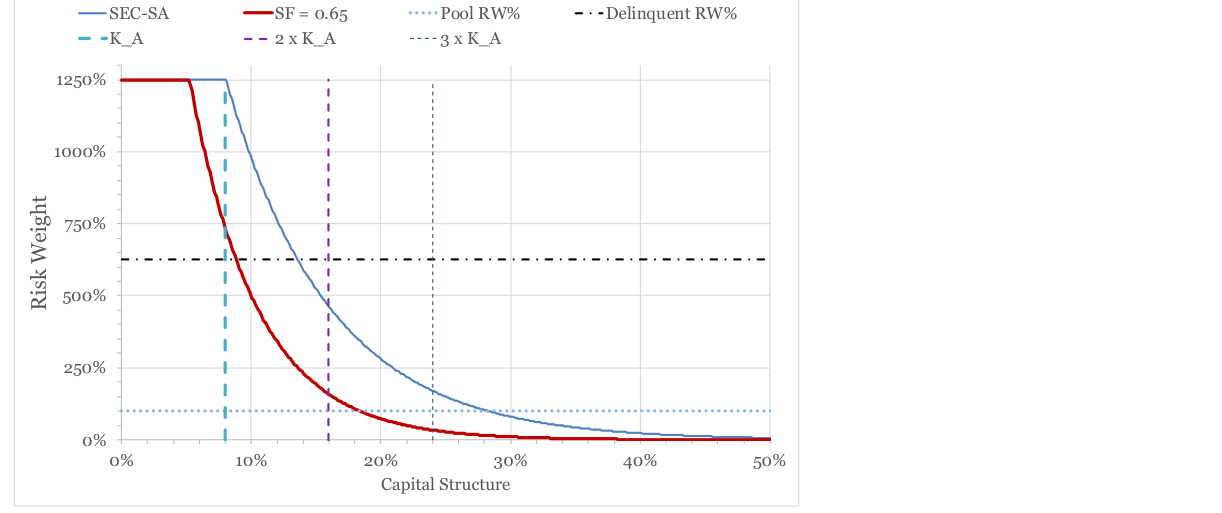
In SEC-SA, with ‘p’ set at 1.0, we have: o Under the allocation role 1, ‘p’ overcapitalises tranches from x0.0 to infinity, and materially so from x0.5 to x2.5 KA. In the zone x1.0 to x2.0 KA, the capital burden for what is considered a fairly safe tranche in investment terms has a higher level of capital requirement than a delinquent asset that is implicitly risk weighted at 625% - this is clearly shown in Figure 1. There are no zones of undercapitalisation, even in the most senior part of the capital structure. The SEC-SA, as calibrated, fails in the allocation role 1. Under the capital surcharge role 2, there will be 100% more capital, meaning that the economic cost o doubles. The SEC-SA, as calibrated in Europe, fails in the capital surcharge role. o Under the cliff effect smoothing role 3, the initial drop is well managed. It is almost as if there was an imaginary straight line going from 1250% risk weight at x1.0 pool capital down to 0% RW at x2.0 pool capital. Out of the 3 roles, ‘p’ is a regulatory “success” only with regards to the cliff-effect smoothing role, cliff-effect which never was a securitisation risk in the first place, but a regulatory risk.
4. Rescuing the Rules and Reviving the Market
Can the SSFA under SEC-SA be ‘rescued’? Ideally, 3 independent roles would require 3 independent parameters. This might be judged to depart too much from the Basel agreements. But as the Basel agreements are not a Treaty, the European authorities (and more so, the US authorities) have departed when required from the letter of the Basel rules while keeping the spirit of the agreements. For example, the presence of a moderating coefficient that applies to the basic Basel formula when calculating the capital requirements of SME loans. A similar scaling factor SF could be applied to the input KA in the mathematical description of SEC-SA, to be replaced by K′A = SF× KA.
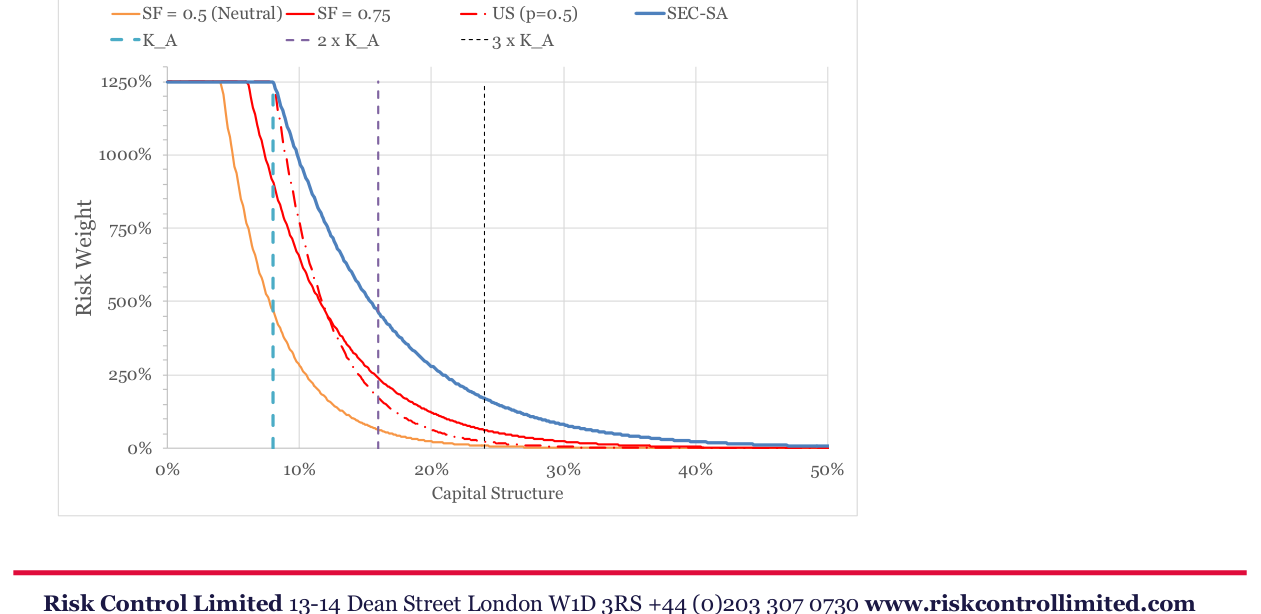
With SF set at 0.5, one gets capital neutrality (see Figure 2), removing the capital surcharge, hitting the target under role 2. Under role 1, this would be a significant improvement as the capital of the tranches and the investment risk would be more aligned, in particular in the area x0.5 to x1.5 pool capital. However, the steepness of the curve leaves the area x1.5 to x2.5 slightly undercapitalised, underachieving role 3. There are, of course, trade-offs for this, such as increasing SF to 0.65 (see Figure 1), at the cost of creating a 30% capital surcharge appears under role 2. Other solutions exist to solve the European securitisation problem, but that would take longer than a 3-pager.
Notes
[1] Correspondence to georges.duponcheele@riskcontrollimited.com or william.perraudin@riskcontrollimited.com.
[2] Unless specified, the term ‘European’ applies to countries of the European Union and the UK.
[3] Our comments can be found here: www.riskcontrollimited.com/public/Securitisation_Regulation_in_Europe.pdf
[4] Where K- = (1 −w) K5- + w∙625% ∙8% with w the proportion of delinquent assets and K5- the pool risk weight of non- delinquent assets.