

This paper presents a new design and calibration for the Risk Weight (RW) Floor of securitisation instruments and shows how it may be used as the basis for regulatory capital. Unlike the current RW Floor, which is specified as a constant percentage of par, we propose a risk-sensitive RW Floor that equals a percentage of pool risk weights. This risk-sensitive proposal may be stated as: RRRR FFFFFFFFFF= 10% × KKPPPPPPPP × 12.5 where KKPPPPPPPP is the capital KK expressed as a percentage for the underlying securitised assets under the appropriate regulatory approach (Standardised Approach (SA) or Internal Rating Based approach (IRB)). The current RW Floor is a fixed value of 15% (or 10% for Simple, Transparent and Standardised (STS) securitisations) that bears no relation to the underlying risk of the securitised asset pools. When the RW Floor is set at an arbitrary value unreflective of asset risk, certain asset classes in particular countries are favoured, creating a distorted securitisation market that has little relation to economic activity. By setting KKPPPPPPPP at KKSSSS for all investing banks, the level playing field that this simple proposal creates would strengthen the European Single Market. If they choose, regulators could introduce greater differentiation by replacing the 10% factor of proportionality we propose for the risk-sensitive RW Floor described above with 7% and 12%, respectively, for STS and non-STS securitisations. Regulatory rules, in our view, should be concerned with the riskier non-senior tranches that contain the systemic risk. Differentiation (STS vs. non-STS, IRB vs. SA) should be applied for these non-senior tranches (via a review of the pp-premium and of the cliff-effect generating deduction threshold). Those reforms will take time, however. In contrast, a simple political decision on implementing a risk-sensitive RW Floor could be implemented quickly, on a timetable resembling that of the accelerated legislative changes that occurred for the Non- Performing Loan (NPL) RW Floor within the Capital Markets Recovery Package.
Table of Contents
Executive Summary
This study examines key aspects of the European rules on the regulatory capital that banks must hold in respect of their securitisation exposures. The subject is topical because of the priority given to reviving Capital Markets Union (CMU) by the European authorities. Securitisation remains the primary way in which financial institutions in different European countries can raise funding and transfer the risk of the exposures they have originated from/to a diverse group of investors with different risk and duration preferences. The securitisation market remains largely stalled in Europe[4], however, in large part, because of distortions caused by regulatory rules on bank and insurer capital.
The European securitisation market splits into (i) a funding market based on traditional funded securitisation of bank assets and (ii) a risk transfer market employing synthetic securitisation instruments (although some transactions achieve both). Achieving an effective CMU will require overcoming obstacles that affect both market segments. Several distinct European measures are necessary to relaunch the European securitisation market. Key objectives should be to make the regulatory framework for securitisation more risk sensitive and to reflect appropriately the historical performance of the securitisation market in Europe.
The single most important (as well as the simplest) measure that should be considered would be to make the Risk Weight (RW) Floor risk sensitive. The European bank capital rules require that the capital for any given tranche must exceed a fixed RW Floor. This penalises securitisation of relatively low-risk loans; for example, the RW for a given untranched portfolio of prime residential mortgage loans originated by a bank is not much greater than what the rules would imply for the senior tranche of a securitisation of the same portfolio, despite the senior tranche in the securitisation benefitting from additional protection given the loss absorption provided by junior and mezzanine tranches. So, the RW Floor effectively determines why certain banking assets are financed via securitisation more than others, or not at all, with no risk or economic rationale, and thus strongly discourages securitisation altogether.
This study advocates the simple expedient of adopting a ‘risk-sensitive RW Floor’ specified as a percentage of pool RWs. This may be stated as: RRRR FFFFFFFFFF= 10% × KKPPPPPPPP × 12.5
Here, KKPPPPPPPP is the capital KK expressed as a percentage for the underlying securitised assets under the appropriate regulatory approach (Standardised Approach (SA) or Internal Rating Based Approach (IRB)).
What justification do we provide for the 10% factor of proportionality? First, we offer a systematic historical review of how RW Floors have been regarded in past versions of the securitisation regulation in order to provide a context for our proposal. The last few relevant calibrations that regulators have proposed are set out in Table ES1. The calibrations performed by Basel regulators have typically been performed using corporate loan data. Since unrated corporates have pool RWs of 100%, a floor that is 10% of pool RWs is consistent with this calibration.
Table ES1: Recent evolution of the RW Floor calibration Explicit/ Year Comment Assets Structure Approach Comments on conceptual Implicit advances (or the opposite) 15% 2013 Basel III Second CP All, except Senior AAA SEC-ERBA Variable RW Floor as a
• 25% and Standard Securitisations function of tranche maturity 15% 2013 Basel III Second CP Id. All SEC-IRBA and Standard 15% 2013 Basel III Second CP Id. All SEC-SA and Standard 10-12% 2015 Basel STC CP STC pools Traditional All Risk-sensitivity to structure STC and pool 10% 2016 Basel III Final rules STC pools Traditional SEC-IRBA, Senior tranche only amended for STC STC SEC-SA 10% 2020 EBA Synthetic STS STC pools Synthetic STS SEC-IRBA, Senior tranche only SEC-SA 12% 2022 Proposal in the JC Non-STS Resilient All Originator only. Additional ESAs report Synthetic operational constraints. 7% 2022 Proposal in the JC STS Id. SEC-IRBA Id. ESAs report Note: Here JC ESAs report attributes to the 2022 report of the Joint Committee (JC) of the European Supervisory Agencies (ESAs). Here CP denotes Consultative Paper, SEC denotes Securitisation, ERBA denotes External Ratings-Based Approach, STC denotes Simple, Transparent and Comparable, and STS denotes Simple, Transparent and Standardised.
Second, the Basel Consultative Document of December 2012 justified the imposition of a RW Floor by referring to “the model risk associated with credit ratings, risk modelling, and risk-weight calibration”. Since 2012, European banks have allowed for Margins of Conservatism (MoC) in their calibration of risk parameters including Probability of Default (PD) and Loss Given Default (LGD). Capital for senior tranches remains subject to model risk around correlations, however. To calibrate a risk-sensitive RW Floor, Risk Control (2024) shows how one may calculate the distribution of correlation parameters and then apply an analytic securitisation capital model to obtain an appropriate floor level of capital for senior tranches. This yields a factor of proportionality in the region of 10% of pool RWs.
The other calibration presented in this study is based on the understanding that, for senior tranches, attaching at a level at which the RW Floor applies, contains operational risk almost exclusively. Taking a conservative approach by allocating the entire ratio of operational risk to credit risk, as per the values obtained from the EU-wide stress tests results, we obtain a similar calibration, i.e., that the RW Floor is in the region of 10% of pool RWs.
In the specific area of the RW Floor, while the study provides for detailed solutions for tackling granularity effects for those rare low-granularity securitisations, from the perspective of the CMU, we argue that, for investing banks[5], it would be sensible to make no distinction between IRB and SA banks[6], between STS (Simple, Transparent and Standardised) and non-STS securitisations. This would provide a level playing field across different categories of banks, and different market segments.[7] To achieve this, the RW Floor could be based on the SA RW (see Table ES2). As is the usual practice in Europe, the rating agencies-based approach would be the back-up approach for those assets that are not originated by banks and where the risk weight is not known by banks.
Table ES2: Application of a RW Floor Equal to 10% of SA Pool RWs with Basel III Finalised Standards Pool RW Calibrated Current Comment on most likely Asset Pool (Basel III SA) RW Floor RW Floor type of securitisations Corporate Granular Large Corp. CLOs Rating (AAA to AA-) 20% 2,0% For reference only Rating (A+ to A-) 50% 5,0% 10% STS (Bulk of the market) Rating (BBB+ to BBB-) 75% 7,5% 10% STS Rating (BB+ to BB-) 100% 10.0% 10% STS Rating (Below BB-) 150% 15,0% 15% Non-STS Leveraged Loans SME no rating 85% 8,5% 10% STS SME Retail Highly granular ABS Revolving assets 75% 7,5% 15% Non-STS Credit cards Consumer loans 75% 7,5% 10% STS Auto loans Residential Real Estate Highly granular RMBS Owner Occupier (LTV ≤ 50%) 20% 2,0% 10% STS STS Owner Occupier (50% < LTV ≤ 60%) 25% 2,5% 10% STS (Bulk of the market) Owner Occupier (60% < LTV ≤ 80%) 30% 3,0% 10% Owner Occupier (80% < LTV ≤ 90%) 40% 4,0% 10% STS STS Owner Occupier (90% < LTV ≤ 100%) 50% 5,0% 10% Owner Occupier (LTV > 100%) 70% 7,0% 15% Non-STS Income Producing (LTV ≤ 50%) 30% 3,0% 15% Non-STS (Bulk of the market) Non-STS Income Producing (50% < LTV ≤ 60%) 35% 3,5% 15% Income Producing (60% < LTV ≤ 80%) 45% 4,0% 15% Non-STS Non-STS Income Producing (80% < LTV ≤ 90%) 60% 6,0% 15% Non-STS Income Producing (90% < LTV ≤ 100%) 75% 7,5% 15% Income Producing (LTV > 100%) 105% 10,5% 15% Non-STS Income Producing (Criteria not met) 150% 15,0% 15% Non-STS
Commercial Real Estate Low granularity CMBS General (LTV < 60%, rating A) 50% 5,0% 15% Non-STS General (LTV < 60%, rating BBB) 60% 6,0% 15% Non-STS (Bulk of the market) General (LTV > 60%, rating BBB) 75% 7,5% 15% Non-STS General (LTV > 60%, rating B) 150% 15,0% 15% Non-STS Non-STS Income Producing (60% < LTV ≤ 80%)) 90% 9,0% 15% Income Producing (LTV > 80%) 110% 11,0% 15% Non-STS Land acq., dev., constr. (ADC) residential 100% 10,0% 15% Non-STS (very low gran.) Loan to ADC company / SPV 150% 15,0% 15% Non-STS (very low gran.) Specialised Lending Low granularity CLO Project Finance, pre-operational phase 130% 13,0% 15% Non-STS Project Finance, operational 100% 10,0% 15% Non-STS Project Finance, operational (high quality) 80% 8,0% 15% Non-STS (Bulk of the market) Object Finance 100% 10,0% 15% Non-STS Commodity Finance 100% 10,0% 15% Non-STS Note: Here SME denotes Small and Medium Enterprise, LTV denotes Loan to Value, CLO denotes Collateralised Loan Obligations, ADC denotes land acquisition, development and construction. While the above table indicates numerical levels of a risk-sensitive RW Floor, for a given transaction, the exact value would be dependent on the content of the pool itself; for example a mixed pool of BBB and BB corporates, would have an overall RW Floor reflecting that composition.
If regulators wish to retain greater differentiation, they may replace the ‘factor of proportionality’ of 10% we propose above with 7% and 12% for STS and non-STS securitisations, respectively. For tranches that are not senior, it is important to distinguish between STS and non-STS (both for banks via the CRR and for (re)insurers via Solvency II). For such tranches, the appropriate capital levels and the stability that they exhibit in downturns are key to avoiding financial instability.
On the latter issue of avoiding financial instability, other research conducted by some of the authors of this paper (see Duponcheele and Perraudin (2022b)) explains how including a simple scaling factor permits one to apply capital charges that are appropriately calibrated in level and do not induce instability in the capital that banks must put aside in economic downturns. The latter arises if capital charges exhibit cliff effects, generating sharp changes in bank capital and, thereby, creating the potential for capital shortfalls and a related credit crunch.
On further topics of regulatory development, if the European policy makers really want the European securitisation markets to develop, they should address other shortcomings of the European securitisation framework, among them:
1. The implementation in Europe of a STS synthetic framework has removed (re)insurance companies from being able to participate in this risk transfer market by not allowing them to provide unfunded guarantees, the way that (re)insurance companies provide credit protection. We are not aware that the legal wording was chosen with this specific objective, and as the legislation was part of what is known as the ‘Covid Quick Fix’, similar legal routes could be followed to reverse the exclusion of (re)insurers from the unfunded STS market.
2. Another area that needs a complete overhaul is the capital charges for securitisation products included in Solvency II. The extreme cliff-effect between STS and non-STS capital charges for senior tranches cannot be justified empirically as is clear from Perraudin and Qiu (2022a). Those capital charges should be modified to reintroduce the basic financial notion that the capital charge of a CQS1 senior tranche, that is highly protected against credit risk by mezzanine and junior tranches and is most of the time more liquid than the underlying securitised exposures, cannot exceed the capital charge of the unprotected, untranched, underlying pool.
3. An adjustment in the eligibility of different types of securitisations for Liquidity Coverage Ratio (LCR) purposes and the applicable haircuts should also be considered. A study by Perraudin and Qiu (2022b) examines the relative liquidity of senior Asset Backed Securities (ABS) and Covered Bonds (CBs), and the evidence provided in it suggests that senior ABS should be included within higher LCR categories than is currently the case.
4. Important non-quantitative barriers to securitisation relating to European regulatory disclosure and due diligence requirements remain, and measures to address them need to be taken.
1 Introduction
In her 2023 State of the Union Address (see EC (2023)), Ursula von der Leyen states that “to preserve a European edge on critical and emerging technologies” which she sees as a “question of European sovereignty” requires “common European funding”[8]. The notion of common European funding is also at the core of the European Capital Markets Union (CMU). One of the main channels through which funding flows from one European country to another is through securitisation. This occurs primarily via investment in the senior tranches of traditional securitisations, instruments that are also central to the way the European Central Bank (ECB) operates in its dealings with European banks.
For Europe to achieve its economic objectives in coming years, the use of on-balance sheet synthetic securitisation by banks will also be important. Synthetic securitisation enables European banks to access a wide diversity of global investors for capital relief, bolstering their balance sheets and helping them to improve their competitiveness. With access to this market, European banks are better able to finance economic growth and the investments needed for a clean transition.
The financial potential of traditional securitisation and the capital efficiency achievable via synthetic securitisation have so far barely been tapped in Europe. Doing so would contribute substantially to a CMU that would significantly boost European economic performance and sovereignty.
Again in her State of the Union Address, Von der Leyen tasked Mario Draghi with preparing a report on the future of European competitiveness, saying “Europe will do “whatever it takes” to keep its competitive edge.” In 2013, as President of the European Central Bank (ECB), Draghi with Mark Carney from the Bank of England (BoE), suggested that favourable capital treatment might be accorded to high quality securitisations, starting the discussions that subsequently led to the introduction of the Basel framework of Simple, Transparent and Comparable (STC) securitisation. That framework halved the securitisation capital surcharge by half, and cut the Risk Weight (RW) Floor of senior tranches by a third, to 10% from 15%.[9]
Without support from the ECB and BoE, the Simple, Transparent and Standardised (STS) securitisation framework, the European transposition of the Basel STC framework, would not have been created and the financing of the European economy via traditional securitisations would be in a dire state. In 2021, an EU STS synthetic securitisation framework (which, being post-Brexit, has no equivalence in the UK) was implemented, under which the capital parameters are aligned with the STS framework for traditional securitisations.
Nevertheless, the concessions just described have proved insufficient to compensate for the overall negative effects of the Basel III revised framework and significant revival of the European securitisation markets appears far off.
Christine Lagarde describes the broader picture as follows in ECB (2023): “we are facing a new set of challenges that will require a generational effort to finance. […] To start, what does history teach us about how capital markets develop? The most important lesson is that a capital markets union emerges when there is a need to finance an economic transformation that exceeds the capacities of fragmented financial markets. […] Despite two European Commission action plans, Europe’s capital market remains fragmented. Financial integration is lower than before the financial crisis. […] And there are two ways in particular in which Europe is being held back. First, existing firms that want to digitalise or decarbonise cannot access the full amount of financing they need. […] The issue here is not only that SMEs cannot tap capital markets, but also that the lack of capital market development affects banks’ ability to grant riskier loans. A genuine CMU would mean building a sufficiently large securitisation market, allowing banks to transfer some risk to investors, release capital and unlock additional lending. In the United States, banks have access to a securitisation market that is three times the size of Europe’s. This could be even more powerful in our bank-based financial system.”
In this paper, we argue that central to the development of European securitisation has been the RW Floor. By imposing an arbitrary minimum RW on securitisation tranche capital, the floor strongly affects which assets in which countries can be securitised synthetically. If the floor is high, then the retained senior tranche in typical securitisations becomes too costly in capital terms for the issuing bank. This is especially true when the underlying assets are low risk. It also affects the incentive for one originator bank to provide secured funding to another investor bank by buying the senior tranche in the former’s funded securitisation.
Section 2 of this paper gives a historical perspective on how the idea of a RW Floor (RWF) came into being, and how, over a 25-year period, successive sets of regulators sought to calibrate it to be more sensitive to the risks of the underlying pool assets. One may summarise this evolution through a time series of dates and fixed percentage values: RRRRRR2001 = 14%, RRRRRR2002 = 7%, RRRRRR2002 = 20% (non-granular), RRRRRR2009 = 20% (re-securitisations), RRRRRR2012 = 20% (post-Global Financial Crisis (GFC)), RRRRRR2013 = 15%, RRRRRR2015 = 10% (STC), RRRRRR2020 = 100% (Non-Performing Loans (NPLs)), RRRRRR2022 = 12% (Synthetic Non-STS Proposal), RRRRRR2022 = 7% (Synthetic STS Proposal).
Note that, since corporate exposures may be calibrated at a 100% risk weight, a fixed value RWF in the range 7% to 20% is comparable to adopting a capital floor equal to 10% of RWAs. Other asset classes have much lower risk weights under Basel rules, however. For example SMEs may be risk-weighted at 75% while the RW of residential mortgages may be 35%. Securitisations involving less risky assets merit a lower RW Floor in our view. Retaining fixed value floors, which amounts to calibrating the RW Floor for riskier corporate asset pools, means that the securitisation market for safer assets will not develop.
Section 3 describes the evolution of European Union thinking on the issue of the RW Floor. The EU implemented its own framework for synthetic STS securitisations in 2021, as a conscious and intended departure from the Basel standards. Proposals are currently under discussion to reduce further the RW Floor under certain conditions. Specifically, the 2022 report of the Joint Committee (JC) of the European Supervisory Agencies (ESAs) to the European Commission contains a proposal to reduce the RW Floor for originator banks to 12% (from 15%) for non-STS securitisations, and to 7% (from 10%) for STS securitisations. These changes would only affect synthetic securitisations and would be under certain conditions.
While such changes would no doubt be welcomed by market participants, focussing on the narrow issue of the numerical value to employ (i.e., 15%, 12%, 10%, or 7%) will not align capital charges to risk and, hence, will favour deals involving some assets over those involving others with no clear justification. We believe that it is, therefore, time to review the whole question of the RW Floor and its implications for European competitiveness.
This view may be compared with that of the European Financial Services Round Table (EFR)[10], which stated: “After the GFC, regulatory reforms have reduced securitisations risks, for instance through risk retention requirements for originators, enhanced credit underwriting standards (Mortgage Directive), ongoing monitoring of securitisations by supervisory authorities, investor due diligence requirements and performance reporting. These changes justify lowering the RW floors.” (EFR (2023)).
Section 4 asks what is the rationale for a RW Floor? The answer is that it protects against non-credit-related risks such as (i) model and (ii) operational risks. Consistent with this view, we examine, as a basis for calibrating the RWF, (i) model risk considering what capital would be implied for senior tranches in European securitisations by mismeasurement in correlation and (ii) operational risk. From the stress tests of the European Banking Authority (EBA), we note that the ratio of operational risk to credit risk in Europe is 10.3%.
Furthermore, learning from the historical evolution of the notion of a RW Floor, we distinguish and discuss desirable and undesirable features of its design. We review two historical proposals made by Duponcheele et al. in 2014 that introduced the idea of risk-sensitivity, linking the floor to the underlying risk weight of the pool. We also review the 2022 proposal of the JC of ESAs and show how a small granularity adjustment would remove the new granularity cliffeffects that it introduces (to avoid creating issues in certain types of SME securitisations). This paper extends the JC’s proposal into a ‘Unified’ proposal that keeps the JC’s sensitivity on resilience, sensitivity on the structure (STS / non-STS), sensitivity on tranche seniority, and adds the required granularity adjustments to remove cliff-effects and proposes a solution for very low granularity securitisations.
Mindful of the need to adopt simple, parsimonious solutions, we propose a risk-sensitive RW Floor with the simple formulation: RRRR FFFFFFFFFF= PPPPPPPPPPPPPPPPPPPP× KKPPPPPPPP × 12.5
The simplest proposal would be to have a proportion of 10% for all senior tranches. But to allow for greater differentiation, the STS proportion would be 7% for senior tranches and 15% for non-senior ones, and the non-STS proportion would be 12% for senior tranches, and 20% for non-senior tranches.
We believe that tackling the issue of the RW Floor would contribute to European competitiveness by unlocking the CMU for funding (traditional securitisation) and capital relief (synthetic securitisation).
2 How the concept of the RW Floor has evolved over time
2.1 Securitisation’s “original sin” under Basel I
In July 1988, the Basel Committee on Banking Supervision (BCBS) published the International Convergence of Capital Measurement and Capital Standards (commonly referred to as the ‘Basel Capital Accord’ or the ‘1988 Accord’). This document (BCBS (1988)) was subsequently amended in the 1990s, and both the original and its amendments are nowadays referred to as ‘Basel I’. The focus of the 1988 Accord was to establish a minimum ratio of capital to risk-weighted assets (RWAs) of 8% (the ‘Cooke ratio’) that would be implemented by the end of 1992.
The original document of 1988 Accord is 30 pages long, and the list of on-balance sheet assets and associated risk weights occupies just one-and-a-half pages in its Annex 2. There were five risk weight categories: 1) 0% for cash and OECD central government and central banks, 2) a range of 0%-10%-20%-50% for domestic public sector entities, 3) 20% for Multilateral Development Banks[11] and OECD banks and other non-domestic public sector entities, 4) 50% for rented or owner-occupied residential mortgages, and 5) 100% for non-OECD entities, for corporates, for equipment, for real estate, for investment, and with important consequences for securitisation which we will assess later, for ‘capital instruments issued by other banks (unless deducted from capital)’, and for ‘all other assets’.
While the securitisation technique predates the 1988 Accord, it was a minor instrument in the US and almost nonexistent in Europe. Therefore, as the word ‘securitisation’ is not mentioned in the 1988 Accord, all tranches fall under the last category in the list, ‘all other assets’, for which a risk weight of 100% applies by default.
In addition, the original document had a list of Credit Conversion Factors (CCFs) in its Annex 3 for off-balance sheet assets. They were derived from the estimated size and likely occurrence of the credit exposure, as well as the relative degree of credit risk identified in a previous paper (BCBS (1986)). There were eight categories of CCFs with four possible values: 100% for direct commitments or with recourse to the bank, 50% for contingent commitment or with a maturity greater than one year, 20% for short-term self-liquidating trade-related contingencies, and 0% for ‘commitments with an original maturity of up to one year[12], or which can be unconditionally cancelled at any time’. The CCF was then multiplied by the on-balance sheet risk weight to provide an off-balance sheet risk weight.
One may expect that a regulatory rule that does not allocate capital consistent with risk would generate incentives for banks to engage in regulatory arbitrage. When arbitrage brings risk closer to what a risk-sensitive regulatory capital rule would imply, one might regard this as benign or ‘good’ arbitrage. When it leads to a situation in which the capital is misaligned with risk one could regard it as harmful or ‘bad’ arbitrage. If financial firms are incentivised to take on more risk without this being reflected in regulatory capital this constitutes an ‘extremely bad’ arbitrage.
An example of ‘good’ arbitrage in our view is the creation of Asset-Backed Commercial Paper (ABCP) conduits to provide liquidity lines to off-balance-sheet vehicles refinancing the safest tranches of securitisations. For trade receivables, it could be a 20% risk weight (20% CCF times 100% RW for safe securitisation tranches), already a level that is not too dissimilar from future levels that will be set for a RW Floor. With hindsight, had the Basel I rules been more risk sensitive, such as having a 20% RW for senior securitisation tranches, it is likely that ABCP conduits would have applied the 50% CCF for maturities greater than one year, resulting in an implied RW Floor of 10% for the refinancing of long dated senior tranches, and a 20% CCF for senior tranches of trade receivable securitisation, resulting in an implied 4% RW Floor.
Unfortunately, most banks pushed the arbitrage further, and provided “364-day liquidity lines” to benefit from the 0% CCF, thus reducing the risk weight of such lines to 0%. On a scale from 0% RW to 1250% RW, the value 0% RW does not create a systemic risk when it is relative to an implied level of 4% RW (and no European trade receivables conduits experienced difficulties during the GFC). It did become a serious issue for the few banks that used ABCP conduits to refinance long dated senior tranches of US RMBS[13] or the yet fewer number that fatally refinanced tranches of US CDOs of Mezzanine RMBS.
Included among ‘extremely bad’ arbitrages were the situation in which ‘issuing’ banks (later called ‘originating’ banks) began securitising portfolios of assets, typically corporates or consumer loans (all risk-weighted at 100%), with a 20% thick junior tranche that was retained and a very thick senior portion of 80% that was placed with the capital markets (most of the time via rated tranches). The issuing bank in this case kept almost all the economic risks while its capital requirement was divided by a factor of 5. In other words: 20% of the capital requirement for 100% of the economic risk. “Well, if it is compliant with the rules, why not?”, a few institutions must have thought.
Several banks started to adopt this ‘Basel I regulatory arbitrage’ and some European regulators (France especially) took exception to this development that was neither intended or even discussed by G10 central bank governors when they launched in 1987 the consultation for a future Accord (BCBS (1987)). Those regulators searched for ways to stop this ‘Basel I regulatory arbitrage’ anomaly that could threaten financial stability.
To stay compatible with the Basel rules – which some though not all regulators seek to do – regulators used the item in the Basel I list that preceded ‘all other assets’, i.e., that ‘capital instruments issued by other banks (unless deducted from capital)’ should be risk-weighted at 100%. The key words were ‘other banks’, so it did not apply to an ‘issuing bank’. Thus, some jurisdictions, such as France, adopted an emergency interim rule that ‘issuing banks’ must ‘deduct from capital’ the retained thick junior tranche, and that this deduction was capped at the underlying pool capital requirement KKPPPPPPPP At the time of a Basel I Cooke ratio of 8%, this deduction of the exposure value from capital was equivalent[14] to a 1250% risk weight, as 1250% times 8% is equal to 1, i.e., the exposure value itself.
The effect was to eliminate immediately the Basel I arbitrage structures of the early to mid-1990s. The “original sin” was the split between senior placed and junior retained which, in practice, might take the form 80%/20%. In this structure, everything was risk-weighted at 100% even though the split of economic risk is closer to almost all the risk for the junior and almost none for the senior. The regulatory response was devised within the Basel I constraints that existed at the time but has persisted ever since in the form of Basel rules for which all tranches up to pool capital KKPPPPPPPP are deducted (or have a de facto 1250% RW) and tranches attaching above KKPPPPPPPP are risk-weighted according to various regulatory approaches. In Basel I, the approach for those latter tranches was a 100% risk weight.
As a result, the sum of the capital for all tranches, KKAAAAAA ttttttttttℎeeee, clearly exceeds KKPPPPPPPP, and the difference (KKAAAAAA ttttttttttℎeeee −KKPPPPPPPP) becomes an embedded securitisation capital surcharge. The market started to take it as a given that there is a capital ‘surcharge’ for securitised pools, with a flat layer at 1250% RW and a ‘floor’ of 100% RW for everything else, including the thick senior tranche. But this surcharge resulted from the constraints of the Basel I list in the Annex 2 of the 1988 Accord, not from a proper mathematical analysis of the stressed expected loss distribution which should guide the computation of regulatory capital. Not before December 2022 did a proper discussion on the issue appear in the regulatory literature in the form of the Appendix of the JC’ EBA report.
In the 1990s, the US securitisation market for residential mortgage pools grew. The Basel I risk weight for this asset class was 50%. To have a senior tranche, with credit enhancement, risk-weighted at 100% while the pool is riskweighted at 50%, was a clear incoherence of an oversimplified list. The US adopted a ‘look-through’ interim rule (not available in Europe) for which the risk weight of the non-junior tranches was capped at the risk weight of the pool. With this, the notion of risk-sensitivity, albeit crude, entered the securitisation framework.
Interim rules in the US and Europe improved the situation for a while. But another opportunity for capital arbitrage emerged. The junior tranche of an ‘issuing bank’ was deducted from capital (akin to 1250% RW) but ‘another bank’ could ‘invest’ in it, receive a high coupon reflecting the economic risk, but would risk weight this investment at 100% as per the Basel I list. And so, another type of Basel I market arbitrage grew, with ‘investing banks’ in jurisdictions like Spain buying and risk-weighting at 100% only the unrated junior tranches in securitisations from ‘issuing banks’ in other European jurisdictions that would be 1250% risk-weighted otherwise. Issuing banks continued to place the senior part of the capital structure in the capital markets.
While supervisors of ‘issuing banks’ could be satisfied with the status quo, supervisors of ‘investing banks,’ with risk management practices that left something to be desired, became concerned. Discussions started behind the scenes in the late 1990s within the BCBS to address the problem in the ‘New Capital Accord’ that was under development.
2.2 Basel II: a RW Floor sensitive to pool granularity and tranche seniority
2.2.1 First consultative package (June 1999)
In 1998, BCBS announced it would review the 1988 Accord. The First consultative package was published in June 1999 (BCBS (1999)). This described the new capital framework comprising three pillars: 1) minimum capital requirements, 2) a supervisory review process, and 3) disclosure of information to facilitate market discipline. On Pillar 1, the 1988 Accord would become the ‘Standardised Approach’. For sophisticated banks, the use of internal credit ratings would be allowed, and, subsequently, use of portfolio models would be permitted.[15]
The First consultative package had a section dedicated to securitisation. It stated: “This review of the Accord is designed to improve the way regulatory capital requirements reflect underlying risks. It is also designed to better address the financial innovation that has occurred in recent years, as shown, for example, by asset securitisation structures. As a result of this innovation, the current Accord has been less effective in ensuring that capital requirements match a bank’s true risk profile.”
Regarding the Standardised Approach for securitisation, BCBS stated: “the Committee has become increasingly concerned with some banks’ use of structured financing or asset securitisation to avoid maintaining capital commensurate with their risk exposures. Furthermore, the current Accord lacks consistency[16] in that the same economic risk may result in substantially different capital requirements depending on the type of transaction that a bank employs. Thus, through such techniques, a bank may be able to achieve an overall risk-based capital ratio that is nominally high but which may obfuscate capital weakness in relation to the actual economic risks inherent in the bank’s portfolio.”
BCBS, thus, proposed to use external ratings with the following risk weights: 20% for AAA down to AA-; 50% for the A range, 100% for the BBB range, 150% for BB range, and 1250% for B+ or below or unrated.
In the 1999 proposal, residential mortgages kept the Basel I risk weight of 50% under the Standardised Approach. Thus, the ‘floor’ for securitisation tranches had now moved from 50% for US securitisation of residential mortgages to 20% for the senior tranches. There was an implicit recognition by BCBS that the senior tranche (assumed AAA), benefiting from credit enhancement, deserved a lower risk weight than the pool itself, i.e., that the ‘look through’ approach was too conservative, within a ‘consistent’ framework.
Europe would benefit even more from such a reduction, as the proposed ‘floor’ would move from a risk weight of 100% to 20% (although some European jurisdictions had already applied the same ‘look-through approach’ as in the US).
2.2.2 Second consultative package (January 2001)
In January 2001, BCBS issued its Second consultative package (BCBS (2001a)). This contained 7 supporting documents of which one was dedicated to Asset Securitisation (BCBS (2001b)). Prepared by a newly created Asset Securitisation Working Group, it addressed the “treatment of explicit risks associated with traditional securitisation” and “with synthetic securitisation”. In the Second consultative package, the Standardised Approach was unchanged, with a de-facto RW Floor of 20% for AAA/AA rated securities.
For the Internal Ratings-Based (IRB) approach, BCBS simply stated that it was working on an ‘hybrid’ that “follows the same economic logic used for the standardised approach. At the same time, the Committee wishes to take advantage of the greater capacity for risk-sensitivity under the IRB framework. The specific mechanism depends on whether the bank in question is an issuer or an investor in securitisation tranches.”
For issuing banks, the securitisation supporting document offered little rationale apart from that of preventing the Basel I arbitrage structures, punishing such structures with unlimited amounts of capital: “for banks issuing securitisation tranches, the full amount of retained first-loss positions would be deducted from capital, regardless of the IRB capital requirement that would otherwise be assessed against the underlying pool of securitised assets.” Other tranches would be assessed with a mapping of external ratings to PD and LGD.
For investing banks, a mapping of external ratings to PD would be used and the LGD would be set at 100% for all tranches. Unrated tranches would be capital deducted. An implicit RW ‘floor’ would have resulted from the use of the lowest PD in the mapping. This proposal will not be retained by regulators in subsequent rule proposals.
2.2.3 Working paper 10 (October 2001)
How regulators were thinking about securitisation capital was revealed by the BCBS Securitisation Group in October 2001 in its Working Paper on the Treatment of Asset Securitisation (BCBS (2001c), also known as WP10). This contained many conceptual advances.[17] Several guiding principles for the capital treatment were set out, one of which was capital neutrality: “in recognition of asset securitisation as an important source of funding and mechanism for credit risk transference, the IRB approach should be neutral[18] with regard to the capital requirements it produces in order not to create incentives or disincentives for banks to engage in securitisations.”
At the time, the risk weight for the underlying corporate loans was a numerical interpolation, based on Vasicek’s formula for a stressed probability of default, although not as fully developed as it became in the final Basel II rules. Nevertheless, Table 1 of the WP10 explains how ABS risk weights were benchmarked. The regulatory one-year PD was assumed to be at the ‘PD floor’ of 0.03%, and, using the LGD from the January 2001 Second consultative package proposal for Foundation IRB corporate senior secured exposure of 50% (it will be 45% in the final rules), the resulting risk weight was 14%.[19] This was mapped to the ABS Aaa and Aa category, and 14% was, thus, a new RW Floor for securitisation.
Regulators were already aware that risk weights for securitisation could not be the same as for corporate exposures in the bottom part of the capital structure. Thus, they introduced an ‘ABS scaling factor’, that increased from 1.0 for ‘AAA/AA/A’ risk to 3.0 for Ba2 risk.[20] While this is conceptually correct this ABS scaling factor was motivated by the clear regulatory concern that the Basel I regulatory arbitrage should not be repeated: “Another equally important objective is to avoid creating incentives for banks to securitise their assets solely to reduce regulatory capital requirements.”
In WP10, the first version of the formula appears that will later be adopted for Basel III in SEC-SA and SEC-IRBA. Called simply the ‘Supervisory Formula’, it is the same design as the Basel III SSFA (Simplified Supervisory Formula Approach). In fact, SEC-SA is the same as the WP10 Supervisory Formula, in which KKIIIIII is replaced by KKAA (or KKGG in the US). The formula was motivated by maintaining the anti-Basel I regulatory arbitrage measure of requiring capital deduction (or 1250% RW) up to KKIIIIII. For tranches attaching above KKIIIIII, capital then converged exponentially down to zero, with a ‘premium’ pp of 0.2.
To avoid the close-to-zero levels of capital for senior tranches, WP10 stated that “in addition to the premium factor, a capital floor is also proposed for inclusion in the supervisory formula approach. The floor is meant to ensure that banks hold regulatory capital against exposures of the highest quality as they do involve some credit risk. Absent such a mechanism, the supervisory formula would produce a capital requirement of effectively zero, which would be inconsistent with the IRB treatment of other highly rated exposures. The Group intends to calibrate the floor following its consultation with the industry on the contents of this working paper.”
An interesting question was asked by BCBS as part of the 2001 consultation, on an issue that would later be ignored in adopting SEC-SA in 2014. They stated: “The derivation of the supervisory formula presumes that the securitised pool of assets is highly granular. If the underlying pool of assets is not sufficiently granular, in the extreme, the resulting capital requirement may be much too low for risk positions beyond KIRB. What might be an appropriate way of handling relative few underlying assets or pools of assets that are not granular?”
Granularity is indeed a legitimate source of concern. The current Basel III SEC-SA that adopts the WP10 formula can easily be a source of regulatory arbitrage when pools exhibit extremely low granularity and the RW Floor takes a fixed value at 15%, insensitive to pool characteristics. Therefore, this design flaw needs to be addressed to develop a coherent proposal and we will discuss this further in Section 4.
2.2.4 Working paper 11 (October 2002)
In October 2002, the BCBS Securitisation Workgroup published its Second Working Paper on Securitisation (BCBS (2002), also known as WP11). Among the conceptual changes were the introduction of granularity as an explicit component of the calibration, both for the Ratings Based Approach (RBA) and the Supervisory Formula Approach (SFA). Indeed, the paper stated: “Available evidence suggests that the granularity within the underlying pool of exposures is an important determinant of how the risk is distributed across securitisation tranches. Specifically, it appears that securitisations of non-granular pools tend to shift greater amounts of systematic risk to more-senior tranches compared with otherwise identical securitisations of highly granular pools. This arises because the less granular pool will tend to exhibit greater probabilities of experiencing relatively high loss rates. Accordingly, a granularity component has been incorporated into both the RBA and SFA.”
Proposed RBA The proposed RBA was calibrated using a Monte Carlo approach that generalised the JP Morgan Creditmetrics model to permit exposure to tranches of securitisations.[21] The calculations performed for that purpose are reported in Peretyaktin and Perraudin (2004).[22] The calibration was performed so as to ensure that, allowing for supervisory overrides, when all the tranches in a structure were rated and capital was calculated using the RBA, the implied capital for a bank holding all the tranches was similar to that required for holding the underlying assets on balance sheet.[23]
In the case of a highly granular pool of BBB corporate senior secured exposures, the senior enough (i.e. ‘thick’) AAA tranche warranted a 7% risk weight. Implicit in this calibration is the ratio of 7% to a Pool RW of 100% which we will refer to in Section 4. From a conceptual point of view, this situation is a particular case of a variable RW Floor, in which a 7% fraction of the underlying Pool RW is used, rather than a fixed value of 7% risk weight for all kinds of underlying risks.
For highly-rated exposures, WP11 proposed risk weights of 7% and 10% respectively for certain AAA and AA rated securitisation exposures under the RBA. However, it stated: ‘to be eligible for these lower risk weights, (a) the underlying pool would need to be “highly granular”, and (b) the exposures would need to constitute a relatively “thick” position in the securitisation structure.” This notion is very close to the notion of ‘resilience’, a concept that has reappeared in the 2022 EBA paper, that we will discuss in Section 3.
The ‘relatively “thick” position’ mentioned above related to the credit enhancement, rather than the thickness as we understand the notion under Basel III. It was defined as a ‘position relative to the size of the pool (denoted QQ)’, and the senior enough level was such that QQ satisfied the equation: QQ ≥ 0.1 + 25/NN. In practice, a corporate pool of 100 exposures required that the attachment point of the tranche would need to be at least greater than 35% of the capital structure to be able to qualify for the 7% risk weight.
The QQ criteria was an attempt at interpolating two markets: the corporate market with QQ ≥ 35% when NN was equal to 100, and the mortgage market when NN was very high. For NN at 500, one obtains the condition QQ ≥ 15%, whereas when NN ≥ 5000, one obtains QQ ≥ 10.5%.
For non-granular pools, defined as NN < 32 in WP11, the implied AAA risk weight was 20%, and when between 32 < NN ≤ 100, the risk weight was 10%.
Proposed Supervisory Formula (SF) In October 2002, the BCBS Securitisation Workgroup, proposed that tranches, retained or purchased, with credit enhancement levels of KKIIIIII or less, be deducted (i.e. 1250% RW eq.). There was little methodological justification for this, apart from stating that: ‘This requirement was introduced in the October 2001 Working Paper [WP10] and remains in place. […] The [BCBS] Committee believes that this requirement is warranted in order to create strong incentives for originating banks to shed the risk associated with highly-subordinated securitisation positions that inherently contain the greatest risks.” In other words, BCBS was still focussed on the regulatory arbitrage that could arise in a non-risk-sensitive framework like Basel I, and maintained the solution to this problem, setting aside the issue of what this might imply within the new risk-sensitive Basel II framework.
For tranches with credit enhancement levels above KKIIIIII, banks had to use external ratings too via the RBA. However, if the position was unrated, only those banks authorised to use the Supervisory Formula Approach (SFA) could calculate capital requirements with the Supervisory Formula. The new WP11 SFA differed materially from what is now called in Basel III the Simplified Supervisory Approach (SSFA), which had been proposed a year earlier in WP10.
The 2002 SFA had strengths and weaknesses. On the positive side, there were conceptual advances. The formula was risk sensitive to the four primary risk drivers affecting the loss distribution in a securitised pool of assets: granularity, default correlation, probability of default, loss given default. The pool granularity NN and the pool loss given default LLLLLL were explicit inputs of the SFA, while the correlation and probability of default were incorporated indirectly through the use as an input of KKIIIIII. The SFA was sensitive to the level of credit enhancement (LL) and the thickness (TT) of a tranche (features that are part of the Basel III approach).
The modelling approach used to derive the SFA starts from the assumptions of the Asymptotic Single Risk Factor (ASRF) model that underlies the Basel II IRB risk weights for on-balance sheet loans. If a bank has an asymptotically granular portfolio of loans, the credit quality of which is driven by a single risk factor, then the Marginal Value at Risk (MVaR) and, hence, capital for such loans may be calculated using an explicit formula that depends on the probability of default and LGD of the loan and on its correlation with then single factor. It turns out that under these same assumptions, if one supposes, in the case of a bank's securitisation exposure, that the risk factors driving pool loans have the same correlation with each other as with those contained in the bank’s wider portfolio, then adding Expected Loss to MVaR, the resulting securitisation tranche risk weights are 1,250% up to attachment levels of KKIIIIII and are zero thereafter.
Naturally rejecting the notion that risk weights be zero for tranches attaching above KKIIIIII, regulators sought a modelling device that could smooth and allocate capital to more senior tranches. The approach they adopted was to suppose that the attachment point is uncertain. This notion labelled ‘Uncertainty in Loss Prioritisation’ (ULP), attracted the criticism that it is counterfactual and, as such, can never be calibrated from data. When the securitisation framework was subsequently reviewed in 2013, regulators abandoned the ULP. Nevertheless, adopting the ULP and the ASRF assumptions, one obtains a smooth inverted ‘S-curve’ for securitisation tranche capital. To this can be added several ‘regulatory over-rides’, the first being the anti-Basel I regulatory arbitrage device of effective deduction up to KKIIIIII. The second is a capital floor that was built directly into the SFA capital formula.
The floor in the SF of WP11 took a form which would not survive in later Basel rules in that it was an ‘add-on’ of the formula that was not arbitrageable. Indeed, this feature will, unfortunately, disappear in the final 2004 rule when the floor will become a ‘minimum’, giving rise to optimisation (a type of regulatory arbitrage for senior tranches).
Indeed, in the WP11 the capital requirement was defined as, with L being the credit enhancement and T the thickness: Art. 573: “[…] The IRB capital charge for the securitisation tranche is as follows: IIIIII cccccccccccccc ccℎaaaaaaaa= (SS[LL+ TT] −SS[LL]) times then notional amount of credit exposures that have been securitised, where the function SS[∙] (termed the ‘Supervisory Formula’) is defined in the following paragraph. […]
Art. 574: The Supervisory Formula is given by the following expression: LL wwℎeeee LL≤KKiiiiii ⎧ ωω(KKiiiiii−LL)
![Equation: ⎪ KKiiiiii + KK[LL] −KK[KKiiiiii] + dd∙ KKiiiiii KKiiiiii wwℎeeee KKiiiiii < LL≤LL∗ ωω aa−ee](/api/media/file/eq-228-300x20.png?prefix=media)
SS[LL] = ⎨ ωω(KKiiiiii−LL∗)
![Equation: ⎪KKiiiiii + KK[LL∗] −KK[KKiiiiii] + dd∙ KKiiiiii KKiiiiii + (LL−LL∗)FFFFFFFFFF wwℎeeee LL> LL∗ ωω aa−ee](/api/media/file/eq-229-300x20.png?prefix=media)
⎩ […] And LL∗ solves the following non-linear equation: ωω(KKiiiiii−LL∗) KKiiiiii FFFFFFFFFF= (1 −ℎ) ∙(1 −BBBBBBBB[LL∗; aa, bb]) + dd∙ee
On calibration, the Floor was proposed to be the value of 0.056 (which translates into 7% Risk Weight times 8% of the McDonough ratio). In essence, the Floor was compatible with the highly granular AAA risk weight for tranches that satisfied the QQ criteria (for resilience).
It is not the purpose of this paper to explain the notation present in WP11, but to highlight the fact that the notion of a Floor was not in Article 573, but in Article 574, and only as part of a layer of additional capital that covers the part above a sufficiently high level of credit enhancement of LL∗. In essence, with regards to the third line of the formula SS[LL], the floor concept is correct, as it acts not as RW Floor, but as a RW Floor Add-On for additional capital, on tranches that are sufficiently resilient (attaching above LL∗). The fact that LL∗ is derived from the ULP theory is the flaw, not the ‘Add-on’ and not the notion of ‘Resilience’.
2.2.5 Third consultative paper (April 2003)
In April 2003, BCBS published its Third consultative paper (BCBS (2003)). Capital for on-balance sheet loans was now expressed in the form of an explicit ‘Marginal Value at Risk’ (MVaR) formula based on ASRF assumptions and is now almost in its final Basel II form.[24] The Proposed RBA was almost unchanged compared to WP11, whereas the SFA would see a change on how to implement the floor.
The most notable conceptual change was found in Art 589/590 (eq. to Art 573/574 in WP11), where the ‘Floor’ add-on became a ‘minimum’, and the new wording will be adopted unchanged in the current Basel III regulation.
Indeed, the exact wording in Art 623 is the following: Art 589 […] Tranche’s IRB capital charge = the amount of exposures that have been securitised times the greater of (a) 0.0056*T, or (b) (S[L+T] – S[L]), where the function S[.] (termed the ‘Supervisory Formula’) is defined in the following paragraph. […].
Art. 590: The Supervisory Formula is given by the following expression: LL wwℎeeee LL≤KKiiiiii
ωω(KKiiiiii−LL)
![Equation: SS[LL] = KKiiiiii KKiiiiii + KK[LL] −KK[KKiiiiii] + dd∙ KKiiiiii wwℎeeee KKiiiiii < LL ωω aa−ee](/api/media/file/eq-230-300x25.png?prefix=media)
To a securitisation structurer, the language used immediately invites a type of optimisation that regulators did not intend and which is now common in on-balance sheet (synthetic) securitisations. Specifically, originating banks will find it optimal to set the thickness of the retained senior tranche to ensure that the Art 589 component (a) equals the Art 589 component (b) above.
The idea of the Basel Committee was to simplify the work done by its Securitisation Workgroup, by removing the calculation for LL∗ seen in the SFA of WP11. But LL∗ was simply a way of computing a point of resilience, where the floor add-on applies.
If the idea was indeed to simplify for function S[.], it would have been much better for risk-sensitivity to think of the fixed RW Floor as a ‘RW Floor Add-on’. For example, the following wording would have been preferable and killed the kind of non-risk-sensitive optimisation mentioned above: Tranche’s IRB capital charge = the amount of exposures that have been securitised times ((S[L+T] – S[L]) + 0.0056*T), where the function S[.] (termed the ‘Supervisory Formula’) is defined in the following paragraph. […].
Having an add-on to all tranches, rather than on from the point of resilience, has the added advantage that all tranches are covered, including the resilient ones.
Unfortunately, the wording in the Third consultative paper, i.e., the use of a minimum instead of an add-on, was adopted in the 2004 Final rules for Basel II, and the same wording is currently implemented for Basel III SEC-IRBA and SEC-SA. This issue should be addressed by future generations of regulators.
2.2.6 Basel II final rules (June 2004)
Basel II RBA In June 2004, BCBS published the New Capital Accord (Basel II) (BCBS (2004)). The final RBA will be changed slightly compared to the Third consultative paper, and the SFA will be unchanged.
The recalibration in the final 2004 RBA catered to a split in the single A range into A+, A, and A- categories, and to make some other minor changes.
More important was the loss of the notion of a minimum credit enhancement QQ. In the Third consultative paper, to qualify for the lower risk weight, a AAA tranche had to be backed by a pool that was highly granular (NN> 100) and sufficiently resilient with a minimum credit enhancement QQ. In the final 2004 RBA, instead of requiring a minimum credit enhancement QQ, the tranche had to be senior. And instead of the pool being highly granular, the granularity threshold was dropped from 100 to 6.
So, a AAA tranche backed by a ‘granular’ pool (i.e., NN≥6) and senior could benefit from the 7% risk weight. A nongranular pool meant that the AAA tranche was risk-weighted at 20%. And a non-senior AAA tranche backed by a ‘granular’ pool (i.e., NN≥6) had a 12% risk weight.
The regulatory thinking behind dropping the granularity adjustment in the RBA was influenced by the calculations in Peretyaktin and Perraudin (2004). These showed that as granularity declines, tranche Expected Losses (EL) and PD rise relative to the increase in MVaRs, i.e., capital. In other words, it becomes increasingly difficult to achieve a high rating if pools are less granular. Hence, a mapping from EL or PD to capital (which is what a RBA look-up table amounts to) may be stable as granularity decreases even if the capital that a bank should hold for a particular tranche would certainly increase as granularity falls (since the tranche rating will fall with granularity).
The de-facto RW Floor remained a fixed value of 7% for the RBA. The main problem was that it was not risk sensitive to the underlying risk weight of the pool.
It is worth, at this point, reflecting on the direction that the securitisation product itself had taken by 2004 when the Basel II rules were finalised.
• The securitisation product was robust when it involved regulated assets that were themselves risk-weighted appropriately, such as RMBS of prime mortgages with recourse to the borrower, or CLOs of SME loans, or ABS of auto loans.
• The more fragile part of the market consisted of securitisations using unregulated assets that were not riskweighted appropriately, such as RMBS of US subprime mortgages with no recourse to the borrower.
• The highly risky version of securitisation which in retrospect should have attracted major regulatory scrutiny was re-securitisations of existing tranched exposures, a key example being CDOs of Mezzanine US RMBS. For these, the fixed value of the 7% risk weight for the senior AAA tranche was clearly inadequate. There are two distinct issues here:
The first one being that the underlying risk weight in the RBA for non-senior tranches backed by o granular pools is (correctly) much above the risk weight for a corporate entity with the same rating (for example risk weight of 425% for BB-rated securitisation tranches, whereas it is slightly above 100% for corporate exposures). Had the RW Floor been proportional to the underlying pool risk weight, many banks would have found that holding the AAA senior tranche of CDOs of Mezzanine US RMBS unprofitable (as a risk-sensitive RW Floor would have been x4.25 higher) and would not have invested in these products.
The second issue was that the correlations used by rating agencies for mezzanine tranches were too o low. Those tranches contain mainly systemic risk, and their asset correlation is more in the 70%-80% range (as the Global Financial Crisis (GFC) will show). Unfortunately, as regulators had explicitly forbidden banks to make their own assessment of the risk in securitisation products for the purpose of the determination of capital requirement, few resources were allocated by bank risk management departments to assessing the correlation risk in securitisation tranches. Because of the regulatory stance, the entire market, banks and regulators, became reliant on the views of three rating agencies.
The reliance on external rating agencies will be addressed (fundamentally in the US, and partially in Europe) but the problems that resulted from a fixed value RW Floor remain.
It is an irony of the history of financial regulation that the entire Basel II regulation proposal for residential mortgages under the Standardised Approach was a single sentence in the 2001 Second consultative package: “Claims secured by residential property: Lending fully secured by mortgages on residential property that is or will be occupied by the borrower, or that is rented, will be risk-weighted at 50%.”
The 50% risk weight will be lowered to 35% risk weight in the 2003 Third consultative paper with the following paragraph: Claims secured by residential property: Lending fully secured by mortgages on residential property that is or will be occupied by the borrower, or that is rented, will be risk-weighted at 35%. In applying the 35% weight, the supervisory authorities should satisfy themselves, according to their national arrangements for the provision of housing finance, that this concessionary weight is applied restrictively for residential purposes and in accordance with strict prudential criteria, such as the existence of substantial margin of additional security over the amount of the loan based on strict valuation rules. Supervisors should increase the standard risk weight where they judge the criteria are not met.
At a time (in the early 2000s), when the US subprime mortgage was growing exponentially, the BCBS devoted significant quantitative resources to developing rules for the financial technique of securitisation while ignoring the rising danger signs in the US subprime mortgage which meant that the underlying assets were risk-weighted wrongly. Only after the GFC did regulators in some jurisdictions move the risk weight of US subprime mortgages to 100%, making a clear distinction with prime mortgages, risk-weighted at 35%.
Throughout the period before and after the GFC, the quality of European residential mortgage pools has been exceptional and resilient. Several banks’ IRB models showed pool risk weights that could be below the 10%-15% risk weight levels. Hence, a 7% value for a RW Floor is clearly too high for portfolios of European residential mortgages ‘with recourse’ that are originated by regulated banks. To be clear, the 7% value may be calibrated correctly for a pool of 100 corporate exposures that are risk-weighted at 100%. But the design of the RW Floor as a fixed value, with no dependence on the underlying pool risk weights means that the same 7% fixed value is not calibrated appropriately for European residential mortgages with recourse.
Basel II SFA No material changes were made compared to the Third consultative paper. Within the SFA, the de-facto RW Floor remained equal to a fixed value of 7% for all tranches.
2.3 Basel III: a RW Floor that is risk-sensitive to securitisation type
2.3.1 First consultative document (December 2012)
In December 2012, BCBS published its First Consultative Document for Revisions to the Basel Securitisation Framework (BCBS (2012)). While the regulatory mood at the time was in favour of punishing the securitisation technique, since it had been the vehicle through which the US subprime crisis affected European banks, some conceptual advances were nevertheless incorporated in the proposals including the notion of ‘a level playing field’. If there was reliance on an external rating to calculate capital requirement, it was thought that IRB or SA banks should have the same capital requirement since neither had performed their own assessment to determine capital requirements.
Under the regulatory logic at the time, because the AAA rating of a securitisation tranche led to a 20% RW for an SA bank, then a RW Floor of 20% for an IRB bank was warranted. And the RW Floor was to ‘guard against model risk’. The relevant extract is as follow:
The lowest risk weight proposed under the revised securitisation framework, for both long and short-term exposures, would be set at 20%. This would be consistent with the current SA securitisation framework, and would be equal to the lowest risk weight that can be assigned to other credit exposures within the SA for credit risk other than certain sovereign exposures. This change would reduce cliff effects from deterioration of securitisation exposures and would mitigate the model risk associated with credit ratings, risk modelling, and risk-weight calibration.
Model risk is arguably more acute for securitisations exposures, because setting capital requirements for securitisation exposures involves multiple layers of modelling exercises and assumptions. The modelling work done to simulate the behaviour of securitisation exposures is itself based on the modelling work to estimate the behaviour of the underlying assets. This layering of models and assumptions can amplify the uncertainty associated with capital estimates. In addition, the uncertainty in capital estimates is higher for highly-rated, seemingly low-risk tranches and there is an asymmetric nature to the uncertainty.
This came as a surprise to the banking industry, as in June 2009, in an emergency Enhancements to the Basel II framework (BCBS (2009)), BCBS had set the AAA senior tranche risk weight of re-securitisations (i.e., targeting the CDOs of US Mezzanine RMBS) to 20%, instead of 7% as per the 2004 RBA. This was an implicit recognition that the RW Floor should be risk sensitive to the underlying pool risk weight.
It, thus, appeared in 2012 that the BCBS Ratings and Securitisation Workstream (RSW) wanted to give the same capital treatment to well performing European assets as the BCBS had determined in 2009 was appropriate for the riskiest type of securitisation. If there was ‘level playing field’, the proposal was clearly not ‘risk-sensitive’ with regards to the underlying pool risk.
This created situations in which prime residential mortgage pools in European banks’ books that were in the 10%-15% risk weight range would generate a AAA tranche with a 20% risk weight. The situation was seen as Kafkaesque, as in such instances, the RW Cap[25] could override the RW Floor, a mathematical and financial nonsense. And worse than that, when using the proposed Revised Ratings Based Approach (RRBA) that was exposited in the 2012 Consultative Document, the risk weight of a tranche with a maturity greater than 5 years increased to a 68% risk weight. It appeared that there was no limit to the regulatory ‘punishment’ of the securitisation instrument. European banks started to openly question whether to continue with securitisations. The European Commission’s vision of using the securitisation technique to accomplish cross-border financing among European Union members was threatened.
The calibration of the RRBA, exposited in BCBS (2013b) (also known as WP23) was aligned with a new model, the Modified Supervisory Formula Approach (MSFA), that was to be used by IRB banks. The MSFA, exposited in BCBS
(2013a) (also known as WP22), attempted to address the deficiencies of the Basel II Supervisory Formula, dropping the counterfactual ULP assumption. The MSFA was criticised by Duponcheele et al. (2013a) as diverging fundamentally from the core notion that capital should bear a relation to that of the underlying assets, implying neutral or close to neutral treatment before and after securitisation. The MSFA generated more than 3 times the capital of the underlying assets. The MSFA also contained a fixed value RW Floor of 20%, adding even more capital charges.
SA banks were to use the Simplified Supervisory Formula Approach (SSFA). This formula was directly inspired by what was applied at the time in US trading books following the order by US Congress that regulators drop the use of external ratings in their rules. In applying the SSFA in trading books, US regulators based their approach on what had been proposed in the 2001 WP10, applying a premium pp of 0.5 rather than 0.2 suggested in WP10. When it came to the First Consultative Document, however, BCBS proposed a premium pp of 1.5, which meant a 150% capital surcharge, before the application of the 20% RW Floor.[26]
If the intention of BCBS was to ‘punish’ securitisation, they had delivered. But some central bank governors in Europe, as well as some European governments, became concerned that the attempt to accomplish the objectives of the G20 had become over-zealous. Moderation in the BCBS calibration and a return to the fundamentals of the capital framework design was required.
2.3.2 Second consultative document (December 2013)
In December 2013, BCBS published its Second consultative document (BCBS (2013c)). Compatibility pre- and postsecuritisation was restored. For IRB banks, BCBS, having abandoned the MSFA that defined capital as expected shortfall rather than MVaR, replaced it with an SSFA again inspired from the 2001 WP10 paper. The new approach had a new acronym: SEC-IRBA. The SSFA for SA banks itself was re-labelled the SEC-SA. And a slightly modified version of the RRBA was renamed SEC-ERBA, clearly referencing the use of ‘External Ratings’.
The level-playing field for IRB and SA banks was maintained, at least at the RW Floor level with a new fixed value of 15%. Meanwhile the SEC-ERBA produced for AAA tranches a risk weight of 15% for a 1-year tranche maturity up to 25% for a 5-year tranche maturity.
The premium pp in the SSFA was reduced from 1.5 to 1.0 for SA banks (compared to the US that, at the present time, still applies a pp value of 0.5 for all its securitisations).
For IRB banks, the pp-premium, in this context denoted ppIIIIIIII was calibrated as a function of pool characteristics: regulatory framework, granularity NN, pool capital KKIIIIII, and LLLLLL, as well as tranche characteristics: seniority and tranche maturity MMTT. BCBS claimed to have calibrated this function using an adapted version of the MSFA that was modified to allow for intra-pool correlation.[27] However, there was no transparency to the process in that no study was ever published justifying the calibration or explaining the dataset used.
2.3.3 Basel III securitisation framework (December 2014)
In December 2014, BCBS published its final rules (BCBS (2014)) and made a few small changes to the proposal contained in the Second consultative document. Re-securitisations would be subject to SEC-SA with a premium pp of 1.5, and a RW Floor of 100%.
It looked like Europe was going to apply a system set up as if it had experienced US default rates. While there was progress between the 2012 consultation and the 2013 consultation, European central bankers (ECB and BoE) decided that something had to be done to lower the capital requirements further by carving out securitisations involving good performing assets, such as many European asset classes. The sharpest criticism came from Mr Yves Mersch, ECB Executive Board Member, who declared in October 2014:
“Since the start of the crisis, the default rates of European ABS were on average between 0.6% and 1.5%. In the US over the same period, they were on average 9.3% to 18.4%. […] It makes little sense to calibrate the international rules solely on the basis of US experiences. It would be like calibrating the price of flood insurance for Madrid on the experience of New Orleans. The current rules lump all ABS together and are much too conservative. They effectively question their existence.” (ECB (2014))
2.3.4 STC consultation (November 2015) and Basel III STC rules (July 2016)
Europe’s objectives would be achieved via IOSCO’s intervention, and an IOSCO/BCBS taskforce was designed to identify the criteria that identified the ‘good’ securitisations, labelled ‘Simple, Transparent and Comparable’ (STC), with a joint consultation launched in July 2015 (BCBS-IOSCO (2015)).
In November 2015, BCBS published a consultation on the capital treatment for STC securitisation (BCBS (2015)). The proposal contains two important elements: 1) a RW Floor reduction from 15% down to a range of 10-12%; 2) a reduction of the premium pp in SEC-IRBA and SEC-SA that involved multiplying it by a value x in the range of 0.6-0.8. This was explained in Table 1 of the consultative paper which is reproduced as Table 2.1 here.
SEC-IRBA The reduction factor (xx) in the range of [0.6-0.8] is applied to pp, while preserving the prudential floor of pp at 0.3
![Equation: ppSSSSSS = mmmmmm 0.3; [xx] × AA+ BB× 1 NN + CC× KKIIIIII + DD× LLLLLL+ EE× MMTT](/api/media/file/eq-231-300x25.png?prefix=media)
SEC-SA The supervisory parameter pp is rescaled from 1 to a lower number in the range [0.6-0.8]
![Equation: The fact that a function ppIIIIIIII = AA+ BB× NN + CC× KKIIIIII + DD× LLLLLL+ EE× MMTT,[28] that had been calibrated by the](/api/media/file/eq-232-300x12.png?prefix=media)
BCBS RSW was simply multiplied by a reduction factor [xx] was clear evidence for research-inclined experts that the pretence of calibration based on data was abandoned. Indeed, the above adjustment in SEC-IRBA implied that a calibration on five different risk drivers on a data set of securitisations qualifying for the STC label would have produced a linear reduction of the sensitivities. In other words, that a proper calibration would have resulted in AASSSSSS = [xx] × AA; BBSSSSSS = [xx] × BB; CCSSSSSS = [xx] × CC; DDSSSSSS = [xx] × DD; and EESSSSSS = [xx] × EE, with the same value of [xx], which seems quite implausible.
This policy change could be adopted without challenge, however, as BCBS had never published the data that led to the 2014 SEC-IRBA calibration. As this calibration could not be evaluated by outside researchers (see Duponcheele et al. (2014a)), neither could the STC reduction. The European Authorities’ political objective was not to justify the BCBS RSW calibration presented in December 2013 (BCBS d303), but instead just to reduce urgently the unjustified burden on European securitisations, so that Europe would not lose an important financing tool for its economy.
For SEC-ERBA, the RW Floor for AAA tranches was proposed at 10% for a 1-year tranche maturity, increasing to 15% for a 5-year tranche maturity. The RW Floor was no longer a fixed value, but a variable function of the tranche maturity MMTT. The notion of a de-facto, variable RW Floor entered the regulatory world which could be seen as progress. Unfortunately, the variable function was applied to a characteristic that is not a risk-driver of a securitisation, i.e., tranche maturity MMTT. Had the variable function been applied to the asset pool maturity MMPPPPPPPP, this would have constituted an improvement, as asset pool maturity MMPPPPPPPP is a secondary risk driver of securitisations, affecting the asset correlation in a securitisation pool and the pool probability of default.
In July 2016, BCBS published a revised Basel III framework for securitisation (BCBS (2016)) in which the RW Floor was set at a fixed value of 10% and the pp-premium was simply divided by 2 (i.e., [xx] = 0.5) for both SEC-IRBA and SEC-SA.
2.3.5 Short-term STC consultation (2017) and Basel III short-term STC rules (2018)
The 2015 STC consultation had excluded short-term securitisations, i.e., the financing activity that is mainly conducted in ABCP conduits. This was subsequently addressed by a joint consultation launched in July 2017 (BCBS-IOSCO (2017)) on defining criteria for short-term STC securitisations. The capital treatment for STC securitisations was published a year later in May (BCBS (2018a)) and this was incorporated in the Basel III framework in July (BCBS (2018b)). The RW Floor is unchanged and remains a fixed value of 10%.
2.3.6 Non-performing loans securitisations (November 2020)
In November 2020, BCBS published a technical amendment (BCBS (2020)) to the securitisation framework which clarified some ambiguities in the 2016 framework. This amendment contained an explicit definition of securitisations of Non-Performing Loans (NPLs). It also established a new RW Floor of 100% for securitisations backed by NPLs under both the SEC-IRBA and the SEC-SA (which replaced the RW Floor of 15% designed for performing loans).[29]
From a conceptual point of view, if one considers that NPL assets should be treated with a risk weight of 1250% (which they are not), the ratio to the underlying pool risk would be 8%.
In any case, there is no ‘credit risk’ in an NPL pool, as the PD of each asset is 100%, thus the only remaining risk is an LGD risk. In SEC-SA, when determining the underlying pool capital KKAA of a pool comprising performing and ‘delinquent’ (i.e., non-performing loans) the LGD risk is represented by the coefficient 0.5 that is multiplied by the proportion of ‘delinquent’ assets in pool, ww:
KKAA = 0.5 × ww+ KKSSSS × (1 −ww)
Here, KKSSSS is the underlying capital of the proportion in the pool that is performing.
This can be re-written in risk-weight terms as:
RRRRAA = 625% × ww+ RRRRSSSS × (1 −ww)
Thus, the LGD risk of non-performing loans in SEC-SA is risk-weighted at 625%, and therefore, the new RW Floor for NPL securitisations established in 2020 represents a proportion of 16% of the underlying risk weight of 625%.
2.4 Historical evolution of the RW Floor calibration reflecting risk sensitivities
Explicit/ Year Comment Assets Structure Approach Comments on conceptual Implicit advances (or the opposite) 100% 1988 Basel I All All (eq. SA) Fixed value, No sensitivity 50% 1990s Basel I - US ‘Look- US residential (eq. SA) Risk-sensitivity to pool through approach mortgages capital 20% 1999 Basel II First CP All AAA to AA- SA Consistency with SA RW for AAA to AA- corporates 20% 2001 Basel II Second CP All AAA to AA- SA 14% 2001 First WP (WP10) All Aaa IRB Comparability with IRB RW using floored parameters 20% 2002 Second WP (WP11) N ≤ 32 AAA RBA (IRB) Non-granular, risk sensitivity 10% 2002 Second WP (WP11) 32 ≤ N < 100 AAA RBA (IRB) Granular, risk sensitivity 7% 2002 Second WP (WP11) N ≥ 100 AAA and RBA (IRB) Highly granular and credit Q ≥ 0.1 + enhancement sufficiently 25/N thick (i.e. ‘Resilient’) 7% 2002 Second WP (WP11) All All SFA (IRB) RW Floor designed as an Add-on (no senior arbitrage) 20% 2003 Basel II Third CP N < 6 AAA RBA (IRB) Non-granular 12% 2003 Basel II Third CP N ≥ 6 AAA (no RBA (IRB) Granular criteria on Q) 7% 2003 Basel II Third CP N ≥ 6 AAA and RBA (IRB) Granular and ‘Senior enough’ Q ≥ 0.1 + 25/N 7% 2003 Basel II Third CP All, except All SFA (IRB) RW Floor oversimplified as Securitisations a minimum (opening the door to senior arbitrage) 20% 2004 Basel II Standard N < 6 AAA IRB (RBA) Non-granular 12% 2004 Basel II Standard N ≥ 6 Non-senior IRB (RBA) Granular AAA 7% 2004 Basel II Standard N ≥ 6 Senior AAA IRB (RBA) Granular 20% 2009 Basel II Securitisations AAA IRB (RBA) Resecuritisation Enhancement 20% 2012 Basel III First CP All, except Senior AAA IRB and SA Variable RW Floor as a
• 68%! Securitisations (RRBA) tranche maturity function. 20% 2012 Basel III First CP Id. All MSFA (IRB) All, except Resecuritisation 20% 2012 Basel III First CP Id. All SSFA (SA) All, except Resecuritisation 15% 2013 Basel III Second CP All, except Senior AAA SEC-ERBA Variable RW Floor as a
• 25% and Standard Securitisations function of tranche maturity 15% 2013 Basel III Second CP Id. All SEC-IRBA and Standard 15% 2013 Basel III Second CP Id. All SEC-SA and Standard 100% 2014 Basel III Standard Securitisations All IRB and SA Resecuritisation only (SSFA) 10-12% 2015 Basel STC CP STC pools Traditional All Risk-sensitivity to structure STC and pool 10% 2016 Basel III Final rules STC pools Traditional SEC-IRBA, Senior tranche only amended for STC STC SEC-SA 10% 2020 EBA Synthetic STS STC pools Synthetic STS SEC-IRBA, Senior tranche only SEC-SA 100% 2020 Basel III Standard NPLs All SEC-IRBA, RW Floor overrides as a RW for NPL SEC-SA Cap in certain conditions 12% 2022 Proposal in the JC Non-STS Resilient All Originator only. Additional ESAs report Synthetic operational constraints. 7% 2022 Proposal in the JC STS Id. SEC-IRBA Id. ESAs report
3 European regulatory thinking on the RW Floor
3.1 European transposition of Basel standards and filling the ‘void’
3.1.1 SECR and CRR (December 2017)
There are small nuances in the way the Basel standards are implemented in European legislation. There is no single text containing all information, but rather a collection of legislative texts, measures and guidelines. This reflects the Lamfalussy architecture that governs European financial regulation. The original Lamfalussy report (2001) recommended that:
• At ‘Level 1’, the European Parliament (EP) and the Council of the European Union (CEU), i.e., the colegislators, adopt the basic laws proposed by the European Commission (EC). This level is for setting out framework principles.
At ‘Level 2’, the EC can adopt, adapt and update technical implementing measures with the help of
• consultative bodies composed mainly of EU countries representatives.
• At ‘Level 3’, committees of national supervisors are responsible for advising the EC in the adoption of level 1 and level 2 acts and for issuing guidelines on the implementation of rules. The committees were: Committee of European Banking Supervisors (CEBS), Committee of European Securities Regulators (CESR), Committee of European Insurance and Occupational Pensions Supervisors (CEIOPS).
• At ‘Level 4’, the EC and national governments coordinate for the enforcement of the rules.
However, after the GFC, the architecture was changed in 2010 with the addition of the European Systemic Risk Board (ESRB), and the creation of the European Supervisory Agencies (ESAs) that replaced the Level 3 committees. The ESAs are the European Banking Authority (EBA), the European Securities and Markets Authority (ESMA), and the European Insurance and Occupational Pensions Authority (EIOPA). While keeping the ‘Level 3’ competences (such as issuing guidelines), the ESAs were granted new competences. These included the responsibility to prepare the so-called ‘technical standards’ – a particular category of level 2 measures which the ESA in question should draft and submit to the EC.[30]
Thus, the Level 1 text for the transposition of the 2016 STC-amended Basel III securitisation framework was split into two European legislative regulations, published on 12 December 2017, with an application date on 01 January 2019:
• Regulation (EU) 2017/2401 amending Regulation (EU) No 575/2013 on prudential requirements for credit institutions and investment firms. This regulation is known as the ‘Capital Requirements Regulation’ or ‘CRR’.
Regulation (EU) 2017/2402 laying down a general framework for securitisation and creating a specific
• framework for simple, transparent and standardised securitisations (STS), and amending previous directives and regulations written in 2009. This regulation is known as the ‘Securitisation Regulation’ or ‘SECR’. And ‘STS’ is the European transposition of the Basel STC standard.
The RW Floors are, thus, to be found in the CRR, while technical discussions on the subject remain mainly with the ESAs, with a final say by the EC, unless the EP and CEU exercise their scrutiny rights.
3.1.2 CMRP (December 2020)
As the Basel STC framework was the result of a joint effort with IOSCO[31], the RW Floor of 10% in the 2017 CRR only applied to traditional securitisations, and not to on-balance sheet (synthetic) securitisations. Thus, a regulatory ‘void’ needed to be addressed for ‘synthetic STS’. This was accomplished in May 2020 with the publishing by the EBA of a report on STS framework for synthetic securitisation (EBA (2020)). The question of the RW Floor is tackled, and a proposal is made to align its value to that applied to STS traditional securitisations, i.e., 10% for senior tranches.
Because of Covid, the regulatory process was accelerated, and in July 2020, the EC made a proposal to the EP to amend SECR to create a “specific framework for simple, transparent and standardised securitisation to help the recovery from the COVID-19 pandemic”. This obtained the support of the European Council and was formally introduced in December 2020 in the Capital Markets Recovery Package (CMRP) (better known as the ‘Covid Quick Fix’). The final legislation was published in March 2021 as:
• Regulation (EU) 2021/557 amending the 2017 SECR to help the recovery from the COVID-19 crisis. This extended the STS framework to synthetic securitisations and took effect almost immediately in April 2021.
• Regulation (EU) 2021/558 amended the CRR as regards adjustments to the securitisation framework to support the economic recovery in response to the COVID-19 crisis. This regulation transposed the Basel NPL rules (with the RW Floor at 100%) and the extension of the STS framework for traditional securitisations to synthetic ones, which meant that the RW Floor of 10% applied for synthetic STS securitisations.
Because the ‘synthetic STS’ securitisation framework has no Basel equivalent, the European co-legislators have more leeway to change its components, and a unique opportunity to ‘get it right’.[32] In the case of the CRR, this means the RW Floor for the senior tranche of synthetic STS securitisations could be modified. The RW Floor does not have to be a fixed value. It could, instead, be based on a proportion of the risk weight of the underlying pool.
3.2 European Commission’s willingness to remove the biggest barriers
3.2.1 High Level Forum (June 2020)
In June 2020, the High Level Forum (HLF) on CMU, an expert group set up by the EC composed of highly experienced industry executives and top international experts and scholars[33], issued its final report (HLFCMU (2020)). It contained a set of 17 recommendations aimed at “removing the biggest barriers in the development of the EU’s capital markets”. The report included specific recommendations on amendments to the securitisation prudential framework, both for banks and insurers.
The report stated that “if properly designed, securitisation provides for significant diversification gains by creating financial instruments with lower risks compared to the individual assets in the underlying “securitisation” pool.” In this sentence, there was an implicit criticism of the fact that any many instances, especially for securitisations of European prime residential mortgages with enforceable recourse to the borrower, the senior tranche of a securitisation can have, because of the RW Floor, a risk weight that is greater than the underlying pool risk weight, a financial nonsense which impedes the market.
The HLF considered that a “review of the securitisation rules should seek to simplify the process for significant risk transfer assessments, adjust prudential treatment of securitisation for banks and insurers, support the development of synthetic securitisation, reconsider the eligibility of securitisation for liquidity purposes, as well as simplify disclosures.” The expert group proposed that the EC put forward a series of targeted, prudentially sound amendments to improve the EU securitisation framework.
3.2.2 EC call for advice (October 2021)
In October 2021, the EC’s Directorate-General for Financial Stability, Financial Services and Capital Markets Union issued a Call for Advice (CfA) to the Joint Committee of the ESAs (JC) for the purposes of the incoming securitisation prudential framework review (EC (2021)). The EC explicitly referred to the recommendations of the HLF on CMU.
Moreover, the EC was obliged to submit a report to the European co-legislators (EP and CEU) under Article 519a of the CRR “in the light of developments in securitisation markets, including from a macroprudential and economic perspectives”, and it was stated in the article that the report could be accompanied by a legislative proposal.
To achieve this, the EC sought input and technical assistance from the JC to carry out a targeted review of the securitisation prudential framework.
Relevant to this paper was the advice sought primarily on the application and impact of the calculation of risk-weighted exposure amounts for positions in a securitisation, including:
• the non-neutrality correction factors designed to capture the agency and modelling risks prevalent in securitisations, specifically:
(i) the (p) factor embedded in the formulae of the SEC-IRBA (Article 259(1) of the CRR) and the o SEC-SA (Article 261(1) of the CRR) as a capital surcharge on the securitisation tranches’ capital requirements; and
(ii) the capital floors setting the minimum risk weight on the senior securitisation positions at 15% o (Articles 259, 261 and 263 of the CRR) and 10% for STS securitisations (Articles 260, 262 and 264 of the CRR);
• the caps for securitisations that include a “look-through approach” for the most senior securitisation position (Article 267 of the CRR) and an overall cap on capital requirements for all tranches (Article 268 of the CRR).
3.2.3 JC response (December 2022)
In December 2022, the JC of the ESAs provided its response to the 2021 CfA on the review of the securitisation prudential framework (ESMA (2022))). The advice consisted of two parts – one for banks (EBA (2022)) and the other for (re)insurers (EIOPA (2022)). As this paper is focused on the design and calibration of the RW Floor, we will focus on the former, i.e., the part for banks.
The JC report on the banking regulatory framework contained three broad recommendations:[34]
1. Technical fixes to the prudential framework aiming at improving its consistency and clarity in the framework. […]
2. A more substantial, but still targeted, recommendation aimed at improving the risk sensitiveness of the framework by recognising the reduced model and agency risk associated to originators […]. The JC advice elaborates on why a reduction of the risk weight floor for senior tranches retained by originators may support further growth in the SRT market in a prudent manner, if accompanied by a set of appropriate safeguards. This would in particular promote the issuance of resilient securitisations, which can qualify for a more beneficial capital treatment, without jeopardising financial stability.
3. General issues on the securitisation risk weight formulas that underpin the framework […]. These however require further work which should be potentially brought for discussion to the Basel Committee on Banking Supervision (BCBS).
On item (2): the JC has focussed on the most pressing item: the RW Floor, and its importance for the growth of a market that is mainly European for the time being. While we consider that the issue raised by the JC applies to both traditional (cash) and on-balance sheet (synthetic) securitisations, we understand that there is more legislative leeway for manoeuvre for on-balance sheet (synthetic) STS securitisations.[35] Nevertheless, since the EC has a political mandate for the efficient implementation of the CMU (and this covers traditional securitisations), we will extend our analysis of the RW Floor to both types of securitisations, traditional and synthetic, and for both typologies: STS and non-STS.
On item (3): indeed, there are four primary risk drivers in a securitisation: granularity, default correlation (expressed as an asset correlation in the Basel II/III framework), PD and LGD. There are of course important secondary risk drivers, such as the asset maturity (MMPPoooooo) that affects both the PD and the default correlation (see Duponcheele et al. (2013c). As most previous regulatory focusses have been on PD and LGD, the authors of this paper note with interest the regulatory discussion in the Appendix of the banking report on the ‘inverted-S’ curve and the proper effect of granularity and correlation on the shape of the loss distribution in a securitisation (see Duponcheele et al. (2013d) for a detailed discussion on the subject). The ‘inverted S’ is here derived using actual ‘historical’ PDs and LGDs. The very same derivation may be made using parameters stressed at a 99.9% confidence level to obtain closed form capital computations for tranched exposures consistent with the Basel II/III capital treatment of on-balance-sheet loans. We would hope that a future generation of Basel regulators will use this approach to derive capital formulae rather than relying on ad hoc expressions such as the SSFA.
3.3 JC proposal for synthetic securitisation RW Floor: deep dive
3.3.1 The JC RW Floor proposal (December 2022)
In the Banking report (EBA (2022)), the JC considers that amendments to improve the risk sensitiveness of the securitisation prudential framework (CRR) “should be introduced only if based on targeted measures with appropriate safeguards. Such measures improving the risk sensitiveness in the prudential framework is likely to further stimulate the origination of securitisation by credit institutions on a sound basis.”
When applied to the RW Floor, this consideration is exposited in Recommendation 7 of the response. a “reduction of the RW Floor for originators of resilient transactions meeting certain eligibility criteria.”
This is elaborated as: “A lower risk weight floor should be applied to securitisation positions held in senior securitisation tranches which:
- are retained by credit institutions acting as originators in accordance with point (3)(a) of Article 2 of the SECR;
- satisfy a set of eligibility criteria (as defined in Table 4) at the origination date and on an ongoing basis thereafter.
Eligibility criteria are needed to ensure:
1. a low agency and model risk,
2. robust buffers on losses for the senior tranches and
3. no concerns in terms of a sufficient granularity of the pool of underlying exposures.
From a calibration perspective, the proposal is summarised in Table 3.1. All RW Floors in the table are ‘fixed’ values. Approach for Securitisation Tranche seniority Current Proposal Ratio Comment Originators only (A) (B) (B)/(A) SEC-IRBA Non-STS Senior 15% 12% x0.8 Winner SEC-SA Non-STS Senior 15% 12% x0.8 Winner SEC-ERBA (IAA) Non-STS Senior AAA 15% 12% x0.8 Winner SEC-IRBA Non-STS Non-senior 15% 15% x1.0 Unchanged SEC-SA Non-STS Non-senior 15% 15% x1.0 Unchanged SEC-ERBA Non-STS Non-senior AAA 15% 15% x1.0 Unchanged SEC-IRBA STS Senior 10% 7% x0.7 Top winner. Also, IRB/SA ratio close to x0.725 SEC-SA STS Senior 10% 10% x1.0 Unchanged, but Loser compared to IRB originator SEC-ERBA (IAA) STS Senior AAA 10% 10% x1.0 Unchanged, but Loser compared to IRB originator SEC-IRBA STS Non-senior 15% 15% x1.0 Unchanged SEC-SA STS Non-senior 15% 15% x1.0 Unchanged SEC-ERBA STS Non-senior AAA 15% 15% x1.0 Unchanged
The main winners are IRB originating banks retaining the senior tranche of STS securitisations. We note with interest that the ratio of post- to pre-recommendation is x0.7, close to the final SA Output Floor ratio of x0.725 – we will return to this issue in Section 4. However, SA originator banks or those that rely on SEC-ERBA (or its proxy SEC-IAA for the assets financed in ABCP conduits) for their senior tranches in STS securitisations will not see any additional benefits. Also, winners are all originating banks that retain the senior tranche of non-STS securitisations, whether they are users of SEC-IRBA, SEC-SA, SEC-ERBA or SEC-IAA. The situation is unchanged for originators that are holding nonsenior tranches, regardless of STS status or regulatory approach used.
3.3.2 The JC proposed additional eligibility criteria
The primary consideration of the JC in focussing on a reduction of the RW Floor is that it can be done without affecting the deeper questions of design[36] and calibration[37] of the underlying SEC-IRBA and SEC-SA regulatory models, which the JC consider should be negotiated at the BCBS, rather than the European, level. By limiting its proposal to originators only, the JC focuses on the Significant Risk Transfer (SRT) market, rather than the funding market relevant to the CMU. Indeed, it states:
“In these [synthetic] transactions [used by] credit institutions [for risk management and capital optimisation purposes, they] retain the senior tranche and possibly the first loss tranche, contrary to SRT traditional securitisations where due to the underlying funding purpose of those securitisation the comparably large senior tranche is usually sold. Considering this retention structure, where the mezzanine tranche is usually transferred to non-banks investors, and that the retained first loss tranche risk weight is 1250%, the reduction of the p-factor for originator would have an effect on the RW of the retained senior tranche only. This reduction of the senior risk weight, and so the potential impact of the proposal, would be anyway constrained by the risk weight floor. In this respect, it is the JC view that reducing the risk weight floor for the originator, under certain conditions, may be better able to boost the use of synthetic securitisations by originators and thereby the supply side of the market.”[38]
But in exchange for a reduction in the RW Floor, the JC wants ‘thicker’ mezzanine tranches sold to the non-bank investor market. The JC argues:
“Contrary to a potential reduction of the p-factor, which has the drawback of increasing cliff effects […], a reduction of the risk weight floor if accompanied by robust eligibility criteria may contribute to a prudentially sound structuring of transactions by giving the originators an incentive to engage in more resilient transactions (e.g. based on granular pools) and increasing the risk sharing through a transfer of thicker junior and/or mezzanine tranches.”
Let us comment on the issues raised by regulators, which lead to the creation of the eligibility criteria presented in Table 3.2 and see whether the criteria are addressing the regulators’ concerns regarding model risk and robustness.
1) Amortisation Sequential amortisation or non-sequential amortisation This covers ‘regulatory’ model risk provided that the transaction includes performance-related triggers to switch to a sequential amortisation which should be compliant with the EBA RTS on performance-related triggers. The credit protection agreement by which the transfer of risk is This criterion is not necessary. The 2) Counterparty credit risk achieved shall comply with the criteria specified in paragraphs whole issue of cash collateral for (synthetic 8 to 10 of Article 26e SECR for STS synthetic securitisation. As STS securitisation has not been only) a way of derogation from paragraph 10, the third and the thought through. fourth subparagraphs, and the minimum credit quality step of the originator, or one of its affiliates, for collateral in the form Warning on financial stability: this of cash on deposit with them, as set out in the second STS requirement leads potentially subparagraph, shall not apply for synthetic securitisations to an unsound recycling of capital in other than STS on-balance-sheet securitisations. the financial system via investor banks’ trading books. 3) Thickness of The thickness of the sold non-senior tranche is captured by the This covers the notion of the sold non- RW assigned to securitisation positions held in senior ‘resilience’. The calibration is senior securitisation tranches by the formulas. The latter should be arbitrary. The issue could be tranches below 50% of the STS and non-STS RW floors (i.e. the senior resolved naturally with a RW Floor RW is below 5% for STS and below 7.5% for non-STS). ‘Add-on’. 4) Good The exposures in the pool shall comply with a concentration The granularity notion is granularity limit of 0.5% determined in accordance with point (a) of fundamental, but the granularity Article 243(2) CRR. This will imply that, at origination, the threshold is too high, and introduces minimum effective number of exposures N requested will be granularity cliff-effects. 200 or more, depending on the distribution of the exposures. Warning on growth: it will quickly restrict SME lending in Europe, especially to those high growth SMEs that are becoming ‘large corporates’ and that are at the limit
Comment on the Eligibility Criteria 4 (Good granularity) SEC-IRBA and SEC-SA have been (officially) calibrated with high granularity securitisations. And only SEC-IRBA uses granularity as an explicit input. This gives rise to concerns for the regulators, as there are an increasing number of securitisations claiming SRT for large corporate or project finance pools featuring a low number of exposures. The EBA states in this regard: “Considering the low sensitivity of the SEC-IRBA to the granularity of the pool, the RW of the senior tranche produced under this formula might underestimate the correlation and concentration risk. In the current framework the competent authorities have the power to decline the use of the SEC-IRBA under Article 258
(2) CRR in case of complex transactions with significant correlation and concentration risk, but this does not give the room to further refine the SEC-IRBA sensitivity but rather to oblige the credit institutions to apply in a mandatory manner the approach further down the hierarchy. Therefore, it is the EBA view that a discussion at the Basel table on the framework’s ability to account for non-granular pools should take place.”
While the JC only criticises the calibration of SEC-IRBA with respect to the granularity input NN, its solution is to push the issue back to ‘the BCBS table’. There is an alternative, however, to have a RW Floor that uses explicitly the granularity input in its definition.
The JC recognises that the notion NN is not part of the SEC-SA approach, and, thus, proposes to make an exception for SA originator banks, saying that if they want to benefit from the reduced risk weight in Table 3.1, they need to calculate this parameter as if they were an IRB originating bank. They also mention that SA originator banks do calculate this parameter as part of the financial COREP reporting.
This raises the question: if both IRB and SA originator banks calculate the value NN, and the recommendation for a RW Floor only applies to originator banks, why can’t those banks use a RW Floor that uses NN as an explicit input?
Instead of using NN as an explicit variable of the RW Floor, the eligibility criteria 4 in Table 3.2 defines the ‘good granularity’ as the maximum concentration limit of 0.5%. This is at odds with the 2.0% limit for the STS criteria. This effectively splits transactions into ‘good STS’ benefitting from the 7% RW and ‘bad STS’ that remain at a 10% RW.
While the JC criteria for ‘good granularity’ will create no issues for securitisations of prime residential mortgages, auto loans and consumer loans, it will create issues for SME exposures. Indeed, the world of SMEs is highly diversified, from very small to ones that are on the border of becoming large. The latter ‘large’ SMEs tend to borrow to finance growth, and banks need to transfer their risks to non-bank investors to maintain this growth. By limiting the concentration to 0.5%, regulators would reduce banks’ capacity to lend to large SMEs (not an appealing prospect for the SMEs concerned) or encourage the inclusion of loans to large SMEs into large corporate portfolios (not an appealing prospect for investors).
Setting a threshold that needs to be observed throughout the period of the transaction, including the amortisation phase, means that banks will include a buffer to ensure that it will not fail the criterion. For example, a typical limit of 0.75% can be seen in STS SME pools, because during the amortisation phase of the pool, a non-amortisable loan (or one with a long grace period) will represent an increasing percentage of the outstanding pool. With time calls at the weighted average life (WAL) (proxy for half of the pool’s amortisation), there is enough room for manoeuvre to avoid the requalification of the STS label.
It is not advisable to create a cliff-effect due to granularity. The preferential treatment on a senior tranche risk weight should not jump suddenly from 7% to 10%, because the granularity (or the highest concentration changes from 0.50% to, say, 0.51% in the pool. A linear interpolation from the 0.5% (RW Floor at 7% for N= 200) to the 2% (RW Floor at 10% for N=50) would be preferable for financial stability.
RRRRFFFFFFFFFF,IIIIII,SSSSSS,SSSSSSSSSSSS,CCCCCCCCCCCCCCCC 4 = 7% × ααNN + 10% × (1 −ααNN) with

There is little complexity in the above formula and its use would remove the new cliff-effect introduced by Recommendation 7 to the EC in the JC banking report.
Comment on the Eligibility Criteria 1 (Amortisation) The supervisory approaches (SEC-IRBA and SEC-SA) both define a tranche by its attachment point AA and detachment point DD, the difference being the tranche thickness TT. Implicit in the definition of the loss allocation is that tranches amortise (the non-loss part) sequentially. Internal models used by sophisticated investors can handle more complex situations in which amortisation is pro-rata under low loss rate situations but switch to sequential when relevant amortisation triggers are exceeded. But banks are not allowed to use such models for the purpose of capital requirements and instead must use simplified regulatory models. We agree that the model risk introduced by the use of simplified regulatory model requires reasonable safeguards such as the performance related triggers referred to in Criteria 1 (Amortisation).
Comment on the Eligibility Criteria 3 (Thickness of the sold non-senior tranches) Regulators are aware that the senior tranche thickness can be optimised by originators in a way that was not intended (i.e., the senior tranche absorbing mezzanine risk until the senior tranche RW matches the fixed value RW Floor). The
JC states: “Moreover, the thickness of the non-senior tranches does not feed in all cases into the final risk weight assigned to a securitisation position in an adequate manner due to the relatively high-risk weight floor. In fact, the buffer of the attachment point of the senior tranches on the K affects the risk weight assigned to the senior securitisation position.”
Over the years, regulators have attempted to answer the question of what is ‘senior enough’ in terms of the attachment point of the senior tranche, which is the same as asking: what should be the thickness of the credit enhancement? The question was raised in the Basel II Working Paper 11, where the notion of LL∗ was introduce, LL∗ being the solution to an equation involving the floor value itself.
The eligibility criteria 3 attempts to grapple with the same issue by imposing the attachment point of a pre-floor formula that would produce half the value of the no-benefit floor. We find this process arbitrary and lacking calibration. We understand that an answer on the resilience of a tranche is being sought to avoid the optimisation that is currently taking place in the market due to the badly designed Basel II and Basel III floor. But to fight a regulatory optimisation by proposing a second regulatory optimisation is not a sound idea.
In this regard, we prefer the approach that the Bank of England takes in imposing a minimum attachment point in SEC- SA SRTs defined as a multiple of pool capital (the scalar), i.e., x1.5 KKSSSS. A senior tranche which attaches below this point does not qualify for SRT purposes. A similar notion should be applied here for this eligibility criteria on resilience. Regulators could refer to the underlying capital of the pool, KKIIIIII or KKSSSS, and decide that the reduction in the floor, or the application of a risk-sensitive floor, is only applicable for ‘sufficiently high scalars.’
The regulatory concerns underlying this eligibility criteria covering the notion of ‘resilience’ can be naturally resolved if the RW Floor were an ‘Add-on’. However, if no major changes to the current formula are proposed, we would recommend that the resilience issue be addressed by simply choosing a sufficiently high scalar, such as x2 KKIIIIII or KKSSSS, to which one would apply the risk-sensitive floor. The adoption of a sufficiently high scalar would remove the optimisation described above, leading to insufficiently thick non-senior tranches. Moreover, the risk-sensitive floor would apply to the portion of the senior tranche above the scalar. By focusing on the portion of a tranche above the scalar rather than the attachment point of the tranche itself, one removes undesirable jumps in tranche risk weights.
Comment on the Eligibility Criteria 2 (Counterparty credit risk (synthetic only)) We consider that this criterion should be removed altogether as it contributes potentially to financial instability. Indeed, the regulatory focus has been the protection of an originator against counterparty credit risk of the protection seller. While the requirement for collateral for STS securitisations appear well intentioned, little attention has been paid to how this collateral is financed by protection sellers, and who benefits.
While most private debt funds investing in SRT raise their capital from pension funds, family offices, and from institutional investors’ allocations into ‘alternatives’, some hedge funds investing in SRT are partially doing so through financing extended by the trading books of banks (mainly, but not only, from outside the EU). The latter component is typically structured with non-term financing arrangements subject to mark-to-market adjustments which, if it keeps growing substantially, may have consequences for the financial stability of the wider system. If a systemic crisis were to occur, the junior tranches used as collateral for the trading books will trigger margin calls and could ultimately be foreclosed, resulting in having the trading books of such banks holding illiquid junior tranches in SRT trades that will be risk-weighted at 1250%. The issue here is not the micro-prudential consequence for the originator but macroprudential implication for financial stability.
The other aspect is that the counterparty credit risk criterion results in excluding highly regulated, well capitalised and well-diversified (re)insurers from the European synthetic STS market. Indeed, such (re)insurers that want to participate in the SRT securitisation market will not be able to support the STS market altogether because of the funding requirement and limit themselves mainly to the unfunded non-STS market. Indeed (re)insurers participate in banks’ capital relief trades via the liability side of their balance sheets, as they prefer to hold liquid assets on the asset side of their balance sheets to be able to pay insurance claims when such claims arise (e.g., property and casualty claims arising after a natural catastrophe such as an earthquake or a flood). Non-senior tranches in SRT transactions are notoriously illiquid and are not suited for the asset side of the balance sheet[39]. They are risk bearing instruments, best suited for the liability side.
Within the context of the CMU, it cannot possibly have been the intention of the policymakers to exclude highly regulated, well capitalised and well-diversified (re)insurers from providing credit protection to banks when executing an STS transaction, while supporting such risk transfer when executing a non-STS transaction.
4 Designing a coherent RW Floor
4.1 Considerations in designing and calibrating a RW Floor
The historical evolution of regulatory thinking on securitisation regulation described in the last section helps one to understand the desirable and undesirable features of an improved design for the RW Floor.
First, we focus on very negative features of a RW Floor that one should make significant efforts to avoid. Having a badly calibrated RW Floor that requires the introduction of additional safeguards such a RW Cap is
• to be avoided. Such problems were evident in 2012 Basel III First consultative paper on the revised framework in which the formula-based floors reached levels that were higher than the risk weight of the underlying pool RRRRPPPPPPPP (e.g. for European prime residential mortgages).
To avoid this situation, the RW Floor should be, by design, always a proportion (lower than identity) o of the RRRRPPPPPPPP, or more precisely as a percentage of the KKIIIIII for SEC-IRBA (to take into account the EL component) and KKSSSS for SEC-SA.
The only situation in which this should be possible is when the granularity drops to NN= 1, in which o case the RW Floor should be equal to RRRRPPPPPPPP.
• Having a RW Floor dependent on a variable that is unrelated to risk, such as tranche maturity MMTT, can only lead to inconsistencies in the framework. This was particularly noticeable during the 2012 Basel III First CP on the revised framework in which, with RRBA, the AAA RW could increase from 20% to 68% solely as a function of tranche maturity MMTT. Under SEC-ERBA, this can move from 15% to 25%.
Asset pool maturity MMPPPPPPPP is a second order driver of risk. The notion of tranche maturity MMTT is a o poor proxy for MMPPPPPPPP. The asset maturity is currently reflected in the MVaR calculations but not in the intra-pool correlation (see Duponcheele et al. (2013c)). It, thus, makes sense to have the allocation of capital for mezzanine tranches dependent on asset pool maturity operating through the calibration of ppIIIIIIII.
However, once the credit-risk-related element of capital becomes extremely small, the residual risk in o the higher portion of the capital structure will not depend on pool maturity (given that regulatory capital requirement is defined as a shock at the one-year horizon). Therefore, the RW Floor should not be a function of MMPPPPPPPP (and even less of MMTT).
• There should be no cliff-effects in applying a RW Floor. Once a transaction qualifies for a particular RW Floor at inception, it should not be disqualified from using that approach or obliged to switch to using a different approach.
Negative but less serious design and calibration flaws that one should make efforts to avoid include the following.
• A fixed value RW Floor leads to favouring the financing of asset classes compared to others, without any economic or political rationale for doing so.
A fixed value will always be too high for good quality assets, and too low for bad quality assets. This o alone provides a reason to avoid fixed values.
Regulators themselves struggled historical with the calibration for fixed value RW Floors for Basel II. o They adopted adjustments based on granularity (trying 100, 32, 6 as thresholds). In Basel III, the granularity threshold is 25. Under the reduction proposed by the 2022 JC report, the threshold is 200 (with the presence of cliff-effects).
Regulators made a series of historical adjustments, first from 7% to 20% RW for resecuritisations o
(2009) and then to 100% RW for resecuritisations (2013). Even for NPLs, the 15% for non-STS securitisations was deemed inadequate and pushed up to the 100% (2020).
The historical evolution of the notion of a RW Floor shows that it should be somehow linked to the o credit quality of the underlying pool, and to the granularity of the asset pool.
• The capital requirement of a tranche should not result from the comparison of two values, i.e., the RW Floor as a ‘minimum’ value, and the capital allocation function (i.e., the SSFA) between the attachment and detachment points. The tail part of the SSFA mathematical function is concerned with correlation risk, whereas the RW Floor is concerned with operational risk. Account should be taken of both. An ‘Add-on’ would solve this problem.
Having a RW Floor, designed as a ‘minimum’, masks the point at which senior tranches are resilient. o
The over-simplification of the RW Floor as a ‘minimum’ leads to undesirable optimisations. It was o oversimplified as a minimum during the 2003 Third consultative paper, without any discussion as to the implications of such a choice.
Positive aspects of RW Floor design and calibration that one should make significant efforts to incorporate include the following.
• The RW Floor should ideally be designed as an ‘Add-on’.
The only time it was conceived as an ‘Add-on’ for resilient tranches was in the Basel II WP11. o
• The RW Floor should be calibrated and justified in a transparent manner.
The only known calibration that derives from credit risk model is the one done by the Bank of o England in 2002 using a pool of corporate exposures.
Other justifications have been based on comparable instruments, specifically covered bonds. This is o misleading since the systemic risk of covered bonds is far higher than that provided by the senior tranches of securitisations.
We agree that the presence of new and bespoke contracts in any securitisation introduces an o operational risk (and there are more legal contracts in a traditional securitisation compared to a synthetic one). The recognition of some sort of operational risk could be the basis for the calibration of a RW Floor.
• Ideally, the RW Floor for IRB banks should be calibrated with KKIIIIII. This is the best microprudential approach.
An alternative, using Comparability as a basis for calibration, would be to calibrate the RW Floor considering
• the impact of the SA Output Floor. At a macroprudential level, for the sake of financial stability, there should be no incentive as to whether to securitise or not, depending on IRB or SA treatment. Therefore, the IRB RW Floor should be set to be equal to the x0.725 the SA RW Floor, as 72.5% is the final SA Output Floor under the Basel III Finalised Standards.
• Regulatory formulas are simplified models. They carry far more model risks than sound credit models. Therefore, a RW Floor should reflect the regulatory model risk. A simplistic SEC-SA, with only one fixed value pp-parameter with a one-size-fits-all value of 1.0 or 0.5 warrants a higher RW Floor than a calibrated simplistic SEC-IRBA. The calibration as a function of risk drivers reduces regulatory model risk, and to have a lower IRB RW Floor is thus justified. Having the IRB RW Floor equal to x0.725 the SA RW Floor is compatible with such a view.
4.2 Design and calibration of a RW Floor
4.2.1 The need for a RW Floor
Until the JC Banking report (EBA (2022)), there has been little discussion on the securitisation RW Floor. The historical evolution that is summarised in Table 2.2 shows that different generations of regulators have attempted to tackle the issue from different angles with some sensitivity on pool riskiness (increase in the value with the Basel II amendment for re-securitisations, and Basel III amendment for NPLs), on pool granularity (Basel II RBA criteria), on resilience (Q variable in the Basel II Second CP), a notion resurfacing in the JC Banking report, on structuring and asset quality (Basel III amendment for STC).
There has been no discussion at all in the regulatory working papers or consultations papers on whether the design should be an add-on (Basel II WP11) or a minimum (Basel II Third CP, Basel III). There has been little discussion on the calibration (besides invoking comparability with other asset classes (Basel II WP10) or with other regulatory approaches (Basel III WP23).
We will attempt to provide answers below. We believe that understanding the risks that a RW Floor protects against leads to a better regulatory design, contributing to financial stability and the objectives of the CMU.
a) The Conundrum of the Convergence to Zero
Floors have been introduced in the securitisation framework to deal with the model risk inherent to any formula: the different models used by BCBS (the 2001 SSFA, the 2002 SFA, the 2013 MSFA) to derive securitisation exposure risk weights all converge to 0% in the upper part of the capital structure (very high senior tranches) which is obviously an underestimation.
This issue also occurs with the Arbitrage Free Approach (AFA), a two-factor model (Duponcheele et al. (2013a)) that was calibrated with data from the GFC, to determine the appropriate level of intra-pool correlation. Indeed, LLLLLLPPPPPPPP, the weighted-average Downturn LGD of the pool is the end of the loss distribution and corresponds to the point where the entire pool has defaulted. Implicit in this assumption is the fact that in the Basel regulation, the Downturn LGD is an invariant.
To compensate for this convergence-to-zero issue and to keep the risk sensitivity of the underlying model, all the way up to the attachment point LLLLLLPPPPPPPP, in a variant of the AFA, called the Conservative Monotone Approach (CMA) (Duponcheele et al. (2014c)), a floor was added to the risk weight derived from the CMA model with the following equations:[40]
• For the most senior tranche of high-quality securitisations:[41]
FFFFFFFFFF(RRRRPPPPPPPP) = mmmmmm([15%], [5% + 10% × RRRRPPPPPPPP])
• For all other tranches:
FFFFFFFFFF(RRRRPPPPPPPP) = [15%]
The calibration of 15% was chosen to be compatible with the BCBS (2013) proposal. Indeed, in earlier work, the authors of the CMA had argued that the floor should be sensitive either to the level of underlying pool capital (for IRB) or to the pool asset class (for SA).[42] Thus, for a corporate pool risk-weighted at 100%, the resulting risk weight of 15% for the most senior tranche was split between a fixed value of a 5% risk weight (to represent the operational and legal risks associated with the creation of SPVs in traditional securitisations) and a variable value of a 10% risk weight (calculated as a 10% proportion of the underlying pool risk weight) to cover model risk.[43] As those risks exist for all tranches, the floor was designed as an ‘add-on’, and not a minimum.
b) Inherent limitations on LGD modelling
Models cannot quantify every situation., especially as regards recoveries. As stated by Mora (2012), when the PD and the LGD are incorrectly assumed to be uncorrelated, key measures of credit risk can be misleadingly low. The hypothesis made within all past frameworks is that we have a clearly defined level for those recoveries based on average values and its average distribution.[44] However, the distribution of recoveries usually follows a U shape, or at least this distribution presents a high concentration of losses leading to 0% recoveries.
Even if the LGD modelling were improved in supervisory formulae, some non-modellable elements would remain. For example, it may happen that 0% recoveries are due to missing elements in the documentation of the loan or caused by a fraud. In such case, this is less an issue of LGD modelling but rather an operational risk event. Therefore, a capital floor is warranted to cover uncertainties in known parameters in a credit risk model (in this case LGD).
c) Inherent limitations on Correlation modelling
Correlations are also difficult to assess; therefore, default rates may behave differently from the theoretical prediction of models. This is not just a question of length of the time series[45] but also each severe economic crisis has the capacity to improve the models. Such situation arises when a non-modelled factor is included in the transaction, driving correlation.
As an example, during the GFC, the severity of credit losses in US residential mortgages was amplified by behavioural issues linked to the legal framework. Many US borrowers with a property value that was below the mortgage value, even when having the ability to repay instalments, decided to default. The absence of recourse, or of enforceable recourse, meant that banks had only the collateral for their recoveries and ended-up managing a far greater proportion of defaulted loans with negative equity than anticipated by their credit models. The correlation implied from the behaviour of borrowers against whom recourse is not possible is fundamentality different from the correlation that is assessed according to normal economic cycles. Negative equity changes behaviour. Pre-crisis rating approaches did not factor this rational behaviour in a period of negative equity; there was indeed a hidden correlation in the structure. However, if one analyses what happened in the rating process, one could also argue that the incorrect assessment of the documentation showing no enforceable recourse could be classified as an operational risk.[46]
In contrast, in Europe, residential mortgages provide lenders with enforceable recourse, which precludes in this region the behaviour exhibited by US borrowers. Delinquencies occurred but loans were restructured as borrowers were incentivised to continue paying. This is also evidenced from S&P’s European structured finance and default summary report that shows that the AAA RMBS 1-year default rate is 0.06% (a very low level), over the period 1983-2022, which covers the GFC (S&P (2023)). Therefore, a capital floor is warranted, to cover unknown elements/behavioural aspects that may affect the way credit risk is modelled or known elements that are not sufficiently considered.
4.2.2 The calibration of a RW Floor based on data
The need for a RW Floor is rooted in the difficulty of allowing for non-modelled credit or operational risk events. Indeed, the Basel Consultative Document of December 2012 justified the imposition of a RW Floor by referring to “the model risk associated with credit ratings, risk modelling, and risk-weight calibration”. Since 2012, European banks have allowed for Margins of Conservatism (MoC) in their calibration of risk parameters including PDs and LGDs. Capital for senior tranches remains subject to model risk around correlations, however.
To calibrate a risk-sensitive RW Floor, Risk Control (2024) shows how one may calculate the distribution of correlation parameters and then apply an analytic securitisation capital model to obtain an appropriate floor level of capital for senior tranches. This yields a factor of proportionality in the region of 10% of pool RWs.
An alternative argument may be based on operational risk. To calibrate the RW Floor appropriate for senior tranches, we can compare operational risk quantification with credit risk quantification on average on banking activities. Such data is available for Europe. Indeed, the EBA publishes the results of stress tests, not only on an individual bank basis, but also on an aggregate level for all European banks which are subject to such exercise.[47] Table 4.1 reproduces data for the years 2022 and 2020, and we have added the ratio of Operational Risk to Credit Risk.
Figure 4.1 displays the distribution of this ratio among European banks with credit risk exceeding €31 bn. The cutoff is chosen to exclude some small banks that exhibit outlier behaviour. The distribution is relatively centred on the range 9%-12%, the median being slightly less than 10.9%.
We believe that our approach is adapted to the European situation, especially using real operational risk estimates and credit risk estimates to define an appropriate level for the floor. However, to be exhaustive, we should also consider the level of EL, which is deducted from the CET1 for IRB banks.
To estimate this impact, since EL is not disclosed in the EBA reports, we have looked at the level of EL for an average transaction on a corporate with 1% PD. Basel formula leads to an addition of 7.7% on the Credit Risk Weighted Assets to include the EL component (defined as 12.5 x EL). With 0.5% PD on a corporate portfolio the addition would be 5.4%, and for retail assets it is higher (+8.7% for 0.5% PD, +12.3% for 1% PD). Standardised banks represent 21% of the total Credit Risk Weighted assets, hence this EL component represents on average on European banks at least 6% of additional RWA equivalent (from 79% x 7.7% = 6.1%).
The 2022 median value for Europe is around 10.9%. If one were to consider that in KKIIIIII there is already an additional 6% of one-year EL, and this value would drop below 10.3% = 10.9%/(1+0.06). Therefore, an additional amount of capital, a floor add-on, that is based on 10.3% of KKIIIIII would be the correct calibrated value for Europe. It should be noted also that if we take the corresponding value for the 80th percentile we would have 14.4% of KKIIIIII.
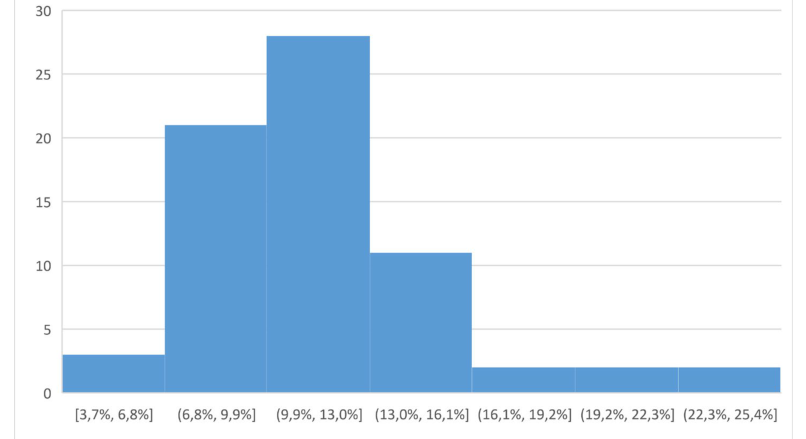
Note: The distribution shown is for banks with credit risk exposure greater than €31 bn. The cutoff is chosen judgmentally to exclude a few smaller banks that appear to be outliers.
| RWA Aggregate on EU Banks (€bn) Dec. | 2022 Dec. | 2020 |
|---|---|---|
| Credit Risk (A) | 7,127 | 6,075 |
| Operational Risk (B) | 835 | 761 |
| Ratio (B)/(A) | 11.7% | 12.5% |
4.2.3 Implied floor values of a risk-sensitive RW Floor
To look at the impact on the absolute level of the floor, we will use the risk weights under the Standardised Approach as stated in the Basel 3 Finalised Standards (BCBS (2017)) and look for the most common asset securitised. We have added some additional comments for context.
Table 4.2 shows that the situations where the Calibrated risk-sensitive RW Floor comes close or matches the current fixed value RW Floor corresponds to the riskiest assets: Project Finance in their construction phase (13%); Leveraged Loans (15%); Buy-to-let subprime residential mortgages (i.e., where the criteria are not met).
For asset classes that are not eligible for the STS treatment (Commercial Real Estate, Specialised Lending), it would be preferable to have a well-designed granularity adjustment in the RW Floor to reflect the nature of the risk linked to low granularity rather than having a fixed value that is only relevant for the riskiest assets in those asset classes. For example, a securitisation that is backed by a couple of loans to land acquisition, development and construction (ADC) companies (whose underlying risk weight is one of the highest at 150%) should have a RW Floor exceeding 15% to allow for the extremely low granularity of such transactions.
Asset Pool (Basel III SA) RW Floor RW Floor type of securitisations Corporate Granular Large Corp. CLOs Rating (AAA to AA-) 20% 2,0% For reference only Rating (A+ to A-) 50% 5,0% 10% STS (Bulk of the market) Rating (BBB+ to BBB-) 75% 7,5% 10% STS Rating (BB+ to BB-) 100% 10.0% 10% STS Rating (Below BB-) 150% 15,0% 15% Non-STS Leveraged Loans SME no rating 85% 8,5% 10% STS SME Retail Highly granular ABS Revolving assets 75% 7,5% 15% Non-STS Credit cards Consumer loans 75% 7,5% 10% STS Auto loans Residential Real Estate Highly granular RMBS STS Owner Occupier (LTV ≤ 50%) 20% 2,0% 10% Owner Occupier (50% < LTV ≤ 60%) 25% 2,5% 10% STS STS (Bulk of the market) Owner Occupier (60% < LTV ≤ 80%) 30% 3,0% 10%
Owner Occupier (80% < LTV ≤ 90%) 40% 4,0% 10% STS STS Owner Occupier (90% < LTV ≤ 100%) 50% 5,0% 10% Owner Occupier (LTV > 100%) 70% 7,0% 15% Non-STS Income Producing (LTV ≤ 50%) 30% 3,0% 15% Non-STS (Bulk of the market) Non-STS Income Producing (50% < LTV ≤ 60%) 35% 3,5% 15% Income Producing (60% < LTV ≤ 80%) 45% 4,0% 15% Non-STS Non-STS Income Producing (80% < LTV ≤ 90%) 60% 6,0% 15% Non-STS Income Producing (90% < LTV ≤ 100%) 75% 7,5% 15% Income Producing (LTV > 100%) 105% 10,5% 15% Non-STS Income Producing (Criteria not met) 150% 15,0% 15% Non-STS Commercial Real Estate Low granularity CMBS General (LTV < 60%, rating A) 50% 5,0% 15% Non-STS General (LTV < 60%, rating BBB) 60% 6,0% 15% Non-STS (Bulk of the market) General (LTV > 60%, rating BBB) 75% 7,5% 15% Non-STS General (LTV > 60%, rating B) 150% 15,0% 15% Non-STS Non-STS Income Producing (60% < LTV ≤ 80%)) 90% 9,0% 15% Income Producing (LTV > 80%) 110% 11,0% 15% Non-STS Land acq., dev., constr. (ADC) residential 100% 10,0% 15% Non-STS (very low gran.) Loan to ADC company / SPV 150% 15,0% 15% Non-STS (very low gran.) Specialised Lending Low granularity CLO Project Finance, pre-operational phase 130% 13,0% 15% Non-STS Project Finance, operational 100% 10,0% 15% Non-STS Project Finance, operational (high quality) 80% 8,0% 15% Non-STS (Bulk of the market) Object Finance 100% 10,0% 15% Non-STS Commodity Finance 100% 10,0% 15% Non-STS
After the calibration exercise, it is obvious that the fixed value RW Floor of 15% for non-STS and 10% for STS is too high for the very large majority of European transactions, and therefore the JC was correct is questioning the values and proposing a reduction. The 12% fixed value proposed by the JC is numerically better than the current 15% fixed value for non-STS senior positions, but as the design of the RW Floor has not changed and is not risk sensitive to the underlying pool, we can already foresee that this would not be sufficiently high for senior securitisations backed by pools of leveraged loans.
The same holds for STS securitisations. The 7% fixed value proposed by the JC for IRB banks is more adequate than the current 10% fixed value. However, we do not understand why this is the preserve of IRB banks.
Overall, the reduction in the fixed value of the RW Floor will help the European economy, but only the design of the RW Floor as a variable value that is risk-sensitive to the underlying pool risk will also address issues of financial stability.
4.2.4 The calibration of a RW Floor based on comparability
Comparability with Financial Instruments Previous attempts at calibration of the RW Floor were made based on Comparability with other financial instruments. AAA corporate exposures were first used for this purpose in BCBS WP10. In the first attempt at calibrating on the basis of Comparability, this was made by using the AAA PD (set at the regulatory floor of 0.03%). In that sense, the logic was to match the PD-based approaches of credit rating agencies such as S&P or Fitch’s.[48] But the corporate formula required another input, the LGD and the choice was made in the working paper to use the corporate Foundation LGD of 50%.[49] With the then formula for corporate exposure, the risk weight resulted in a value of 14%. However, senior securitisation tranches have a much lower LGD than corporate exposures. If this had been considered, then with a AAA tranche LGD of let’s say 10%, rather than 50% the RW Floor would have been 2.8%. And for thin non-senior tranche the LGD may be higher than 50%, resulting a value that should be higher than 14%, using the then corporate formula.
Another instrument often mentioned when comparing securitisation is covered bonds (CBs). Both instruments are used to enable banks to diversify their sources of funding and to reduce overall funding costs. While there are similarities (both use a pool of assets and both have a tranching (explicit for securitisation, implicit via the overcollateralisation for CBs)), there are also key differences. These include (i) recourse limited to cash flows for securitisation while CBs exhibit dual recourse, sequential to the issuer first and then to the cover pool, (ii) lower operational risk in a securitisation as the aim is to minimize any link to the originator/sponsor and there are enhanced reporting requirements on mainly static pools, whereas for CBs, there is an ongoing and residual link to the issuer/sponsor CBs, with a dynamic cover pool, and lower reporting requirements, and (iii) capacity to recycle capital for further lending in the case of securitisations, but not in the case of CBs.
Using IRB, in a comparison of both instruments, the credit rating agency DBRS (see (DBRS (2016)) indicates that the risk weight of the higher rated CBs are between the extremely low value of 2% and the low value of 7%. Under the SA, and to be more exact, under the Basel III Finalised Standards, the lowest possible value for CBs is a 10% risk weight. So, an IRB bank that is subject to the SA Output Floor will have an implicit 7.25% risk weight (= 0.725 x 10% RW). The SA Output Floor was introduced to protect against residual risk or estimation risk on IRB model parameters.
Comparability with Regulatory Approaches In Basel II, regulators wanted to ensure that the lowest risk weight, 7%, under the RBA for the most senior position of granular pools, was also available under the SFA, which had a 56 bps floor (i.e. a 7% RW). So two different approaches had the same floor, but both approaches could only be used by IRB banks.
In the consultations for Basel III, the IRB MSFA had a 160 bps floor (i.e. a 20% RW), which matched the 20% RW Floor of the Standardised Approach SSFA. This time, regulators wanted comparability within the hierarchy of approaches. This worked up to a point, as in the BCBS hierarchy of approaches, the Revised external Ratings Based Approach (RRBA) was sandwiched between the IRB MSFA and the SA SSFA approaches. While IRB and SA had the same RW Floor of 20%, this was not the case for the RRBA as the AAA risk weight increased disproportionately with tranche maturity from 20% to 68%.
This issue remained in the final Basel III rules with SEC-IRBA, then SEC-ERBA followed by SEC-SA. Thankfully, the EC corrected this hierarchy, and the European implementation is SEC-IRBA, then SEC-SA followed by SEC-ERBA. Therefore, the RW Floor of 15% is compatible between SEC-IRBA and SEC-SA and only increases further down the hierarchy with SEC-ERBA as a function of tranche maturity for AAA tranches from 15% to 25%.
It is in this context that Duponcheele et al. (2014d), in calibrating a European SSFA to revive the European securitisation market, stated that “as a matter of principle, […] low quality pools warrant higher floors than high quality pools. Of course, in formulating regulations, one may wish to take into account other elements, such as compatibility with other rules.” The 15% risk weight was chosen to match the BCBS (2013) proposal, rather than resulting from a calibration exercise. The authors stated: “we advocate the use of a simple, risk-sensitive floor equal to the value of (5% + 10% × RRRRSSSS), where RRRRSSSS is the risk weight of the associated asset class in the pool so that the floor is higher for low quality pools and lower for high quality pools. For example, a high quality mortgage portfolio with RRRRSSSS = 35% would give a floor of 8.5% (= 5% + 10% × 35%); a low quality pool with RRRRSSSS = 150% would give a floor of 20% (= 5% + 10% × 150%).” And when the basic risk weight of 100% was used, this matched the 15% in the BCBS proposal. The fundamental idea behind a variable floor is that “securitisations with very low risk weight pools are likely to have fewer hard-to-assess sources of risk”.
4.2.5 Design issues for a RW Floor
The primary issue that needs to be addressed in the design of the RW Floor is this notion that a floor needs to be a fixed value.
Any fixed value is not risk-sensitive, and the absolute level of the RW Floor can then be assessed as a relative proportion of the underlying pool risk weight. In some instances, it ceases to be a proportion, and it becomes a multiplier of the underlying pool risk weight. This was especially evident when the first Basel III proposal (BCBS (2012)) set the RW Floor at 20%. The issue remained with the revised RW Floor at 15%.
Indeed, residential mortgage loans in some European countries have a low risk. For example, an analysis of the 16 largest European banks in Duponcheele and Perraudin (2022a) shows that the average risk weight is 11.2%, with a wide dispersion between the banks, with the lowest at 6.0% and the highest at 16.5%.[50] With the current fixed value RW Floor of 15% (and 10% for STS), it is, therefore, for most banks, very inefficient to transfer to another bank the risk of what is prime European collateral using securitisation. It is a situation where the capital requirement of the senior tranche (typically AAA-rated) is higher than the capital requirement of the unsecuritised assets. This financial incoherence has consequences: by freezing defacto the prime European residential mortgages on the banks’ balance sheets, it results in a major impediment for a proper functioning of the CMU.
BCBS had to implement a rule CRE 40, Article 40.51 that explicitly states: “Where the risk weight cap results in a lower risk weight than the floor risk weight of 15%, the risk weight resulting from the cap should be used.”
This statement should not be present in a well-designed set of rules. Its mere presence simply highlights that the problems created by a high fixed value of the RW Floor really exist and have been created by the regulators themselves. In other words, when in a regulation a cap needs to override a floor, something is very wrong either in the calibration or in the design, or in both the design and the calibration.
The JC’s proposal only touches upon the calibration, and not the design. We think that the EC has an opportunity to address both.
Another issue here is the fact that the RW Floor is designed as a ‘minimum’ rather than as ‘an add-on’. As mentioned in Duponcheele and Perraudin (2022a), a ‘minimum’ is a design flaw:
“It would be better to remove this design flaw by having a layer of additional risk weight linked to the underlying pool capital rather than using a formula based on the word ‘minimum’. Regulators believe that the existence of a floor is conservative; financial structurers understand it is a design flaw and will push the attachment point of the senior tranche as low as possible until equality to the floor has been reached. Future regulation should address this and remove incentives for lowering senior tranches’ attachment points.”
4.3 Summary of various ideas for a RW Floor and possible improvements
4.3.1 Proposals in Duponcheele et al. (April and November 2014)
In April 2014, Duponcheele et al. (2014c) proposed that the RW Floor be an ‘add-on’, i.e., it is added to the RW of the tranche obtained with the underlying formula (in this case the CMA approach).
• For the most senior tranche of HQS (high quality securitisations, a notion that will become STC in Basel, STS in Europe):
FFFFFFFFFF(RRRRPPPPPPPP) = mmmmmm([15%], [5% + 10% × RRRRPPPPPPPP])
• For all other tranches:
FFFFFFFFFF(RRRRPPPPPPPP) = [15%]
This was calibrated by comparability[51] with the BCBS proposal at that time (BCBS (2013)).
As SEC-ERBA and SEC-IAA were referencing the other approaches (SEC-IRBA and SEC-SA), for the lowest risk weight for AAA, it would have been natural to recalibrate those two approaches accordingly.
In November 2014, in another proposal (Duponcheele et al. (2014d))[52], when the debate on European HQS securitisations (and that will be labelled STC later on) started to take shape in regulatory circles, the idea was to address the concerns expressed by some members of the then Basel RSW who objected to the use of the IRB risk weight of the pool in the use of a RW Floor, whose aim was partly to reduce model risk.
This could be achieved by using the regulators’ own view of the risk, by using Standardised Approach capital requirement KKSSSS for defining the RW Floor of both IRB banks and SA banks.
For HQS securitisations, one would have used the lesser of two numbers:
FFFFFFFFFF(RRWWPPPPPPPP) = mmmmmm([15%], [5% + 10% × KKSSSS × 12.5]) which would have given a HQS RW Floor of 8.5% for prime residential mortgages, 10.7% for SMEs benefiting from the European supporting factor, 12.5% for SMEs without the supporting factor and 12.5% for consumer loans. The STC RW Floor will later become with BCBS a fixed value of 10% for all qualifying assets, regardless of the underlying risk.
Whereas Non-HQS securitisations would have a higher RW Floor, when the underlying risk weight was above the 100% corporate risk weight (for example for US subprime mortgages or for Construction loans), by taking the higher of two numbers: FFFFFFFFFF(RRRRPPPPPPPP) = mmmmmm([15%], [5% + 10% × KKSSSS × 12.5])
This would have given a Non-HQS RW Floor of 15% for large corporates, 20% for leveraged loans. The Non-STC RW Floor will remain at the 2013 BCBS proposal, a fixed value of 15%.
4.3.2 Proposal of the JC of the ESAs (December 2022)
Subject to four additional criteria (one of which creates financial instability at a macroprudential level – see Section 3.3.2)
• For NN ≥ 200, for the senior tranche only:
For STS o
• for IRB Banks: IIIIII RRRR FFFFFFFFFF= 7%
• for SA Banks: SSSS RRRR FFFFFFFFFF= 10%
For non-STS o
• for IRB Banks: IIIIII RRRR FFFFFFFFFF= 12%
• for SA Banks: SSSS RRRR FFFFFFFFFF= 12%
When those four criteria are not met:
• RW Floor for STS (for senior tranche): RRRR FFFFFFFFFF= 10%
• RW Floor for non-STS (for senior tranche): RRRR FFFFFFFFFF= 15%
The RW Floor is undifferentiated between STS and non-STS for non-senior tranches: RW Floor for STS (for non-senior tranche): RRRR FFFFFFFFFF= 15%
• • RW Floor for non-STS (for non-senior tranche): RRRR FFFFFFFFFF= 15%
SEC-ERBA (and its SEC-IAA proxy) follows the choices for SEC-SA, with some additional penalties due to the incorrect presence of tranche maturity, instead of asset pool maturity, as a risk parameter.
The RW Floor remains a ‘minimum’ (and this design flaw is not addressed in the proposal).
In the spirit of the 2022 JC Proposal, one can adopt improvements by removing the cliff-effects created by granularity thresholds. Using a High granularity case (NN= 200) and a Low granularity (NN= 50), we have:
• For NN ≥ 200, for the senior tranche only:
For STS o
• for IRB Banks: IIIIII RRRR FFFFFFFFFF= 7%
• for SA Banks: SSSS RRRR FFFFFFFFFF= 10%
For non-STS o
• for IRB Banks: IIIIII RRRR FFFFFFFFFF= 12%
• for SA Banks: SSSS RRRR FFFFFFFFFF= 12%
For 50 ≥ NN > 200, for senior tranche only:
• We thus define a granularity weight ααNN: o

For STS o

For non-STS o

NN < 50, for senior tranche only:
• For STS: Not applicable o For non-STS o
• for IRB Banks: IIIIII RRRR FFFFFFFFFF= 15%
• for SA Banks: SSSS RRRR FFFFFFFFFF= 15%
• For all non-senior tranches
For STS and non-STS: o
• for IRB Banks: IIIIII RRRR FFFFFFFFFF= 15%
• for SA Banks: SSSS RRRR FFFFFFFFFF= 15%
This minor granularity adjustment removes the cliff-effects due to the granularity threshold in the current JC’s proposal.
In practice, only European SME transactions could potentially be impacted by such granularity threshold. Indeed, securitisations backed by pools of residential mortgages or consumer loans have granularity levels that are usually well above 500.
4.3.3 Proposal for a unified risk-sensitive RW Floor
This approach has its origin in the JC’s proposal, with additional improvements. It is risk-sensitive to a) pool granularity, b) credit risk in the pool, c) structure (STS / non-STS), d) tranche seniority, and e) properly calibrated on European operational risk data.
This approach unifies the JC’s thinking, the calibration on operational risk data, the BCBS work on STC, the historical evolution demonstrating the need for proportionality to pool risk. It also contains a linear granularity interpolation to remove granularity cliff-effect in the JC’s proposal and contains a novel granularity adjustment to cater for the risk of extremely low granularity securitisations. We have thus labelled this approach ‘Unified Risk-Sensitive RW Floor’
Using the following notation: RRRRPPPPPPPP = 12.5 × KKIIIIII for IRB banks, RRRRPPPPPPPP = 12.5 × KKSSSS for SA banks, and based on granularity thresholds, High granularity threshold (N=200) and Low granularity threshold (N=50), we have:
• For NN ≥ 200
For senior tranche only: o
• for STS: RRRR FFFFFFFFFF= 7% × RRRRPPPPPPPP.
• STS benefit: the 7% proportion is below the median 10.3% obtained with the operational risk calibration.
• for non-STS: RRRR FFFFFFFFFF= 12% × RRRRPPPPPPPP
• Non-STS disadvantage: the 12% proportion is above the median 10.3% obtained with the operational risk calibration.
For non-senior tranches: o
• for STS: RRRR FFFFFFFFFF= 15% × RRRRPPPPPPPP (This could be reduced to 13% for a STS benefit).
for non-STS: RRRR FFFFFFFFFF= 15% × RRRRPPPPPPPP
• Non-senior tranche penalty: the 15% proportion is significantly above the median obtained with the 10.3% operational risk calibration.
• For 50 ≥ NN > 200 (this section removes the cliff-effects due to granularity)
For senior tranche only: o
• We first define a granularity linear interpolation weight ααNN:

For non-senior tranches: o
• for STS: RRRR FFFFFFFFFF= 15% × RRRRPPPPPPPP
• for non-STS: RRRR FFFFFFFFFF= 15% × RRRRPPPPPPPP
• For NN < 50 (this section introduces a special granularity adjustment to cater for the loss distribution distortion in extremely low granularity pool (for the sake of completeness as those securitisations are rare). The aim of this adjustment is to ensure the mathematical equality between the RW Floor and the RW of the Pool when there is a single asset (NN= 1). However, this solution as business limitations as explained in the next section.
For all tranches, with: o
1 1 50−NN
![Equation: RRRR FFFFFFFFFF= 100% × • NN + 15% − [50] × 1 − 50−1 × RRRRPPPPPPPP](/api/media/file/eq-238-300x18.png?prefix=media)
• Alternatively, instead of using RRRRPPPPPPPP = 12.5 × KKIIIIII for IRB banks, one can use the SA Output Floor final ratio of 72.5% to define the IRB RW Floor in relation to the SA RW Floor (as defined above) with the following equation:
IIIIII RRRR FFFFFFFFFF= 0.725 × SSSS RRRR FFFFFFFFFF
The calibration for this approach does not make a judgement as to whether the RW Floor should be a ‘minimum’ or an ‘add-on’, although an add-on would be preferable (and would not create optimisation opportunities against which one would have to develop additional resilience criteria – an unnecessary complexity).
4.3.4 Proposal for a simple operational risk-calibrated, risk-sensitive RW Floor
In this proposal, we use the distribution in Figure 4.1.
For IRB banks, for the most-senior tranche:
IIIIII RRRR FFFFFFFFFF= 10% × KKIIIIII × 12.5
For SA banks, for the most-senior tranche:
SSSS RRRR FFFFFFFFFF= 10% × KKSSSS × 12.5
The design of this RW Floor proposal is risk-sensitive to all risk components that have been included in the evaluation of the KKIIIIII or KKSSSS (as the case may be KKPPPPPPPP), by being proportional to that risk:
RRRR FFFFFFFFFF= PPPPPPPPPPPPPPPPPPPP× KKPPPPPPPP × 12.5
A proportion of 10% calibration would be calibrated on the median of the ratios of Operational Risk to Credit Risk as described in Section 4.2.2. Using this proportion has the major advantage of being calibrated on EBA data, i.e., with a European perimeter (exact value being 10.3%).
However, regulators may want to exercise judgement and incentivise a European Securitisation market towards STS structures, whenever feasible. The level of 10% is thus adequate for STS transactions since they have more than 50 exposures (NN) thanks to the 2% concentration threshold on a single obligor.
For non-STS transactions, we can look at the distribution in section 4.2.2, and use a 80th percentile value that would correspond to a proportion of 14.4%, which rounded-up is 15%.
We would thus have for STS transactions:
RRRR FFFFFFFFFF= 10% × KKPPPPPPPP × 12.5
For non-STS transactions:
RRRR FFFFFFFFFF= 15% × KKPPPPPPPP × 12.5
When granularity drops, we consider that a potential adjustment should be obtained through a change in the capital allocation of tranches, and thus using a potentially increased KKPPPPPPPP. We discuss such possibility in Zana (2023), however, since current values of KKPPPPPPPP do not allow for granularity, we propose an additional granularity adjustment based on:
NN
![Equation: Additional Granularity adjustment: 5% × 1 −[50]](/api/media/file/eq-239-300x27.png?prefix=media)
As all securitisations with a granularity below 50 are by definition non-STS, we would have for those ones:

The additional granularity proportion is not calibrated on data and is a regulatory overlay to increase the RW Floor towards the historical high Basel II RW Floor of 20% for granularity below 6, or to an historically high level as in the 2012 Basel proposal. This would enable single loan CMBS senior tranche RW to be capped at 20%.
In that sense, this approach overrides the mathematically correct formula that stipulates that for a single asset the RW Floor should be equal to the RW of the asset itself. This override is necessary as the mathematics of the SSFA do not cater for the LGD tranching of a single asset, and therefore the mathematical formulation for extremely low granularity securitisation might not be a correct representation of the financial risk.
The calibration for this approach does not make a judgement as to whether the RW Floor should be a ‘minimum’ or an ‘add-on’, however the same principle should apply to every type of treatment (SEC-IRBA, SEC-SA, SEC-ERBA, SEC-IAA).
5 Conclusion
The recent legislative developments of the European co-legislators (EP and CEU) related to securitisation capital rules have sought to address immediate concerns regarding the impact that the SA Output Floor may have on synthetic transactions originated by European IRB banks. A political compromise (the ‘Boyer amendment’) enables IRB banks to reduce the pp-premium by a factor of two, for calculating the risk weight of the senior tranche of retained synthetic securitisation.
Duponcheele and Perraudin (2022a) noted that, without legislative changes, the effect of the introduction of the SA Output Floor on the securitisation market would vary considerably across regulatory asset classes. Wholesale loan securitisations such as large corporate or SME loans would be scarcely feasible under the rules. On the other hand, retail loan securitisations such as residential mortgages, auto loans and other consumer loans, would be boosted.
While the Boyer amendment is welcome, its application is temporary. Because of it, the banking industry has won a four-year reprieve. The presence of sunset clauses in the European legislation does not contribute to the creation of a stable market. From a financial stability point of view, it is undesirable that substantial economic activities should be subject to regulatory volatility, especially when no impact assessment of specific regulatory choices has been made to the co-legislators.
The current and welcome debate on the RW Floor launched by the JC of the ESAs is an attempt to address the economic damage generated by the existing Basel-designed and Basel-calibrated RW Floor. The JC proposes to reduce the RW Floor in certain circumstances, but in so doing, it repeats the historical mistake of employing a fixed value floor independent of the underlying risk weights of the securitised assets.
The JC proposal represents a departure from the Basel calibration for the rules applicable to European banks. In their willingness to depart from Basel, European co-legislators have a unique opportunity to address the key design flaw in the securitisation capital rules that hampers the effective functioning of the CMU. This paper argues that the RW Floor should not be a fixed value (such as 15%), a value unconnected to the underlying risk weight of the securitised assets (which typically range from 7% to 150%).
An examination of approaches that regulators have taken to the RW Floor over the last 30 years shows that successive reforms have replaced previous calibrations in attempts to improve risk sensitivity, but the reliance on arbitrary fixed values has led to regulatory rules that favour certain asset classes in particular countries, distorting the securitisation market to the extent that its size and composition bears little relation to European economic activity.
In reviewing the historical evolutions of Basel RW Floors, we have proposed approaches that address the issues raised by regulators. Among those proposals are differentiated calibrations for STS and non-STS, for IRB and SA banks, and for the rare cases of extremely low granularity. However, central to the calibration is the recognition that senior tranches which attach high enough for the RW Floor to apply contain only operational or model risk without contributing to credit risk.
Using the EU-Wide Stress Tests, we estimate that the operational risk that a senior tranche contains is 10.3% of the underlying pool risk weight. A simple and effective proposal to ensure a level playing field across countries in the EU, across economic sectors and asset classes, across the regulatory classification of banks, is, therefore, to have a RW Floor as expressed in the following formula:
RRRR FFFFFFFFFF= 10% × KKPPPPPPPP × 12.5
Here, KKPPPPPPPP is the capital KKIIIIII or KKSSSS expressed as a percentage for the underlying securitised assets under the appropriate regulatory approach.
While the above is best for originator banks or sponsor banks, when KKPPPPPPPP is set at KKSSSS for all investing banks, the level playing field that this simple proposal creates would permit the strengthening of the European Single Market. More regulatory variations can be introduced, for example, favouring STS securitisations versus non-STS (say by replacing the above 10% factor of proportionality with 7% and 12%, respectively), or favouring IRB banks versus SA banks (say by multiplying the KKSSSS by the 0.725 final coefficient that applies to IRB banks when calculating the SA Output Floor).
Where additional complexity is introduced, we consider that it should be accompanied by a clear economic assessment of which borrowers, banks and countries will be positively or adversely affected and what is the cost of such additional complexity. This should be done not through a regulatory prism but with a view to understanding the impact of such choices on the European economy and its competitiveness.
The level playing field should be maintained across the hierarchy of approaches: SEC-IRBA, followed by SEC-SA, followed by SEC-ERBA / SEC-IAA. The latter is key for ABCP conduits, an important financing tools for Auto loans/leases and Trade receivables/finance assets. The level playing field should be extended to SEC-ERBA / SEC-IAA, by ensuring that the top line in the SEC-ERBA / SEC-IAA table for the determination of risk weight of externally rated tranches can refer to the same RW Floor as in SEC-SA. Not doing so would create artificial competitive biases between ABCP conduits using SEC-IRBA and ABCP conduits using SEC-IAA.
A good design and data-based calibration of the RW Floor issue is central to the CMU. The calibration presented in this paper is based on the EU-wide Stress Tests results, and specifically the ratio of operational risk to credit risk. This is justified because the capital for senior tranches attaching at a level for which the risk-weight floor applies almost exclusively covers operational risk. Another view on RW Floor calibration (based on model risk) is provided by Risk Control (2024).
Regulatory capital rules should, of course, be concerned with non-senior tranches as well. These constitute the riskier part of securitisations that contains most of the systemic risk. Differentiation for securitisation capital (STS vs. non-STS, IRB vs. SA) should be tackled at the level of such tranches (via a combined review of the pp-premium and of the cliff-effect generating deduction threshold).[53] For such tranches, the appropriate capital levels and the stability that they exhibit in downturns are key to avoiding financial instability.
On the latter issue of avoiding financial instability, other research conducted by some of the authors of this paper (see Duponcheele and Perraudin (2022b)) explains how including a simple scaling factor permits one to apply capital charges that are appropriately calibrated in level and do not induce instability in the capital banks must put aside in economic downturns. The latter arises if capital charges exhibit cliff effects, generating sharp changes in bank capital and, thereby, creating the potential for capital shortfalls and a related credit crunch.
On further topics of regulatory development, if the European policy makers really want the European securitisation markets to develop, they should address other shortcomings of the European securitisation framework, among them:
1. The implementation in Europe of a STS synthetic framework has removed (re)insurance companies from being able to participate in this risk transfer market by not allowing them to provide unfunded guarantees, the way that (re)insurance companies provide credit protection. We are not aware that the legal wording was chosen with this specific objective, and as the legislation was part of what is known as the ‘Covid Quick Fix’, similar legal routes could be followed to reverse the exclusion of (re)insurers from the unfunded STS market.
2. Another area that needs a complete overhaul is the capital charges for securitisation products included in Solvency II. The extreme cliff-effect between STS and non-STS capital charges for senior tranches cannot be justified empirically as is clear from Perraudin and Qiu (2022a). Those capital charges should be modified to reintroduce the basic financial notion that the capital charge of a CQS1 senior tranche, that is highly protected against credit risk by mezzanine and junior tranches and is most of the time more liquid than the underlying securitised exposures, cannot exceed the capital charge of the unprotected, untranched, underlying pool.
3. An adjustment in the eligibility of different securitisation types for Liquidity Coverage Ratio (LCR) purposes and the applicable haircuts should also be considered. A study by Perraudin and Qiu (2022b) examines the relative liquidity of senior Asset Backed Securities (ABS) and Covered Bonds (CBs), and the evidence provided in it suggests that senior ABS should be included within higher LCR categories than is currently the case.
4. Important non-quantitative barriers to securitisation relating to European regulatory disclosure and due diligence requirements remain, and measures to address them need to be taken.
These reforms will take time. However, changes in the RW Floor can be implemented quickly as a political decision, on a timetable resembling the accelerated legislative changes that occurred for the NPL RW Floor with the Capital Markets Recovery Package.
6 References
BCBS (1986) “The Management of Banks’ Off-Balance-Sheet Exposures,” BIS, March. (Here: bcbsc134)
BCBS (1987) “Proposals for international convergence of capital measurement and capital standards,” Consultative Paper, BIS, July. (Here: bcbs03a)
BCBS (1988) “International Convergence of Capital Measurement and Capital Standards,” BIS, July. (Here: bcbs04a) (known as Basel I)
BCBS (1999) “A New Capital Framework,” Consultative Paper, BIS, June. (known as First Consultative Package) (Here: bcbs50)
BCBS (2001a) “A New Capital Framework,” Consultative Document, BIS, January. (known as Second Consultative Package) (Here: bcbsca02)
BCBS (2001b) “Asset Securitisation,” Consultative Document, BIS, January. (Supporting Document of the Second Consultative Package) (Here: bcbsca06)
BCBS (2001c) “Working Paper on the Treatment of Asset Securitisation,” BIS, October. (Here: bcbs_wp10)
BCBS (2002) “Second Working Paper on Securitisation,” BIS, October. (Here: bcbs_wp11)
BCBS (2003) “The New Basel Capital Accord,” Consultative Document, BIS, October. (Here: bcbscp3) (known as Third Consultative Paper)
BCBS (2004) “The New Basel Capital Accord,” BIS, June. (Here: bcbs107) (known as Basel II)
BCBS (2009) “Enhancements to the Basel II framework,” BIS, July. (Here: bcbs157)
BCBS (2012) “Revisions to the Basel Securitisation Framework,” Consultative Document, BIS, December. (Here: bcbs236) (known as First consultative document)
BCBS (2013a) “Foundations of the Proposed Modified Supervisory Formula Approach,” Working Paper No. 22, BIS,
January. (Here: bcbs_wp22)
BCBS (2013b) “The Proposed Revised Ratings-Based Approach,” Working Paper No. 23, BIS, January. (Here: bcbs_wp23)
BCBS (2013c) “Revisions to the Basel Securitisation Framework,” Consultative Document, BIS, December. (Here: bcbs269) (known as Second consultative document)
BCBS (2014) “Revisions to the Securitisation Framework,” Basel III Document, BIS, December. (Here: d303)
BCBS-IOSCO (2015) “Criteria for identifying simple, transparent and comparable securitisations,” Consultative Document, BIS-IOSCO, July. (Here: IOSCOPD494)
BCBS (2015) “Capital treatment for “simple, transparent and comparable” securitisations,” Consultative Document, BIS, November. (Here: d343)
BCBS (2016) “Revisions to the securitisation framework, Amended to include the alternative capital treatment for “simple, transparent and comparable” securitisations,” Consultative Document, BIS, July. (Here: d374)
BCBS-IOSCO (2017) “Criteria for identifying simple, transparent and comparable short-term securitisations,” Consultative Document, BIS-IOSCO, July. (Here: IOSCOPD572)
BCBS (2017) “High Level Summary of Basel III reforms,” BIS, December (Here: d414_hlsummary)
BCBS (2018a) “Capital treatment for short-term “simple, transparent and comparable” securitisations,” Standard, BIS, May. (Here: d442)
BCBS (2018b) “Revisions to the securitisation framework, Amended to include the alternative capital treatment for “simple, transparent and comparable” securitisations,” Basel III Document, BIS, July. (Here: d374)
BCBS (2020) “Capital treatment of securitisations of non-performing loans,” Technical Amendment, BIS, July. (Here: d511)
DBRS (2016) “Covered Bonds vs. Securitisation – A Quick Comparison”, DBRS Commentary, DBRS, May. (Here)
Duponcheele, Georges, William Perraudin and Daniel Totouom-Tangho (2013a) “A Principles-Based Approach to Regulatory Capital for Securitisations,” BNP Paribas/Risk Control mimeo, April. (Here)
Duponcheele, Georges, William Perraudin and Daniel Totouom-Tangho (2013b) “The Simplified Arbitrage-Free
Approach: Calculating Securitisation Capital based on Risk Weights Alone,” BNP Paribas/Risk Control mimeo, July. (Here)
Duponcheele, Georges, William Perraudin and Daniel Totouom-Tangho (2013c) “Maturity Effects in Securitisation Capital: Total Capital Levels and Dispersion Across Tranches,” BNP Paribas/Risk Control mimeo, September. (Here)
Duponcheele, Georges, William Perraudin, Alastair Pickett and Daniel Totouom-Tangho (2013d) “Granularity, Heterogeneity and Securitisation Capital,” BNP Paribas/Risk Control mimeo, September. (Here)
Duponcheele, Georges, William Perraudin and Daniel Totouom-Tangho (2014a) “Calibration of the Simplified Supervisory Formula Approach,” BNP Paribas/Risk Control mimeo, March. (Here)
Duponcheele, Georges, William Perraudin and Daniel Totouom-Tangho (2014b) “Reducing the Reliance of Securitisation Capital on Agency Ratings,” BNP Paribas/Risk Control mimeo, February. (Here)
Duponcheele, Georges, Alexandre Linden, William Perraudin and Daniel Totouom-Tangho (2014c) “Calibration of the CMA and Regulatory Capital for Securitisations,” BNP Paribas/Risk Control mimeo, April. (Here)
Duponcheele, Georges, Alexandre Linden and William Perraudin (2014d) “How to Revive the European Securitisation Market: a Proposal for a European SSFA,” BNP Paribas/Risk Control mimeo, November. (Here)
Duponcheele, Georges and William Perraudin (2022a) “Impact of the SA Output Floor on the European Securitisation Market”, Research Report, AFME/Risk Control mimeo, November. (Here)
Duponcheele, Georges and William Perraudin (2022b) “Reviving Securitisation in Europe by Scaling Inputs to Capital Formulae,” Risk Control note, 22-113a, July. (Here)
EBA (2020) “Report on STS framework for synthetic securitisation under Article 45 of Regulation (EU) 2017/2402,” European Banking Authority, May. (Here: EBA/OP/2020/07)
EBA (2022) “Joint Committee advice on the review of the securitisation prudential framework (Banking),” EBA, December. (Here: JC 2022 66)
EC (2021) “Call for advice to the Joint Committee of the ESAs for the purposes of the securitisation prudential framework review,” October. (Here: CfA)
EC (2023) “2023 State of the Union Address by President von der Leyen”, Speech to the European Parliament, European Commission, September. (Here)
ECB (2014) “Capital markets union – the ‘Why’ and the ‘How’”, Dinner speech by Yves Mersch, Member of the Executive Board of the ECB, Joint EIB-IMF High Level Workshop, October. (Here)
ECB (2023) “A Kantian shift for the capital markets union”, Speech by Christine Lagarde, President of the ECB, at the European Banking Congress, November. (Here)
EFR (2023) “Serving Customers and the European Economy, European Financial Services Sector Outlook,” European Financial Services Round Table, March 2023. (Here)
EIOPA (2022) “Joint Committee advice on the review of the Securitisation prudential framework (Insurance),” EIOPA, December. (Here: JC 2022 67)
ESMA (2022) “Joint Committee advice on the review of the securitisation prudential framework,” ESMA, December. (Here: JC 2022 65)
Fed Board (2006) “Draft Basel II NPR - Preamble - V. Calculation of Risk-Weighted Assets,” Notice of Proposed Rulemaking (NPR) and Supporting Board Documents, Basel II Capital Accord, Federal Reserve Board, March. (Here)
HLFCMU (2020) “A new vision for Europe’s capital markets,” Final Report of the High Level Forum on the Capital Markets Union, June. (Here)
Mora, Nada (2012) “What Determines Creditor Recovery Rates?,” Economic Review, Federal Reserve Bank of Kansas City, vol 97(QII). (Here)
Peretyatkin, Vladislav and William Perraudin (2004) “Capital for Structured Products,” Risk Control Limited.
Perraudin, William and Yixin Qiu (2022a) “ABS and Covered Bond Risk and Solvency II Capital Charges,” Research note 21-161a, Risk Control Limited, March. (Here)
Perraudin, William and Yixin Qiu (2022b) “Comparing ABS and Covered Bond Liquidity,” Research note 21-134a, Risk Control Limited, February. (Here):
Pykhtin, Michael and Ashish Dev (2002) “Credit Risk in Asset Securitisations: Analytical Model,” Risk, 15(5), S16-S20, May.
Pykhtin, Michael and Ashish Dev (2003) “Credit Risk in Asset Securitisations: The Case of CDOs,” Risk, 16(1), 113-116.
Pykhtin, Michael, (2004) “Asymptotic Model of Economic Capital for Securitisations,” in William Perraudin (ed.), Credit Structured Products, Risk Books.
Risk Control (2024) “Calibration of a Securitisation Capital Floor, 24-37a” March.
S&P (2023) “Default, Transition, and Recovery: 2022 Annual European Structured Finance Default And Rating Transition Study,” S&P Global Ratings, July. (Here)
S&P (2023b) “Global Trade Receivable Methodologies And Assumptions,” S&P Global Ratings, November. (Here)
Zana, Frédéric (2023) “Assessing the regulatory treatment revision on securitization”, CFP Balance Sheet Management Europe, October. (Here)
7 Glossary
ABCP Asset-Backed Commercial Paper
ABS Asset-Backed Securities
ADC land acquisition, development and construction
ASRF Asymptotic Single Risk Factor
BCBS Basel Committee on Banking Supervision
BoE Bank of England
CCF Credit Conversion Factor
CDO Collateralised Debt Obligations
CEU Council of the European Union
CfA Call for Advice
CLO Collateralised Loan Obligations
CMRP Capital Markets Recovery Package
CMU Capital Markets Union
CRR Capital Requirements Regulation
EBA European Banking Authority
EC European Commission
ECB European Central Bank
EFR European Financial Services Round Table
EIOPA European Insurance and Occupational Pensions Authority
EL Expected Loss
EP European Parliament
ESAs European Supervisory Agencies
ESMA European Securities and Markets Authority
ESRB European Systemic Risk Board
GFC Global Financial Crisis
HLF High Level Forum
IOSCO International Organization of Securities Commissions
IRB Internal Ratings-Based approach
JC Joint Committee (of the ESAs)
K Capital Requirement
LGD Loss Given Default
LTV Loan To Value
MSFA Modified Supervisory Formula Approach
MVaR Marginal Value at Risk
NPL Non-Performing Loan
PD Probability of Default
RBA Ratings-Based Approach
RMBS Residential Mortgage-Backed Securities
RRBA Revised Ratings-Based Approach
RSW Ratings and Securitisation Workstream
RW Risk Weight
SA Standardised Approach
SEC-ERBA Securitisation – External Ratings-Based Approach
SEC-IAA Securitisation – Internal Assessment Approach
SEC-IRBA Securitisation – Internal Ratings-Based Approach
SEC-SA Securitisation – Standardised Approach
SECR Securitisation Regulation
SFA Supervisory Formula Approach
SME Small and Medium Enterprise
SRT Significant Risk Transfer
SSFA Simplified Supervisory Formula Approach
STC Simple, Transparent and Comparable
STS Simple, Transparent and Standardised
ULP Uncertainty in Loss Prioritisation
WG Working Group
WP Working Paper
Notes
[1] Dr. Georges Duponcheele is Senior Credit Portfolio Manager at Great Lakes Insurance SE (part of Munich RE) and teaches the Securitisation module for the Executive Master in Asset Management from University Paris-Dauphine PSL and Ensae Paris in partnership with Lefebvre Dalloz; he has co-written numerous papers on the Basel and European securitisation frameworks. Marc Fayémi is a Principal in the Capital & Financial Markets Development team at the European Bank for Reconstruction and Development (EBRD) conducting policy dialogue, designing technical assistance and supporting the development of debt capital market including securitisation in various regions covered by EBRD. Jérémy Hermant is a securitisation expert who has led teams closing traditional ABS and capital relief trades for both UK and EU banks. Dr. William Perraudin is the Managing Director of Risk Control Limited, a specialist analytics firm advising financial institutions on balance sheet optimisation. Dr. Frédéric Zana is Head of Quantitative Structuring at CACIB and provides training at Group level on regulatory matters and ALM management issues; he is the author of a proposal for the recalibration of securitisation risk-weighted assets. All authors can be contacted via LinkedIn. Any errors are ours.
[2] Paris Europlace brings together over 600 stakeholders from the financial ecosystem – banks, insurance companies, asset managers, intermediaries, fintechs, industrial and commercial enterprises, consulting firms, public actors. It has a Securitisation Committee that aims to identify regulatory and prudential obstacles that hinder securitisation within the European Union and explore ways to address them under satisfactory conditions. The Committee is subdivided into four Working Groups, with a focus on data (WG1), prudential regulation (WG2), reporting (WG3), and French-specific issues (WG4).
[3] The authors give particular thanks to Olivier Vigna, Gilles Saint-Marc, Véronique Ormezzano from Paris Europlace, as well as Alexander Batchvarov, Antoine Chausson, Patrick Cogan, Fernando Gonzalez Miranda, Michael Heckl, Andrea Itri, Thomas Lupbrand, Ewen McMillan, Ronan Mellon, Alastair Pickett, Rainer Roczen, Eric Rossignol, Jesper Skoglund, Georgi Stoev, Alessandro Tappi, Stephan Tilke, Jim Turnbull, Maeve Verdon, Emma Viallard and Ansgar West, for their support, their contribution, their numerous and helpful comments. The views expressed are the authors’ own and not necessarily those of their firms nor of those with whom the authors had discussions or their firms.
[4] The US market continues to grow and develop.
[5] Meaning banks that are neither Originator or Sponsor of the relevant securitisation, and investing in the senior tranche from another bank’s securitisation.
[6] Between the regulatory methods used in SEC-IRBA, SEC-SA, SEC-ERBA, and IAA for banks
[7] The level playing field should also be maintained across the hierarchy of approaches: SEC-IRBA, followed by SEC-SA, followed by SEC-ERBA / SEC-IAA. The latter is key for ABCP conduits, an important financing tools for Auto loans/leases and Trade receivables/finance assets. The level playing field should be extended to SEC-ERBA / SEC-IAA, by ensuring that the top line in the SEC-ERBA / SEC-IAA table for the determination of risk weight of externally rated tranches can refer to the same RW Floor as in SEC-SA. Not doing so would create artificial competitive biases between ABCP conduits using SEC-IRBA and ABCP conduits using SEC-IAA.
[8] Strategic Technologies for Europe Platform
[9] The value of 15% had already been reduced from the 20% initially proposed by the Basel Committee on Banking Supervision (BCBS) as part of its attempt to calibrate the revised framework using the experience of the 2008 Global Financial Crisis (GFC) triggered by the US subprime mortgage crisis. The whole calibration made by the BCBS’ Ratings and Securitisation Workstream (RSW) had also been criticised at the time by Yves Mersch, ECB’s Executive Board Member, when he said: “It makes little sense to calibrate the international rules solely on the basis of US experiences. It would be like calibrating the price of flood insurance for Madrid on the experience of New Orleans. The current rules lump all ABS together and are much too conservative. They effectively question their existence.” (ECB (2014)).
[10] The EFR is chaired by Jean-Lemierre, Chairman of BNP Paribas and Vice-Chairman of Paris Europlace.
[11] Large MDBs will later benefit from a 0% risk weight under Basel II, instead of the 20% in Basel I, and this will bring material changes to the European synthetic securitisation landscape.
[12] Hence the appearance of 364-day liquidity lines in ABCP conduits.
[13] Moreover, from an accounting point of view, in the US, banks could easily deconsolidate their ABCP conduits. Changes in accounting norms during the crisis led to a full accounting consolidation on the balance sheet, creating large capital requirement increases at the worst point in time.
[14] Note that ‘deduction from capital’ affects the numerator of the capital ratio, whereas an addition of RWAs at 1250% RW affects the denominator. The equivalence holds mathematically only when the bank’s capital ratio is 8%. Under Basel III deduction is no longer permitted (except for CET1) and, the minimum capital ratio is materially greater than 8% for many banks. In this case, risk weighting at 1250% consumes capital larger than the exposure value – another incoherence in the framework – but this is another debate.
[15] The ‘later’ never materialised.
[16] Emphasis is ours.
[17] And with historical hindsight, there was a comment that would prove disastrous in the GFC: “In developing an IRB treatment for securitisation, the [BCBS Securitisation] Group has ruled out the possibility of basing the capital requirement on banks’ internal assessments of the credit risk of individual securitisation tranches. The reason being that this would require banks to employ credit risk modelling for assessing the correlation effects within the underlying asset pool. The Basel Committee determined in 1999 after extensive study that it is not appropriate at this time for banks to rely on credit risk models in setting regulatory capital.” Most banks investing in securitisation did not develop strong quantitative capabilities, as they were discouraged to do so by the regulators themselves. Instead, the market (originators, investors, and regulators) had de-facto outsourced the capital requirements to external rating agencies. Basel III regulators will over-compensate for this Basel II decision, requiring due diligence requirements for investors and cashflow modelling capacity. Central Banks themselves only equipped themselves with cashflow modelling capacity for securitisation products only after the GFC.
[18] Emphasis is ours.
[19] The risk weight formula for corporate exposure in the January 2001 second consultative package was not in its final form. It was proposed as: LLLLLL 1−PPPP RRRRCC = ቀ[50] ቁ × BBBBBBBBℎmmmmmmmm RRRRCC(PPPP) and BBBBBBBBℎmmmmmmmm RRRRCC(PPPP) = 976.5 × NN(1.118 × NN−1(PPPP) + 1.288) × ቀ1 + 0.047 × PPPP0.44ቁ
[20] The assumed LGD estimates by rating category used to derive the ABS scaling factors were as follows: Baa1: 30%, Baa2: 40%, Baa3: 50%, Ba1: 60%, Ba2: 70%, and Ba3: 80%.
[21] Under stylised assumption of homogeneous assets and securitisations with a 1-year maturity, this model yields the same results as the closed form Pykhtin- Dev model of securitisation capital (see Pykhtin and Dev (2002) and (2003) and surveyed in Pykhtin (2004)). The closed-form Pykhtin-Dev model does not reveal the effects of granularity, however, nor that of realistic maturities greater than one year.
[22] William Perraudin was at that time Senior Advisor to the Bank of England.
[23] In this sense, the RBA calibration was capital neutral and did not aim to give credit for diversification, contrary to statements in BCBS (2013b).
[24] The risk weight formula for corporate exposures in the April 2003 third consultative paper was almost in its final form. It was proposed as: • for the asset correlation ρρ(PPPP) = 12% × (1 −ee−50×PPPP) + 24% × ee−50×PPPP does not change in the final form. • the maturity adjustment bb(PPPP) = ൫0.08451 −0.05898 × log (PPPP)൯[2] is recalibrated in its final form to ൫0.11852 −0.05478 × log (PPPP)൯[2] NN−1(PPPP)+ρρ(PPPP)×NN−1(0.999) 1+(MM−2.5)×bb(PPPP) ቃ × • the capital requirement KK= LLLLLL× NNቂ ඥ1−ρρ(PPPP) 1−1.5×bb(PPPP) , will separate in its final form the Unexpected Loss and the NN−1(PPPP)+ρρ(PPPP)×NN−1(0.999) 1+(MM−2.5)×bb(PPPP) ቃ−PPPP × LLLLLLቁ × Expected loss (=PPPP× LLLLLL) with KK= ቀLLLLLL× NNቂ ඥ1−ρρ(PPPP) 1−1.5×bb(PPPP) • The risk weight: RRRR= KK× 12.5 • The risk-weighted amount: RRRRRR= RRRR× EEEEEE, and in its final form RRRRRR= min (1250%, 1.06 × RRRR) × EEEEEE In the Basel II final rules, to obtain the RWA used in the capital ratio, IRB banks had to multiply the RW by a scaling factor of 1.06 (resulting from a QIS calibration to ensure that the Basel I capital and the IRB Basel II capital was equivalent at a macro-prudential level). This scaling factor can be interpreted as a 6% additional capital requirement for the supervisory model risk linked to the use of the Vasicek approach in Basel II (this can cover the supervisory choice of the ASRF itself and its assumption of independence between PD and LGD, or the supervisory choice of regulatory asset correlation, or the supervisory numerical interpolation for the wholesale framework). In the Basel III Finalised Standards (aka Basel 4.0), this scaling factor was removed, as this supervisory risk is considered covered by the additional capital buffers (CCB, the CCyB and the G-SIBB), and there is no longer any justification to maintain a Basel I legacy into the Basel III Finalised Standards.
[25] A Risk Weight Cap is the maximum amount, whereas a Risk Weight Floor is a minimum amount. The problem arises when the maximum value needs to override the minimum value.
[26] BCBS authors of BCBS236 prefer to use the terminology ‘supervisory adjustment factor’ for p, but the notion in the 2001 WP10 labels clearly this parameter, it is a ‘premium’ and this is why it was annotated as ‘pp’. We take the view that ‘pp-factor’ removes the original meaning and effect of the parameter.
[27] See Duponcheele et al. (2013a) for calibration levels of rho star.
[28] Here, the function is designed to reflect sensitivities on the regulatory framework (coefficient AA), granularity (coefficient BB), underlying pool capital (coefficient CC), pool loss given default (coefficient DD) and tranche maturity (coefficient EE).
[29] Interestingly, BCBS (2020) (d511) also contains an override (a kind of risk-weight cap) to the result of the formula when the risk weight of a tranche is excessive, as any value obtained by the formula is replaced by 100% risk weight in SEC-IRBA and SEC-SA, if the following three conditions are met: the tranche is senior; it is backed by a pool of NPLs; the non-refundable purchase price discount is equal to, or greater than, 50% of the securitised portfolio.
[30] For more information see: https://finance.ec.europa.eu/regulation-and-supervision/regulatory-process-financial-services_en
[31] IOSCO has a remit on ‘securities’. Synthetic securitisations do not generate necessarily ‘securities’, and thus was considered out of scope.
[32] The Basel Committee on Banking Supervision (BCBS) is a Standard Setting Body (SSB). A Standard is not a Treaty. It is the responsibility of each legislative body to ensure that the BCBS standards are appropriate for their economy when making their transposition into national law.
[33] List of members: https://finance.ec.europa.eu/system/files/2019-11/191118-cmu-high-level-forum-members_en.pdf
[34] On a more personal note, while the JC’s advice was found wanting by the industry as little immediate implementable action was presented, from an academic perspective, we take a different view and consider that there are several giant conceptual advances that were made in the report ̶ unfortunately, those advances are buried in the Appendix of the banking report. However, we can see that the JC has now a technical understanding of what needs to be tackled in future BCBS negotiations.
[35] This is because there is no STC regime under the 2016 amendments to the BCBS revised securitisation framework, and therefore, the European Commission can fill the void left by an absence of BCBS rules.
[36] The main design issue is the presence in Basel III standards of features designed in the late 1990s to stop now-extinct Basel I regulatory arbitrage transactions. This concerns the requirement to risk weight a tranche content at 1250% up to pool capital KIRB or KSA. Those regulatory requirements made sense in a non-risk-sensitive framework (Basel I), but in a risk-sensitive one such as Basel II and Basel III, they are not compatible with a proper ‘Inverted-S’ shape, and overwhelm the risk-sensitivity.
[37] The main calibration issue is the premium pp that is required for the SSFA underlying SEC-IRBA and SEC-SA. It is not possible to have risk-sensitivity on the three regulatory axes: 1) cliff-effect smoothing, 2) loss distribution close to an ‘Inverted-S’, 3) capital surcharge, with just one parameter. This is clearly stated in the Appendix of the JC Banking report. We assess the thinking of the reasoning in the Appendix as advanced; it needs to be translated into better regulatory design and calibration in the future.
[38] Emphasis in bold is ours.
[39] In contrast, funded senior tranches of traditional securitisations are ideal for the asset side.
[40] Equation A2.30, page
[41] This concept will be explicated as ‘STC’ securitization in Basel, and STS securitisations in Europe
[42] In the AFA paper (Duponcheele et al. (2013a)), the idea was to use the Basel II ‘1.06’ scaling factor that IRB banks needed to apply on top of the IRB Unexpected Loss (UL) formula, and use this additional 6% of pool capital, as a layer to add to all tranches. The reason was that the underlying AFA was principles-based and thus, capital-neutral. By matching a RW Floor add-on as 6% times KIRB, one could achieve both capital neutrality and have capital to cover model risk. In the Simplified AFA paper (Duponcheele et al. (2013b), the idea was to match the 20% value contained in the Standardised Approach proposal in the Basel III First consultation paper (BCBS (2012)), this resulted into a model risk capital charge (i.e. RW Floor add-on) as 20% times KSA, leading to a RW Floor add-on of 20% for BBB corporate exposures. In the case of SA, the RW Floor add-on could be simplified per broad categories of asset classes.
[43] MMMMMMMM SSSSSSSSSSSS TTTTTTTTTTℎee 15% RRRR = 5% RRRR (ffffffffff) + 10% RRRR (vvvvvvvvvvvvvvvv) = 5% RRRR (SSSSSS) + 10% × 100% RRRR(PPPPPPll)
[44] The independence between PD and LGD is a mathematical necessity to obtain a closed form formula for the Vasicek formula using the ASRF equation. The closed form formula is used to calculate the capital requirement of the underlying assets in IRB. Regulators have compensated for this model risk issue by requiring the LGD to be a ‘Downturn LGD’. Introducing a dependence is possible but would require Monte Carlo simulations.
[45] Asset correlations are notoriously unstable over short time-series and is one of the reasons that regulators have used IRB correlations in Basel II as a supervisory parameter.
[46] For other examples of operational risks, such as the issues raised by waves of downgrades followed by waves of upgrades due to rating agency methodology changes, see Duponcheele et al. (2014b). The EC is to be commended for having had the courage to place SEC-SA above SEC-ERBA in the CRR hierarchy of approaches, contrary to the BCBS order that would increase operational risk in banks’ balance sheets had SEC-ERBA been kept above SEC-SA.
[47] https://tools.eba.europa.eu/interactive-tools/2023/powerbi/st23_visualisation_page_2.html
[48] Moody’s has an EL-based approach for the rating of securitisation tranches.
[49] In later BCBS consultations, the Foundation LGD value of 50% will be lowered to 45%.
[50] See Duponcheele and Perraudin (2022a), Table 10.3
[51] For additional context, see section 4.2.1 (a).
[52] Table 9 of Duponcheele et al. (2014d) shows the importance of the RW Floor issue in Europe. At the time, in that study, 96% of all European securitisations using SEC-IRBA had their ‘most senior’ tranche risk weight at the 15% floor (as proposed in BCBS (2013)), and for those using SEC-SA, the number was 92%. This showed a complete lack of risk-sensitivity in Europe for one of most important component of the CMU. The authors also stated: “For ‘Other’ tranches, the percentages for which risk weights equal a fixed floor of 15% is surprisingly high (between 26% and 46% depending on the assessment method). We hypothesise that this reflects the fact that ratings agencies oblige issuers to devise structures with high senior-tranche attachment points by viewing some asset classes very conservatively compared, for example, to regulators.”
[53] On this matter, see Zana (2023)