

This report aims to provide Multilateral Development Banks (MDBs) with a roadmap for the implementation of truly scalable risk transfer. To do this, it reviews the risk transfer techniques employed by commercial banks and US mortgage refinance agencies and then sets out proposals for how MDBs could proceed.
Executive Summary
This report aims to provide Multilateral Development Banks (MDBs) with a roadmap for the implementation of truly scalable risk transfer. To do this, it reviews the risk transfer techniques employed by commercial banks and US mortgage refinance agencies and then sets out proposals for how MDBs could proceed.
The so-called ‘billions to trillions agenda’ adopted by MDBs in 2015 implies a substantial expansion in MDB balance sheets. Without an implausibly large increase in MDB capital resources, this requires extensive balance sheet optimisation, tapping into the risk-bearing capacity of private sector investors. One-off deals and transactions without standardisation and coordination would be a very inefficient way to achieve this. New arrangements and infrastructure are necessary to implement risk transfer from MDBs on a large scale.
Examples for how MDBs could proceed may be found in the arrangements of commercial banks. Individual banks wanting to create flows of risk transfer off their balance sheet rely on programs or ‘platforms’ in which they generate sequences of deals involving loans with similar characteristics to speed-up the risk transfer process, reduce operational risk, and benefit from economies of scale. For example, rating agencies are much quicker to provide feedback on transactions repeated from an existing platform.
As competitors, commercial banks tend to develop their own in-house platforms. They do not operate in a coordinated or cooperative way with other banks in implementing risk transfer, but some effective coordination occurs to the extent that the banks are required by regulators to generate data adhering to reporting standards.
In contrast, one may find in the practices of the US Government Agencies and Government Sponsored Enterprises (GSEs) which provide re-financing in the US residential mortgage market, an example of more coordinated approaches. These institutions have successfully enforced data standards which support a highly efficient pipeline of loan risk transfers from initial contracts to investor reporting, thereby transforming the US housing loan industry.
The investor-led standardisation of US mortgage market risk transfer may be relevant to MDBs which, as unusually cooperative financial organisations, may wish to implement an originator-led approach to standardised and coordinated risk transfer.
MDBs have already adopted some elements of a coordinated risk transfer approach. Such elements include a consortium historical database known as GEMs, which develops and coordinates data standards for MDB loan information. The data standards have been devised by participating MDBs to facilitate the calibration of internal MDB risk models and the information is currently insufficiently rich to meet the needs of investors on issues including collateral and financial characteristics. No data is currently included on sustainability which investors are also likely to require.
Also, MDBs have begun to develop institution-specific platforms for risk transfer. Examples include IFC’s and ADB’s arrangements with panels of insurers. Common country platforms have been proposed by the IMF for MDBs and bilateral DFIs that wish to provide development finance for specific countries, with the first example being Bangladesh.
But what would be necessary for all these ideas to come together and for MDBs to shape collaboratively a systematic and coordinated approach to risk transfer? That is the topic of this paper.
Reflecting on the experience of commercial bank and US housing agency risk transfer platforms, we develop proposals for a scalable and flexible approach in which loans from one or more MDBs are transferred to a warehouse and then subject to funded or synthetic ‘take-out’ securitisations. A novel feature of what we suggest is the use of sovereign B-loans. This devise would permit MDBs to manage their leverage as well as their Risk Weighted Assets, an important aspect while some rating agencies remain wedded to methodologies that rely heavily on leverage as an indicator of capital adequacy.
Use of a warehouse would efficiently exploit the financing capacity of specialist investors, while the use of securitisation would bring the benefits of diversification and the possibility of matching the risk appetite and expertise levels of a wide range of capital market investors. Through this approach, MDBs may expect to receive the most favourable pricing for their loan-book credit risk.
1. Introduction
To support their borrower countries in the climate emergency and to be consistent with their 2015 ‘billions to trillions agenda,’ Multilateral Development Banks (MDBs) are seeking to lend more. To avoid pressure on their capital adequacy and ratings, they are considering different approaches to Balance Sheet Optimisation (BSO) including risk transfer.
Risk transfer can take many forms but essentially involves shifting risk to other entities through insurance, guarantees and sales or transfers or exchanges of assets off their balance sheets. Organisations that may assume risk from MDBs via risk transfers include private sector investors, other multilateral organisations, and donor governments.
Several prominent MDBs have pioneered specific approaches to risk transfer. In 2018, the African Development Bank (AfDB) led the way with synthetic securitisation of loans on its balance sheet with the protection providers being combinations of official and private sector entities. The Inter-American Development Bank (IDB) and Asian Development Bank (ADB) have employed guarantees of sovereign exposure with the protection provider being the Swedish International Development Agency (SIDA). Recently, the ADB has initiated an innovative first-loss transaction with donor governments while IDB Invest is developing plans for another synthetic securitisation.
This paper aims to provide MDBs with a roadmap for developing scalable risk transfer arrangements. In this, we point to two key elements:
1. Business models of risk transfer that can efficiently handle large volumes of risk transfer, matching the appetite of multiple investor types and tapping the risk capacity of capital markets, and
2. Standards in the ways in which loans and their contractual, credit risk and Environment, Social and Governance (ESG) characteristics are described.
On 1, risk transfer, especially of new or relatively new asset classes, benefits from the availability and appetite of specialist investors willing to evaluate and take on the risk involved. Ultimately, however, high volume risk transfer requires mechanisms and arrangements that can match the risk appetites and levels of expertise of a wide range of investors. Furthermore, risk transfer business models, especially for new asset classes, must possess reasonable flexibility in the sense that different volumes may be accommodated, and arrangements should be capable to handling different types of risk transfer.
MDBs vary in the kinds of balance sheet optimisation which is advantageous. This is in part because the major MDBs are rated by all three global credit rating agencies, each of which use different criteria. Specifically, Moody’s and Fitch emphasise risk-insensitive leverage ratios while the Standard & Poor’s relies on a highly risk sensitive approach. Standard & Poor’s also employs a punitive treatment of Single Name Concentration (SNC). Depending on which rating is the most constraining, an MDB may be incentivised to perform risk transfers that ameliorate leverage, reduce Risk Weighted Assets or reduce exposure to a few key names.
In the light of these considerations, we develop in this document a proposal for a scalable, flexible risk transfer platform in which loans can be syndicated and transferred first to a warehouse and then risk transferred to capital markets via funded or synthetic ‘take-out’ securitisations.
On 2., to achieve risk transfer on a significant scale, however, MDBs should be able to provide investors with information on their portfolios in an organised and standardised manner. A relevant example is the standardised data formats employed by the refinance organisations Fannie Mae and Freddie Mac in the United States residential mortgage market. The use of common data formats and ways of recording information in that market has contributed to the commoditisation of risk, facilitating highly efficient risk transfer on a substantial scale, and creating a deep and liquid market in risk transfer instruments.
Another example is the European Data Warehouse (EDW), a deal data repository complying with the European Securities Market Authority (ESMA) regulatory templates to provide transparency to the European public securitisation market. The activity of the EDW has contributed to a standardisation of approaches, facilitating comparison and analysis of risk transfer transactions and underlying asset classes across Europe.
Although MDBs lack regulators or official oversight bodies that might impose common standards, they are unusually cooperative financial institutions, focussed on their shared mandates rather than on competition with their peers. MDBs have proved willing to adopt common standards and approaches in different fields. An example is the Global Emerging Markets Risk Database (GEMs) Consortium. Involving the Risk Departments of 24 MDBs and Development Finance Institutions (DFIs), the GEMs Consortium has established (a) common template for credit-related loan information on MDB loans and (b) a database from which Consortium members can access summary statistics on Probabilities of Default (PDs) and Loss Given Default (LGDs) for countries, regions, and loan types.
This study is part of a project that Risk Control is implementing on behalf of the MDB Challenge Fund to generate and document data templates and digital ways of representing those formats applicable to MDB loans. The templates are constructed to meet the needs of potential investors in risk transfers from MDBs. The data formats and the associated designs of how they can be used collectively constitute a digital architecture for MDB risk transfer.
Risk transfers have a natural life cycle. Transactions are initiated, negotiated, implemented, and then endure while the assets are outstanding. At different points in the life cycle, the originating bank must provide information to investors. To elicit initial interest, the generic quality of the assets must be documented. When a deal is under consideration, a loan data tape of past performance on comparable assets is commonly shared. Characteristics of the assets specifically covered by the transaction must be transmitted to investors. After a deal is completed, additional flows of information are provided. Information may focus on credit and financial details of the assets but, increasingly, investors are interested in non-credit indicators 0f such issues as Environmental, Social and Governance (ESG) characteristics.
Investors just like issuers are interested in sustainable flows of assets with predictable, repeat transactions. For investors interested in a new MDB loan asset class, it would be advantageous if data from MDBs were presented in a common fashion. The Risk Control project team working for the MDB Challenge Fund has devised a set of Detailed data templates for MDB loans (specifically, for (a) Sovereign, (b) Corporate and Financial Institution (FI), and (c) Project Finance (PF) and Infrastructure loans).
Risk Control (2024b) provides a preliminary description of the data templates and format. Risk Control
(2024c) analyses regulatory requirements for securitisation data across various jurisdictions where most institutional investors in securitisations are located (EU, UK, US, Australia, and Japan) and how data templates could be mapped.
The current paper is organised as follows. Section 2 explains how commercial banks and MDBs are employing risk transfer for Balance Sheet Optimisation (BSO) purposes. Section 3 describes the existing risk transfers in MDBS. Section 4 presents business models that would allow scaling up risk transfer in MDBs. Section 5 explains the data requirements and how data are distributed for risk transfer. Section 6 sets out data strategies to develop the digital architecture to facilitate these business models.
2. Risk Transfer by Commercial Banks
2.1 What is Risk Transfer?
Financial institutions such as commercial banks or government-sponsored enterprises (GSEs) have used risk transfer transactions and platforms to offload credit risk, often with the objective of using scare capital resources more effectively. Commercial banks in Europe, for example, engage in risk transfer deals to economise on regulatory capital. In the US, the GSEs Fannie Mae and Freddie Mac employ Credit Risk Transfer (CRT) programs extensively, sharing the credit risk of US residential mortgages with private investors. In all these cases, risk is transferred to external parties with different risk profiles and appetites in exchange for earning associated returns.
Commercial bank lending volumes are constrained by regulatory capital imposed by the Basel III rules following the Global Financial Crisis of 2007-2009 (GFC) through increased Risk Weighted Assets coefficients (RWAs) on the underlying exposures. Under certain conditions, the prudential and regulatory authorities take account of credit risk mitigation techniques, such as guarantees and credit derivatives which are used mainly to reduce the impact of concentration risk and counterparty risk on single names. The regulators have also strengthened the constraints, supervision and capital on portfolio-based credit risk reduction mechanisms such as securitisation, which represent more efficient techniques to reduce bank-level credit risk on a large scale.
In 2017, EU regulators published the EU Securitisation Regulation with the aim of re-launching the securitisation market for European banks, thereby providing a funding tool for the economy. The Regulation was designed to reinforce transparency by placing requirements on bank originators by requiring greater due diligence by investors. Since 2017, a large market has emerged for Significant Risk Transfer (SRT) transactions.
In the United States, banks have begun to engage in similar transactions, labelled Credit Risk Transfer (CRT) deals, following the publication of proposed rules for such instruments by US regulators in September 2023 (as part of their broader “Basel End Game” proposals). The proposals are to be reviewed by the authorities in 2024 after the industry feedback, with the target being implementation in 2025.
Risk Transfer can take various forms. Examples include true sale securitisations (RMBS, ABS and CLOs), synthetic securitisations, financial guarantees, credit insurance, and credit derivatives. Securitisation permits banks to reduce regulatory capital and improve capital efficiency by transferring junior or mezzanine risk in credit portfolios to insurers and funds. Through such transactions, banks cut their regulatory Risk Weighted Assets (RWAs), generating improvements in their regulatory capital ratios. This permits banks:
a) To deploy available capital more efficiently to other areas by releasing part of the capital held for the risk of the underlying exposures,
b) To lower the risk involved in entering new markets or issuing new products,
c) To maintain their presence in certain capital-intensive sectors.
In traditional or true sale securitisation, the financial institution benefits from capital relief and also from additional liquidity and funding. In synthetic securitisation, the financial institution keeps the underlying loans on balance sheet and transfers credit risk using credit derivatives or guarantees. The choice of structure and counterparty depends on various factors, such as the type and quality of the assets, regulatory treatment, market conditions and the cost and availability of funding.
European commercial banks have increasingly used SRT securitisation, in recent years, to reduce regulatory capital requirements[1] in the context of Basel III and to free up capital for new transactions. This growth is likely to continue as the so-called ‘Basel IV’ measures have started taking effect since 2023. According to the European Central Bank, the volume of SRT securitisation of performing loans in Europe reached more than €154 billion in 2023, mostly involving performing loans, out of which more than 90% were synthetic securitisations.[2]
Out of the 110 SRT transactions involving performing loans issued in Europe in 2022, 72 were synthetic securitisations (€145 billion) and 38 traditional securitisations (€18 billion), as the focus has been recently on obtaining capital relief with cheaper and easier to execute transactions. The US implementation of Basel III (“Basel End Game”)[3] proposed in September 2023 and to be reviewed in 2024 have had similar effect on US commercial banks.
Many large commercial banks headquartered in the US, Canada, the EU and the UK have established risk transfer programmes and employed them for years. Some programmes seek funded risk transfer, for example via true sale securitisations, and other programmes focus on capital relief objectives via synthetic securitisations.
Major commercial bank players in such risk transfer programmes include Citigroup, JPMorgan Chase and US Bancorp in the US and Bank of Montreal (BMO) in Canada. For banks headquartered in Europe (including the UK), major players active in credit risk transfer comprise Santander, Standard Chartered, HSBC, Barclays and Deutsche Bank, to mention only a few.
Worldwide, Santander Group has been, perhaps, the most significant loan originator among commercial banks, highly active in both synthetic securitisation and credit risk transfer markets[4]. The bank has been active in both cash and synthetic securitisation of various asset classes, including residential mortgages, consumer loans, auto loans, SME loans, leasing, and large corporate loans.
2.2 Commercial Banks Risk Transfer Platforms
This section describes the programme and platform approaches typically employed by large commercial banks to execute credit risk transfer transactions in large amounts in an efficient manner.
Cash Securitisation
The credit risk transfer technique creating the most important structuring constraints is generally cash securitisation, as it typically requires a true sale of loans to a bankruptcy-remote securitisation special purpose entity (SSPE). As a result, cash securitisation programmes are often dedicated to diversified pools of granular assets by a single originator (as legal entity) and in a single country.
In countries where they originate on a large scale, commercial banks have established efficient cash securitisation programmes, providing both funding and capital relief, which have been used repeatedly including for large issuance amounts. Selling junior and mezzanine tranches to outside investors provides capital relief and risk transfer, whilst selling large senior tranches is more focused on funding.
Some of the Santander cash securitisation programmes have the primary objective of providing funding. Examples include Santander UK’s RMBS master trusts Fosse and Holmes. Santander is also a huge originator of consumer loans and auto loans in Spain in programmes which can yield both funding and capital relief. An example is the Santander Consumer Spain Auto programme for Santander’s car-finance subsidiary in Spain, Santander Consumer Finance SA.
By issuing cash ABS in up to six classes of notes (Class A down to generally Class E being rated from AA/Aa1 for Class A, down to BBB/Baa3 for Class D and BB/Ba2 for Class E, by DBRS and Moody’s and offered to investors, and Class F not rated and retained by Santander), the Santander Consumer Spain Auto ABS issuances achieves two objectives: (i) raising non-recourse funding for the Santander group, and (ii) transferring significant credit risk from Santander’s Spanish consumer auto-loans thereby also generating capital relief. The distribution of such Class E and D notes (which transfer a significant portion of second-loss and third-loss risk) to external investors is required to comply with the SRT criteria and benefit from capital relief from Santander’s regulator, the ECB.
Since its creation in 2016, the platform has issued seven transactions for issuance amounts comprised between €525 million and €707 million each. Between 2019 and 2023, the Santander Consumer Spain Auto programme completed one such issuance every year, the largest one in 2022 for €707 million.
Large commercial banks set up other cash securitisation platforms adapted to their relevant originating entities and loan asset classes. For example, Santander has also established the Santander Consumo platform for general consumer loans originated in Spain by Banco Santander SA. The platform’s latest issuance was Santander Consumo 5 for €816 million split into six classes of notes (A to F) with a similar approach, including external ratings, as the Santander Consumer Spain Auto programme.
Synthetic risk transfer
When funding is not an objective or is less efficient to raise at the same time, large commercial banks make extensive use of synthetic securitisation or portfolio credit insurance to achieve credit risk transfer at scale. This can be achieved by buying protection for a junior or mezzanine risk of a tranche yielding high regulatory risk weight from third parties using insurance or credit derivatives/Credit-Linked Notes (CLN).
When the amounts originated permit repeat transactions over time, such synthetic securitisations have been created using approaches comparable to those employed in cash securitisation platforms. Large commercial bank groups such as Santander, Standard Chartered, HSBC, Barclays, Deutsche Bank, BNP Paribas and BMO
(to mention a few) have set up credit risk transfer programmes, providing capital relief, via synthetic securitisation.
HSBC, for example, reports that its securitisation programmes provide capital relief (complying with the SRT criteria) in its Pillar 3 disclosures. The bank’s UK subsidiary, HSBC UK Bank PLC, closed a synthetic securitisation referencing US$2.3 billion of corporate loans via its Neon Portfolio Distribution platform at end
2023. HSBC also reports it employed the Neon Portfolio Distribution platform in 2019 to complete a previous corporate loan synthetic securitisation referencing a US$1.6 billion portfolio.[7]
Standard Chartered is another global commercial bank which utilises credit risk transfer on a very international basis. It states in its 2023 Pillar disclosures that “the Group has 15 synthetic securitisation transactions originated and managed by Financing Risk Balance Sheet Securitisation unit, with an aggregate hedge capacity of US$24 billion (2022: US$20.1 billion).” It also specifies that “the securitised assets consist of commercial loans and trade finance facilities extended by the Group’s branches and subsidiaries to borrowers mainly from the emerging markets in Asia, Africa and Middle East.” Further, it provides a short analysis of the evolution of securitisation positions in 2023 and adds: “There were 3 new synthetic securitisations that were executed in 2023, referencing US$2 billion of trade finance assets and US$4.0 billion of commercial loans. Of the 3 transactions, only 2 transactions qualified for capital relief.”[8]
Barclays was runner-up behind Santander for the ‘Issuer of the Year’ award (for capital relief trades) by the SCI publication. SCI mentioned that “Barclays completed nine first-loss transactions with a notional face-value of US$1.4 billion and an aggregate reference portfolio worth US$17 billion during the awards period under its Colonnade programme” (a one-year period).[9] In its 2023 Pillar 3 report, Barclays lists the SSPE originated and sponsored by the group. This list contains no less than 53 different SSPEs created between 2017 and 2023 for the frequent issuances made by Barclays via its three Colonnade synthetic securitisation programmes (see Table 2.2 below).
Alongside its cash securitisation programmes, the Santander group is also a major player in the SRT market via synthetic securitisation. The group has set up a highly efficient global risk transfer platform which allows it to multiply risk transfer transactions. 2023 was a particularly active year in the credit risk transfer markets, notably for Santander which stated: “Of the 57 synthetic securitisation funds, seventeen were originated in 2023.” Santander group has established credit transfer programmes via synthetic securitisation in various countries, for example in Spain, the US and the UK on a repeated basis, and in other countries on a more adhoc basis (such as in Poland at end 2023 for its Polish leasing subsidiary).
At end 2023, Santander Group reported exposures of €350 million to SRT traditional securitisations and €47.1 billion to SRT synthetic securitisations, for which the securitised assets were originated by the group. Among the SRT transactions, the main asset classes securitised were as follows: ● Retail: consumer and auto-loans (€14 billion), residential mortgages (€8 billion), ● Wholesale: corporate loans (€19.5 billion), commercial mortgages (€3.2 billion), and finance leases and receivables (€1.9 billion).[5]
Figure 2.1 below illustrates a typical SRT structure via funded synthetic securitisation – as employed e.g. by Santander – which utilises an SPV to issue CLNs to external investors.
In the UK, Santander has carried out credit risk transfer transactions on a regular basis since at least 2014, on auto loans originated by its UK consumer loan subsidiary, Santander Consumer (UK) plc, via a synthetic securitisation platform called Motor Securities. The latest issuance from the platform was Motor Securities 2023-1 DAC last year referencing a GBP 823 million auto-loan portfolio originated by Santander Consumer (UK).[10]
In 2023, Santander also completed its first pan-European commercial real estate (CRE) credit risk transfer (Project Gomber), referencing a GBP 2.1 billion CRE loan portfolio, and its fourth project finance credit risk transfer (Project Bocarte), referencing a US$1.6 billion portfolio spread mainly across Spain, the US and the UK. Both transactions transferred credit risk utilising the synthetic securitisation method. Project Gomber’s originator was Santander UK plc, the group’s main banking subsidiary in the UK whereas Project Bocarte’s originator was Banco Santander SA, the group’s parent company.
US commercial banks had focused on cash securitisation for the past few years until 2023. Since September 2023, the Federal Reserve has approved a significant risk transfer (SRT) transaction using credit-linked notes (CLNs) issued directly by Morgan Stanley (and not issued by an SPV). The Federal Reserve did not publish a blanket approval of the capital relief transactions using direct CLN issuance by the banks - as illustrated in Figure 2.2 below-, unlike the situation in Europe. This has nevertheless paved the way for reviewing such transactions and potentially approving capital relief on a case-by-case basis for banks that the FED regulates.
Since then, some large US commercial banks like JPMorgan and US Bancorp have quickly stepped-up synthetic securitisation programmes, in anticipation of the review of proposed tighter capital requirements for large US banks and significant risk transfer criteria in the implementation of the ‘Basel Endgame’.
For example, in Q4 2023, JPMorgan announced preparing synthetic securitisation transactions to achieve risk transfer and capital relief on a pool of US$25 billion of corporate loans. Out of this programme, it closed three SRT issuances before end 2023 and already a fourth one in January 2024.
In December 2023, US Bancorp closed a risk transfer transaction for a US$2.5 billion pool of US auto loans as a synthetic securitisation via direct issuance of a CLN.[13] We also understand from market activity reports that US Bank completed a second synthetic securitisation in Q1 2024, this time referencing a portfolio of corporate loans potentially of a similar size.
Previously, Citigroup used to be the more frequent US commercial bank in the SRT market, i.e. employing synthetic securitisation for credit risk transfer transactions providing capital relief. Early 2024, some market commentaries mentioned that Citigroup returned to the SRT market in Q3 2023 after a pause since 2021. There has not been any public information about Citi’s recent synthetic securitisation, but it was rumoured that the transaction may have referenced a US$4 billion corporate loan pool and issued a 13% first loss tranche.
Even before the Federal Reserve clarification, Santander has set up two credit risk transfer programmes via synthetic securitisation in the US, respectively for residential mortgages via its Santander Bank Mortgage Credit-Linked Notes platform and for auto loans via its Santander Bank Auto Credit-Linked Notes platform. Both platforms employ the CLN issuance technique by Santander Bank NA,[14] however Santander Group, being subject to EU regulatory rules, was already able to benefit from capital relief at the consolidated level.
Use of Risk transfer platforms
To make efficient use of credit risk transfer and achieve capital relief, large commercial banks set up SRT programmes and platforms, as illustrated by Santander’s approach.
Santander’s risk transfer programmes are diverse and cover a large variety of asset classes and geographies, such as: ● asset classes: loans to corporates and SMEs, consumer loans[15], residential mortgages, commercial mortgages, trade receivables and leasing, ● geographies: Spain, United States, Portugal, Germany, Italy, United Kingdom, Eastern Europe, Latin America (Mexico, Brazil). According to the Santander Pillar 3 Disclosure Report for 2023, as loan originator, “in 2023, Grupo Santander originated 26 securitisations mainly for risk transfer purposes.” It continues by disclosing the extent of its risk transfer programmes: “Grupo Santander has a total of 83 securitisations that transfer risk and free up capital (26 traditional transactions and 57 synthetic). The main underlying portfolios are consumer loans (primarily for cars) and loans to businesses.”[16]
Table 2.Table 2.1 provides a non-exhaustive list of recent SRT platforms of the Santander Group and the years they were established. It is worth noting that Banco Santander SA is the parent company of Santander Group and its main banking entity in Europe (including Spain) and in the global capital markets. Even when the loan originator is the main global banking entity of a commercial bank group, the credit risk transfer programmes are typically specialised by loan asset classes, to create consistency in structuring as well as in communication and distribution to investors. This approach is employed consistently by commercial banks both in the cases of cash securitisation platforms and of synthetic securitisation programmes.
Large commercial banks make extensive use of credit risk transfer including via cash and synthetic securitisation structures. When possible, they establish securitisation programmes and platforms most often specialised by asset class and by originating entity within their group. Setting up these programmes and platforms aims to permit to issue new risk transfer transactions efficiently on a regular basis. To do so, the programmes and platforms set up emphasise a certain consistency of asset class, geographies, structuring 14 Santander Bank, National Association, main banking subsidiary of Santander in the US. 15 Here, consumer loans include auto loans to consumers. 16 See Santander Group (2024), section “6.2 Santander securitisation activity.”
approach and communication vis-à-vis investors market participants (including investors) across transactions issued at different times. On the disclosures and data fronts, among others, investors tend to expect and to appreciate as much consistency of the information provided as possible, for a given programme, which helps the issuance process to be efficient for all parties involved.
Table 2.2 recapitulates some significant synthetic risk transfer (SRT) platforms from commercial banks (other than Santander), the originator group, the geographic regions of exposures and the years the programmes were established. It illustrates the extensive use of SRT issuances by commercial banks for risk transfer and capital relief.
The way large commercial banks set up credit risk transfer programmes and platforms, via cash or synthetic securitisation, is adapted to the legal entities within the group that originated the underlying exposures, the countries of such exposures and the type of risk transfer employed.
A Bank would typically start initiating a transaction that comply with the SRT criteria of its regulator and provide a favourable ratio of capital relief vs. spread given to investors.
Securitisation is often a complex project and costly for new originators new to the technique which often requires adjustments in the organisation and data, involving legal due diligence on loan level contracts and feasibility study, assessment by rating agencies, data provided to investors, legal set-ups and documentation, accounting and tax preparation, and regulatory approvals.
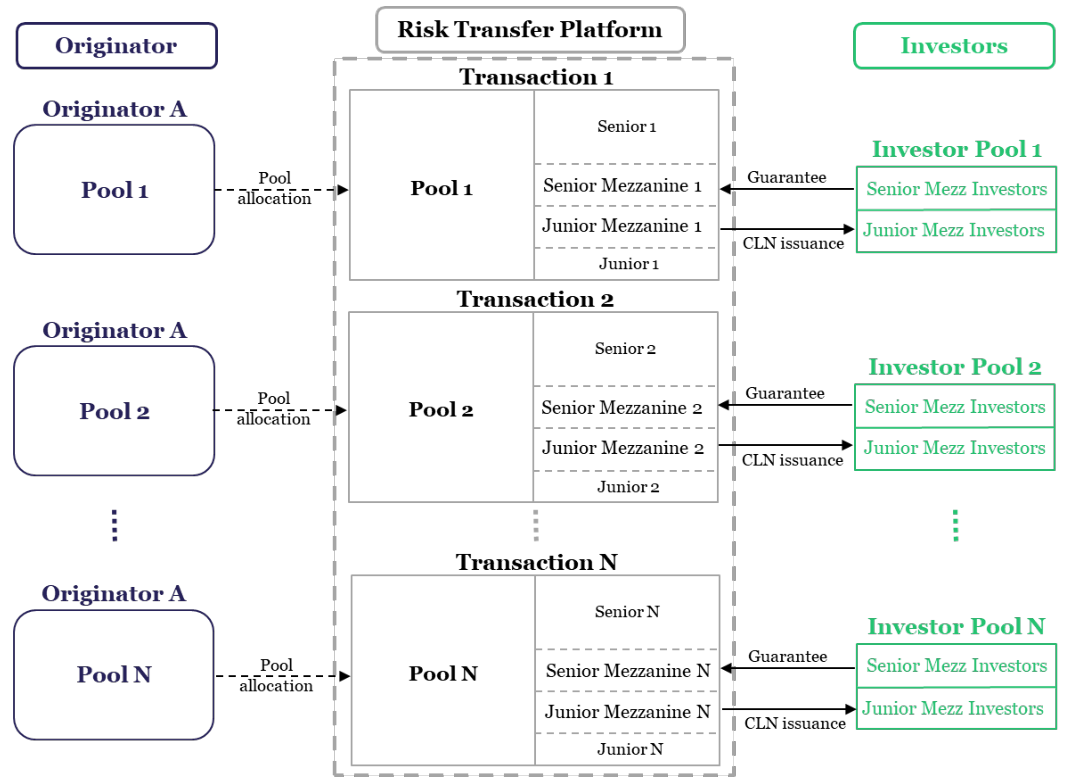
Once a SRT deal is closed and the risk transfer is operational, all this work can be re-utilised for other transactions, especially when the pool of loans amortises. Banks therefore often leverage the set-up of a transaction that allows Significant Risk Transfer so that follow-up transactions can be issued with just updates implying minimal cost: loan documentation and data can be standardised, legal structures (SPVs) have been set-up, securitisation legal documentation could be reutilised, external third-party work can be reduced on repeat transactions, systems produce similar pre-agreed reports, etc. And if there is no unexpected disappointing risk/return performance, the demand and the investor base would remain or even extend. Commercial banks have therefore organised platforms to make risk transfer mechanisms more systematic and provide more room for growth.
Some Banks have even implemented strategies on their loan products with “originate to securitise” or “originate to share” frameworks which allow them to increase their revenues with assets which can be churned and capital that can be recycled.
Figure 2.3 illustrates how a credit risk transfer platform is typically used by commercial banks for multiple repeat SRT issuances, via synthetic securitisation in this example.
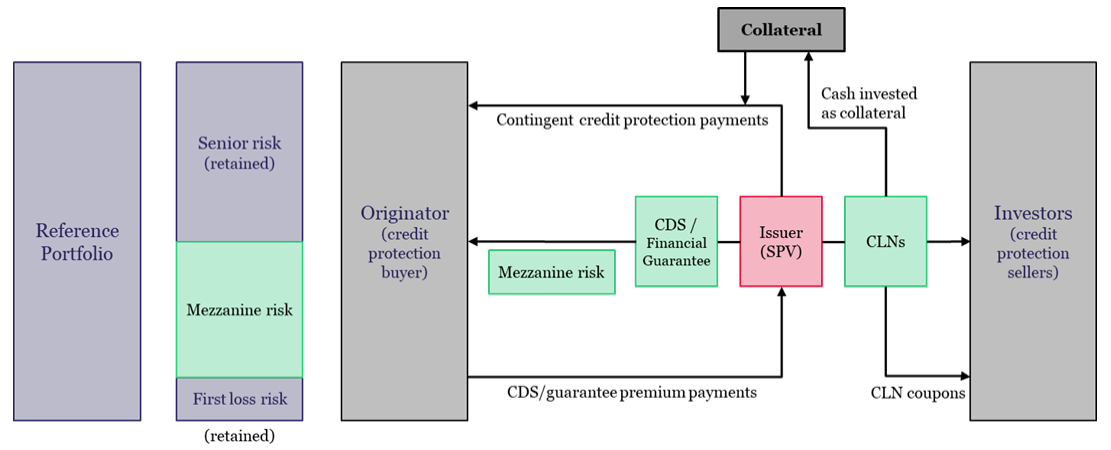
Note: the figure sources are Structured Credit Investors and Risk Control Limited.
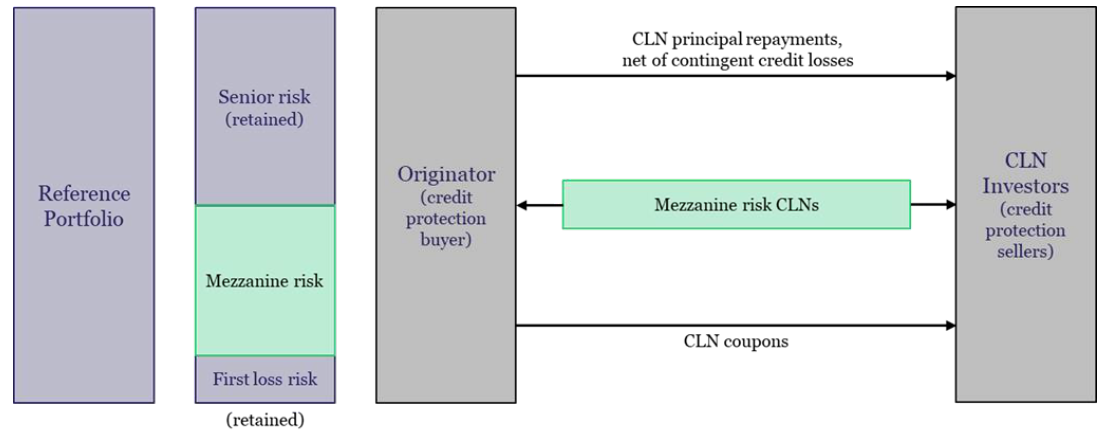
Note: the figure sources are Structured Credit Investors and Risk Control Limited.
| Region / Country | Originator | Asset Class | SRT Platform Name | SRT | Platform Type Year | Established | |
|---|---|---|---|---|---|---|---|
| Europe / Spain | Santander | Consumer Finance SA | Auto-loans | Santander Consumer Spain | Cash ABS | 2014 | |
| Auto | |||||||
| Europe / Spain | Banco | Santander SA | Consumer loans | Santander Consumo | Cash ABS | 2016 | |
| Europe / Spain | Banco | Santander SA | Corporate & SME loans | Magdalena | Synthetic | securitisation | 2017 |
| Europe / UK | Santander | Consumer (UK) plc | Auto-loans | Motor Securities DAC | Synthetic | securitisation | 2019 |
| Americas / USA | Santander | Bank NA | Auto-loans | Santander Bank Auto CLNs | Synthetic | securitisation | 2021 |
| Global | Banco | Santander SA | Project Finance | Project Bocarte | Synthetic | securitisation | 2022 |
| Americas / USA | Santander | Bank NA | Residential mortgages | Santander Bank Mortgage | Synthetic | securitisation | 2023 |
| CLNs | |||||||
| Pan-European | Santander | UK plc | CRE loans | Project Gomber | Synthetic | securitisation | 2023 |
| Europe / Poland | Santander | Leasing SA (Santander | Corporate & SME leasing | Not disclosed | Synthetic | securitisation | 2023 |
| Bank Polska | Group) |
Notes: DAC means designated activities company. CLNs stands for credit-linked notes. CRE means commercial real estate.
| Region / | Country | Originator | Asset | Class | SRT | Platform Name | SRT | Platform Type Year | Established |
|---|---|---|---|---|---|---|---|---|---|
| Global | BNP Paribas | Corporate | loans | Resonance | Synthetic | securitisation | 2013 | ||
| Europe / | UK | Barclays Bank | Corporate | loans | Colonnade | UK | Synthetic | securitisation | 2016 |
| Global | Barclays Bank | Corporate | loans | Colonnade | Global | Synthetic | securitisation | 2016 | |
| Europe / | UK | Barclays Bank | CRE loans | Colonnade | CRE | Synthetic | securitisation | 2017 | |
| Americas | / USA & | Bank of Montreal (BMO) | Corporate | loans | Manitoulin | USD – Muskoka | Synthetic | securitisation | 2018 |
| Canada | |||||||||
| Americas | / USA & | Bank of Montreal (BMO) | SME loans | Manitoulin | USD – Algonquin | Synthetic | securitisation | 2019 | |
| Canada | |||||||||
| Europe / | UK | HSBC UK Bank | Corporate | loans | Neon Portfolio | Distribution | Synthetic | securitisation | 2019 |
| Global | Standard Chartered | Corporate | loans | Gongga | (Corporate Loans) | Synthetic | securitisation | 2019 | |
| Global | Standard Chartered | Corporate | loans | Sumeru IV | (Corporate Loans) | Synthetic | securitisation | 2022 | |
| Americas | / USA | JPMorgan Chase | Corporate | loans | Not disclosed | Synthetic | securitisation | 2023 | |
| Americas | / USA | US Bancorp | Auto loans | Not disclosed | Synthetic | securitisation | 2023 | ||
| Americas | / USA | Citigroup | Not disclosed | Not disclosed | Synthetic | securitisation | 2023 |
2.3 US government-sponsored enterprise platforms
In the US, the main government-sponsored enterprises (GSEs) that issue mortgage-backed securities (MBS), known as Fannie Mae and Freddie Mac, have been placed under conservatorship since the Global Financial Crisis of 2008 (GFC). Their conservator and supervisor is the US Federal Housing Finance Agency (FHFA).
The GSEs’ role is to provide liquidity in the US mortgage market, by providing a secondary market for mortgage lenders. To do so, the GSEs raise liquidity by packaging the residential mortgages they buy into residential mortgage-backed securities (RMBS) and selling them to capital market investors.
At end 2023, the US single-family housing market, which represents most US residential housing, amounted to US$45.5 trillion, of which US$12.9 trillion was financed by outstanding mortgage debt. Of these US$12.9 trillion, US$9 trillion was financed by Agency MBS (which include the GSEs and Ginnie Mae) and the Agency MBS guaranteed by the GSEs (Fannie Mae and Freddie Mac) amounted to US$6.6 trillion. RMBS guaranteed by the GSEs, therefore, represented 51% of the US single-family housing market. This proportion has remained consistently high since the GFC when private-label securitisations of mortgages all but disappeared from the US secondary residential mortgage markets.
Figure 2.4 illustrates the annual origination of single-family residential mortgages in the US, between 2012 and 2022, and the share funded by the GSEs. During that period, the GSEs have funded between 47% and 64% of the US residential mortgages every year.
The GSEs guarantee timely payment of principal and interest on all RMBS issued to finance mortgages they purchase to fulfil their role of ensuring the liquidity of the US secondary mortgage market. Consequently, the GSEs have guaranteed most of RMBS issued in the US since the GFC and, in effect given their conservatorships, the risks kept by the GSEs are borne by the US taxpayers.
The risks borne by GSEs include funding risk, interest risk, prepayment risk and credit risk. The GSEs have historically transferred funding risk, interest risk and prepayment risk to investors via the issuance of Agency MBS. Since the GFC, however, the GSEs have kept the credit risk by guaranteeing timely payment of principal and interest on all RMBS they have issued. In 2012, the FHFA also called for the GSEs to develop the use of credit risk transfer (CRT) programmes to offload some of that credit risk to external investors.
The Common Securitization Platform (CSP): Common Securitization Solutions, LLC The GSEs have historically been huge issuers of RMBS in the US capital markets, more than US$500 billion every year since 2001 and often closer to US$1 trillion or more. Their highest RMBS issuance levels were US$2.3 trillion in 2021 and US$2.6 trillion in 2022. Such volumes of issuance necessitate highly efficient securitisation platforms and infrastructure to manage frequent emissions every year and command the required trust by the external investors who are critical to placing such transactions and raising the required funds.
In 2012, the FHFA directed the GSEs to develop a shared platform, the Common Securitization Platform (CSP), as it observed that the GSEs' systems for securitising mortgages were outdated and in immediate need of maintenance and upgrading. The FHFA thought a shared CSP would be more efficient and less costly than each enterprise trying to upgrade its own systems separately. To achieve this, the FHFA directed the GSEs to create and fund a common subsidiary, Common Securitization Solutions, LLC (CSS), which would “create, operate, update, and maintain the technology and business activities necessary to facilitate the Enterprises’ (and potentially other users’) issuance, sale, and administration of single-family MBS” and could become a sort of “public utility” for the US secondary mortgage market.[17]
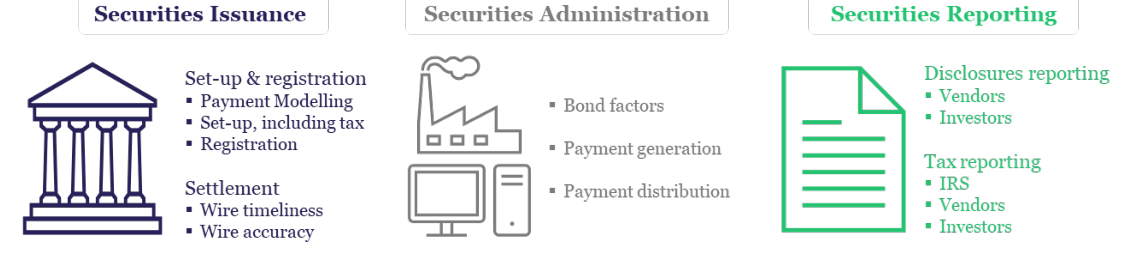
CSS became operational in 2019 after several years of development due, among others, to the complexity of transferring to it all RMBS issuance from both GSEs. CSS now operates all single-family MBS of both GSEs (Fannie Mae and Freddie Mac). Figure 2.4 illustrates the services provided by CSS to both GSEs.
As a common securitization platform, CSS provides to the GSEs all the services, digital architecture and infrastructure required to issue and administer all their single-family MBS issuance. Such services include, among others: ● setting up the MBS transactions and issuing the securities to investors, ● administering and performing all payments to investors, ● receiving all relevant data on the securitised mortgages, ● processing the mortgage data and preparing disclosures reporting for lenders and investors, ● providing the relevant accesses to individual mortgage data and aggregate reports to lenders and investors, for their respective requirements.
In 2021, CSS was processing 30 million mortgage loans and US$6 trillion in single-family RMBS in the CSP on behalf of the GSEs. The FHFA Office of Inspector General (FHFA-OIG) reported that CSS issued approximately US$12.6 trillion of GSEs’ RMBS between its inception and end September 2022. CSS has been a highly successful securitization platform and digital infrastructure which forms part of the backbone of the multitrillion-dollar US residential housing market.
The Credit Risk Transfer (CRT) programmes Given the guarantee provided by the GSEs to their MBS issuance, such securitisations do not transfer credit risk to external investors, but only funding risk, interest rate risk and prepayment risk. This is why the FHFA also called in 2012 for the GSEs to develop the use of credit risk transfer (CRT) programmes to offload some of that credit risk to external investors.
For this purpose, both Freddie Mac and Fannie Mae started to implement credit risk transfer programmes in 2013, albeit each developed its own CRT programmes. Freddie Mac created its Structured Agency Credit Risk (STACR®) Trust programme and Fannie Mae created its Connecticut Avenue Securities® (CAS) programme, both applying a synthetic securitisation approach to transfer the credit risk of reference single-family mortgage portfolios. The STACR and CAS programmes have become known in the US as the ‘single-family CRT
17 See FHFA-OIG (2023).
programmes.’ They have operated and developed on a regular basis since 2013, even in 2020 during the COVID-19 pandemic, after a relatively short period of disruption for four to six weeks.[19]
Alongside synthetic securitisation structures, the GSEs also developed the use of portfolio credit insurance to transfer credit risk on single-family mortgage portfolios, after their purchase, to insurers and reinsurers. Freddie Mac created its Agency Credit Insurance Structure (ACIS®) programme in 2013, and Fannie Mae set up its Credit Insurance Risk Transfer™ (CIRT™) programme in 2014.
The GSEs have also used other means to transfer credit risk such as lender risk sharing (whereby the original mortgage lenders take back some of the credit risk from their portfolios from the GSEs) and loan-level mortgage insurance. However, the GSEs’ CAS and STACR synthetic securitisation programmes and their CIRT and ACIS portfolio insurance programmes constitute the large majority of their existing credit risk transfer transactions.
The FHFA reported that, between the start in 2013 and the end of 2022, the GSEs transferred credit risk on approximately US$6.2 trillion of single-family mortgages in aggregate, for a total amount of risk transferred of US$197 billion (or 3.2% of aggregate mortgages).[20] Synthetic securitisations (CAS and STACR) accounted for 66% of the total credit risk amounts transferred and credit insurance/reinsurance represented 28%. For 2021 and 2022, the FHFA reported that the GSEs transferred credit risk on single-family mortgage portfolios of US$1.1 trillion in both years. In 2022, synthetic securitisations accounted for 61% of the credit risk amounts transferred and credit insurance/reinsurance represented 39%.[21]
To foster the development of their CRT programmes and their ability to offload credit risk, the GSEs have heavily invested in data disclosures to market participants (which include mortgage originators, data providers, investors and reinsurers) and the required data-sharing infrastructure. For this, they have capitalised on the establishment of their CSP in 2019, while it was also strengthening the efficiency, reliability and liquidity of their MBS issuances.
Fannie Mae developed its Data Dynamics® platform, initially launched in 2016, to support its single-family CRT programmes, enabling market participants to analyse for free the transactions and the comprehensive historical loan dataset which comprised, at the time, 23 million loans dating as far back as 2000. In 2019, the same year when the CSP was launched, Fannie Mae released what it called its Data Dynamics 2.0 tool, powered by a loanlevel back-end system enabling more granular data analysis by synthetic securitisation investors and reinsurers.
In 2019 as well, Freddie Mac released its free Clarity Data Intelligence® (Clarity) portal. In 2023, the Clarity portal became Freddie Mac’s centralised hub for sharing CRT and MBS data. It provides various data intelligence tools and dashboards, including the functionality to download deal-level and loan-level data. Since 2023, Freddie Mac’s Clarity has made available to market participants loan-level credit performance data on all mortgages purchased or guaranteed by the enterprise from 1999 onwards.
The comprehensive Data Dynamics and Clarity data-sharing platforms, alongside the CSP digital infrastructure, have contributed considerably to the GSEs’ ability to rebound since the GFC, to consolidate their role in US MBS issuances and to ensure the liquidity of the US secondary mortgage market while developing CRT programmes. As seen above, these credit risk transfer programmes now account for trillions of US dollars and have been hugely instrumental in reducing the potential systemic risk represented by the GSEs and burden, for US taxpayers, of the implicit US government guarantee while they are still in conservatorship.
19 See Layton (2021). 20 See FHFA (2023). About risk amounts transferred via CRT, the FHFA reports a notion of ‘Risk in Force’ (RIF) different from the unpaid principal balance (UPB). For synthetic securitisations, RIF corresponds to the notes or tranches placed to external investors. For credit insurance, it refers to the US$ amounts of risk that insurers and reinsurers have agreed to cover. 21 See FHFA (2023).
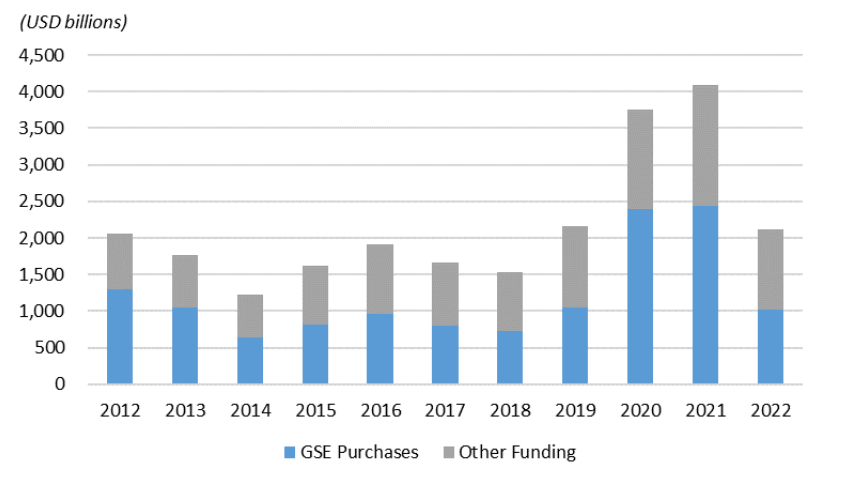
Note: the data source is the National Mortgage Database (NMDB) from the US Federal Housing Finance Agency (FHFA).
Note: the source is FHFA-OIG (2023).
3. Existing Risk Transfer by MDBs
3.1 Motivating MDB risk transfer
Multilateral Development Banks (MDBs) have been encouraged by their shareholders to use risk transfer of the kinds just described as a tool in Balance Sheet Optimisation (BSO). The 2015 Toronto G20 declaration recommended that MDBs consider securitisation as a means of sharing risk on their Non-Sovereign Obligor (NSO) portfolios. In 2022, the G20 Capital Adequacy Framework Panel Report recommended that MDBs use securitisation for transferring both NSO and Sovereign Obligor (SO) risk.
MDBs are constrained in any expansion of lending by the objective of protecting their current high ratings. The three World Bank lending arms and the major regional MDBs are all triple-A rated by the three global rating agencies, Moody’s, Standard & Poor’s, and Fitch. They view rating downgrades as imperilling their business models which involve borrowing at very low rates in international bond markets and lending on at modest spreads to sovereign borrowers. The approach is sustainable because sovereign borrowers accord de facto seniority to MDB debt in the form of Preferred Creditor Treatment (PCT), leading to very low default rates and high recoveries even when the sovereign borrowers are rated lowly by the rating agencies.
The primary considerations for MDBs in considering risk transfer are, therefore, two-fold: 1) to reinforce their ratings. 2) to mobilise private capital, to increase their lending headroom.
Two rating agencies, Standard & Poor’s and Fitch, assess MDB capital adequacy in large part by evaluating the ratio of equity resources to agency-specific computations of Risk-Weighted Assets (RWAs). For the third major rating agency, Moody’s, a leverage ratio and a Weighted Average Rating are the key metrics for assessing MDB capital adequacy. In considering a possible risk transfer, an MDB evaluates the potential gains it will obtain in these rating agency metrics compared to the cost of the risk transfer expressed in forgone spread or insurance premiums.
Such calculations are closely analogous to the way that commercial banks evaluate risk transfers.
3.2 Existing risk transfer for single loans/exposures
The main approaches employed by MDBs for sharing and transfer credit risk of single loan exposures are summarised in Table 3.1 below. They include:
• Loan syndications (funded risk sharing at origination),
• Loan sales or participations (funded risk sharing later in the life of loans),
• Purchase of credit insurance or guarantees (unfunded risk transfer).
MDBs have been active in credit risk sharing for loan exposures for many years. For single exposures, they have used approaches such as syndication, co-financing and unfunded credit protection (via credit insurance or unfunded risk participations). Some MDBs (such as IFC and IDB Invest) have also occasionally resorted to loan sales later during the life of the transaction to reduce their exposure, albeit in limited amounts.
Loan syndications and co-financing The traditional way for MDBs to share lending risks is to syndicate or co-finance loans at origination, typically on a transaction-by-transaction basis.
Loan syndication has been employed by MDBs mainly for non-sovereign lending, in the forms of A/B loans. In A/B loan structures, an MDB grants a single loan to its borrower and is the lender of record, The MDB retains only a portion of the loan (the A loan) and syndicates the rest (the B loan) to other lenders which can be from the private sector or other DFIs. The B lenders benefit from the Preferred Creditor Treatment (PCT) of the MDB.
For sovereign and sovereign-guaranteed lending, MDBs commonly use co-financing approaches to share the exposure with other lenders at origination. In co-financing, the other lenders grant separate loans directly to the MDB’s borrower. Unlike A/B loan structures, the MDB is not the lender of record of the separate loans which do not benefit from its PCT.
Loan syndication is well suited to larger MDBs (such as ADB, AfDB, EBRD, IFC and IBD Invest) which generate enough volume of new loan origination to maintain syndication desks required for an ongoing activity.
Later loan sales/participations Some MDBs have occasionally performed loan sales in recent years, mainly IFC and IDB Invest. Such sales occur after the initial loan financing on the MDB’s balance sheet. They typically take the form of partial assignments or participations of retained A loans to other lenders (commercial banks or DFIs).
Gregory (2023) sets out that such sales face constraints in relation to the MDB’s role, its cost recovery and the loans risk profile. In terms of role, MDBs add value to loans through their PCT and their relationship with borrowers. Complete sales of loans or in high proportions could reduce such benefits. If such sales were too soon, an MDB might not recover the costs due to its origination, monitoring and management of the loans, which may need to be factored into loan terms. In addition, some loans may have initial credit profiles which are too risky for other lenders. The origination MDB may need to retain such loans long enough for their credit profile to improve and match the risk appetite of potential buyers (e.g., for infrastructure financing, the project moving from construction to operation phase).
Unfunded credit protection MDBs also employ unfunded protection on single loans to transfer some of their risks, including credit risk, to insurance companies and specialised multilateral insurers such as the Multilateral Investment Guarantee Agency (MIGA), the African Trade and Investment Development Insurance (ATIDI) and the Islamic Corporation for the Insurance of Investment and Export Credit (ICIEC).
Such unfunded credit protection takes the form of credit insurance policies, partial credit guarantees or unfunded risk participations and is often contracted at the time of loan origination. It can be used for nonsovereign obligors (NSOs) and for sovereign obligors (SOs) and can help reduce concentration risks and riskweighted assets without contributing to the MDBs’ funding.
Table 3.1 summarises these risk transfer approaches for single exposures. It gives examples of MDBs employing them, transaction sizes and investor types, and comments briefly on the scalability of these approaches for MDB risk transfer.
| Single loan sales | IFC, IDBI | $10m | - | $500m | Commercial | banks | Partial or complete | sale of single | Limited scalability given |
|---|---|---|---|---|---|---|---|---|---|
| or other DFIs | loans (e.g. A loan | participations or | the potential impact on | ||||||
| assignments). | PCT and MDB's cost | ||||||||
| Generally take place | after an initial | recovery. | |||||||
| period on the MDB's | balance sheet: | ||||||||
| allowing for some | initial cost | ||||||||
| recovery by the | MDB and potential | ||||||||
| improvement of | risk profile (e.g. | ||||||||
| after construction | phase for | ||||||||
| infrastructure loans). | |||||||||
| Single loan syndication | ADB, AfDB, | $20m | - | $500m | Commercial | banks, | Typically used for | non-sovereign | Limited scalability given |
| EBRD, IFC, IDBI | institutional | lending via A/B loan | structures. A | the bespoke process | |||||
| investors able | to | loan is retained by | the MDB and B | transaction-by-transaction. | |||||
| grant loans | loan is syndicated | (funded | |||||||
| participation). MDB | remains the | ||||||||
| lender of record. | |||||||||
| Single exposure | ADB, AfDB, | $20m | - | $500m | Private insurance | Single credit insurance | policies | Limited scalability given | |
| unfunded credit | EBRD, IFC, IDBI | companies, | (known as "facultative | insurance"), | the bespoke process | ||||
| protection | multilateral | single guarantees | or unfunded risk | transaction-by-transaction. | |||||
| guarantors | participations, | typically contracted | |||||||
| at origination. |
Notes: Typical transaction sizes are given in US dollars. IDBI refers to IDB Invest.
3.3 Existing risk transfer for portfolios of loans/exposures
To increase the scale and amounts of mobilisation, MDBs have developed portfolio approaches of co-financing, risk sharing and risk transfer. Table 3.2 below summarises such approaches for risk sharing and risk transfer. They include:
• Portfolio sales,
• Portfolio syndications via co-financing programmes,
• Portfolio credit insurance and guarantees,
• Exposure Exchange Agreements (EEAs),
• Synthetic securitisation.
Portfolio sales Gregory (2023) mentions that MDBs can use portfolio sales and give the example of IFC. Loan portfolio sales are subject to the same limitations as single loan sales and add the challenge of pool diversification (as not using credit structuring and tranching techniques). Portfolio sales are better suited to larger institutional investors and to larger MDBs with loan portfolios presenting good geographical and sectoral diversification.
Portfolio syndications via co-financing programmes Sharing new risk at scale has also been achieved by developing platforms or programmes to originate and share risks on portfolios of loans. Such platforms can be established by MDBs and can also be set up by third parties. To increase scale and speed to market, MDBs have partnered with investors and offered them access to loans issued from their origination pipeline.
Two prominent examples of such platforms are the Managed Co-Lending Portfolio Program (MCPP) developed by IFC and a US$1 billion private debt fund, ILX Fund 1, established by ILX Management and Cardano Development with major Dutch pension funds as investors.
IFC’s MCPP has employed three different approaches to co-financing or risk sharing with its partner investors: trust funds, B-loan funds and portfolio insurance. The first two approaches are based on co-funded risk sharing using a portfolio syndication approach while the third MCPP approach resort to unfunded risk sharing (which we discuss below).
The funded MCPP facilities employ a syndication approach where IFC originates new loans, from its development pipeline, with pre-agreed eligibility criteria and sectoral focus. The loans are then syndicated to funds set up with public investors or institutional investors, with IFC retaining a portion and being the lender of record for the whole loans.
ILX is an example of fund set up by private sector investors which wanted to invest at scale in B loans originated by MDBs. ILX can participate in B loans from single loan syndications. However, in 2023, ILX concluded a partnership with EBRD and the EU whereby EBRD will originate €300 million of B-loans over three years syndicated to ILX. The loans will be focused on projects which would otherwise not have benefited from private sector participation and will be supported by an EU guarantee to facilitate the co-lending by EBRD and ILX Fund 1.
Portfolio credit insurance and guarantees MDBs have also pioneered the use of portfolio credit insurance and guarantees to share exposure risks with private insurance companies and specialised multilateral insurers (SMIs) at scale and free up economic capital and lending headroom on their balance sheet.
Such transactions constitute unfunded risk transfer. They can be implemented on existing loans and exposures, as balance sheet optimisation, such as AfDB’s US$500 million Room2Run insurance transaction with ATIDI (then called ATI) in 2018.
They can also be established for new origination such as ADB’s master framework program with five global private insurers in 2022 and IDB’s US$300 million portfolio credit insurance in 2023 with 14 private insurance companies. IFC has also implemented four credit insurance iterations of its MCPP (portfolio insurance) platform, for amounts increasing from US$500 million for MCPP URP in 2017 to US$3.5 billion for the latest MCPP FIG III in 2023 which involves 13 private insurers and reinsurers. As for other MCPP iterations, each MCPP credit insurance facility follows a similar approach by applying insurance protection automatically on new loans originated by IFC, based on eligibility criteria and sectoral focus pre-agreed with each syndicate of insurers and reinsurers.
As an unfunded risk transfer approach, portfolio credit insurance has demonstrated a significant potential of replicability and scalability with private insurers, while it can adapt to the size of loan pools of MDBs and DFIs.
Exposure Exchange Agreements (EEAs) Major MDBs which provide large amounts of loans to sovereigns (like IBRD, AfDB, ADB and IDB) face significant geographical and single name concentrations in their sovereign exposures. In rating agencies methodologies, such concentrations have an adverse impact on risk-weighted assets.
MDBs such as IBRD, AfDB, ADB and IDB have entered EEAs with one another to reduce such concentrations. EEAs are synthetic risk transfer agreements whereby two MDBs provide cross-protection to each other for some of the default risk from their own sovereign portfolios. This default protection is unfunded and helps reduce excess sovereign concentrations in each MDB’s portfolio.
In the past few years, EEA transactions have been contracted between AAA-rated MDBS. Transactions involving MDBs with other ratings is more complex. In April 2024, IDB and the OPEC fund for International Development[23] have signed an EEA, the first such transaction with one of the counterparties not being a AAArated MDB.
MDBs EEAs constitute risk transfer between the MBDs involved but do not reduce the overall credit exposure of each MBD. They simply reduce concentration risks and improve diversification in their sovereign portfolios. The impact on lending headroom would be more significant in S&P’s rating approach.
Synthetic securitisation Some MDBs have also take inspiration from unfunded risk transfer practices of commercial bank and have started to implement synthetic securitisations.
Synthetic securitisation is a form of unfunded risk transfer which, unlike portfolio credit insurance and guarantees, permits to structure and tranche the credit risk offered to investors. This enables to appeal to other types of institutional and capital market investors which have an interest in tranched exposure to emerging markets.
AfDB has pioneered the use of synthetic securitisation with its Room-to-Run balance sheet optimisation programme. In 2018, AfDB entered in a US$1 billion synthetic securitisation for its non-sovereign obligors (NSO) exposures. Then, in 2022, AfDB implemented a second US$2 billion synthetic securitisation for its sovereign obligor (SO) exposures. More recently, IDB Invest has announced it is preparing a synthetic securitisation of its NSO exposures to be closed in 2024.
Table 3.2 recapitulates the current risk transfer approaches for portfolios of loan exposures. It gives examples of MDBs employing them, transaction sizes and investor types, and comments briefly on the scalability of these approaches for MDB risk transfer.
| Type of Risk Transfer | Examples | Sizes | Investor Types | Description | Scalability for Risk | Transfer | ||
|---|---|---|---|---|---|---|---|---|
| Portfolio sales | IFC | $100m | - $1bn | Institutional | Partial or complete | sale of a | Limited scalability | given the |
| investors | portoflio of loans, | after an | potential impact on | PCT and | ||||
| initial period on | the MDB's | MDB's cost recovery, | and | |||||
| balance sheet (as | for single | limited investor | appetite | |||||
| sales). | without risk structuring. | |||||||
| Portfolio syndications | IFC MCPP | $500m | - $3bn | Commercial | Syndication of | pools of MDB | Capacity of replication | at |
| via co-financing | platform, | banks, | loans (e.g. B loans) | to loan | scale with different | pool of | ||
| programmes | EBRD/EU/ILX | sovereign | funds, based on | pre-agreed | investors, by larger | |||
| partnership | investors, | eligibility criteria | with | MDBs/DFIs with | significant | |||
| institutional | investors. Generally | applies to | origination pipelines. | |||||
| investors | new loans to be | originated. | ||||||
| The loan funds | can benefit from | |||||||
| MDB/DFI credit | enhancement if | |||||||
| needed. | ||||||||
| Portfolio credit | ADB, AfDB, IDB, | $100m | - $3.5bn | Private | Master policies | or framework | Significant capacity | of |
| insurance | IFC | insurance | agreements | between an MDB | replication at scale, | with | ||
| companies, | and groups of | insurers (or a | appropriate insurer | |||||
| specialised | multilateral | guarantor) to cover | syndicates and | exposures | ||||
| multilateral | a pool of exposures. | eligibilty criteria. | ||||||
| insurers | Can cover existing | exposures or | ||||||
| define eligibility | criteria | |||||||
| applying to new | exposures to | |||||||
| be originated. | ||||||||
| Exposure Exchange | ADB, AfDB, | $1bn - | $3bn | MDBs | Agreements | between at least | Can be replicated | subject to |
| Agreements | IBRD, IDB | two MDBs to | provide cross- | the existence of | portfolios | |||
| credit protection | for their | of similar risk levels | ||||||
| respective sovereign | exposures, | between two different | ||||||
| to reduce excess | country | MDBs. | ||||||
| concentrations | for each MBD. | |||||||
| Synthetic | AfDB | $500m | - $2bn | Institutional | Unfunded risk | transfer for | Can be replicated | and |
| securitisation | Room2Run | investors, | portfolios of | exposures, using | scaled to transfer | credit risk | ||
| NSO and SO, | sovereign | risk tranching | techniques | without funding, | subject to | |||
| IDBI in | investors | commonly used | by commercial | availability of large | enough | |||
| preparation | banks. | diversified portfolios. | ||||||
| Permits to target | different types | |||||||
| of investors as a | function of | |||||||
| their risk appetite. |
Notes: Typical transaction sizes are given in US dollars. IDBI refers to IBD Invest.
4. Business Models for Scaling up MDB Risk Transfer
In this section, we outline which risk transfer business models MDBs can develop to support the objectives of boosting their own lending as well as private sector mobilisation while managing the constraints they may create on their balance sheets and capital resources.
Section 4.1 explains how risk transfer strategies could provide lending headroom to MDBs from potential impact on ratings. Section 4.2 sets out the issues with scaling up existing risk sharing and risk transfer approaches. Section 4.3 reviews how to scale up unfunded portfolio risk sharing, its potential and limits. Section 4.4 outlines the approaches to scale up funded risk transfer via syndication and securitisation platforms to address also leverage ratio constraints.
4.1 MDB Risk Transfer and ratings
MDBs have been urged to increase considerably their own lending as well as private sector mobilisation to boost chances of achieving the SDGs and the billions to trillions. To manage the constraints on MDBs balance sheets and capital resources, there have been growing calls for MDBs to move from an “originate to hold” to an “originate to share” model, which involves MDBs scaling up risk sharing at origination and offloading the risk of portfolios remaining on their balance sheet at a later stage (i.e. risk transfer).
The principal concern for most major MDBs is to keep their AAA/Aaa ratings which is essential to their lending business model seeking to borrow at low cost in international debt markets. In Table 4.1, we present different MDB risk transfer strategies and how they affect various components of the MDB rating approaches of Standard & Poor’s (S&P), Moody’s and Fitch.
Separate studies by Risk Control (such as Risk Control (2024)) have observed that most major AAA-rated MDBs are more constrained, in terms of lending headroom, by their Moody’s Aaa rating and its leverage ratio component, than by their S&P and Fitch ratings.
Among risk transfer strategies available to MDBs, Table 4.1 displays the following findings:
• Exposure Exchange Agreements (EEAs) affect essentially concentration metrics.
• Unfunded risk transfer approaches (synthetic securitisation, credit insurance, sovereign guarantees) affect essentially the average credit quality of an MDB’s development related assets (DRAs) and its corresponding risk-weighted assets (RWAs).
• Only funded syndications and securitisations can affect and improve an MDB’s leverage ratio.
| Agency / Rating | Factor | EEAs | from Securitisation | private from insurers | SMIs | guarantees A/B | Loans) | Securitisation |
|---|---|---|---|---|---|---|---|---|
| Standard & | Poor's | |||||||
| Adjusted Capital | (TAC) | X | X | |||||
| Risk Weights or | EAD | X | X | X | X | |||
| SNC - Corporate | X | X | X | |||||
| Sector concentration | ||||||||
| Geographic | concentration | X | X | X | X | X | ||
| PCT Sovereign | X | X | X | X | ||||
| PCT FI & Corporate | ||||||||
| SNC - Sovereign | X | X | X | X | X | X | ||
| Enhanced | RAC | |||||||
| Moody's | ||||||||
| Leverage | ratio | X | X | |||||
| WABR | X | X | X | X | ||||
| Equity investments | fraction | |||||||
| Country HHI | X | X | X | |||||
| Sector HHI | ||||||||
| Largest exposure | fraction | X | X | X | ||||
| Top 10 exposures | fraction | X | X | X | ||||
| Willingness to | support | |||||||
| Fitch | ||||||||
| Equity to assets | ratio | X | X | |||||
| Capital to RWA | ratio | * | X* | X* | X | |||
| of Loans and | Guarantees | X* | X* | X | ||||
| Concentration | ratio | X | X | |||||
| of net debt by | callable capital |
Note: The mark X denotes that the factor would be affected by the implementation of the strategy. The mark X* denotes factors that are already affected by the BSO but that are soon to be changed. The mark * denotes factors that are not affected in the current methodologies, but that are expected to be impacted soon. Acronyms in the table mean the following: EEAs exposure exchange agreements, EAD exposure at default, SNC single name concentrations, PCT preferred creditor treatment, RAC risk adjusted capital, WABR weighted average borrower rating, HHI Herfindahl-Hirschman Index, RWA risk weighted assets, WAR weighted average rating.
4.2 Scaling up MDBs’ risk sharing and risk transfer approaches
The MDBs' approaches to risk-sharing and risk transfer for individual loans have proven effective on a transaction-by-transaction basis. They are particularly suited to financing bespoke development projects and can be replicated by smaller MDBs and DFIs. They have been so far pre-eminently used in single name risk sharing using syndication or credit insurance.
Their scalability remains limited, however, to boost volumes of lending and risk sharing and to produce the acceleration effects sought by MDBs and their shareholders. A large portion of the exposures remain on the balance sheet and the level risk capital available for new lending is limited for further growth.
Whilst MDBs should continue case by case risk-sharing origination and transactions, they should further develop and organise portfolio approaches to risk transfer. Portfolio approaches, both funded and unfunded, have shown greater potential for mobilising private sector capital more quickly on a larger scale, as they can appeal to larger investors. Portfolio risk transfers could be organised on existing pools of loans as well as future loans. The key point is that risk transfer is pre-agreed with investors on an “envelop” of loans, even if the loans have not been originated yet, which allows to immediately produce lending in the knowledge that the risk is shared or will be transferred[24]. Large institutional and capital market investors look for sizeable assets or pools of assets to invest in, which they can assess in an efficient process. An advantage is that transactions can reach significant sizes of, for example, US$1 billion or more.
This would involve standardisation of products and risk transfer processes within MDBs. To invest at scale, institutional investors need to establish efficient processes to assess the loan portfolios and transactions. This would be facilitated with greater standardisation of financing terms and the creation of homogeneous loan pools.
Investors also require detailed portfolio data and historical performance data (e.g. default and loss/recovery data) to familiarise themselves with the loan pools offered for investment and to enable efficient processes for reviewing and evaluating these larger-size transactions. The aggregated default and recovery data published by GEMs, IBRD and IFC in 2023 and 2024 constitute positive steps in providing risk data from MDBs and DFIs in emerging markets and developing economies. Scaling up the crowding-in of private sector investors will require, however, to provide more granular and detailed data on the underlying exposures and their historical risk and performance, as is already done by commercial banks and the US GSEs.
The challenge of growing the lending capacity of MDBs and DFIs has some similarities with the issues documented by the EU Capital Markets Union plans to increase the financing of the economy. The EU regulators have included favourable capital treatment for Simple Transparent and Standardised (STS) Securitisations, which is the implementation of the Basle III treatment for Simple Transparent and Comparable (STC) Securitisation: Lending to the economy could be multiplied using structured financing that are simple and transparent enough for investors and standardised for repeat transactions and market appeal. In the EU and the USA, data on securitisation transactions need also to be posted on a data repository approved by regulators[25]. The challenge faced by the MDBs is different, but a sharp increase of lending capacity and absorption by the market would also require standardisation and transparency towards the investors, which involves standardised products and processes.
The following sections explore the scaling-up of risk transfer using portfolio approaches focusing on unfunded approaches (section 4.3) and funded approaches ((section 4.4).
4.3 Unfunded portfolio risk transfer models
MDBs have made a few unfunded portfolio risk transfers (via credit insurance, guarantees and synthetic securitisation) sharing the credit risk of loan pools (for NSO and SO obligors) with certain types of institutional and capital market investors, including:
• private insurers and reinsurers,
• credit funds active in credit risk transfer markets,
• specialised multilateral insurers (SMIs),
• sovereign funds.
Simple Portfolio credit insurance and guarantees have been effective for MDBs and DFIs to transfer some of the credit risk of their portfolios especially when negotiated with a single private insurer[26] or SMI (such as MIGA, ATIDI, ICIEC). SMIs can reinsure some of their risks to private insurers and reinsurers thereby mobilising private capital and reducing their equity requirements. Rating agencies require the guarantees to be irrevocable, timely and unconditional.
Such forms of portfolio risk assurance (or guarantee) are simpler and easier to implement than more structured synthetic securitisation approaches involving more tranches and structural features[27]. They can be adopted and scaled more easily by smaller MDBs and DFIs and can be efficient for portfolios of moderate size (e.g. US$300 million to US$1 billion). With its MCPP credit insurance programme, IFC has managed to set up portfolio credit insurance facilities from US$1 billion to US$3.5 billion. However, such sizes are less frequent and often involve large syndicates of insurers (such as 13 global insurance companies for the US$3.5 billion MCPP FIG III in 2023).
To foster more frequent and effective unfunded risk transfer, it will be important to develop large transactions which can be more efficient for originators and investors by increasing portfolio diversification and permitting to amortise implementation and on-going costs over larger portfolios, while achieving significant amounts of capital mobilisation.
This requires broadening the scope of investors which can be targeted by such transactions. Employing synthetic securitisation approaches (as in the AfDB NSO and SO Room2Run transactions) enables to structure tranches with different risk levels to be offered to investors. This allows to target additional types of institutional and capital market investors as a function of their risk appetite, such as various kind of credit funds active in unfunded risk transfer and with interest in developing more exposure to EMDE assets. In the case of risk transfer by commercial banks and the US GSEs, the markets absorption capacity of considerable volumes of unfunded risk transfer deals has been demonstrated for years in the CRT markets in the US and in the SRT markets in the US, Canada and Europe.
For medium to long-term maturity exposures, synthetic securitisation approaches are particularly adapted to portfolio of existing MDB exposures for which detailed descriptions and data can be provided from the outset to investors. For shorter-term exposures, such as trade finance, synthetic securitisations can also be arranged for longer maturities (e.g. 3 to 5 years) via ‘revolving transactions’ where maturing trade finance loans can be replaced by new loans with similar characteristics pre-agreed at the time of implementation of the transaction.
In terms of terms of benefits for MDBs, as mentioned earlier unfunded risk sharing and risk transfer strategies can have a beneficial impact on the average credit quality of assets and reduce the resulting RWAs. However, they will not permit to alleviate any leverage ratio constraints an MDB might have.
4.4 Developing funded portfolio risk sharing and risk transfer
4.4.1 Funded portfolio risk sharing
MDBs need to implement scalable funded risk sharing and risk transfer approaches, such as syndications and cash securitisations, to obtain beneficial impact on potential leverage ratio constraints they may have, in the rating methodology of Moody’s.
Single loan syndications have proven effective for specific or bespoke loans but have a limited potential of scalability, as it is also the case for loan sales. For scalability, MDBs need to develop business models of funded portfolio syndication and securitisation. This could be done by establishing platforms which can be utilised to replicate transactions over time, allowing investors to become progressively more familiar with the loan portfolios and transactions offered to them.
IFC’s funded MCPP programmes have built on this approach for new origination, fostering co-financing at origination (i.e. risk sharing from the outset) based on pre-agreed eligibility criteria and sectoral focus with large investors and transactions dedicated to them. For future origination, this approach can be scaled up with large investors by MDBs with significant origination pipelines and good diversification.
An additional risk transfer business model can be considered by MDBs and DFIs by developing an MDB loan warehouse which would ramp up portfolios of loans with the aim to securitise them on a periodic basis. This approach would scale up mobilisation via the warehouse and repeat securitisations to institutional and capital market investors.
The approach consists of using A/B loan structures in conjunction with a warehouse facility and then tapping capital markets with periodic take-out securitisations. A/B loans can be highly efficient for MDBs, especially those for which rating agency criteria imply a leverage constraint. MDBs commonly employ A/B loans for lending to Non-Sovereign Obligors (NSOs). There is nothing to prevent MDBs from making A/B loans to Sovereign Obligors (SOs) and one may note that the International Bank for Reconstruction and Development (IBRD) made such loans over a long period (although has ceased to do so recently).
Section 4.4.2 describes an MDB B loan warehouse and how it could work. Section 4.4.3 explains what take-out securitisations would add by freeing up capacity in the warehouse. Section 4.4.4 summarises the benefits of the approach for an MDB in terms of balance sheet optimisation and mobilisation.
4.4.2 B Loan Warehouse
A/B loans permit an MDB to mobilise external capital via the B loans while retaining only a smaller portion via the A loans. Loan syndication is an efficient process for MDBs to mobilise private sector capital transaction-bytransaction for both funding and risk sharing. While the syndication approach appeals to commercial banks, development institutions and sophisticated private investors, it is not particularly adapted to the broader private capital markets investors.
A way to mobilise private capital at a larger scale could be to offer a portfolio of B loans to private sector investors by gathering the loans into a common structure which would act as a ‘B loan warehouse’. The warehouse can then be funded by private sector lenders or investors which, if needed, can benefit from credit enhancement by the MDB or other development finance actors.
Indicative features of a B Loan Warehouse Figure 4.1 shows how a B loan warehouse could work. In summary:
1. A/B loans are originated by an MDB to non-sovereign or sovereign obligors.
2. The MDB retains the A loans on its balance sheet and syndicates the B loans to the B Loan Warehouse.
3. The warehouse could be funded by a combination of private sector lenders and DFIs (including the originating MDB).
4. If required, the warehouse funding from private sector lenders could be structured into a senior tranche, credit-enhanced by junior lending from the originating MDB and possibly other DFIs.
5. The warehouse will ramp up a portfolio of B loans to build size and diversification.
6. Once a relevant amount and diversification of B loans is reached, such a portfolio may be transferred out of the warehouse to capital markets investors through a B loan securitisation (see below).
7. Such B loan securitisations will free up capacity in the B loan warehouse, enabling to replenish it with new loans in the future.
In A/B loans, the originating MDB is the lender of record of both A and B loans. It will remain the lender of record of the syndicated B loans and will act as loan servicer vis-à-vis the Warehouse. The external investors in an A/B loan warehouse could be commercial banks, DFIs or sophisticated emerging market investors that are able to invest in an unrated senior tranche (via loans or notes).
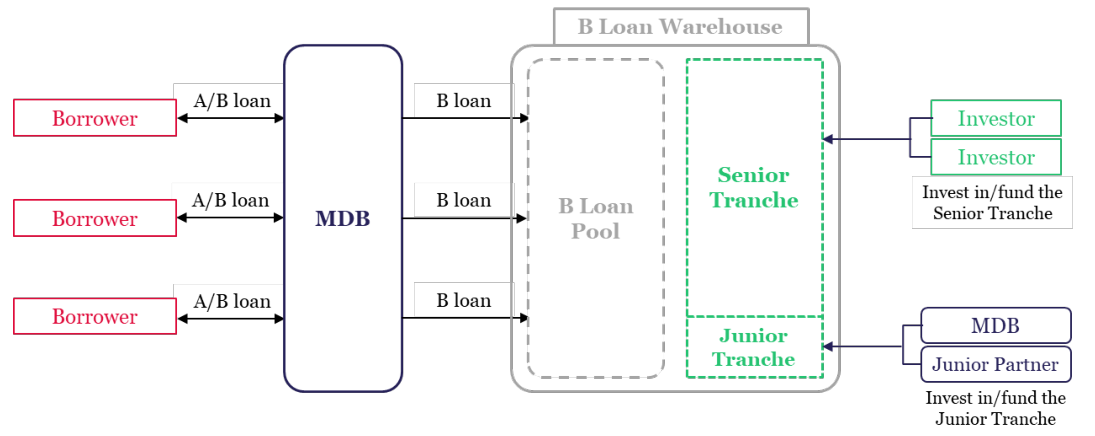
Note: The MDB originates A/B loans to its borrowers. The A loans stay on the MBD’s balance sheet. The B loans are financed by the B Loan Warehouse through risk participation agreements with the MDB.
4.4.3 Take-out Securitisations
When the pool of B loans in the warehouse has reached a certain size and level of diversification, such a pool can be transferred to a securitisation SPV to arrange a take-out securitisation.
A take-out securitisation permits capital market investors to invest in the selected B loan pool via tranched notes. In this manner, take-out securitisations can mobilise other investors who may not have invested in the B loan warehouse otherwise, and free up capacity in the warehouse for new lending.
Indicative features of a Take-out Securitisation Figure 4.2 shows how a take-out securitisation of B loans could work. The steps are as follows:
1. When certain ramping-up targets of size and diversification have been reached in the warehouse, a subpool of B loans is selected to be securitised.
2. The sub-pool is transferred to the Securitisation SPV which becomes the B lender for these loans.
3. As for the warehouse, the MDB remains the lender of record of the securitised B loans and will act as loan servicer vis-à-vis the SPV.
4. In the securitisation SPV, the B loan sub-pool is tranched into notes with different seniority and risk levels: senior notes, mezzanine notes, junior notes.
5. The notes are offered to capital market investors who purchase them, thereby funding the B loans in the securitisation SPV and freeing up capacity in the warehouse.
Depending on the capital market investors targeted, the securitisation notes may be unrated, or certain tranches may be rated (typically the senior and mezzanine tranches).
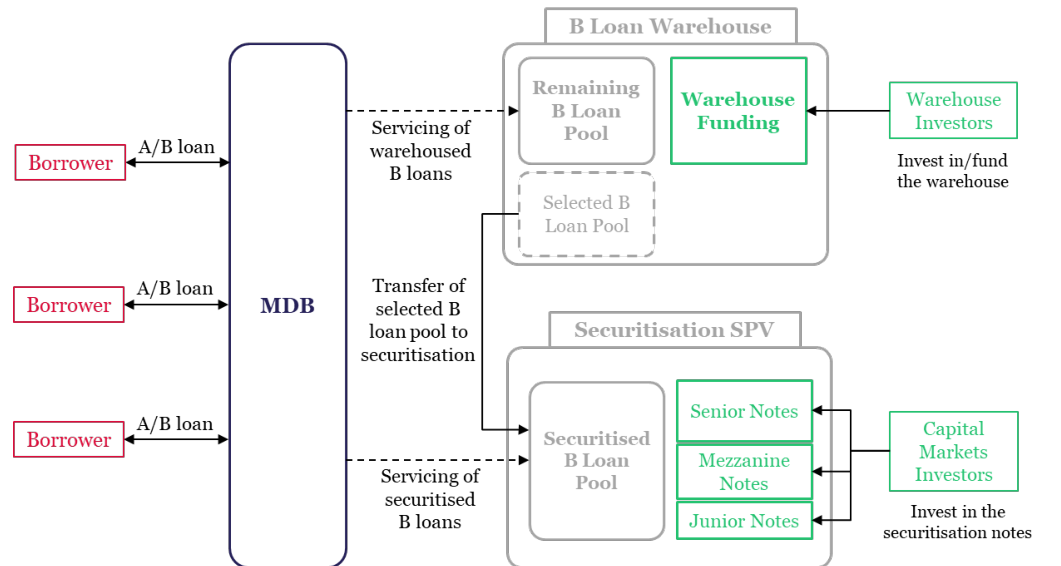
Note: A sub-pool of B loans is transferred from the Warehouse to a Securitisation SPV which is financed by new capital market investors. This frees up capacity in the Warehouse, which the MDB can use to originate new A/B loans to its borrowers and transfer the B loans to the Warehouse.
4.4.4 Benefits for Originating MDBs
The B loan warehouse and take-out securitisations would have significant benefits for an originating MDB, allowing it to enhance its balance sheet optimisation and generate mobilisation.
Balance-sheet optimisation benefits
• B loans are transferred to the warehouse/securitisation SPVs through funded risk participations: they are not on the MDB balance sheet.
• This reduces constraints on the MDB in terms of both risk-weighted assets and leverage ratio, maximising the balance-sheet optimisation benefits.
Mobilisation benefits
• Via the warehouse, external capital is mobilised from the outset of new A/B loan origination.
• The warehouse can attract typical participants in MDB loan syndications: commercial banks, other DFIs and other sophisticated emerging market investors.
• Take-out securitisations enable the mobilisation of other types of investors in the global capital markets who may require more sophisticated risk tranching approaches.
• Take-out securitisations create new lending capacity for the MDB by freeing up capacity in the B loan warehouse.
• A/B loans can be granted to non-sovereign obligors and could also be offered to sovereign obligors.
• By maintaining the MDB status as lender of record, this approach aims at preserving the benefits of PCT for both the warehouse and take-out securitisations.
• Separate warehouses and securitisations can be created for non-sovereign and sovereign loans if more optimal for the MDB and investors.
5. Data for MDB Risk Transfer
5.1 Introduction
Risk Control project is to support MDBs in boosting risk transfer activity, converting it from an intermittent step taken by some MDBs to manage balance sheet constraints to a regular channel of substantial asset creation and distribution to private investors. Investors need data, and scaling up risk transfer to increase lending capacity would be possible with a robust data infrastructure which provides sufficient transparency and some standardisation to investors. The following sections describe the data infrastructure, i.e. the data necessary and how they can be organised and distributed to investors in the different phases of the risk transfer lifecycle.
Investors require data from the MDBs at various stages of the ‘Risk Transfer lifecycle’:
1. In an information dissemination phase on MDB loans, generic MDB data would need to be communicated on MDB asset class loan credit performance. This is to promote these MDB asset classes as a favourable investment for the general market and broaden the potential investor base.
2. When entering a risk transfer transaction or partnership with an individual MDB, investors would require historical data on the MDB-specific loan credit performance to assess the quality of the specific MDB loan origination, underwriting and management process for the asset class in consideration.
3. When analysing the specific risk transfer deal, investors require data on the portfolio at loan-level to perform risk-return analysis and risk modelling. This is usually communicated through a deal data room when several parties or potential investors are involved. Investors can perform their due diligence and check the compliance with their own investment criteria.
4. Post deal, investors would require information to monitor the transaction performance.
The data requirements for MDBs and for investors and insurers will depend on specific asset classes (e.g. sovereign debt, financial institutions, corporate loans, trade finance, infrastructure projects, …), but for a given asset class, they would not be very different between these different risk sharing mechanisms.
The section describes different models that can be used, depending on the needs for detail in different phases of the risk transfer lifecycle:
• asset class performance repositories, for example GEMs prototype,
• deal data rooms,
• warehouses for loans to be transferred,
• loan-level data repositories post risk transfer transactions, investor reports.
5.2 Understanding of Generic MDB Loan Credit Performance
There have been a few risk transfer transactions such as the AfDB’s Room2Run. To extend the development of risk transfer for MDBs, the understanding of MDBs assets as a specific asset class would need to be disseminated risk transfer at a much larger scale among stakeholders such as potential investors and rating agencies:
1. In the accurate evaluation of the credit risk of the assets by the market. ideally by providing investors access to historical data for comparable loans from the originating bank itself but also potentially from comparable reference institutions.
2. In a better recognition of MDB risk transfer by rating agencies[28]. Rating agencies still have some way to go in explicitly allowing for MDB risk transfer. In particular, the three global agency’s securitisation methodologies make no allowance for PCT. A partial exception is Standard & Poor’s which has allowed one MDB to rate a retained senior tranche using a dedicated methodology.
To persuade investors or rating agencies, a key step for MDBs is to quantify the nature of MDB loan risk. For Sovereign Obligor (SO) credit exposures, this amounts to quantifying PCT. Even for Non-sovereign Obligor (NSO) loans, MDB knowledge of the local markets and expertise in underwriting and supervising the asset during the lifecycle of the loan, including workouts, mean the MDBs’ default and loss performance is much better than the pre-conception of many investors, even in countries with low ratings. Greater transparency and communication should, therefore, help to improve the understanding of investors and markets including ex-ante sentiment about MDB loans.
Significant progress has been achieved in documenting the effects of PCT, for example in the 2023 GEMs Consortium report[29]. Risk Control as also analysed the impact of PCT in a 2002 report[30]. Further work is needed for NSO loans by MDBs. The GEM Consortium (2023a) and (2023b) reports provides only general statistics.
Mobilising private investors would require increasing transparency and reporting on the MDBs’ historical lending activity and track records of MDB loans as a specific asset class, on historical credit performance and environmental and social impact. It would enable a more accurate (and probably lower) pricing of risk, not only due to actual better performance than investors' preconception in most cases, but also by reducing the margin linked to current perceived uncertainty due to limited public data access.
At the level of the MDB asset class, analyses and reporting should be provided to the market with the following characteristics: ● Frequency of reporting: Analyses and reporting should be performed with an annual frequency. This is a similar frequency to reports published by credit rating agencies or banking associations and it would match to the broad expectations of private investors. ● Granularity of data, Aggregation level and borrower anonymity: Loan level data in the data warehouse and information allowing granular drill-down analysis of MDB originated loans performance while preserving the need for borrowers’ anonymity. A level of aggregation of the loans in the reports would allow to maintain borrowers’ confidentiality. To provide a meaningful understanding to private investors and the market, credit performance should be provided across MDBs at a crosssection of: ○ asset class, ○ industry sector, ○ region or country level for non-sovereign loans, and at regional level (grouping several countries) and/or by country income grouping for sovereign loans, ○ period or vintage ● Performance of underlying loans with and without tranching: Investors would also value additional reporting on MDB loans performance for categories of loans with collateral and credit enhancement or with some tranching (e.g. A/B loans) or guarantees. This would demonstrate further the relative economic performance and value of certain loans in lower rated countries which suffer from a gap between the financing requirements and the ex-ante investor appetite. ● ESG data: In addition, ESG-related data would also be useful to enhance the MDB loan's appeal to investors as a specific asset class, as more investors integrate this aspect in their investment decisions: A common approach to this domain should be sought across MDBs to be able to publish ESG characteristics of general lending by the MDBs. This would preferably be along metrics that investors increasingly require as regards ESG and sustainability. Anticipated pressure from investors and their regulators is deemed to lead to more stringent ESG data requirements and standards. A group of large MDBs have already been working together to agree on joint MDB principles for assessment of Paris
Agreement alignment of new operations,[31] e.g. data relating to and quantifying MDBs assets in either greenhouse gas emissions mitigation (Building Block 1) or adaptation to climate change (Building Block 2),[32] and more recently by launching MDB common principles for tracking nature-positive finance at COP 28.[33] ● Data accessible for studies by MDBs/DFIs, academics and rating agencies: Providing access to loan level performance data to specific MDB/DFIs working groups who publish their analysis would enable spreading the knowledge of actual credit performance. Dissemination of the actual risk of MDBoriginated assets could also be achieved at a larger scale using the leverage of external researchers and rating agencies. It would mean providing these external parties with access to extracts of the digital data infrastructure. A better access by rating agencies may change their preconceptions about MDB loans, and might make them review their methodologies, which would eventually impact their assessment of MDB portfolios, particularly on loans to the private sector. ● Investors’ access to performance data: Investors typically need to have access to sufficient data to perform their own analysis. Insufficient data can make risk assessment a challenge for investors in emerging markets and developing economies.
Figure 5.1 below describes the potential organisation of a MDB performance repository for dissemination of credit performance. Such a digital infrastructure to disseminate the MDB asset class performance could take inspiration from the Global Emerging Market (GEMs) Risk Database which collects loan-level data from 24 MDBs and DFIs and published, in 2021 and 2023, a report on credit performance and historical default of Sovereign and sovereign guaranteed lending covering a period from 1998 to 2020, and reports on Private and sub-sovereign lending covering 1994 to 2020. The reports provide default statistics which allow the market to understand better the broad performance of MDB loans at an aggregated level.
The GEMs repository has not allowed external access to the data, apart from the database contributors.[34] The need for investors at the stage of asset class understanding to directly access the loan level data would be reduced if sufficient analysis and reports were available to them, either through periodic publications of performance or through the studies already mentioned by academics and rating agencies. In the case of live transactions with a specific MDB, investors may have more precise data needs and access to these data might be given by the MDB at a late stage of the transaction to specific investors with signed NDAs, and not necessarily from a platform like GEMs.
However, the data standards developed by GEMs were designed to facilitate the calibration of internal MDB risk models and are currently insufficiently rich to meet the needs of investors on such issues as collateral and financial characteristics. No data is currently included on sustainability which investors are likely to require. The data dissemination by GEMs to market participants (such as investors and rating agencies) is currently limited to the public reports published. GEMs has recently clarified that the “detailed underlying loan portfolio data cannot be made public as this constitutes commercially sensitive information that is protected by confidentiality agreements.” On the possible establishment of a stand-alone entity, GEMs also communicated that their steering committee is working on strengthening the governance and management model of GEMs which “will result in an improved ring-fenced GEMs entity, which will continue to be hosted in Luxembourg by the EIB. This solution provides an effective way to concentrate on results and move quickly towards the dissemination of GEMs statistics.”[35] 35 See GEMs (2024b).
Figure 5.1: MDB Loans and Risk transfer data repository for credit performance analysis
5.3 MDB-Specific Loan Credit Performance – Historical loss performance
In an asset class, even after considering observable indicators such as region, vintage, Loan to Value (in the case of loans with collateral, e.g. mortgages) or financial ratios (in the case of corporate loans), etc, the performance can differ substantially from bank to bank. This is documented by Risk Control (2018) which compares the performance on observationally equivalent loans in pools securitised by different Spanish banks.
In risk transfer for commercial banks, investors also analyse the underwriting standards of the banks to estimate future performance of loan portfolios and the specific historical data of the originator. They would want to assess the quality of the origination, underwriting and management process performed by the specific MDB. They would require the MDB’s description of the processes (e.g. Credit policies, underwriting and workout processes and credit committees’ decisions) and specific historical credit performance: historical delinquencies, defaults, recoveries, losses, often in analyses by vintage.
5.4 Risk Transfer Deal-specific Data: Deal data room
When investors enter in specific risk transfer transactions, they would require detailed data for their due diligence. These data could be organised in a deal data room, with accesses granted once non-disclosure agreements have been signed, and depending on the phase or round of the transaction.
The data room could be organised to cater for the following information:
1. Sponsor / Originator description: A description of the originator of the loan portfolio. In the case of a credit fund or a CLO manager, a description of the sponsor would be required. The description would include the MDB risk transfer justification.
2. Past risk transfer transactions and performance: When there have been previous similar risk transfer transactions from the sponsor or the originator, potential investors are keen to understand the performance of these deals. They may, therefore, require past investor reports and a history of ratings, tranche amortisation, covenant breaches, triggers and clean-up calls. Past investor reports could provide information in this regard.
3. Underlying loan portfolio composition: ● Description of the loan portfolio, ● Stratification tables (e.g. by geographies, industries, internal/external ratings, project types, borrower types, currencies, etc), ● Loan amortisation profiles.
4. Historical performance of underlying asset class: Transparency about default rates and loss-given default for the underlying asset classes by country, asset types, or vintages and correlations are usual requirements from potential investors and rating agencies. These data are considered key to bring investor confidence to MDB loans as described in section 3.3 above (MDB-specific loan credit performance).
5. Asset data tape: Loan-level data using the data template: data on borrower (group, industry), financial characteristics, collateral, internal and external ratings (PDs and LGDs). The MDB loans could be directly transferred from the main section of the digital infrastructure, as standardised templates have been organised to address investors’ needs. All loan data would comply with the same data templates relevant to their asset class so that a consistent analysis would be facilitated. Loans in the underlying portfolio that may come from other financial institutions or commercial and private lenders would need to be included using, if possible, the same data template, so that the investors can easily analyse risk across the portfolio.
6. Legal documentation on underlying assets.
7. Description of Credit Process: ● The originator’s policy and process documents regarding origination and underwriting criteria. For sponsors (of credit funds, or CLO managers) these documents would describe the sourcing, investment, and the due diligence processes, ● The documents describing the credit policy and credit organisation.
8. Financial structure of the risk transfer deal: Description of the risk transfer mechanism: synthetic, guarantees, CDS, CLNs, etc. ● ● Tranching, credit enhancement, priority of payments, amortisation schedule, covenants, DSCR/ICR tests, ● Hedging mechanisms (currency risk, interest rate risk, inflation, ...).
Figure 5.2: Private Deal Dataroom
9. Information memorandum and term sheet of the risk transfer deal.
10. Model simulations and scenarios/stress tests. Providing a cashflow model simulating the structural characteristics of the risk transfer transaction and the cashflow waterfall is a regulatory requirement in the EU and the UK, aimed at increasing transparency and trust in the market[36] and has been discussed by the US regulators (but not implemented in the current regulation). It should help investors to understand the transaction and perform their due diligence and their simulations. Rating agencies and investors (particularly in junior and mezzanine tranches) will assess the performances of the tranches in various stress scenarios and how the deal structure responds to these scenarios.
11. Sustainability, alignment with the Paris accord, ESG disclosures, matching the investor’s criteria.
12. Transaction documents: Legal documents and legal structure, for example SPVs, servicing arrangements, guarantee agreements, etc.
Figure 5.2 describes how a deal data room may be organised.
5.5 Warehouse
For portfolio-level risk transfers, existing and new loans conforming to the selection criteria of the risk transfer transaction could be earmarked for risk transfer and synthetically put into a “loan warehouse” in preparation for the transaction. This is for example the case when a portfolio needs to be built up and reach a meaningful or target size before the transaction can be closed. Loan-level data can be collected for this warehouse in a format that facilitates the follow-on asset data tapes for investors when the analysis of a portfolio can start for investors. Commercial banks build loan warehouses in the context of loan-portfolio securitisations or sales or refinancing of portfolios. IFC has announced a loan warehouse programme in the context of mobilising private investors capital for some of their loans (see section 4). Data in the warehouse should ideally be standardised for efficiency purposes
5.6 Monitoring Post Deal
Once the risk transfer deal has been closed, the investors would need to monitor the performance and control the cash flows of the transaction on an ongoing basis. In most cases, the MDBs would remain the lenders of record to maintain the favourable PCT of the loans.
Investor reports Post risk transfer deal monitoring has traditionally been performed using quarterly investor reports or at each payment date in PDF format. The investor reports for securitisation transactions typically contain ● all data at underlying loan portfolio level describing o new assets (in the case of ramp-up or reinvestment periods), o scheduled and actual cash flows of loan principal and interest collection, amortisation and unscheduled pre-payment, o Arrears, default, principal and interest recoveries ● Data for all tranches: o Tranche cashflows o Covenants level, and triggers levels (e.g. over-collateralisation), excess spread o Liquidity facility drawings o Any breach, remarkable event
Digital data post transaction The digital infrastructure could provide this information in a digital format as described in next paragraph.
5.7 Deal repository
5.7.1 Regulatory transparency requirements:
Under the EU and UK Securitisation Regulations, the Originator, Sponsor, or SSPE is required to make at least the following information available to holders of a securitisation position, to the competent authorities, and upon request to potential investors, by means of a Securitisation Repository:[37],[38] ● Information on the underlying exposures, at least on a quarterly basis, ● All underlying documentation that is essential for the understanding of the transaction,
● A transaction summary or overview of the main features of the securitisation, where a prospectus has not been drawn up, ● The Simple, Transparent and Standardised (STS) notification, for transactions complying with STS criteria[39] which aims to bring more transparency to the market, ● Any inside information that must be made public or if not applicable any significant event.
The US Securitisation regulation has similar requirements for public transactions (except STS requirements) disclosures into a loan-level deal repository called EDGAR. Loan-level and securitisation level (tranches) data include borrower information, financial details of the loan, risk and rating data, information on collateral and periodic performance and cashflows. In the EU, data must comply with ESMA electronic templates[40].
These are examples which are useful for MDBs as they similarly seek to provide the market with confidence in the MDB assets and press for risk transfers to private investors that would allow them to mobilise larger funding to achieve the ambitious development goals, including the UN SDGs. Risk Control has written a report for the MDB Challenge 1B project, which proposes more detailed loan-level data templates that could be used for MDB risk transfers.
5.7.2 A deal repository example: EDW
The European Data Warehouse (EDW) is one example of a Securitisation repository which has been collecting loan-level data on European Asset-Backed Securities and whole loans from issuers since 2012. EDW aims to increase transparency and restore confidence in the securitisation market[41]. EDW has received the ESMA agreement as a deal repository under the European Securitisation Regulation. This data warehouse can be accessed by issuers, investors, national banks, rating agencies, consultants. EDW is collecting loan level data on many Securitisation asset classes (e.g. residential real estate, auto loans, SME and corporate loans, consumer loans). Data include loan level original and updated information for risk management and measurement (borrower information, financial information, collateral data) and securitisation-level information (tranche level and portfolio level data). Credit performance data is collected at loan-level and tranche-level with a minimum quarterly frequency.
Because of the scope and depth of the database on public transactions, central securitisation repositories can be used in various phases of a securitisation lifecycle described above: ● Generic understanding of underlying asset class performance in European countries, ● More detailed credit performance on specific loan originating banks or sectors, ● Monitoring of risk transfer deals down to loan-level data for existing securitisation. Including investor reports ESMA.
EDW also proposes private areas in the system for controlled access to non-public loans data in the context of new transactions and therefore could be used as a partial deal data room focused on asset data tapes. Finally, note that, in the EDW, borrowers identities are not disclosed.
6. Data Strategies by MDBs
What are the approaches that MDBs could implement to step up risk transfer programmes with a view to tapping into the risk-bearing capacity of private sector investors?
Given the developments already implemented, by MDBs themselves and other lending institutions (commercial banks and US government-sponsored mortgage lenders), we would envision three possible approaches that MDBs could adopt, separately or collectively, in terms of coordination of their risk transfer programmes:
(a) a low-coordination approach between MDBs,
(b) a medium-coordination approach, and
(c) a high-coordination approach.
6.1 Low-Coordination Approach
The low-coordination approach (a) has already been used by MDBs for previous risk transfer and mobilisation programmes. It consists typically of a single MDB or MDB group setting up its own risk transfer programme or platform, to transfer credit risk from its own balance sheet to private sector investors and release capital available to be redeployed to originate further development-related assets (DRAs) through loans or guarantees. This has typically been the case with IFC’s MCPP platform, AfDB’s room-to-run programme, and ADB’s and IDB’s portfolio credit insurance transactions.
This low-coordination approach has required less collective work by the MDBs together as a platform, and more targeted work by each MDB involved to set up the required programme and interact with other parties and market participants. It tends to require more work from investors to enter each risk transfer transaction or programme, as all transaction aspects are tailored to the originating MDB.
It is customary for risk transfer transactions to feature bespoke characteristics tailored to the originator, the asset class and the type of risk transfer involved, which is essential to the transactions’ efficiency for the originator and investors. To participate in a new risk transfer transaction (even out of a platform or programme), investors must go back to its specificities regarding the originator, the asset class and the transaction structure. With a low-coordination approach, they may also have to re-adapt to the originating MDB's portfolio data as well as the digital infrastructure and formats chosen to share the data with investors. This can create additional work and barriers to entry for investors to participate in the various risk transfer programmes. As a result, it is likely that the low-coordination approach should yield lower volumes and replicability out of the risk transfer programmes set up.
6.2 Medium-Coordination Approach
The medium-coordination approach (b) could consist in setting up a credit risk transfer platform which involves several MDBs participating in the platform, via different or common risk transfer programmes, with an ongoing coordination approach to developing the platform and fostering the mobilisation of additional capital from private-sector investors.
Such a coordination approach within a country has been recently adopted for the Bangladesh Climate and Development Platform (BCDP) announced at COP28 by the IMF and other partners of the Government of Bangladesh, including, among the MDBs, the Asian Development Bank (ADB), the World Bank, the International Finance Corporation (IFC), the Multilateral Investment Guarantee Agency (MIGA), the Asian Infrastructure Investment Bank (AIIB), the Agence Française de Développement (AFD) and the European Investment Bank (EIB) (see Box 6.1).
As illustrated by the example of the BCDP, this approach entails several MDBs choosing to coordinate together to set up a common platform and various risk transfer or mobilisation programmes out of such a platform on a focused scope. Groups of MDBs have partnered in other cases, such as the common principles for assessment of the Paris agreement Alignment[42], the Joint Mobilisation principles[43] or GEMs.
In the case of credit risk transfer, a few MDBs already active in the field or wanting to implement the utilisation of risk transfer could partner together to set up a common approach and infrastructure, where relevant, to help develop risk transfer programmes capitalising on such approach and infrastructure. Such common grounds could include the approach to certain asset classes (e.g. sovereign lending on one hand, or non-sovereign lending on the other hand) and target geographies, the relevant risk transfer structuring for such exposures and a coordinated approach to mobilising private sector investors for such types of credit risk transfer.
It would also be beneficial vis-à-vis external investors to create some form of harmonisation, where possible, to the data provided to them and dissemination channels. The MDBs having chosen to partner in the mediumcoordination approach described here could take some inspiration from the GEMs approach, in a lighter way, to implement where appropriate common data definitions and formats, and set up a shared digital infrastructure for sharing exposure data, historical performance data and transaction information with investors. The MDB Data Templates proposed for the MDB Challenge could serve as a starting point for harmonising exposure data provided to investors, including detailed collateral and financial characteristics and the sustainability data that investors will require.[44]
Box 6.1: The Bangladesh Climate and Development Platform (BCDP)
On 3rd December 2023, at COP28 in Dubai, the International Monetary Fund (IMF) and other partners of the Government of Bangladesh (GoB) announced the launch of the Bangladesh Climate and Development Platform (BCDP), a project preparation facility, and various financial commitments to foster public and private investment in adaptation and mitigation in Bangladesh.
The various partners involved include the Asian Development Bank (ADB), the World Bank, the International Finance Corporation (IFC), the Multilateral Investment Guarantee Agency (MIGA), the Asian Infrastructure Investment Bank ( AIIB), the Agence Française de Développement (AFD), the European Union and the European Investment Bank (EIB), the Green Climate Fund (GCF), the Government of South Korea, the Japan International Cooperation Agency (JICA), and the United Kingdom via its Foreign and Commonwealth Development Office (FCDO). They announced a “collaborative approach to support a package of measures for Bangladesh aimed at enhancing the nation’s ability to mitigate and adapt to the effects of climate change.”[45]
This partnership furthers the US$1.4 billion Resilience and Sustainability Facility (RSF) approved by the IMF early 2023, the US$1 billion programmatic series of Green and Climate Resilient Development (GCRD) policy credits by the World Bank and the ABD’s ongoing financing of climate projects in Bangladesh.
ADB is helping the GoB, for example by establishing the BCDP secretariat.[46] The partners of Bangladesh will support the country in various ways including project preparation, technical assistance, policy-based lending, improving access to climate finance, GCF funding for public and private sector projects, climate policy-based loan from AFD.
It is hoped that the various developments which will take place in Bangladesh will foster additional private investments into the country, furthering the existing initiatives e.g. by IFC and MIGA, on the MLI front, and by Standard Chartered Bank (SCB), as the largest and longest-standing multinational bank in Bangladesh. It was noted that US$1 invested in adaptation in Bangladesh can yield up to US$10 of economic benefits.[47]
In addition, risk transfers of large pools of exposures and diversified portfolios would be very beneficial in the case of partnerships of several MDBs, and even more so for small MDBs gathering their forces. Such a mediumcoordination approach between several MDBs would likely apply to larger volumes of exposures, and therefore risk transfer, more efficiently than low-coordination. Combined with higher prospects of volumes or repeat
44 See [Risk Control (2023) “MDB Challenge – Data Templates for MDB Loans”]. 45 See IMF (2023). 46 See ADB (2023). 47 See IMF (2023).
transactions, a common digital infrastructure for sharing risk transfer with investors – based on as much as possible harmonised data definitions and templates between the participating MDBs – will make the time investment, to familiarise with the common platform, its programmes and the underlying data, more efficient and more attractive for investors.
As such, the medium-coordination approach would likely permit more volumes and replicability of risk transfer transactions for the participating MDBs and investors alike, albeit limited to such MDBs and asset types selected for the common platform. The medium-coordination approach would likely yield medium volumes of risk transfer and private capital mobilisation for the MDBs.
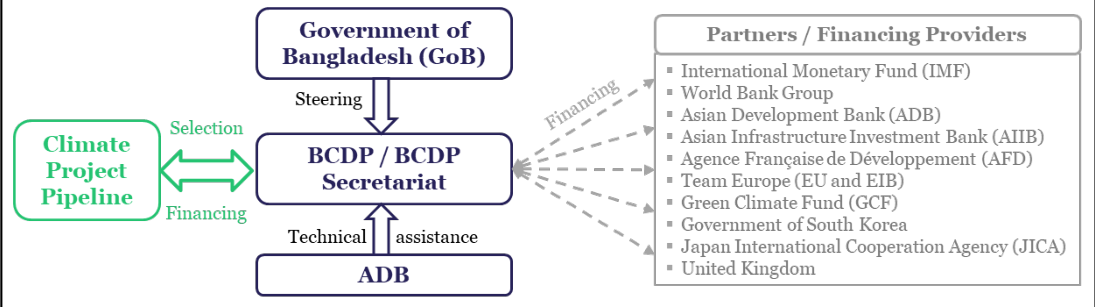
6.3 High-Coordination Approach
Unlike commercial banks, MDBs are used to cooperate when they have common purposes, rather than on competition with their peers. Over the years, they have already implemented a high-coordination approach in setting up and developing the GEMs Risk Database Consortium. GEMs has been highly successful in gathering risk data on MDB exposures, harmonising data definitions and formats, and allowing to perform detailed analyses of default risk and recoveries over long time horizons in relation to such exposures. The default risk analyses and statistics published by GEMs – including, since March 2024, recovery statistics for private and sub-sovereign lending – constitute an essential public good about the performance of MDB and DFI exposures, in EMDEs.[48]
For the high-coordination approach (c), MDBs could still take inspiration from their highly collaborative approach in GEMs and decide to expand on a larger scale than the medium-coordination approach. MDBs already active in credit risk transfer or wanting to develop its utilisation could partner to set up a common approach and digital infrastructure which would be open to future additions.
Such an MDB Risk Transfer Digital Infrastructure (MDB RTDI) and platform could be set up by a few MDBs initially (medium-coordination approach), starting for example with one or two asset classes such as nonsovereign and/or sovereign lending. In the future, this MDB RTDI would be open to further developments in terms of: ● additional asset classes of MDB exposures being added, ● additional MDBs and DFIs joining the platform in due course, ● additional ways to provide data and transaction information to investors (during the structuring phase and during the life of transactions, adapted to confidentiality requirements).
The MDB RTDI platform would aim to implement where appropriate common data definitions and formats and set up a common digital infrastructure for sharing exposure data, historical performance data and transaction information with investors. The MDB Data Templates proposed for the MDB Challenge could serve as a starting point for harmonising exposure data provided to investors, including detailed collateral and financial characteristics and the sustainability data that investors will require[49], and expand at a larger scale coordination.
Figure 6.2 illustrates how the MDB RTDI could be utilised by MDBs preparing a credit risk transfer transaction, which could be out of an already established risk transfer platform. The MDB would make the transaction’s information available to investors via the MDB RTDI (pool datatape, historical information, originator’s information, transaction documentation) within a dataroom dedicated to the transaction. Investors would access all relevant data and information about the transaction via the MDB RTDI. Over time, investors would become more and more familiar with the MDB RTDI, its datarooms and contents (including the MDB data templates for pool data tapes) across various MDBs and transactions/platforms, which would foster operational efficiency for those willing to participate in MDBs’ risk transfer programmes.
Such a high-coordination approach between MDBs would then create the highest prospects of large volumes of risk transfer and of repeat transactions, for the benefit of both investors and MDBs. The time investment of becoming familiar with the platform and participating in its risk-transfer programmes would be worthwhile for investors, with prospects of repeat transactions and large volumes over the years, which would make it the more efficient and attractive approach for them over time.
48 See GEMs (2024a). 49 See [Risk Control (2023) “MDB Challenge – Data Templates for MDB Loans”].
As a result, the high-coordination approach would likely permit the most important development of credit risk transfer programmes by MDBs and would likely yield the largest volumes of private capital mobilisation.
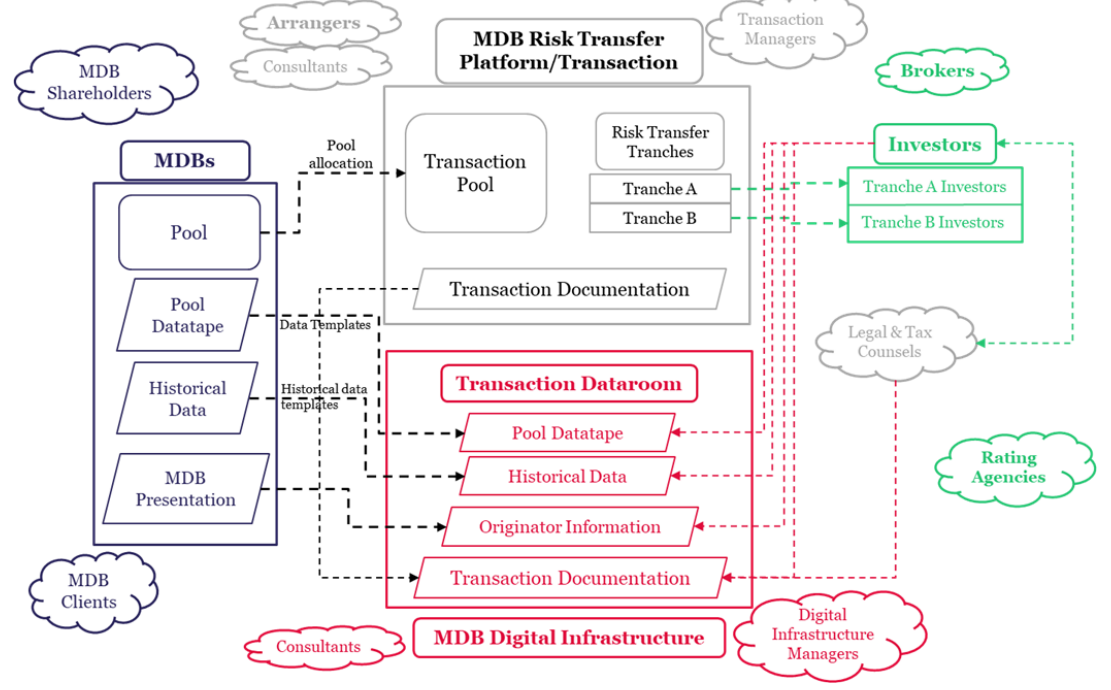
7. Conclusion
This report aims to provide Multilateral Development Banks (MDBs) with a roadmap for the implementation of truly scalable risk transfer. We review the risk transfer techniques employed by commercial banks and US mortgage refinance agencies and then sets out proposals for how MDBs could proceed.
Examples relevant for MDBs may be found in the arrangements of commercial banks. Individual banks wanting to create flows of risk transfer off their balance sheet rely on programs or ‘platforms’ in which they generate sequences of deals involving loans with similar characteristics to speed-up the risk transfer process. Platforms reduce operational risk and generate economies of scale. (For example, rating agencies are much quicker to provide feedback on transactions repeated from an existing platform.)
As competitors, commercial banks tend to develop their own in-house platforms. They do not operate in a coordinated or cooperative way with other banks in implementing risk transfer, but some effective coordination occurs to the extent that the banks are required by regulators to generate data adhering to reporting standards.
The practices of the US Government Agencies and Government Sponsored Enterprises (GSEs) which provide re-financing in the US residential mortgage market offer an example of more coordinated approaches. In particular, the GSEs have successfully enforced data standards which support a highly efficient pipeline of loan risk transfers from initial contracts to investor reporting, thereby transforming the US housing loan market.
The investor-led standardisation of US mortgage market risk transfer may be relevant to MDBs which, as unusually cooperative financial organisations, may wish to implement an originator-led approach to standardised and coordinated risk transfer.
MDBs have already adopted some elements of a coordinated risk transfer approach. Such elements include a consortium historical database known as GEMs, which develops and coordinates data standards for MDB loan information.
The data standards have been devised by participating MDBs to facilitate the calibration of internal MDB risk models and the information is currently insufficiently rich to meet the needs of investors on issues including collateral and financial characteristics. No data is currently included on sustainability which investors are also likely to require.
Also, MDBs have begun to develop institution-specific platforms for risk transfer. Examples include IFC’s and ADB’s arrangements with panels of insurers. Common country platforms have been proposed by the IMF for MDBs and bilateral DFIs that wish to provide development finance for specific countries, with the first example being Bangladesh.
But what would be necessary for all these ideas to come together and for MDBs to shape collaboratively a systematic and coordinated approach to risk transfer?
In this report, reflecting on the experience of commercial bank and US housing agency risk transfer platforms, we develop proposals for a scalable and flexible approach in which loans from one or more MDBs are transferred to a warehouse and then subject to funded or synthetic ‘take-out’ securitisations. A novel feature of what we suggest is the use of sovereign B-loans. This devise would permit MDBs to manage their leverage as well as their Risk Weighted Assets, an important aspect while some rating agencies remain wedded to methodologies that rely heavily on leverage as an indicator of capital adequacy.
Use of a warehouse would efficiently exploit the financing capacity of specialist investors, while the use of securitisation would bring the benefits of diversification and the possibility of matching the risk appetite and expertise levels of a wide range of capital market investors. Through this approach, MDBs may expect to receive the most favourable pricing for their loan-book credit risk.
References
African Development Bank Group (AfDB) (2023) “African Development Bank Group’s Integrated Safeguards System 2023,” May, available at: https://www.afdb.org/en/documents/african-development-bank-groupsintegrated-safeguards-system-2023.
Asian Development Bank (ADB) (2023), “Environmental and Social Framework (Consultation Draft),” September, available at: https://www.adb.org/documents/environmental-social-framework-draft.
Asian Development Bank (ADB) (2023) “People’s Republic of Bangladesh: Supporting the Climate-Resilient Inclusive Development Program,” Technical Assistance Report, December, available at: https://www.adb.org/projects/documents/ban-56253-003-tar.
Attridge, Samantha, Bianca Getzel and Neil Gregory (2024) “Trillions or billions? Reassessing the potential for European institutional investment in emerging markets and developing economies,” ODI Working Paper, May available at: https://odi.org/en/publications/trillions-or-billions-reassessing-the-potential-for-europeaninstitutional-investment-in-emerging-markets-and-developing-economies/.
Bank of England- Prudential Regulation Authority (2020), “Supervisory Statement SS9/13 - Securitisation: Significant Risk Transfer,” July, available at: https://www.bankofengland.co.uk/prudentialregulation/publication/2013/securitisation-ss.
Barclays (2024) “Barclays PLC – Pillar 3 Report 2023,” February, available at: https://home.barclays/investorrelations/reports-and-events/annual-reports/.
Basel Committee on Banking Supervision (2020), “Calculation of RWA for credit risk - CRE40: Securitisation General Provisions”, available at: https://www.bis.org/basel_framework/chapter/CRE/40.htm.
Center for Global Development (2023), “Mining for GEMs”, August, available at: https://mdbreformaccelerator.cgdev.org/mining-for-gems/.
Centre for Development Finance Studies (CDFS) (2023) “As Sense of Securitisation,” CDFS Short Read, December, available at: https://www.thecdfs.org/publications/.
Deutsche Bank (2024) “Pillar 3 Report 2023,” March, available at: https://investor-relations.db.com/reportsand-events/regulatory-reporting/.
European Central Bank (ECB) (2024) “EU securitisations: 2023 in figures,” May, available at: https://www.bankingsupervision.europa.eu/press/publications/newsletter/2024/html/ssm.nl240515_2.en.ht ml.
European Leveraged Finance Association (ELFA) (2023) “CLO Carbon and Climate Disclosures: Methods for Enhancing Transparency,” October, available at: https://elfainvestors.com/publications/ and https://elfainvestors.com/wp-content/uploads/2023/10/ELFA-Insights-39-CLO-Carbon-and-Sustainability- Reporting-Paper-1.pdf.
European Parliament (2017a), “Capital Requirement Regulation (EU) No575/2013 Title II Chapter 5 section2, articles 244/245: Recognition of significant risk transfer,” available at: https://eur-lex.europa.eu/legalcontent/EN/TXT/?uri=CELEX%3A02013R0575-20220410.
European Parliament (2017b) “Regulation (EU) 2017/2402 of the European Parliament and of the Council of 12 December 2017 laying down a general framework for securitisation and creating a specific framework for simple, transparent and standardised securitisation,” December, available at: https://eur-lex.europa.eu/legalcontent/EN/TXT/?uri=CELEX:32017R2402.
European Securities and Markets Authority (ESMA) (2020) “Guidelines on securitisation repository data completeness and consistency thresholds – Final Report,” July, available at: https://www.esma.europa.eu/document/guidelines-securitisation-repository-data-completeness-andconsistency-thresholds.
European Union (2022a), “Commission Delegated Regulations (EU) 2022/1301, Regulatory Technical Standards on information to be provided for STS notification requirements for on-balance-sheet synthetic securitisations, March, available at: https://eur-lex.europa.eu/eli/reg_del/2022/1301/oj.
European Union (2022b), “Commission Implementing Regulation (EU) 2022/1929 implementing technical standards as regards the templates for the provision of information in accordance with the STS notification requirements for on-balance-sheet synthetic securitisations,” March, available at: http://data.europa.eu/eli/reg_impl/2022/1929/oj.
Fannie Mae Perspectives Blog (2019) “Data Standards are Critical for the Mortgage Industry’s Digital Future,” October, available at: https://www.fanniemae.com/research-and-insights/perspectives/data-standards-arecritical-mortgage-industrys-digital-future.
Federal Housing Finance Agency (FHFA) (2015) “Overview of Fannie Mae and Freddie Mac Credit Risk Transfer Transactions,” August, available at: https://www.fhfa.gov/AboutUs/Reports/Pages/Overview-of- Fannie-Mae-and-Freddie-Mac-Credit-Risk-Transfer-Transactions-8212015.aspx.
Federal Housing Finance Agency (FHFA) (2017) “Standardizing Mortgage Data through the Uniform Mortgage Data Program,” October, available at: https://www.fhfa.gov/Media/Blog/Pages/standardizing-mortgage-datathrough-the-UMDP.aspx.
Federal Housing Finance Agency (FHFA) (2023) “Credit Risk Transfer Progress Report, Fourth Quarter 2022,” May, available at: https://www.fhfa.gov/AboutUs/Reports/Pages/Credit-Risk-Transfer-Progress-Report- 4Q2022.aspx.
Federal Housing Finance Agency, Office of Inspector General (FHFA-OIG) (2023) “An Overview of Common Securitization Solutions, LLC,” February, available at: https://www.fhfaoig.gov/reports/whitepapers.
Financial Conduct Authority (2023) “FCA updates on its Sustainability Disclosure Requirements (SDR) and investment labels consultation,” March, available at: https://www.fca.org.uk/news/news-stories/fca-updatessustainability-disclosure-requirements-and-investment-labels-consultation.
GEMs Consortium (2023a) “Default statistics: Sovereign and Sovereign-guaranteed Lending 1998-2020 - Volume 1,” March, available at: https://www.eib.org/en/publications/20220316-default-statistics-sovereignand-sovereign-guaranteed-lending-1998-2020-vol1.
GEMs Consortium (2023b) “Default statistics: Private and Sub-sovereign Lending 1994-2020 - Volume 2,” March, available at: https://www.eib.org/en/publications/20220317-default-statistics-private-and-subsovereign-lending-1994-2020-vol2.
GEMs Risk Database (2024a) “Recovery Statistics – Private and Sub-Sovereign Lending 1994-2022,” March, available at: https://www.gemsriskdatabase.org/#Recovery%20Statistics%20Publication.
GEMs Risk Database (2024b) “GEMs FAQs (Updated 05 April 2024),” April, available at: https://www.gemsriskdatabase.org/.
Gregory, Neil (2023) “Taking Stock of MDB and DFI Innovations for Mobilizing Private Capital for Development,” Center for Global Development (CGD), Policy Paper 290, April, available at: https://www.cgdev.org/publication/taking-stockmdb-and-dfi-innovations-mobilizing-private-capitaldevelopment.
Group of MDBs (2023) “Joint MDB Methodological Principles for Assessment of Paris Agreement Alignment of New operations,” June, available at: https://www.ebrd.com/ebrd-paris-agreement.
HSBC Holdings (2024) “Pillar 3 Disclosures at 31 December 2023,” February, available at: https://www.hsbc.com/investors/results-and-announcements/all-reporting/group?page=1&take=20.
IDB Invest (2020b) “Managing a Portfolio for Impact,” July, available at: https://www.idbinvest.org/en/impact-management-framework.
International Finance Corporation (IFC) (2012) “Performance Standards on Environmental and Social Sustainability,” January, available at: https://www.ifc.org/en/insights-reports/2012/ifc-performancestandards.
International Finance Corporation (IFC) (2023) “NAZAOA MDBs/DFIs webinar series: IFC (World Bank Group),” April, available at: https://www.unepfi.org/net-zero-alliance/alliance-extranet/financingtrack/nzaoa-transition-financing-track-2023/.
IFRS (2021), “IFRS Foundation announces International Sustainability Standards Board, consolidation with CDSB and VRF, and publication of prototype disclosure requirements,” November, available at: https://www.ifrs.org/news-and-events/news/2021/11/ifrs-foundation-announces-issb-consolidation-withcdsb-vrf-publication-of-prototypes/.
IFRS (2023a), “IFRS S1 Sustainability Disclosure Standard – General Requirements for Disclosure of Sustainability-related Financial Information,” June, available at: https://www.ifrs.org/issued-standards/ifrssustainability-standards-navigator/ifrs-s1-general-requirements/.
IFRS (2023b) “IFRS S2 Sustainability Disclosure Standard – Climate-related Disclosures,” June, available at: https://www.ifrs.org/issued-standards/ifrs-sustainability-standards-navigator/ifrs-s2-climate-relateddisclosures/.
IDB Invest (2020a) “Environmental and Social Sustainability Policy,” April, available at: https://idbinvest.org/en/sustainability.
International Monetary Fund (IMF) (2023) “Bangladesh and its Partners are Launching the Bangladesh Climate and Development Platform to Leverage Adaptation and Mitigation Investments,” press release No. 23/420, December, available at: https://www.imf.org/en/News/Articles/2023/12/03/bangladesh-launchclimate-development-platform-to-leverage-adaptation-and-mitigation-investments.
Independent Expert Panel convened by the G20 (CAF Panel) (2022) “Boosting MDBs’ investing capacity – An Independent Review of Multilateral Development Banks’ Capital Adequacy Frameworks,” October, available at: https://www.gihub.org/resources/publications/boosting-mdbs-investing-capacity-an-independent-review-ofmultilateral-development-banks-capital-adequacy-frameworks/.
Inter-American Development Bank (IDB) (2020) “Environmental and Social Policy Framework (ESPF),” September, available at: https://www.iadb.org/en/who-we-are/topics/environmental-and-socialsolutions/environmental-and-social-policy-framework.
Klein, Mossinger, Pfingsten (2021), “Transparency as a remedy for agency problems in securitization? The case of ECB’s loan-level reporting initiative”, Journal of Financial Intermediation – Volume 46, April, available at: https://www.sciencedirect.com/science/article/abs/pii/S1042957320300073
Layton, Don (2021) “The FHFA’s Report on Credit Risk Transfer: Another Controversial Document Further Erodes Confidence in the Agency”, Joint Center for Housing Studies (JCHS) of Harvard University, Industry Perspectives, May, available at: https://www.jchs.harvard.edu/blog/fhfa-report-credit-risk-transferanother-controversial-document-agency.
Lee, Nancy, Valerie Laxton and Samuel Matthews (2023) “What Would the Ideal Development and Climate MDB Look Like?” Center for Global Development (CGD), Policy Paper 299, June, available at: https://www.cgdev.org/publication/what-would-ideal-development-and-climate-mdb-look.
Mortgage Bankers Association (MBA) News Link (2019), “Fannie Mae: Without Data Standards (and MISMO), Mortgage Industry Doesn’t Go Digital,” October, available at: https://newslink.mba.org/servicingnewslink/2019/october/mba-newslink-oct-14-2019/fannie-mae-without-data-standards-and-mismomortgage-industry-doesnt-go-digital/.
Multilateral Development Banks (2022), “Joint Report on Multi Development Bank’s Climate Finance 2021,” October, available at: https://publications.iadb.org/en/2021-mdb-joint-report.
Multilateral Development Banks (2023a) “COP28 Multilateral Development Banks (MDB) Joint Statement,” December, available at: https://www.ifc.org/en/statements/2023/cop28-mdb-joint-statement.
Multilateral Development Banks (2023b), “Joint MDB Methodological Principles for Assessment of Paris Agreement Alignment,” June, available at: https://www.worldbank.org/en/publication/paris-alignment/jointmdb-paris-alignment-approach.
Parrott, Jim (2017) “The Common Securitization Platform – A Cornerstone for Reform,” Urban Institute Brief, July, available at: https://www.urban.org/research/publication/common-securitization-platform.
Partnership for Carbon Accounting Financials (PCAF) (2022), “The Global GHG Accounting and Reporting Standard Part A: Financed Emissions. Second Edition,” December, available at: https://carbonaccountingfinancials.com/en/standard.
Publish What You Fund (2024) “Crowding in: An advanced approach for measuring and disclosing private capital mobilisation,” available at: https://www.publishwhatyoufund.org/app/uploads/dlm_uploads/2024/04/Crowding-in-An-advancedapproach-for-measuring-and-disclosing-private-capital-mobilisation.pdf.
Risk Control (2023), “MDB Sovereign Loan Credit Performance and PCT: Public Data Analysis”, available at: https://www.riskcontrollimited.com/insights/mdb-sovereign-loan-credit-performance-and-pct/.
Risk Control (2024a) “Capital Adequacy Benchmarking for MDBs,” 24-127a, September, available from Risk Control Limited.
Risk Control (2024b) “MDB Challenge – Data Templates for MDB Loans,” 24-124a, September, available from Risk Control Limited.
Risk Control (2024c) “MDB Challenge – Regulatory Requirements for MDB Data Templates in Risk Transfer to Investors in EU, UK, US, Japan, Australia,” 24-126a, September, available from Risk Control Limited.
Risk Control (2024d) “Rating Agency Methodologies and Risk Transfer,” 24-122a, September, available from Risk Control Limited.
S&P Global Ratings (2024) “Banks Ramp Up Credit Risk Transfers To Optimize Regulatory Capital,” Comments, February, available at: https://www.spglobal.com/ratings/en/research/articles/240222-banksramp-up-credit-risk-transfers-to-optimize-regulatory-capital-13009236.
Santander Group (2024) “Pillar 3 – Disclosure Report 2023,” February, available at: https://www.santander.com/en/shareholders-and-investors/financial-and-economic-information.
Standard Chartered (2024) “Pillar 3 Disclosures – 31 December 2023,” March, available at: https://www.sc.com/en/investors/financial-results/.
Structured Credit Investors (2023) “SCI – Capital Relief Trades Awards 2023,” October, available at: https://www.structuredcreditinvestor.com/SCI_Awards.asp
Task Force on Climate-related Financial Disclosures (TCFD) (2023), “Task Force on Climate-related Financial Disclosures – 2023 Status Report,” October, available at: https://www.fsb-tcfd.org/press/tcfd-publishes-finalreport-identifies-further-work-needed/.
The Investor Agenda (2022), “2022 Global Investor Statement to Governments on the Climate Crisis,” November, available at: https://www.unepfi.org/industries/investment/600-plus-investors-call-ongovernments-to-radically-raise-their-climate-ambition-at-cop27/.
The M Report (2020) “The Rising Data Tide Lifting Loan Quality, The new Uniform Residential Loan Application could be the key to unlocking a future of clean data,” December, available at: https://themreport.com/featured/12-17-2020/the-rising-data-tide-lifting-loan-quality.
UMDP Fact sheet (2023), Uniform Mortgage Data Program, January, available at: https://singlefamily.fanniemae.com/media/5181/display.
UK Government (2023) “Guidance – UK Sustainability Disclosure Standards – Information on the UK government’s framework to create UK Sustainability Disclosure Standards (UK SDS) by assessing and endorsing the global corporate reporting baseline of IFRS Sustainability Disclosure Standards,” August, available at: https://www.gov.uk/guidance/uk-sustainability-disclosure-standards.
Urban Institute (2018) “The Case for Uniform Mortgage Servicing Data Standards,” November, available at: https://www.urban.org/sites/default/files/publication/99317/uniform_mortgage_servicing_data_standards.p df.
Urban Institute (2024) “Housing Finance: At A Glance Monthly Chartbook, January 2024,” January, available at: https://www.urban.org/research/publication/housing-finance-glance-monthly-chartbook-january-2024.
Wachter, Susan M. (2018) “Credit Risk Transfer, Informed Markets, and Securitization,” Federal Reserve Bank of New York Economic Policy Review Vol. 24, N0. 3, pp 117-137, December, available at: https://www.newyorkfed.org/research/epr#2018.
World Bank (2022) “Sovereign Climate and Nature Reporting: Proposal for a Risks and Opportunities Disclosure Framework,” January, available at: https://documents.worldbank.org/en/publication/documentsreports/documentdetail/099615001312229019/p170336065a94c04d0a6d00f3a2a6414cef.
Risk Control 8 Golden Square London W1F 9HY +44(0)2033070730 www.riskcontrollimited.com
Notes
[1] The EU (2013) “Regulation (EU) No 575/2013 on prudential requirements for credit institutions and investment firms”
[2] See ECB (2024).
[3] The ‘Basel Endgame’ – or ‘Basel III Endgame’, ‘Basel 3.1’ or ‘Basel IV’– is a way to refer to the final Basel III implementation, frequently used among others in the SRT and capital relief transaction markets.
[4] In October 2023, Santander Group was awarded ‘Issuer of the Year’ – of capital relief trades – by the Structured Credit Investors (SCI) publication and its global panel of credit risk transfer professionals.
[7] See HSBC Holdings (2024).
[8] See Standard Chartered (2024).
[9] See Structured Credit Investors (2023).
[10] The previous issuance out of the platform was Motor Securities 2022-1 DAC, just the year before, and referenced an approximately GBP600 million of auto loans from Santander Consumer (UK).
[13] The transaction is called “U.S. Bank Auto Credit-Linked Notes, Series 2023-1” as mentioned in a 16 November 2023 letter from the US Federal Reserve to US Bancorp and reported on Moody’s website which rates the CLNs issued A2(sf) and Ba2(sf).
[23] OPEC fund for International Development is a Supranational Entity rated AA+ as of April 2024
[24] This includes such cases as commercial banks securitisations with a ramp up or a re-investment period, as well as US mortgages financed by the GSEs. The MCPP are also programmes where future loans share risk at origination.
[25] In the US it is a requirement for registered transactions (i.e. public offerings).
[26] Or a pool of insurers in the case exposure to a single insurer implies a high concentration risk for example in S&P approach.
[27] They would not need a SPV structure and require less legal documentation. Some rating agencies may also have simpler treatment for simple portfolio assurance or guarantee (capped rating substitutions) than for more structured securitisation.
[28] In the case of commercial banks Basel III rules recognise “Risk transference”, with specific Risk Weighted Assets. See “CRE40: Securitisation General Provisions” (2020)
[29] See GEMs Consortium (2023) Default statistics Volume 1 and Volume 2.
[30] Risk Control (2022): MDB Sovereign Loan Credit Performance and PCT: Public Data Analysis
[31] See Multilateral Development Banks (2023b) “Joint MDB Methodological Principles for Assessment of Paris Agreement Alignment of New operations.”
[32] See Multilateral Development Banks (2022) “Joint Report on Multi Development Bank’s Climate Finance 2021.”
[33] See Multilateral Development Banks (2023a) “COP28 MDB Joint Statement.”
[34] According to the Center for Global Development, ILX had access to some GEMs data. That was considered as an exception. See “Mining for GEMs” - Center for Global Development (August 2023).
[36] EU CRR
[37] See European Parliament (2017), chapter 2, article 7.
[38] In the UK Securitisation regulation 2024, disclosure requirements do not include the format of data.
[39] In the EU, the STS framework was extended to cover synthetic securitisations with updated data standards (see European Union (2022) “Regulation (EU) 2021/557,” and EU (2022) “Commission Delegated Regulations” and “Technical standards on STS notifications”).
[40] See paragraphs (16) and (44) and article 7 of Regulation (EU) 2017/2402 (The EU Securitisation Regulation). The investor reporting templates are in the Annex XII of the Disclosure Regulatory Technical Standards (RTS): Commission Delegated Regulation (EU) 2020/1224 of 16 October 2019
[41] European Data Warehouse collects loan- and bond-level data from issuers and performs a variety of data quality checks to ensure the uploaded information is of the highest quality. It then provides reports on the market and performance of asset classes, and access to loan-level data for investors, rating agencies and central banks (see EDW (2023)).
[42] EIB (2023) “2022 Joint Report on Multilateral Development Banks’ Climate Finance
[43] MDB Methodology for Private Investment Mobilisation – Reference Guide (June 2018)