

The recent financial crisis has brought severe financing shortages for SMEs in many countries, especially in Europe. Banks engaged in rebuilding their balance sheets and satisfy new Basel rules on capital and liquidity have been strongly incentivised to scale back their lending to SMEs. The result has been high lending spreads and the rejection of many loan applications for SMEs particularly in Eurozone periphery countries.The financing constraints on SMEs could be solved in part by reviving the European SME-loan-backed securitisation market. This would permit banks to increase lending while still meeting Basel III capital requirements. But, changes are needed in the regulatory stance if this is to happen.Differentiation in capital and liquidity rules between High Quality Securitisations and more risky, less transparent and simple deals is necessary. Reducing reliance on agency ratings in securitisation regulation would also contribute.
1. Introduction
European SMEs have been among the primary casualties of the credit crunch that has gripped much of Europe since the crisis of 2007-8 and the subsequent European sovereign debt crisis of 2011-12. Banks’ attempts to rebuild their balance sheets and meet stringent new capital requirements have led them to scale back their lending. Liquidity requirements and moral suasion from governments have led many European banks to substitute investments in their national governments’ debt for corporate lending. The result has been high lending spreads and rejection of many loan applications for SMEs particularly in periphery countries.
A possible safety valve for the pressures imposed on European banks is securitisation. Prior to the crisis, SMEbacked securitisation was the second largest sector by volume (after residential mortgage-backed deals) of the European securitisation market. Securitisation offers banks the possibility of shifting capital intensive assets such as SME loans off balance sheets.
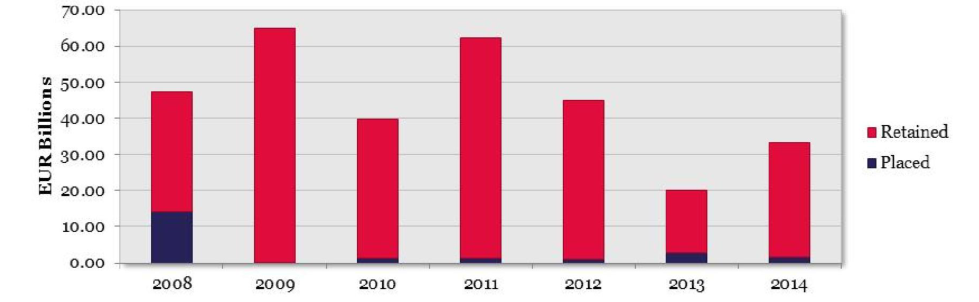
For several reasons, however, the channel of securitisation has effectively been closed. Since the crisis, new issues of European SME-backed securitisations have almost all been aimed at creating securities that banks can pledge to central banks to secure funding. Volumes of European SME-backed deals that have been distributed (as opposed to retained) have been very low since 2007.
This note (i) describes the financing pressure on European SMEs stemming from shortages of bank capital, (ii) explains how this could be alleviated by securitisation, (iii) sets out the impediments to the revival of the securitisation market in Europe and then (iv) suggests some practical policy solutions.
The note draws on an extensive body of recent research on the risks and appropriate capital treatment of securitisations performed by a group of bank securitisation risk specialists known as the AFA Quant group. Comprising securitisation risk experts from more than 20 major international banks, this group has engaged in a series of discussions and exchanges with regulators and central bank officials on the appropriate development of prudential rules for securitisation capital and liquidity.[1]
2. Challenges for SME finance
SMEs are a key part of the European economy, contributing 60% of gross value added and two thirds of employment. SMEs are also an important source of innovation with high tech and knowledge intensive SMEs contributing significantly to countries’ innovation capabilities and growth potential.[2]
Reliant on banks for most of their financing, European SMEs have been particularly hard hit by the crisis. The combination of weak sovereign credit standing and depressed real economic activity has left lenders in Europe scrambling to rebuild capital ratios and reduce the size of balance sheets. SMEs have been an obvious place for banks to focus in their efforts to rein back lending.
Access to finance has, therefore, been a significant challenge for European SMEs, particularly in the periphery countries where banks have been most under pressure to rebuild capital levels.[3] Figure 1 showsthe fraction of loan applicants, for the second half of 2014,that were granted the full amount they requested.
Following the Lehman Brothers collapse of 2008, a loosening of monetary policy pushed rates lower. The decline was reversed in many countries in 2011 and 2012 as concerns about sovereign default and Eurozone exit took hold. Figure 2 shows the evolution of borrowing conditions for SMEs through this period by presenting average interest rates charged on corporate loans in different European countries.
The European economy is now finally beginning to show some signs of recovery. EU growth was 1.3% in 2014 and is forecast by the Commission to growing by 1.7% in 2015. Equipment investment by companies remains weak reflecting limited SME access to financing but the European Commission forecasts a recovery in such investment later in 2015.[4]
It might seem that SME financing shortages could be resolved by the emergence of alternative lenders.[5] There has been much discussion of the emergence in some countries of peer-to-peer lending. Elsewhere national governments have engaged in policy initiatives designed to encourage alternative sources of SME loan finance (an example being the introduction of minibonds in Italy). However, alternative lenders are unlikely to contribute more than a tiny share of SME financing in the immediate future and so the priority remains improving the availability of bank intermediated financing.
pool granularity and longer maturities. The Basel Committee substantially modified their proposals in BCBS (2013), substituting an ad hoc exponential smoothing function known as the Simplified Supervisory Formula Approach (SSFA)for the complex model-based approach of BCBS (2012). Duponcheele (2014a) and (2014b) respectively present calibrations appropriate for European securitisation positions of a model-based solution and of the SSFA. 2 See European Commission (2014). 3 See European Central Bank (2014). 4See European Commission (2015). 5See Price Waterhouse Coopers (2014).
In most cases, European banks have restored profitability. Bank survey evidence suggests a moderate easing of credit conditions. A net 5% of banks surveyed cited easing of credit conditions in the fourth quarter of 2014 following a net 2% improvement in the third quarter.[6] But the logic of bank de-leveraging remains an important feature of the European economy depressing real economic activity including that related to SMEs.
The staged implementation of Basel III includes requirements that banks must progressively implement over the next several years including tighter leverage ratios, liquidity requirements and higher capital requirements. European banks remain under pressure and will not be in a position to expand SME financing significantly for several years.
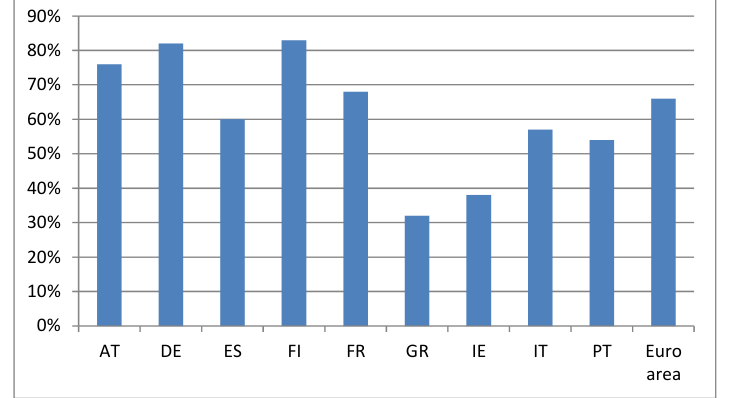
Notes: The figure shows the fraction of SME loan applicants granted their full loan request in different European countries in the second half of 2014. The figure illustrates the fragmentation of European credit markets created by the sovereign debt crisis.
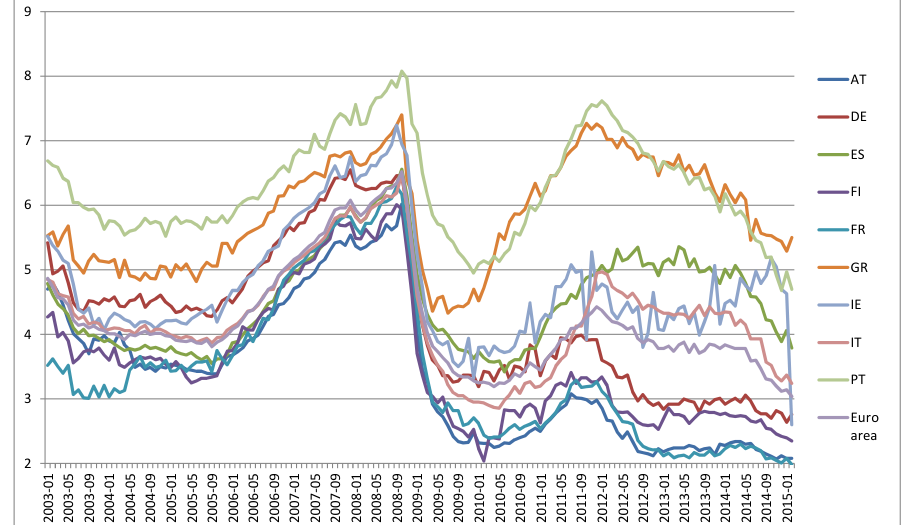
Notes: The figure presents the average corporate lending rate over time in different European countries. The rates shown major dislocation created by the Lehman Brothers collapse, the fall in rates as monetary policy loosened, the subsequent rate rise occurring in countries affected by the sovereign debt crisis and the partial, but far from complete, decline in rates in those countries since 2012.
3. Securitisation as a Safety Valve
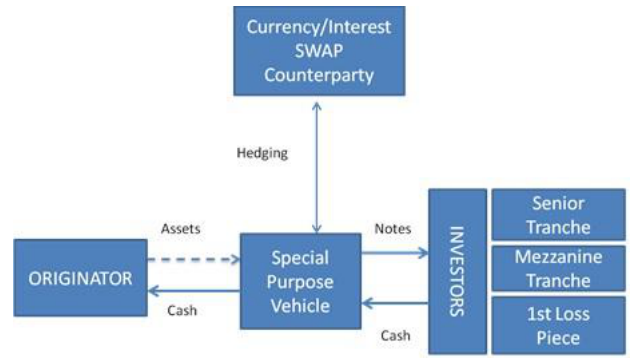
A possible safety valve for the pressures imposed on European banks might be securitisation. Securitisation permits banks to originate loans but to retain only a portion of the economic risk. Securitisation works as follows. A pool of loans is sold by a bank to a Special Purpose Vehicle which issues bonds or notes to finance the purchase of the loans. The notes issued by the SPV are organized in tranches of differing seniority. If the pool performs well, all tranches will pay their principal in full and their contractual coupon. As pool defaults increase, first junior, then mezzanine and finally senior tranches are impaired in the sense that they do not pay their contractual coupon or their principal.
Figure 3 illustrates a typical securitisation structure. The originator, usually a bank, sells loans to an SPV in exchange for the cash that the SPV raises by issuing notes. The SPV enters into swaps with a counter-party to remove any difference in the maturity or exchange rate of the pool loan and note cash flows.
Before the crisis, within the European securitisation market, measured by value issued, SME-backed securitisations were second only to residential mortgage backed deals. Securitisation offers banks the possibility of shifting capital intensive assets such as SME loans off balance sheets. For the market to function well, banks must retain enough of the securitisation exposure to ensure that they have an incentive to manage the pool appropriately (i.e., leaving them with ‘skin in the game’). But, this still would still typically give them scope to sell a significant part of their exposure to outside investors and hence, if the capital rules so allow, to reduce their regulatory capital.
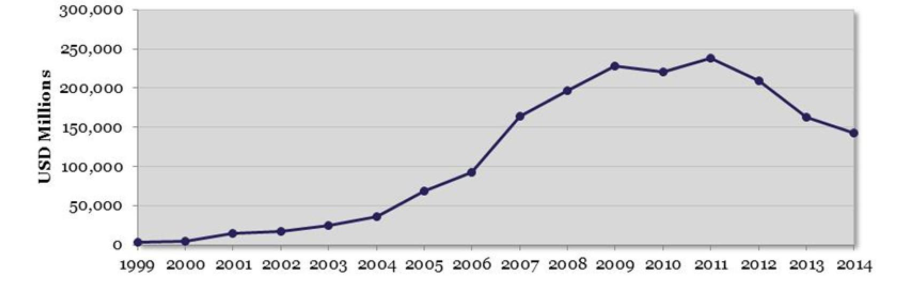
Figures 4 and 5 showthe volume outstanding and new issuance of SME-backed securitisations in Europe. Figure 4 shows SME volume outstanding peaking in the period 2009 and 2011 and then declining. This is deceptive, however, in that the large majority of new issuance after the crisis involved transactions designed to create securities that the bank involved could pledge to its central bank in return for financing. These securitisations were retained rather than being placed with investors. Figure 5 shows the new issuance amounts and how these were split between retained and placed portions. It is clear that, since the crisis, the market has been completely stalled with only a feeble issuance of securitisations that are sold into the market.[7]
4. Obstacles to the revival of SME securitisation
Why has the SME-backed securitisation in Europe been so moribund? A recent EBA Discussion Paper (see EBA (2014)) on Simple, Standard and Transparent Securitisations (SSTS) lists impediments to the general revival of the market:
1. The post-crisis stigma attached to the whole securitisation market by investors;
2. The impact of the macro-economic environment that has unfolded, in some jurisdictions, since the financial crisis;
3. The role of alternative funding instruments available to institutions in the EU, particularly the availability of central bank funding as a response to the financial crisis;
4. The tightening of the main credit rating agencies’ rating methodologies and rating policies, affecting the securitisation asset class following the negative experience of securitisation ratings during the crisis;
5. The lack of a sufficient investor base;
6. The potential regulatory uncertainty for issuers and investors from the numerous not yet finalised regulatory initiatives, both at the EU and global level and, a direct or indirect impact on incentives to securitise and/or invest in securitisations.
The post-crisis stigma has undoubtedly discouraged investor interest, dampening the demand for investment in securitisations. Also, the pure funding motive for banks to issue placed (rather than retained) securitisations has been reduced by the wide access to central bank funding that European banks have enjoyed, particularly following early 2012. However, the primary constraint on European banks since the crisis has not been one of scarce funding but instead the pressing need they have faced to economise on regulatory capital so as to meet Basel III capital requirements.
In this context, 4 and 6 have proved the dominant negative influences on a revival in SME securitisation. 6 reflects a view common among senior European regulators that the review of securitisationregulation that has occurred post the crisis has been too aggressively conservative, at least as far as high quality sectors of the European marketare concerned. 5 has been a consequence of 6 and possibly 1. On 2, the macroeconomic environment might even encourage securitisation in the sense that, other things being equal, it would encourage banks to shift loans off balance sheets.
The significance of 4 is that securitisation capital within Europe is dominated by ratings-based approaches. The Basel II framework for securitisation permits banks to use either (i) the Ratings Based Approach (RBA) which employs lookup tables based on agency ratings or (ii) a formula-based Supervisory Formula Approach (SFA) that takes as input pool capital worked out under demanding Internal Ratings Based Approach (IRBA) information standards. Following Dodd-Frank’s requirement of removing reliance of financial regulation on agency ratings, the US has prohibited its banks from using the RBA and has relaxed informational requirements so that its IRB banks may make wide use of the SFA. European regulators, in contrast, have retained the RBA while maintaining tight informational restrictions that mean banks may only employ the SFA is they are originators of a securitisation. For a large European bank active in securitisation, this means that perhaps only 5% of its securitisation positions are covered by the SFA with all the rest depending on agency ratings for regulatory capital calculation.
default rates of 2.5% in the period 2007 to 2013. Compare this to the United States where GDP declined by 4.3% peak to trough while securitisations experienced default rates of 18.4%. A large fraction of the defaults that made up the 2.5% of delinquent European securitisations was CDOs of ABS, many of which were exposed to US ABS tranches. Leaving out CDOs of ABS, the default rate among European securitisations was 1.8%. Also leaving out CMBS and other CDOs (including synthetic), the default rate drops to 0.12%. Retail and Small and Medium Enterprises (SME) loan backed securitisations in Europe proved strikingly robust against the crisis. RMBS, Other Consumer Asset Backed Securities (ABS), Credit Card ABS and SME CLOs experienced cumulative default rates of 0.10%, 0.13%, 0.00% and 0.41% respectively between 2007 and 2013.
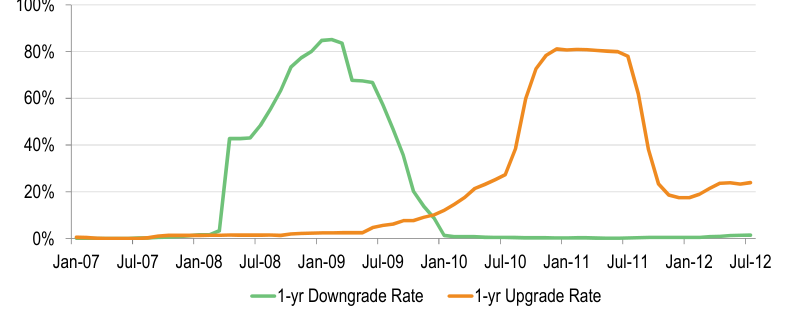
Since the crisis, ratings agencies, struggling to restore their reputation, have adopted sudden and drastic changes in methodology that have imparted an extreme form of procyclicality to securitisation ratings. Figure 6 shows the downgrade and upgrade rates in successive years in the CLO market as Moody’s first introduced, in 2009, a stress on default probabilities for corporate loans in CLO pools (without, incidentally, making corresponding stresses in the ratings of corporate debt issued directly, i.e., outside securitisations) and then, two years later,withdrew the stress.
Furthermore, the operation by ratings agencies of caps and triggers in their ratings evaluations to allow for transfer, convertibility and counterparty risk have increased conservatism, hampering banks located in unfavoured countries from securitising. The agencies’ practices in reviewing securitisation ratings (with intermittent and unsystematic surveillance) are not compatible with the frequency of regulatory capital calculations and the complexity and lack of transparency in structured product ratings create uncertainty that discourages bank investors from wishing to hold such securities.
EBA (2014) presents striking evidence on the effects of the current capital rules on incentives to invest in securitisation. Figure 7 reproduces a graphic from EBA (2014) in which a comparison is made between the total capital that a bank must hold if it owns a pool of SME loans (in this, Expected Loss is added to the pure
Unexpected Loss pool capital) with the capital that banks must hold if they own all the tranches of a securitisation secured on those very same loans. The ratio of the two quantities may be regarded as the degree of non-neutrality in the capital approach.
As one may observe from Figure 7, the current ratings-based capital rules are extremely non-neutral. The degree of non-neutrality varies across countries. For Spain and Italy, total securitisationcapital equals 7 and 6 times pool capital. For the Netherlands and UK, the ratio is 2, while for Germany and Belgium the ratio is 4.
What solutions are available that might rectify the degree of non-neutrality for European securitisation sectors that performed well during the recent crisis, such as SME-backed deals? In spring of 2014, the Bank of England and ECB issued two discussion papers suggesting that a category of High Quality Securitisation be carved out. Implicitly, the idea was that securitisations in this category receive less conservative regulatory treatment.
We support the use in regulations of a distinction between High Quality Securitisation and the rest of the market. Figure 8 shows the average annualised return volatility of High Quality and Other segments of the European securitisation market from mid-2006 onwards. All the tranches involved are AAA-rated. Qualitative criteria are used to differentiate the two categories. Obvious from the figure is the fact that ratings are insufficient as a means of discriminating between risky and less risky securitisation securities.
In the light of Figure 8, it makes sense to investigate different ways of favouring High Quality from Other securitisations in regulatory rules. Ideally, this should be done other than by simply modifying but still retaining ratings-based approaches to determining regulatory capital. For reasons already described above, agency ratings represent an unsatisfactory basis for calculating regulatory capital.
Practical approaches for differentiating High Quality securitisations have been proposed in Duponcheele et al (2014d). That paper suggested simple changes in the Basel rules set out in BCBS 303 that would be suitable for High Quality Securitisations. Those changes involve modifications in parameters used within the Simplified Supervisory Formula Approach which is the formula used as the building block of the capital formulae within BCBS 303.
Note: Data sources are BNP Paribas and Moody’s.
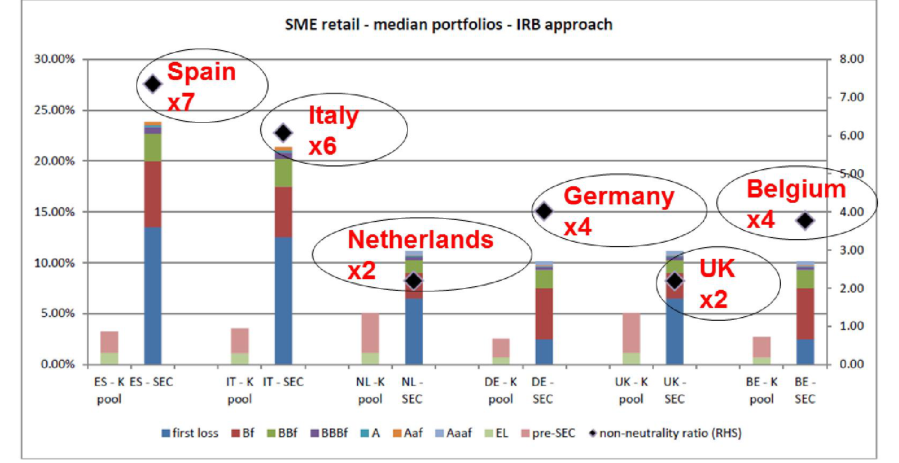
Notes: The figure shows capital for pool assets and for securitisation tranches of hypothetical SME retail securitisation transactions using idealised tranche structure and associated ratings supplied by ratings agencies. The capital of securitisations is calculated using the Basel II Ratings Based Approach. For each country, the left hand bar shows the sum of Expected Loss (EL) and Unexpected Loss (UL) capital for the securitisation pool assets. The right hand bar shows the total capital (combining EL and UL) for tranches having different ratings. The ratio of the height of a right hand bar to that of a left hand bar equals the ratio of capital for a bank that holds all the tranches of a deal to that of a bank that hold the pool assets. This ratio may be regarded as a measure of the non-neutrality of the securitisation capital framework.
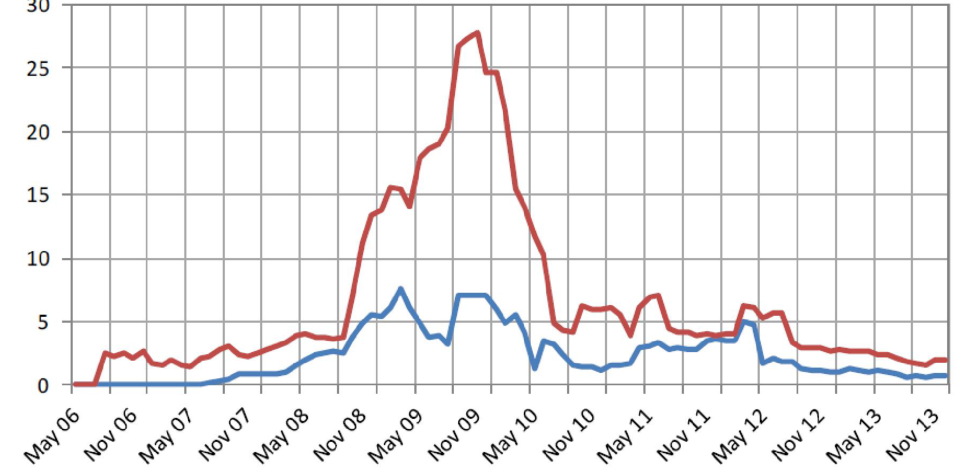
Note: Source Perraudin (2014). The paper shows average, annualised return volatilities for a large dataset of AAA-rated, European securitisation tranches, differentiated between High Quality Securitisations, satisfying a set of qualitative criteria. These include ruling out tranches that involve refinancing risk and those issued by lenders following an originate to distribute business model. (For more details, see Perraudin (2014).)
5. Conclusions
In Europe, as in some other regions globally, the economy remains fragile. This reflects in part the pressure on banks to rebuild their balance sheets which, in turn, limits their scope to resume normal lending activity.Central bank actions may solve funding problems for banks but what remains and continues to restrict their activity is a shortage of capital. This will continue for some years to come as Basel III provisions progressively come into force. SME lending is particularly under pressure because it attracts relatively high risk weights under Basel rules.
A partial solution could be provided by SME-backed securitisation. Without putting pressure on their capital ratios, banks may originate and then securitise SME loans, retaining an appropriate share of the risk so they have “skin in the game”. Since the crisis, the volume of SME-backed securitisations in Europe that is placed with investors has shrunk to a trickle. The EBA has identified several obstacles to the revival of the SME securitisation market in Europe. The most important of these in my view are the current ratings-based capital rules and even tougher Basel III rules in prospect.
The market will not revive without policy action. The blockage could be solved by differentiating between High Quality Securitisation and the riskier part of the market in capital and liquidity rules.It is also important to reduce reliance on agency ratings in prudential rules for securitisations. Simple changes in capital rules could achieve these goals are set out in Duponcheele et al (2014d). Our proposals are based on an extensive body of research completed by quants from a group of major banks. The proposals involve simple changes in the calibration of the Simplified Supervisory Formula Approach that is the building block for the Basel Committee’s current, proposed securitisation capital approach set out in BCBS 303.
6. References
Bank of England and European Central Bank (2014a) “The Impaired EU Securitisation Market: Causes, Roadblocks and How to Deal With Them,” Bank of England and European Central Bank Joint Statement, March
Bank of England and European Central Bank (2014b) “The Case for a Better Functioning Securitisation Market in the European Union: A Discussion Paper,” Bank of England and European Central Bank Joint Publication, May
Basel Committee on Bank Supervision (2012) “Revisions to the Basel Securitisation Framework,” Consultative Document, Bank for International Settlements, December, (BCBS 236)
Basel Committee on Bank Supervision (2013) “Revisions to the securitisation framework,” Consultative Document, Bank for International Settlements, December, (BCBS 269)
Basel Committee on Bank Supervision (2014) “Revisions to the securitisation framework,” Basel III Document, Bank for International Settlements, December, (BCBS 303)
Duponcheele, Georges, William Perraudin and Daniel Totouom-Tangho (2013a) “A Principles-Based Approach to Regulatory Capital for Securitisations,” BNP Paribas mimeo, April, available at: http://www.riskcontrollimited.com/public/Regulatory_capital_for_securitisations.pdf
Duponcheele, Georges, William Perraudin and Daniel Totouom-Tangho (2013b) “The Simplified Arbitrage-Free Approach: Calculating Securitisation Capital based on Risk Weights Alone,” BNP Paribas mimeo, July, available at: http://www.riskcontrollimited.com/public/Simplified_AFA_revised.pdf
Duponcheele, Georges, William Perraudin, Alastair Pickett and Daniel Totouom-Tangho (2013c) “Granularity, Heterogeneity and Securitisation Capital,” BNP Paribas mimeo, September, available at: http://www.riskcontrollimited.com/public/Granularity_Heterogeneity_and_Securitisation_Capital.pdf
Duponcheele, Georges, William Perraudin and Daniel Totouom-Tangho (2013d) “Maturity Effects in Securitisation Capital: Total Capital Levels and Dispersion Across Tranches,” BNPParibas mimeo, September, available at: http://www.riskcontrollimited.com/public/Maturity_Effects_in_Securitisation_Capital.pdf
Duponcheele, Georges, William Perraudin and Daniel Totouom-Tangho (2014a) “Reducing the Reliance of Securitisation Capital on Agency Ratings,” BNP Paribas mimeo, February, available at: http://www.riskcontrollimited.com/public/Reducing_the_Reliance.pdf
Duponcheele, Georges, William Perraudin, Alexandre Linden and Daniel Totouom-Tangho (2014b) “Calibration of the CMA and Regulatory Capital for Securitisations,” BNPParibas mimeo, April, available at: http://www.riskcontrollimited.com/public/Calibration_of_CMA.pdf
Duponcheele, Georges, William Perraudin and Daniel Totouom-Tangho (2014c) “Calibration of the Simplified Supervisory Formula Approach,” BNPParibas mimeo, March, available at:http://www.riskcontrollimited.com/public/Calibration_of_SSFA.pdf
Duponcheele, Georges, Alexandre Linden, and William Perraudin (2014d) “How to Revive the European Securitisation Market: a Proposal for a European SSFA,” BNPParibas mimeo, November, available at: http://www.riskcontrollimited.com/public/How_to_Revive_the_European_Securitisation_Market.pdf
European Central Bank (2014) “Survey On The Access To Finance Of Small And Medium-Sized Enterprises in the Euro Area,” 10.2013-03.2014, available at: https://www.ecb.europa.eu/pub/pdf/other/accesstofinancesmallmediumsizedenterprises201404en.pdf.
European Central Bank (2015) “The Euro area bank lending survey 4th Quarter of 2014,” available at: https://www.ecb.europa.eu/pub/pdf/other/accesstofinancesmallmediumsizedenterprises201404en.pdf.
European Commission (2014) “Annual Report on European SMEs 2013/2014: A partial and fragile recovery,” European Commission Final Report, available at: http://ec.europa.eu/enterprise/policies/sme/facts-figuresanalysis/performance-review/files/supporting-documents/2014/annual-report-smes-2014_en.pdf.
European Commission (2015) “Economic Forecast European Economy 1|2015 Winter,” January, available at: http://ec.europa.eu/economy_finance/publications/european_economy/2015/pdf/ee1_en.pdf.
Perraudin, W., (2014) “High Quality Securitisation: An Empirical Analysis of the PCS Definition,” RCL mimeo, June. www.riskcontrollimited.com/public/High_Quality_Securitisation.pdf
Risk Control Limited 13-14 Dean Street London W1D 3RS UK T: +44 (0)203 307 0730
Notes
[1] Responding to the Basel consultative document BCBS (2012), Duponcheele et al (2013a) advocated a capital formula based on generally reasonable principles. This “principles based approach” was extended and refined in Duponcheele et al (2013b), (2013c) and (2013d), simplifying the formula in some dimensions and extending it in others to cover imperfect Confidential © Copyright Risk Control Limited 2015 6See European Central Bank (2015). 7One might question whether banks can ever be fully incentivised to manage pool risk adequately if they have sold some of the economic risk through securitisation. Reassuring in this is the performance of the European market in the period since the crisis. Perraudin (2014b) comments that, in the period since 2007, GDP in UK, France, Spain and Italy showed peak to trough GDP declines of 7.2%, 4.4%, 5.0%, and 7.2%, respectively . Default rates in European securitisations exhibited