

European policymakers have argued that Europe needs “massive private investments” (see ECB (2024a)) to advance the climate agenda and generate higher productivity and competitiveness. While equity markets can provide EU corporates with some risk capacity to invest more, it will be for debt markets to finance the bulk of the needed investment. European banks, as key intermediators of surplus funds from European and international savers, could alleviate this pressure if they were able to create more lending headroom by transferring risks through securitisation. By doing this, they would generate ‘capital velocity’, by which we mean that securitisation permits a bank to deploy its risk capacity more than once. Covered Bonds (CBs) are no substitute for securitisation in this regard because the credit risk of the loan pool covered by a CB remains on the issuing bank’s balance sheet and, hence, no additional capacity to make new loans is generated. Boosting securitisation would require some relatively small, though judiciously chosen, adjustments, aimed at aligning regulatory rules with actual risk. In this regard, we (i) propose a key change in regulations that would bring capital requirements for senior securitisation tranches in line with risk, namely the introduction of a risk-sensitive risk weight floor, (ii) suggest changes in governance arrangements to ensure an effective implementation of the regulatory framework that could reduce unintended and unforeseen consequences of new rules and (iii) put forward new approaches, including streamlining and unifying some aspects of securitisation supervision under the coordination of one of the ESAs.
1 – Introduction
The European Central Bank’s Governing Council recently argued that Capital Markets Union (CMU) is imperative for Eurosystem countries, stating that:
“making full use of Europe’s capital markets is key to mobilise the massive private investments that are needed to carry out the green and digital transitions, and to enhance the EU’s productivity and competitiveness in a shifting geopolitical landscape” (ECB
(2024a) published 7th March).
From a macroeconomic perspective, there is little mystery why private sector investment in Europe has fallen short of what central bankers and others believe is necessary to generate economic growth. The recovery in demand since the pandemic has been sluggish[3] and the profitability of European firms has been too weak to generate a spontaneous increase in real investment by the private sector.
Moreover, many believe that structural impediments to investment exist in Europe’s financial markets. European debt markets function primarily through the region’s banks, and the profitability of these banks lags behind that of international competitors. This is reflected in the average equity to book values shown in Figure 1.1.
With low economic growth and pressure on bank profitability, banks are far from queuing up to expand their balance sheets by boosting lending. Since new bank equity (beyond what is required by prudential regulation[5]) is largely unavailable, how can banks rise to the challenge of financing additional investment? Greater room to lend can only be achieved if banks are able to shift risks off balance sheet to other non-bank investors. Securitisation provides the framework for achieving this.
In this respect, Covered Bonds (CBs), which, as secured bank funding instruments, are often compared to traditional (true sale) securitisations, are no substitute for securitisation. The credit risk of the loan pool covered by a CB remains on the issuing bank’s balance sheet and CBs generate
3 The IMF predicts that the global GDP growth rate will decrease to 3.1% during the next five years. For the US, the GDP is projected to grow at 2.7% in 2024 and 1.9% in 2025. For the EU eurozone area, the rate is expected to be lower at 0.8% and 1.5% for 2024 and 2025, respectively. 4 The banks are selected based on their total assets at the end of 2023. The top 10 EU banks are BNP Paribas, Crédit Agricole, Santander, Société Générale, Deutsche Bank, Crédit Mutuel, ING, Intesa Sanpaolo, UniCredit and BBVA. The top 10 US banks are JP Morgan, Bank of America, Wells Fargo, Citigroup, U.S. Bancorp, PNC, Truist Financial Corporation, Fifth Third Bank, M&T Bank and Huntington Bancshares. 5 Analysis of how successive versions of Basel rules would have affected the capital treatment of different asset classes (with varying levels of risk) is provided by Bernardi, Perraudin and Yang (2020).
neither a transfer of credit risk nor a commensurate reduction in regulatory capital. When assets are securitised, the issuing bank can recycle its risk bearing capacity by making new loans. One may refer to this feature of securitisation (not shared by CBs) as ‘capital velocity’, capturing the notion that securitisation permits a bank to deploy its risk capacity more than once.
On the other hand, one comparable feature of CBs and securitisations is that both offer a means through which one bank can provide secured funding to another. Having channels for secured lending among banks is important in generating robust funding flows without relying on intermediation by central banks. Before the 2011-2013 European Sovereign Debt Crisis, European banks operated a substantial unsecured interbank market with significant depth even at relatively long tenors. This unsecured interbank market dried up in the 2011-2013 crisis except for transactions at the very shortest tenors. Whilst liquidity has returned, CBs and securitisation remain important mechanisms for making interbank funding robust and reducing the burden that would fall on central banks if another crisis were to occur.[6]
This study seeks to provide prescriptions for increasing ‘capital velocity’ through modest but key adjustments to the regulatory rules on securitisation. Real economy investment would increase if banks were able to optimise their balance sheets more effectively. Over the last decade, European regulators have made multiple attempts to adjust securitisation regulations to arrive at a smooth functioning and financially stable market. Success has been limited. We believe that the answer is not to dismantle the regulatory framework that has been developed but to make small, judiciously chosen adjustments to the framework, thus better aligning regulatory rules with actual risk.
To explain what is needed, in Section 2, we set out European policymakers’ perspectives on Europe’s investment and financing needs and the crucial role that banks must pay in meeting these needs. We believe that many policymakers share our concerns about how the prudential framework for securitisation currently operates and the constraints it places on European investment and growth. We document this view in this section.
In Section 3, we present key data about the European securitisation market, describing its evolution since the GFC, and comparing this with the European market in CBs. The message of this section is that securitisation activity in Europe has failed to recover as regulators had expected after the post crisis reforms. As secured sources of funding for banks, securitisation and CBs are comparable in some respects but not in others. Europe currently faces a challenge of financing growth through investment. This is an issue of risk capacity, difficult to resolve when banks exhibit low profitability and are unconstrained by funding.
Section 4 reflects on how securitisation regulations in the European context could be improved. There have been several instances in which political will ensured that international standards were adapted to European needs. Examples include (i) the European Parliament’s introduction of the SME Supporting Factor, (ii) the European Commission’s rewording of the standards to change the hierarchy of approaches for bank securitisation capital (reducing Europe’s reliance on external ratings), (iii) the European Supervisory Authorities (ESAs) development of a synthetic simple, transparent and standardised (STS) securitisation framework.
The last of these measures is clearly aimed at improving the capital velocity of European banks and represents a success in the sense that volumes rose, and smaller banks participated. But also, it represents a partial failure in that it introduced a new investor fragmentation in the capital markets. By not mentioning regulated and diversified European (re)insurers in the list of authorised guarantors, the rules prevent insurers from participating in the STS market on an unfunded basis (though they remain active in the shrinking non-STS segment).[7]
The adoption of a 0% risk-weighted requirement for Multilateral Development Banks (MDBs) as unfunded guarantors for STS has strengthened the roles of the European Investment Fund (EIF) in various European countries and of the European Bank for Reconstruction and Development (EBRD) in a growing number of CEE countries, where securitisation markets remain subdued. The greater role of these prominent institutions has helped to popularise the securitisation technique and reduced the post-GFC stigma attached to securitisation in those countries. On the other hand, the deployment of MDB resources may have reduced mobilisation of private money in these securitisation transactions which might otherwise have occurred.
Section 4 also considers what competitiveness gains might be achieved by changing regulation and which changes would be easiest to implement and most effective in yielding economic impacts. We argue that a straightforward and effective improvement in the securitisation rules would be the introduction of a risk-sensitive risk weight (RW) floor proportional to pool RWs. The current RW floor equals a constant percentage of notional value which makes no distinction between securitisations secured on risky versus significantly less risky pools. Designs for a risk-sensitive floor are presented in Duponcheele et al. (2024). Here, we describe our preferred option: for IRB and SA banks, a factor of proportionality of 10% applied to the underlying pool risk-weight under SA. This choice would provide stable capital requirements for senior tranches, unaffected by whether the IRB capital requirements or the SA Output Floor capital requirements apply.[8]
Section 5 considers how changing governance arrangements could increase the effectiveness of regulatory reforms. The European Lamfalussy architecture of financial regulation and supervision has moved over time from a principles-based to a rules-based system. This introduces the need for mitigation techniques if unintended consequences from regulation arise. Reform of securitisation rules would be reinforced if enhanced supervisory tools were introduced. The authorities should view securitisation as a balance sheet optimisation and capital velocity instrument and not always to be compared with CBs. To be successful, reforms should be developed in collaboration with capital market participants. We highlight past episodes in which the lack of a ‘smart’ regulatory and supervisory framework has impeded the development of the market and describe cases in which regulators and market participants worked collaboratively to achieve common goals. Finally, in the long-term, we argue that ‘smart’ regulatory governance should foster innovations in the CMU.
Section 6 concludes. We believe that now is the moment to rethink certain aspects of securitisation regulation[9] which are highly material for European competitiveness. The changes we advocate would contribute to the wider social objectives of regulation recently expressed by Mario Draghi, former ECB governor and Italian Prime Minister:
“Rethinking our economic policies to increase productivity growth and competitiveness is essential to preserve Europe’s unique social model.”[10]
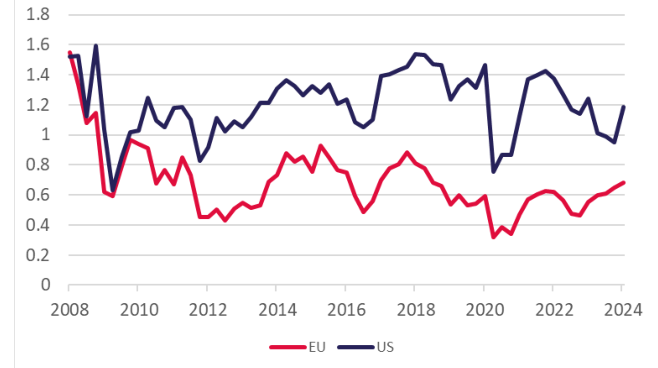
Note: The data is based on price to book ratio data from Bloomberg for the top 10 banks[4] of EU and US region respectively.
2 – Influential calls for regulatory change
The European authorities appear increasingly concerned that Capital Markets Union (CMU) has contributed little to European economic performance or sovereignty.[11] This section highlights a recent statement by the ECB’s Governing Council, parsing the points made in some detail. The statement reveals disquiet among central bankers about key aspects of the regulatory framework for European banks. Below, we also discuss reflections on the future of CMU by the Eurogroup and proposals for regulatory reform by a committee of experts chaired by Christian Noyer.
The ECB Governing Council provides five reasons why progress towards CMU is imperative for the Eurosystem. The first of these is that:
“making full use of Europe’s capital markets is key to mobilise the massive private investments that are needed to carry out the green and digital transitions, and to enhance the EU’s productivity and competitiveness in a shifting geopolitical landscape” (ECB (2024a) published 7th March).
The focus on a shortage of investment is a relatively new concern for policymakers who for some years have prioritised increasing the robustness of the European financial system above growth. Thus, few European policymakers have questioned the adoption of the prescriptions of the final rounds of Basel III. The sluggish recovery from the recent pandemic (in contrast to the experience of other jurisdictions) and the perception that major responses are necessary to combat climate change and respond to technological challenges have changed the terms of the debate within Europe.
The Governing Council’s statement is remarkable for its direct tone:
“It is clear that the EU needs to move beyond broad statements and a piecemeal approach on CMU to a top-down approach, including concrete actions to foster capital market integration and development at the European level. True political will, ambition and follow-up will be critical. The Eurosystem sees a number of specific priorities as essential”.
Evident in this statement is frustration at the lack of concrete progress. Changing financial regulation in Europe is a highly complex process and despite a decade of discussion on how European capital markets can be unified and made more efficient, little progress has been achieved. Could a more topdown intervention improve matters?
A key priority identified by the Governing Council is securitisation:
“Ensuring that the EU securitisation market can play a role in transferring risks away from banks to enable them to provide more financing to the real economy, while creating opportunities for capital markets investors. This requires understanding the supply and demand factors relevant for the development of the securitisation market, including […] reviewing the prudential treatment of securitisation for banks and insurance companies and the reporting and due diligence requirements, while taking into account international standards […]”.
The issue of how to restore volumes in the securitisation market while maintaining financial stability is, of course, far from new. European policymakers have striven for many years to provide a regulatory framework that encourages the development of a transparent and robust securitisation market without unduly discouraging activity. This is why the paragraph on securitisation is preceded by the statement “First, further progress at the EU level is needed on challenging open dossiers”.
Over the last decade, the regulatory bodies that advise the European Commission (EC) have attributed the moribund nature of the securitisation market in Europe to combinations of (i) market conditions,
(ii) the ECB’s TLTRO, (iii) the narrow margins on residential mortgage lending, etc., rather than acknowledging the impact of their rulemaking and adopting necessary adjustments.
On several occasions, senior European central bankers have sought to alert the European authorities to the need to change securitisation regulatory rules. Indeed, in 2014, at the Joint EIB-IMF High Level Workshop on Capital Markets Union – the ‘Why’ and the ‘How’, ECB officials questioned the Basel calibration for the capital charges of this instrument.[12]
On 11th March 2024, a few days after the Governing Council statement, the Eurogroup in inclusive format[13] issued reflections on the future of CMU (Eurogroup (2024)). The group reiterated the points made by the ECB Governing Council, and provided a timeline for change:
“for the next European legislative term of 2024-2029, under the mandate of the EU Leaders, the Eurogroup in inclusive format has identified three priority areas [architecture, business and citizens] for action where measures are necessary to improve the functioning of European capital markets”.
The first measure for the architecture priority is to
“develop the EU securitisation market to allow for the efficient and transparent transfer of risks to parties best equipped to carry those risks.”
This statement is particularly relevant, as many members of the Eurogroup are also members of the Council of the European Union (CEU), who with the European Parliament (EP) is one of the two colegislators. Indeed, though the European Central Bank has supervisory powers, it has no regulatory or legislative powers. While it can sponsor reforms, the ECB cannot translate this sponsorship into drafting laws. Drafting legislation is in the hands of the EC, the EP and the CEU, as well as, under the Lamfalussy architecture, the three ESAs, i.e., the European Banking Authority (EBA), the European Insurance and Occupational Pensions Authority (EIOPA) and the European Securities and Markets Authority (ESMA).
The Joint Committee (JC), as the body by which the ESAs cooperate on cross sectoral issues, is accountable to the EP and the CEU. The JC has a Securitisation sub-committee. While the EBA takes responsibility for the treatment of securitisation for the banking world (the main issuers), EIOPA deals with the treatment of securitisation for the insurers and occupational pension world (the main non-bank regulated investors). ESMA is the bridge between those two worlds as it deals with the transparency, due diligence, CRA and STS requirements. All three authorities take into account international standards pertaining to banking, insurance and securities markets (set by BCBS, IAIS and IOSCO, respectively).
Supply factors are, thus, mainly the responsibility of EBA, while demand factors mainly fall within EIOPA’s field of activity. Understanding and balancing these factors should be the role of the JC. But the JC is mainly advisory and lacks power to act as a ‘referee’ when the objectives of one ESA conflict with those of another one. The JC also lacks the capacity to call in outside experts that are not linked to any of the ESAs – there are no stakeholder groups to advice the JC. Aware of this situation, the Eurogroup has called for governance issues to be addressed. Thus, as its second priority in the statement, it has invited:
“the European Commission to assess ways to improve supervision in the EU through further developing the common rulebook as well as examining a broad range of options to enhance supervisory convergence through a more efficient and effective use of the existing powers of the European Supervisory Authorities and a possible targeted strengthening of their role and governance arrangements.”
The statements of the ECB Governing Council and Eurogroup in inclusive format do not contain any detailed proposals, but such proposals are provided by the most recent report on the CMU by a committee of experts chaired by Christian Noyer, the Honorary Governor of Banque de France, does (Noyer (2024)).[14] The Noyer Committee takes the view:
“Europe will need to invest massively in areas such as green transition, digital transition and defence to maintain its economic competitiveness” and that this is difficult to achieve under the “current underdevelopment of capital markets in Europe [that] is attributable to a smaller investor base and structural fragmentation”.
The report contains four recommendations:
(a) to develop long-term European savings products to increase flows into European capital markets,
(b) to “finally revitalise the securitisation, to back the lending capacities of European banks by deep capital markets”, which implies to a “quick correction of the regulatory and prudential framework”,
(c) to have an integrated supervision of capital market activities, which implies “reforming the governance of the ESMA and extend its supervisory powers”, and
(d) to address technical issues to reduce the fragmentation of settlement of financial transactions in Europe.
Calls for regulatory change may not come solely from the top. Indeed, the European Economic and Social Committee (EESC), the voice of organised civil society in Europe, has started its own initiative entitled ‘Securitisation in the EU – The way forward’. While its opinion is not known at the time of writing, with a publication expected mid-September, it has already held a public hearing,[15] in which one of the authors of this paper was able to emphasise the economic role of securitisation’s capital velocity for European citizens’ wellbeing and employment. Too often the debate has focused on narrow legal differences, such as traditional securitisation (in which assets are sold to a separate vehicle) versus synthetic securitisation (in which assets are referenced). Not enough attention has been paid to the economic role of capital velocity that is generated by some traditional securitisations and by most synthetic securitisations.[16]
Our study, therefore, focuses on the second recommendation of the Noyer report and presents ideas for targeted reforms of securitisation regulations to increase banks’ capital velocity.
3 – Facts and figures
3.1 – European Securitisations
Among financial instruments employed by European banks, securitisation is a newcomer relative, for example to CBs. European securitisation weathered the GFC without significant credit losses for real economy asset classes. The exception was deals backed by low granularity commercial real estate and a few European deals which were exposed to US sub-prime market assets. European banks holding US securitisation products, especially those involving re-securitisation, experienced major losses.
Despite this outcome and instead of focusing on the underlying nature of credit risk in the US and Europe (specifically, the fact that US mortgages in many cases do not offer recourse to the borrower, a feature not shared by their European equivalents), investors in European capital markets reacted to the crisis by ceasing to invest in traditional securitisations, including those issued in Europe. The stigma generated for the European market has taken a long time to dissipate and, one may argue, still partly remains.
Prior to the GFC, almost all traditional EU securitisations were fully placed with investors (third-party banks and non-banks). Figure 3.1 Panel a) shows the EU 27 issuance amount, with the split between placed and retained securitisations. The overall volume of market placed securitisations decreased from almost EUR 300 bn in 2007 to around EUR 40 to 90 bn over the last 10 years, which is very low for the size of the EU economy. By 2009, the placement rate had dropped to 4%. That year coincided with discussions on a future revised Solvency framework, and it was clear that regulators would heavily penalise insurer investment in securitisation tranches. Insurance companies did not wait for the rules to be finalised but rapidly rebalanced their credit portfolios away from securitisation tranches, investing instead in the underlying assets, i.e., loans. Since then, insurers have never returned in meaningful numbers to the securitisation asset class.
Over the last 10 years, the yearly placement rate for securitisation tranches has hovered between 30% and 50%, indicating a split role for traditional securitisations. Most placed securitisations have limited risk transfer (subject to prudential rules) and are issued mainly to obtain external funding. Retained securitisations are not affected by the prudential rules, as their consolidation means that the banks compute capital for the underlying assets rather than for the securitisation positions. Thus, the securitisation prudential rules apply to less than half of the total issuance volumes.
The post-crisis stigma of securitisation was accentuated during the early negotiations for Basel III in the period up to 2014. To mitigate this, negotiations took place to define the criteria for high quality securitisations (HQS) that led to the recalibration of the Basel capital formula for Simple, Transparent and Comparable (STC) securitisations and to a lowering of the risk weight floor, from a fixed value of
15% to 10%. The EC added additional criteria and these changes to the Basel STC framework were implemented in 2019 under the label Simple, Transparent and Standardised (STS), allowing the label to be applied retroactively. At the time, hopes were high that the STS label would reboot the European securitisation market. After 5 years of implementation (shown in Panel b) of Figure 3.1), one must conclude, from the low volume achieved, that these hopes were vain. Important changes are necessary if the market is to be repaired, enabling banks to finance the ‘massive private investments’ called for by the ECB Governing Council.
How much additional investment could, realistically, be financed if the European securitisation were to recover? To answer, one can look at the Total Amount Outstanding of traditional securitisations (placed and retained, to assess the overall potential). Figure 3.2 Panel a) shows the 2023 data per country. The data exhibit various country-level patterns. The volume for Italy is more than double that for Germany, for example. Some countries exhibit negligible volume, for example Denmark and Sweden (in sharp contrast with the CB issuance). Panel b) shows that classes of loans that are securitised also vary notably across countries. For example, Auto loans/leases are important for Germany (brown colour). Similarly, SMEs loans are an important asset class for Belgium (yellow colour).
To assess the economic importance of European securitisation, in Figure 3.3, we compare the ratio of the Total Outstanding Amount to GDP for each EU 27 country since 2012. In that year, the Basel Committee issued its first proposal on how future rules might be framed. Volumes have dropped continuously since 2012 for almost all countries except France with a recent stabilisation occurring (mainly involving retained securitisation). One may conclude that securitisation no longer finances European economic growth in that the EU ratio of 9.3% in 2012 had dropped to 4.3% by 2023.
The overall implication of Figures 3.1 to 3.3 is clear. The traditional securitisation technique is not serving the CMU as it should, neither at a country nor an economic sector level. While the STS label may be a building block for a revival, it cannot be relied on alone. More broadly, one may infer from these data that there is a large untapped financing source that could boost economic growth in all European countries and sectors without encumbering bank balance sheets or requiring unrealisable increases in bank equity and, hence, risk capacity.
How much could the securitisation market grow prudently and sustainably? In the last decade, the yearly placed issuance of traditional securitisation in the EU 27 has been less than €100 bn of notional volume a year (only approaching this level in 2018). The annual totals increase to below €200 bn if one includes retained securitisations. The latter (amounting to more than €100 bn) could be placed, but that would imply that the securitisation regulations, specifically the prudential rules for banks, cease to incentivise banks to prefer retaining assets. Placed, but with whom? Banks and insurance companies are the most obvious candidate investors as their investment modus operandi are affected by securitisation regulations.
For banks, the main issues are (i) whether they might be encouraged to place senior tranches costeffectively and (ii) whether they might invest in other banks’ issues. It seems reasonable that European banks be permitted to invest in senior tranches of European traditional securitisations, especially when these are backed by granular pools of bank-originated assets, which have themselves been originated consistent with EBA guidelines. Currently, the fixed value risk weight floor is an impediment to placed issuance, and the liquidity coverage ratio (LCR) classification and haircuts are seen by many bank treasurers as rendering investment unattractive.[17] By focusing on the senior tranches for banks as investors, one could reinforce bank funding but not contribute to the financing of the economy, which would require addressing issues related to risk taking and capital.
On insurers as potential investors, many industry analysts and trade associations consider that facilitating this through a recalibration of Solvency II is one of the most obvious steps that the European authorities could take and that this would materially help to generate demand for European bank issued securitisations.[18] Insurers have specific concerns, however. Non-life insurers must pay claims according to their contractual obligations[19] and, so, wish to hold highly liquid instruments. If they were to hold many senior securitisation tranches, even STS, the due diligence required of EU buyers if the insurer were to sell could delay transactions, hampering the insurer’s ability to sell within the desired time.
The 2022 British LDI crisis shows the kind of problem that may emerge. It appears from market rumours that UK pension funds sold securitisation papers first to non-EU banks because, due to the extensive due diligence required, no European buyers could buy them quickly. A short period afterwards, following due diligence, the same European buyers were able to buy from non-EU banks the paper offloaded by the UK pension funds.[20] In any case, prudent insurers would not want to be in such a situation, regardless of capital charges. This example highlights the fact that separate regulations can combine to affect the final outcome and care should be taken with rules that have the potential to impede the smooth functioning of market transactions.
If key blockages in European securitisation regulations were to be removed, how much might the market in placed traditional securitisations grow sustainably? Growth would come first from banks as cross-border flows increased. Subsequent growth would likely come from insurance companies. These latter need to reestablish investment teams with the required expertise. Once a large market develops, pension funds would likely increase their allocation to this instrument class. Prudent and sustainable growth might reach 25% per annum over a five-year period. This would represent a trebling of issuance once the five-year period finished, i.e., around €300 bn by 2029, compared to the level of just under €100 bn at end 2023. Such growth would be a major step to achieving the ‘massive private investment’ mentioned by the ECB Governing Council. Still more could be achieved through growth in the synthetic Significant Risk Transfer (SRT) market, as we shall discuss below.
In contrast to the traditional securitisation market, the European SRT market represents a success story. The SRT market permits banks to reduce their credit risk by transferring the risk of a loan portfolio to investors, thereby achieving regulatory capital relief. While SRT can be implemented through traditional (cash) or synthetic (on-balance sheet) transactions, only in the synthetic market have reasonable levels of activity been attained in recent years. While it has existed since the 1990s, the European synthetic SRT market has notably expanded. It now constitutes about 85% of the global synthetic SRT market.
While synthetic transactions dominate (90% of all SRT trades in 2023 had a synthetic form), traditional (cash) transactions still play a role, particularly for funding and asset deconsolidation. In the Euro area, over the five-year period since 2018, synthetic SRT securitisation volume has more than doubled, while the volume of traditional (cash) SRT securitisation transactions stagnated (see González and Triandafil (2023)).
Growth in SRT has been enabled by the EU's regulatory framework established in 2006-2013 (CRD and CRR), the Single Supervisory Mechanism (SSM) set up in 2014, and the European Banking Authority's (EBA) 2017 supervisory guidelines clarifying significant risk transfer criteria. Basel III implementation further incentivised banks to use SRT transactions to free up Risk Weighted Assets (RWAs) rather than raising costly equity.
Indeed, the SRT market has become essential for banks to manage capital and sustain lending amidst profitability challenges without equity dilution. Both large and small banks have integrated SRT into their regular capital planning. As stated in González and Triandafil (2023):
“in general, banks see that synthetic on-balance sheet transactions are simpler to execute [than traditional ones] but there are additional reasons for the higher use. These include
a) confidentiality restrictions: especially with corporate assets, the bank may be restricted from disclosing information about the loans publicly, making a traditional public securitisation unfeasible; b) highly concentrated portfolios: the tranching requirements of the rating approach for these assets is usually much more punitive than the IRBA/SA approaches, making unrated synthetic securitisation more attractive; c) SMEs: the rating-based approach for these assets is more punitive for these types of assets due to their heterogenous characteristics, so an unrated synthetic is usually preferred; d) investor preference: some investors prefer synthetics because they only want exposure to credit risk, not the operational and/or cash flow risk associated with traditional deals.”
Investors in the SRT market are non-bank entities, which typically include pension funds, private credit funds, supranational institutions, and, to a marginal extent, insurance companies. Progress towards CMU requires a solid institutional and policy framework for non-banks, as stated by the ECB Financial Stability Review (ECB (2024b)). In the section on macroprudential policy issues, the report states that:
“securitisation could play a role in financing the real economy by transferring risks from banks to non-banks and by providing a source of funding to non-banks. Securitisation could be part of a diversified funding mix for banks and non-banks alike. Banks could use it as a tool to free up their balance sheets, thereby creating room for lending to the real economy. This is particularly important in view of the investment needed for the green and digital transitions.”
It also frames the issue of reforms in the context of financial stability. The report adds:
“From a financial stability perspective, policy measures in the regulatory framework should aim to ensure that the market develops prudently and sustainably and should lead to genuine risk transfer. This would ensure that risks are distributed across the financial sector to those best placed to assume them.”
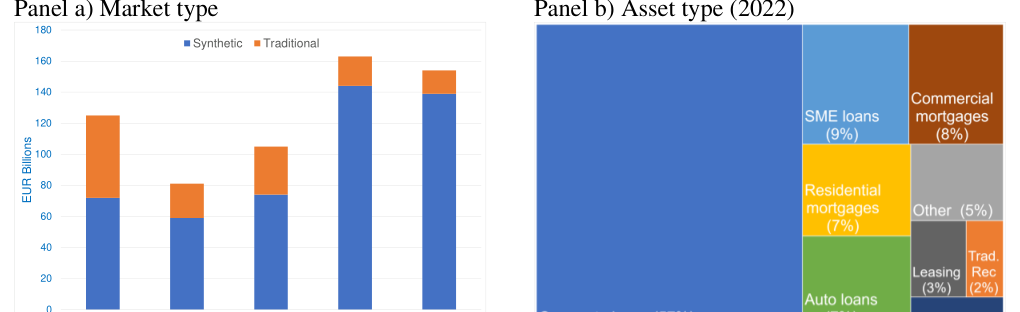
What would be prudent and sustainable growth for this market? The overall SRT market (in synthetic and true sale form) in Europe is around €150-170 bn of notional volume a year according to the latest ECB figures (2022-2023). If the portfolios that banks use in their SRT trades have a risk weight in the region of 75% on average, that notional volume would represent the equivalent of around €4 to 5 bn of capital release per year. The assets currently securitised represent a mere 0.65% of total assets on the balance sheets of European Significant Institutions (SIs) and the capital released on an annual basis is around just 0.22% of total bank equity.[21] It is reasonable to believe that the market volume might double over a five-year period with an average annual growth of 15% per annum and assuming that the size of the European banking system balance sheets and equity remain the same (i.e., around 1.30% total assets securitised and around 0.44% of total bank equity per annum).
One may compare this 15% value with growth over the last five years, as shown in Figure 3.4 Panel a). According to “EU securitisations: 2023 in figures”, an ECB Supervision Newsletter published in May (ECB (2024c)) the market issuance volumes are as follows:
“Focusing on SRT transactions and based on provisional data, the volume of instruments backed by performing loans and originated by banks under direct ECB supervision declined slightly in 2023 to around €154 billion (from €163 billion in 2022)… At origination, banks retain the major portion of SRT instruments – only about 15% of the notional volume is placed with third-party investors.”
2019 2020 2021 2022 2023 Source: ECB (2024c) Source: González and Triandafil (2023)
Thus, in 2023, the €154 billion of SRT volumes represent about €23 bn placed with investors. Can those amounts be doubled over the next five years? Whether or not growth in European securitisation volumes occurs may depend on changes in regulation and how market participants perceive such changes. 2023 looks very similar to 2022 from the point of view of a bank issuer. No growth is occurring despite the absence of a crisis. A steady state may have been reached or IRB banks may be waiting for greater clarity on the Trilogue negotiations that occurred last year on provisional measures for the Output Floor. Market participants expect to see growth in risk transfer volumes in non-EU jurisdictions. For example, the change in the US stance to synthetic securitisations in late 2023 will encourage such transactions. In the EU, smaller institutions under the SA regime are likely to be more present in the market (thanks to the synthetic STS framework), but larger IRB banks may be delaying issuance until they see if regulations will be reformed.
The supervisory authorities do not have a detailed picture of developments on the investor side. No single source provides a complete picture. A 2023 survey by issuing banks of their SRT investors (see González and Triandafil (2023)) defined five categories of investors: (i) specialised credit funds (with 45% of the market), (ii) large asset manager firms (with around 30%), (iii) supranationals such as the EIF (with 15%), (iv) large European pension funds (with 5%) and (v) insurance companies (holding 5%). The share of insurance companies has increased from no activity to a growing presence in recent years according to González and Triandafil (2023).
According to RTRA Intelligence[22], a news provider specialising in the coverage of synthetic securitisations, the number of active investors in the EU SRT space is just above 40, 75% of which invest in a funded format, and 25% invest in an unfunded format.[23]
The funded/unfunded issue is an example of how the investor landscape can be fragmented inadvertently in Europe. The synthetic STS framework introduced in 2021 as part of the Capital Markets Recovery Package (CMRP)[24], explicitly allows multilateral institutions to participate in the STS market on an unfunded basis. It omits, however, mention of private insurance and reinsurance companies, thus, effectively excluding them from the unfunded STS SRT market. At the same time, the regulation pre-CMRP explicitly allows such private enterprises to play their normal economic role as providers of unfunded credit insurance.
The combination of both sets of regulations mean that European insurance and reinsurance companies are confined to being active, on an unfunded basis, only in the non-STS SRT market, and as a result are increasingly looking outside Europe for investment opportunities.[25] The issues are technical but could be fixed quickly, thus, at a stroke increasing the EU investor base for EU STS SRT transactions. It is estimated that the effect would be to add immediately a new annual capacity of €10bn RWA relief.
We understand, from informal discussions with market participants on the buy side and with law firms, that US-based investment firms have been on a recruitment drive since 2023 and are ready to allocate more funds to the EU STS SRT space. This will contribute to the trend highlighted in the Noyer report that “Europe exports its savings through the acquisition of foreign debt securities and imports the equity funding necessary for the development of its companies. As a result, the rest of the world captures the value created by European companies.” (Noyer (2024)). In our view, it is vital that financing flows towards European capital markets be boosted by ensuring that the European investor base is increased, not muffled and pushed towards investments in non-EU jurisdictions.
To summarise, the SRT space is an area in which the EU has become a major early player. In the absence of relevant regulatory and prudential measures for banks and investors, the EU risks seeing the capital markets infrastructure that has developed (teams of investment officers and underwriters, legal expertise, capital) being diverted to other jurisdictions, rather than being used for the ‘massive private investments’ that the EU needs.
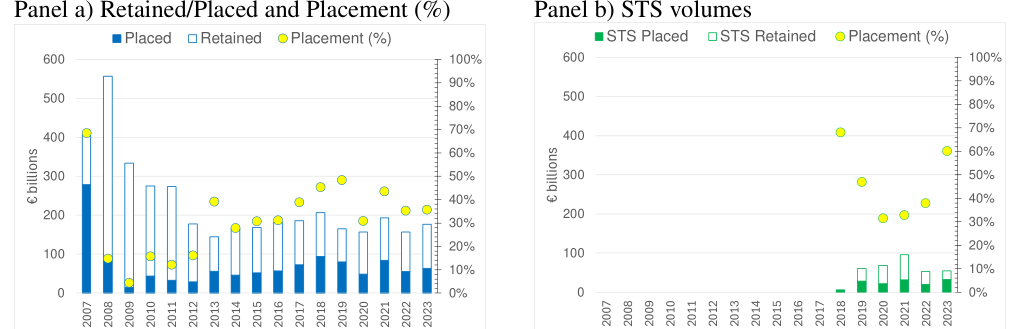
Source: AFME. Includes Pan-European CLOs. Excludes UK.
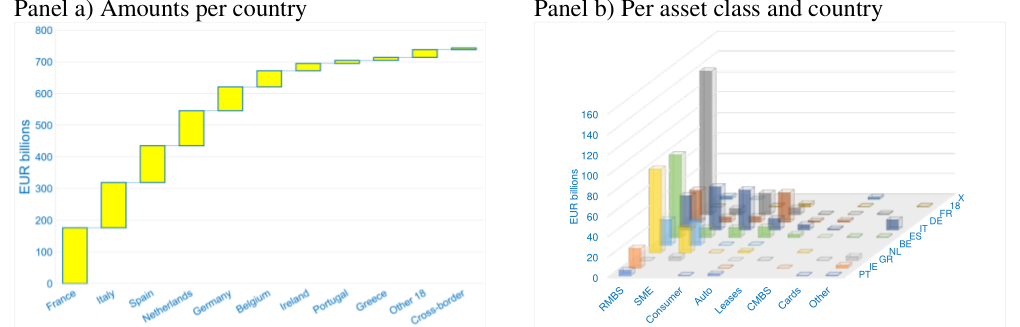
Source: AFME Securitisation Data Reports 2023, Authors’ own aggregation. Excludes CLOs
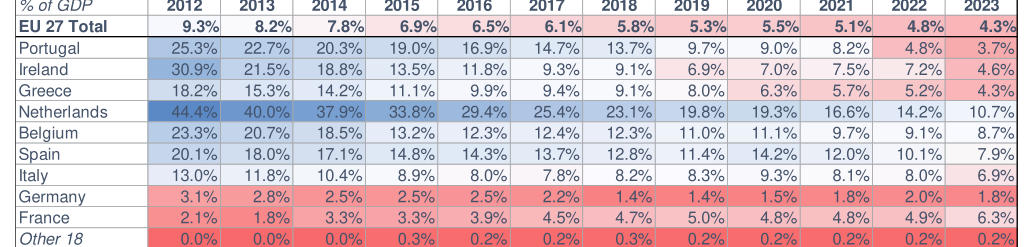
Source: AFME, Eurostat, Authors’ own aggregation. Data excludes CLOs.
3.2 – European Covered Bonds
In this subsection, we provide facts and figures regarding European covered bonds. CBs are dualrecourse bonds, with a claim on a cover pool (the underlying assets) and a claim on the issuer. The recourse to the cover pool will only occur upon default by the issuer.
Within European financial circles, CBs are widely viewed as a success story. Employed initially in a few northern European banking markets, they have been increasingly used by banks in other European countries to raise secured funding. The instrument’s expanded role was important during and after the European sovereign crisis of 2011-12 when some banks in the region experienced major difficulties in raising funds.
It is natural for policymakers and others to compare CBs with securitisations. Both instruments allow banks to raise funding secured against portfolios of loans. The assets in the cover pool of a CB, however, remain on the balance sheet of the issuer. In a securitisation, the loans are transferred off the balance sheet of the bank to an SPV. Because of the recourse to the issuer, the latter can use CBs for maturity transformation between the longer cover pool maturities and the shorter CB maturities. CBs thereby become an asset-and-liability management (ALM) tool. Such maturity transformation (and the risks associated with it) is not generally possible with securitisation.
Recourse to the issuer appears an advantage when the main problem is coping with a crisis of bank funding (as was the case in 2011-12). Even then, one may worry that an issuing bank will fail exactly when asset pools lose most of their value. In this respect, CBs may suffer from what is referred to in collateral management as ‘wrong way’ risk. However, when policymakers wish to boost investment, the fact that assets in a CB remain on the balance sheet and that the instrument holders have recourse to the issuer substantially reduces the usefulness of CBs.
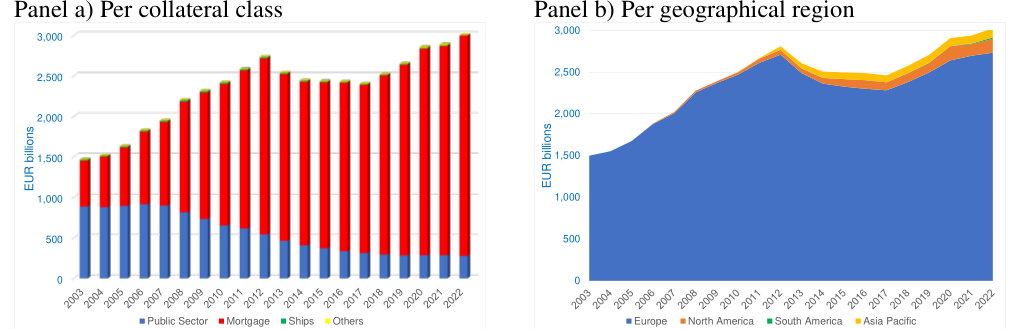
Figure 3.5 presents data on CBs starting in 2006.[26] Panels a) and b) provide breakdowns of the total amount outstanding by asset class and geographical regions.
Panel b) reveals that CBs are almost exclusively a European instrument – although a market outside Europe has recently begun to develop.[28] The Total Amount Outstanding in the EU reached €2,327 bn (€2,468 for the EEA) at the end of 2022 while it equalled a paltry €561 bn (of which Switzerland is €174bn) in the rest of the world. Within Europe, the largest amount is issued in Denmark (€463 bn), followed by Germany (€394 bn), France (€368 bn), Sweden (€225 bn), Spain (€209 bn), the Netherlands (€197bn) and Italy (€166 bn).
The data shows some economic imbalances. For example, Denmark represents 19.9% of the EU CB market but 1.3% of the EU population or 2.5% of EU GDP. Leaving Denmark and Sweden aside, shares of the CB market are in line with GDP. For example, Germany represents 16.9% of the EU CB market, and 18.8% of the EU population or 25.7% of the EU GDP. The importance of CBs for European banking markets and economies has resulted into the adoption of tailor-made European rules for the CB instrument.[29]
The regulatory conditions accorded to CBs include:
• Lower risk-weighting for EEA CBs bought by EEA banks under the EU’s Capital Requirements Regulation (CRR),
• Eligible as liquid assets under the EU LCR regulation, where in 2014 CBs were made eligible for Level 1 and Level 2A High Quality Liquid Assets (HQLA), creating an investor market among bank treasurers,
• Exemption from bail-in under EU’s Bank Recovery and Resolution Directive (BRRD),
• Privileged treatment of CBs under the EU large exposure rules,
• Favourable treatment under Solvency II for insurers, and
• Repo treatment at the ECB and other central banks, with category II haircuts (second lowest haircuts). It is to be noted that during the European sovereign crisis of 2011-2012, market participants viewed the intervention of central banks as being supportive of the CB markets.
More legislative proposals are under study aimed at encouraging other European countries, that make limited use of the CB instrument, to increase their CB issuance to lower bank funding costs.
Might growth in the CB market achieve the EU’s objective as stated by the ECB Governing Council of ‘massive private investment’? In part, perhaps, but not as the main solution. There are four reasons for this.
1. The first reason is collateral. As Figure 3.5 Panel a) shows, mortgages (residential or commercial) constitute the main asset class backing CBs. Other asset classes that figure to a significant degree are public sector assets. Shipping loans (in Denmark and Germany) and exposures to third-party banks play a minor role. There are entire sectors of economic activity, however, that do not appear at all among the asset classes covered by European CBs, most notably large corporate loans and SME loans, trade finance, trade receivables, object finance. Whether the European Secured Notes (ESN) project advocated by trade associations will help to extend the eligible asset classes for cover pools remains to be seen.
2. Despite the regulatory rights granted to CBs in the EU in the last decade, the volume outstanding in the region has stagnated. The 2022 volume is almost the same as the 2012 volume, showing no progression over a decade. The CB market has not grown in line with the economy over this period. It appears uncertain that additional privileges will change this picture.
3. The cover pool needs to maintain its credit quality, and this is a dynamic process. Bank issuers may be under pressure to remove loans from the cover pool if loan-to-value (LTV) thresholds are breached.
4. The fourth and most important issue, already mentioned above, is that the issuance of CBs creates no new risk bearing capacity. A bank can raise funding cheaply through CBs (although, potentially, at the expense of more expensive unsecured funding) but there is no change in the total volume of loans that the bank’s equity can sustain.
Source: ECBC, ABN Amro, Storied Data.[27]
4 – A key step to boost securitisation in europe
4.1 – A Risk-sensitive Risk Weight Floor
When assessing the STS market data on the PCS website[30] per asset class, one surprising fact is that the number of notifications for the Residential Mortgage-Backed Securitisation (RMBS) asset class is of similar magnitude as for the Auto Loans (Auto) asset class. This is a truly depressing statistic for Europe, as the relative volumes of the underlying loan markets means that there should be a difference of an order of magnitude between the two.
To understand the disappearance of traditional RMBS, specifically the disappearance of RMBS backed by bank-originated residential mortgages that are placed with investors and not retained for liquidity purposes, one needs to look at the ratio of the senior tranche risk weight, often set at the RW floor, in comparison to the risk weight of the underlying pool. It is too close to parity for most IRB banks for pools of low LTV mortgages. In France, the average risk weight of a retail mortgage portfolio from 4 large IRB banks is 10.3%.[31] The securitisation of high-quality mortgage assets with risk transfer is, thus, not efficient. Consequently, banks keep the loans on their balance sheet, or use the collateral for other instruments, such as covered bonds.
Retail residential mortgage loans generally represent a large part of European banks’ balance sheets, which is not the case in the US where the long-established government sponsored-enterprises (GSEs) help to lighten the US banks’ balance sheets, helping US banks to recycle their capital towards more productive areas of the economy. Furthermore, the Federal Housing Finance Agency (FHFA), the regulator of Fannie Mae and Freddie Mac, allowed those two entities to set up risk transfer programmes, tapping into the risk appetite of funded investors and unfunded insurers and reinsurers.
Introducing a risk-sensitive risk weight floor will increase traditional and synthetic European residential mortgage securitisations volumes, enabling banks to redeploy funding and capital to areas that contribute more to GDP growth, boosting employment opportunities within the European Union. As European bank financial ratios improve, lenders would be more resilient in the event of financial crisis, as they would have a higher capacity to absorb shocks. The introduction of a risk-sensitive risk weight floor, a simple modification in the current capital framework, would boost activity in European securitisation for other asset classes too.
Duponcheele et al. (2024) presents possible designs and calibration for a risk-sensitive risk weight floor.[32] The designs consider the evolution of international standards over the last 30 years in which a pattern of risk-sensitivity can be detected. Considering the effects of moving to a risk-sensitive risk weight floor and reducing the regulatory frictions to improve the European competitiveness across the European jurisdictions and across the asset classes, we describe our preferred option, i.e., for Internal Ratings-Based Approach (IRB) and Standardised Approach (SA) banks, a factor of proportionality of 10% applied to the underlying capital (KSA. Such as choice would provide stability in the determination of capital requirements of senior tranches.
4.2 – Impacts of a Flagship Measure
The introduction of a risk-sensitive risk weight floor, if the concept were taken up by policymakers as a flagship measure for the CMU reforms, would have a wide impact. Below we explain some salient examples of its impact in further detail.
Non-STS asset classes
The current rules differentiate between STS and non-STS capital charges in that the senior tranche risk weight floor equals 10% of nominal value for STS and 15% for non-STS, and via a reduction of the capital charges for the mezzanine portion of a securitisation (via a p-factor that is halved for STS versus that for non-STS). If Europe wants to finance the sustainable and green transition for all economic sectors in a truly pan-European securitisation market, there should be no such differentiation for senior tranches. The floor should be the unified for most asset classes including those in the specialised lending category (containing project finance (e.g., hospitals) and infrastructure (e.g., energy renewables)). Such assets will never be STS as the associated securitisations are highly unlikely to achieve the level of granularity required by STS (which is straightforward for residential mortgage, SME loans or consumer loan pools).[33]
In discussing reforms to due diligence, the Noyer report mentions that:
“rather than revising the STS label criteria, it would be better not to restrict support measures to the labelled market segment. […] A better approach would be to avoid targeting securitisation support measures exclusively at STS transactions, especially as regards prudential requirements. Some asset classes that help finance the economy may never be eligible for STS classification, primarily because they are not granular enough (loans to corporates and infrastructure projects for instance).” (Noyer (2024)).
We agree and believe that the reasoning in the Noyer report should also be applied to the prudential requirement of the risk weight floor for the senior tranches.[34]
Indeed, the “massive private investments” referred to by the ECB Governing Council in the context of CMU, is unachievable if one relies only on loans eligible for an STS securitisation label. So, the same risk-sensitive risk weight floor should apply to STS and non-STS senior tranches. In our view, pool granularity is the only valid grounds for differentiation.[35]
Market Impact by Levelling the Playing Field (IRB / SA) in SEC-IRBA and SEC-SA
Not all banks manage their assets under the IRB (whether Foundation or Advanced) approach, with many medium sized financial institutions risk-weighting their assets using the SA approach. Indeed, the situation is more complex, as even IRB banks have a substantial portion of their assets riskweighted under the SA approach. Whether an asset is financed by an SA, or an IRB bank makes no difference to the European economy, and from a financial stability point of view, all IRB and SA banks will have originated those assets according to strict EBA loan origination guidelines.
Therefore, if assets have been originated with regulated origination guidelines, the senior risk weight floor should use the same reference for the underlying pool. This is KSA for both IRB and SA banks.
The idea of implementing a level playing field is not new. It is already in place in the current legislation, as the current fixed value risk weight floor (10% for STS and 15% for non-STS) is the same, whether it is applied by an IRB or SA bank. Therefore, using the same SA pool risk weight variable in the determination of a risk-sensitive risk weight floor for senior tranches is compatible with this idea of a level playing field between IRB and SA banks.
Levelling the Playing Field with SEC-ERBA / SEC-IAA
The level playing field should be maintained across all approaches, notwithstanding hierarchy. In Europe, the SEC-IRBA is at the top of the hierarchy, followed by SEC-SA and SEC-ERBA / SEC- IAA. The latter are key for ABCP conduits, an important funding tool for Auto loans and Trade receivables / Trade finance assets. Therefore, the level playing field which exists for SEC-IRBA and SEC-SA for the senior tranche risk weight floor, should be extended to SEC-ERBA / SEC-IAA, taking care to ensure that the top line in the SEC-ERBA table for the determination of risk weight of externally rated tranches can refer to the same risk weight floor method as in SEC-SA. Not doing so would create artificial competitive biases between ABCP conduits using SEC-IRBA and those using SEC-IAA.
Central and Eastern European (CEE) countries
The CMU will be deemed a success once capital flows to the CEE countries are routed via the capital markets. So far, the Capital Requirements Directive (CRD) and CRR adopted in 2017 have not had much impact on the CEE securitisation markets. Transactions have only been occasionally executed in a few CEE countries (Poland, Hungary, Czech Republic, Romania and Croatia). In other CEE jurisdictions, where few banks can use SEC-IRBA, securitisation has practically not emerged.
Both the EIF and EBRD are active in these markets, mainly as investors in synthetic SRT securitisations. The consistent support provided by the ECB for this method of managing bank capital velocity and the ECB’s harmonisation of rules covering the regulation of banks across the Eurozone, have indirectly supported the market in CEE. But those transactions are not numerous and are almost all ‘experimental’. If the regulation could align risk and capital better, a larger volume of ABS and RMBS would be issued in the main countries currently using the technique. The creation of a deeper market would incentivise banks in the CEE to engage more actively in securitisation activities, thereby leading to increased capital market activity.
Lowering risk weights for senior tranches could encourage more non-CEE banks to participate in the CEE securitisation market as investors in their Treasury operations. Greater activity by banks as investors would encourage non-bank investors to participate in the non-senior tranches of securitisations. Such increased investor participation would enhance liquidity in the market increasing efficiency. Growth in the market would, thus, become a virtuous circle.
CEE representatives in the European Parliament, nevertheless, appear to be uninterested in securitisation regulations, which are seen as designed to advantage large IRB banks based in Amsterdam, Frankfurt, Madrid, Milan or Paris. Introducing a senior risk weight floor that is ‘fair’, i.e., a proportion of the risk weight of the SA underlying pool, CEE countries may see that their needs are addressed. This would increase political interest in supporting securitisation reinforcing the European Commission’s efforts to revive the CMU. The reforms would no longer be seen as solely to the advantage of a few countries (those in which major banks are allowed to use SEC-IRBA).
Securitisation could provide an additional source of funding for banks and other financial institutions. By rethinking the design and calibration of the securitisation risk weight floor, regulators could make it more feasible for CEE institutions to access funding and risk capacity through securitisation, thereby promoting financial stability and stimulating economic growth and the green transition. A vibrant securitisation market can support economic growth by providing efficient funding mechanisms and risk capacity for various sectors, including real estate, consumer loans, and infrastructure projects. By introducing a risk-sensitive risk weight floor, policymakers can facilitate the flow of capital into these sectors, thereby contributing to overall economic expansion in the CEE region.
5 – The governance of regulatory reform
5.1 – Mitigating Unintended Consequences in Regulation
This section provides a series of comments (contained in successive sub-sections) on how the governance of regulatory reform could be improved in Europe. The ECB Governing Council’s 7th March statement called for further progress at the EU level on challenging open dossiers. While the first such dossier was securitisation, the second was:
“Integrated supervision of EU capital markets, including by ensuring the European Supervisory Authorities (especially ESMA and EIOPA) have a European and independent governance, sufficient resources and comprehensive oversight powers, and directly supervise the most systemic cross-border capital market actors – in cooperation with their national supervisors.”
The general nature of the second dossier means that it overlaps significantly with the first in respect of governance. This encompassing relationship was made explicit on 11th March, in the statement from the Eurogroup on the future of CMU (Eurogroup (2024)). The latter identified three priority areas: architecture, business and citizens. Here, architecture is defined as:
“Architecture: Develop, within the EU, an agile capital markets framework that allows better cross-border diversification of risk by reducing barriers and developing a competitive, consistent, streamlined, and smart regulatory and supervisory system that works for businesses, investors, and savers, and ensures financial stability.”
The first point of the architecture priority area is:
“To develop the EU securitisation market to allow for the efficient and transparent transfer of risks to parties best equipped to carry those risks.” The second point is stated as: “Further supervisory convergence of capital markets across the EU”.
A detailed explanation follows, inviting the EC to:
“assess ways to improve supervision in the EU through further developing the common rulebook as well as examining a broad range of options to enhance supervisory convergence through a more efficient and effective use of the existing powers of the European Supervisory Agencies and a possible targeted strengthening of their role and governance arrangements. The aim should be to strengthen financial integration, ensure financial stability, simplify processes and reduce compliance costs for supervised entities across the EU, thus delivering a more harmonised enforcement of rules, improving the access to and the attractiveness of EU capital markets and building trust in the single market for EU capital.”
How might this be achieved for securitisation? We illustrate different case studies from which one may draw lessons. The first (see Box 5.1) is an example from the Basel II rules. It shows how pragmatic French supervisors handled an error in the legislative text. The second (see Box 5.2) relates to Basel III rules and demonstrates how the SSM did not enforce a technical recommendation that has unintended consequences. Both examples illustrate how supervisors, can resolve unusual situations.
In the case of Box 5.1, which has humorous elements, it is important to note that French supervisors were not equipped with the powerful governance tool of “reservation of authority” available to their US counterparts. Under the US system, if regulators determine that the capital requirements of the legislative text are not commensurate with a bank’s actual credit, market, operational, or that there are other risks,[36] for example if a legislative text contains an error, supervisors can write a letter to a bank stating that they “reserve their authority” and will not enforce a paragraph until the next version of the legislative text corrects the relevant sentence, or until a successor text comes into force. Additionally, US supervisors retain far greater discretion to amend the application of legislative text through the issuance of supervisory guidance[37] or interim rulemakings[38] or corrections to legislative text.
Box 5.1: French SRT Basel II rule glitch - smartly ignored by French supervisors
Legislative texts sometimes contain errors. A misplaced comma, for example, may dramatically change the interpretation of a text. Such a situation arose in French legislation, under Basel II, when the original draft in English from the EU was translated into French. The translator appears to have performed a ‘copy-paste’ from a previous paragraph instead of translating the correct paragraph. The mistake was not spotted before the text became French law. The ‘letter’ of the law stated that if a bank was retaining most of the risk, it could recognise the significant risk transfer, and calculate the risk weights of securitisation tranches instead of the risk weights of securitised assets. Obviously, the English version meant the exact opposite.
Following Montesquieu’s philosophical tradition of Esprit des Lois, or in English, “Spirit of the law”, the pragmatic French supervisors had no intention of applying the so-obviously-erroneous ‘letter’ of the law. They, therefore, asked French banks to add a legal reasoning in their SRT request report stating why the French supervisors should not follow the letter of the law. Lawyers enjoyed writing that part of the report. It was particularly amusing to read how legal experts explained that the French legislators probably did not intend to write what one could obviously read in the text and inviting the French supervisors to read the English version which more probably represented the intention of the European authorities, and even to compare the English version with German practices (which differed at the time but had similar quantitative effects).
Thus, the legal reasoning continued, it should really be the case that if a bank retained the minority of risk, it should be allowed to recognise significant risk transfer. As the English version also sounded more reasonable to bank structurers and practitioners outside France, it was suggested to the French supervisors that, just for that part of the French law, its spirit rather than its letter should be applied. At the formal meetings between French banks seeking the pre-approval of the transaction and their supervisors, the latter accepted the legal reasoning with a bemused smile.
The second case we consider involves Basel III rules. To understand this, one must grasp how Basel standards are implemented in European legislation. No single text contains all the information, but instead a collection of legislative texts, measures and guidelines is relevant. This follows from the Lamfalussy architecture that governs European financial regulation. The 2001 original Lamfalussy report[39] recommended that regulations be implemented at four institutional levels:
• At ‘Level 1’, the European Parliament (EP) and the Council of the European Union (CEU), i.e., the co-legislators, adopt the basic acts proposed by the European Commission (EC). As this procedure is usually complex and time-consuming (and difficult to correct), the Lamfalussy report recommended it be used only for setting out framework principles.
• At ‘Level 2’, the EC can adopt, adapt and update technical implementing measures with the help of consultative bodies composed mainly of EU countries representatives. The aim of this level is to let the CEU and EP focus on the key political decisions. Technical implementing details can be worked out afterwards by the EC.
• At ‘Level 3’, committees of national supervisors are created that are responsible for advising the EC in the adoption of Level 1 and Level 2 acts and for issuing guidelines on the implementation of rules. Initially, the committees were the Committee of European Banking
Supervisors (CEBS), the Committee of European Securities Regulators (CESR) and the Committee of European Insurance and Occupational Pensions Supervisors (CEIOPS).
• At ‘Level 4’, the report advocated that the EC play a strong role in ensuring the correct enforcement of EU rules by national governments.
In 2007, the Lisbon Treaty created the current system of Level 2 measures, i.e., delegated and implementing acts. Delegated acts are those that supplement or amend certain non-essential elements of a Level 1 basic act. Implementing acts are to be used where standard conditions for employing basic acts are required.
Following the GFC in 2010, however, the architecture for financial regulation was modified with the addition of the macroprudential regulator, the European Systemic Risk Board (ESRB), and the creation of microprudential regulators, i.e., the European Supervisory Agencies (ESAs) that replaced the ‘Level 3’ committees. The ESAs are the European Banking Authority (EBA), the European Securities and Markets Authority (ESMA) and the European Insurance and Occupational Pensions Authority (EIOPA).
While keeping the ‘Level 3’ competences, such as issuing guidelines, the ESAs were granted new functions. These included the responsibility of preparing the so-called ‘regulatory technical standards’ (RTS) adopted via a delegated act, and the ‘implementation technical standards’ (ITS) adopted via an implementing act – a particular category of Level 2 measures which the ESA in question should draft and submit to the EC. Thus, under the post-GFC system, the ESAs are both advisors (providing guidelines) and de facto lawmakers (through their role in issuing RTS and ITS).
In essence, from its inception, the Lamfalussy architecture proposed a regulatory and supervisory system that was principles-based. But in the aftermath of the GFC, the culture for financial regulation moved to a rules-based system. The basic acts (Level 1) related to the financial sector contain far more than framework principles, including many technical details that ought to be in Level 2. Thus, one could say that the Level 1 acts (under the responsibility of the EP and CEU) have moved down somewhat, implicitly encroaching on the EC domain, in what Lamfalussy would have classified as Level 2 territory.
The replacement of the Level 3 committees by the ESAs has further blurred the boundaries in the Lamfalussy architecture, but in the opposite direction. The ESAs have moved up from their Level 3 domain, explicitly encroaching on the EC domain (Level 2) as they draft RTS and ITS. While moving from a principles-based architecture to something that is more rules-based, the mitigation tools needed to correct rules with unintended consequences have not been created. It is impossible to correct a technical aspect that is part of a basic act (Level 1) without reopening the basic act itself. Furthermore, it is very difficult to correct a technical detail that is part of a RTS or ITS (Level 2) without a long review process.
Moreover, the European Banking Union (EBU), created in the aftermath of the GFC, comprises two pillars, namely, a Single Supervisory Mechanism (SSM) and a Single Resolution Mechanism (SRM). The SSM refers to the system of banking supervision in Europe.[40] It comprises the ECB and the national supervisory authorities of the participating countries. The ECB directly supervises around 110 significant banks of the participating countries. These banks hold almost 82% of banking assets in these countries.
Created in 2013, the SSM started its supervisory function in 2014. Thus, in the pecking order of the Lamfalussy architecture, it can be considered, for some of its activities, as a ‘Level 4’ institution. Indeed, among other things, it conducts supervisory review, on-site inspections and investigations, and ensures compliance with EU prudential rules. It has, therefore, an intimate knowledge of the Level 1, 2 and 3 texts and of possible local interpretations in participating countries.
The second case (see Box 5.2) relates to the European practice of ensuring that all SRT transactions are pre-approved by supervisors from the SSM. This includes enforcing Level 1 and Level 2 text and respecting, as much as possible, Level 3 text. Case 2 highlights that this is not always possible, and that like the French supervisors almost twenty years ago (See Box 5.1), the SSM is adopting a smart approach to solving issues under today’s rules.
Box 5.2: Unintended consequences of SRT recommendations
In the EBA Report on SRT in Securitisation (2020), Recommendation 10 (Allocation of Lifetime Expected Losses (LTEL) and Unexpected Losses (UL) to tranches) is a recent example of an unintended consequence brought about by regulation. Recommendation 10 was designed to help supervisors assess SRT in a uniform way across the EU. It specifies a so-called back-loaded scenario in which a significant number of losses would affect the transaction late in its life. By then, the protection provided by investors may have amortised, whereupon the likelihood that losses will generate losses for senior tranches may be large.
The recommendation appears never to have been tested with actual transaction data as would normally be done before a regulation is passed and implemented. If such testing had been accomplished, regulators would have seen that most transactions would be unable to pass the SRT test of commensurate risk transfer. Some in the industry were quick to point the finger, assuming that regulators intended to hobble the SRT market by making it virtually impossible for transactions to pass the SRT tests (except when derogations were applied). This is clearly untrue since such an intention would have conflicted with higher level legislation (CRR) that permits SRT securitisations.
In its supervisory role, the SSM saw the potentially drastic consequence of applying the letter of Recommendation 10 and opted not to implement it in its supervisory process for SRT assessments. The fact that this was just a recommendation (i.e., one that did not represent even a formal Level 3 guideline) made it easier for the SSM not to implement it. Had it been a prescribed rule in regulation at a higher level, such as Level 3 or Level 2, the SSM would have had no choice but to implement the badly designed rule seriously undermining the market and financial stability.
While the ESAs were created with substantial powers, they are not able to disapply EU legal text directly, or to issue a “no action letter” (NAL), to use the US terminology. Such letters permit the staff of US financial regulators to remove or temporarily suspend certain obligations by exercising their supervisory discretion. The question of whether mitigation tools are needed in a rules-based system, such as NALs, is not new in Europe. McCann FitzGerald[41] discussed the origins of the European version of NALs introduced in Regulation (EU) 2019/2175, and how they differ materially from those employed in the US.
While it is not possible in this report to go into the details, in Europe, NALs have been restricted to managing conflicts between legal acts or tackling practical difficulties by an absence of guidelines and recommendations, but “only in exceptional circumstances”[42]. European NALs do not provide, as they and similar supervisory mechanisms do in the US, the power to disapply a rule to facilitate business. An example is what occurred in September 2023, when the staff of the Federal Reserve Board used their reserved authority to allow direct Credit Linked Notes (CLNs) for SRT purposes.
In a rules-based system, issues and mistakes can arise if rules are developed in haste, not well calibrated, or insufficiently tested through Quantitative Impact Studies (QISs). Within the regulatory community, operational risk exists too. The ESAs need a safety mechanism that enables them to rectify issues quickly, while implementors (SSM, and National Competent Authorities (NCAs)) should be able to react to live situations and decide on transactions. Mitigation techniques are, therefore, needed. Appendix 2 (Box 5.3) provides another example, showing how such mitigation techniques would help when Level 1 text departs from basic principles.
The Eurogroup’s statement in inclusive format calling for “developing a competitive, consistent, streamlined, and smart regulatory and supervisory system that works for businesses, investors, and savers, and ensures financial stability” is ambitious, and goes beyond securitisation. But reforms need to start somewhere. Perhaps, the securitisation area is the right place to do a ‘smart experiment’ by granting a new ‘Reservation of Authority’ or enhanced NALs to the Joint Committee of the ESAs and/or to the SSM/NCAs.
5.2 – Unify EU Securitisation Supervision
Another aspect worth considering is the market claim that the multiplicity of NCAs generates inefficiencies and risks by creating divergent supervisory expectations across the EU that impede the good functioning of markets. 48 distinct supervisory entities are responsible for the supervision of securitisation transactions in the European Union. These institutions are in 27 different EU jurisdictions. Furthermore, the ECB is a competent authority for securitisations by Significant Institutions. This large number increases the risk of supervisory non-convergence and creates resource and cost inefficiencies due to the multiplication of common supervisory functions across many jurisdictions.[43]
To develop a more consistent and streamlined supervisory system, while enhancing supervisory convergence, and to rationalize the use of scarce resources by concentrating supervisory activities somewhere in the EU, an EU supervisory college under the coordination of one of the ESAs should be instituted. This would create a single entry-point for market participants while increasing supervisory convergence and reducing costs on an EU-wide basis. Single national supervisory authorities could rely on guidance from such an ESA Securitisation college.[44]
Replacing the current national supervisory system by a more coordinated and cohesive system of supervision at EU level could be achieved in different ways, depending on the scope of supervision included and level of ambition. One could conceivably start by concentrating aspects related to market supervision in a European college or supervision platform under the coordination of ESMA. Member States could participate in the college either voluntarily or on a mandatory basis. The overall supervisory architecture described above should ideally be combined with a governance structure capable of providing a second level of control of the activities conducted on a regular basis by the EU college. The responsibility could lie with the Joint Committee of ESAs Securitisation Committee.
Should the EU be successful in enhancing governance and streamlining supervisory initiatives, resulting in a relaunched European securitisation market able to finance the ‘massive private investments’ needed by the EU, the experiment could be extended to other areas of financial regulation.
5.3 – Understanding the Separate Roles of Securitisation and CBs
This subsection discusses how the role of securitisation differs from that of CBs. CBs have a long history in the EU, as explained above. In Denmark, the instrument has proved so successful with residential mortgages that almost the entire eligible collateral is encumbered for CBs[45], and there remains little collateral that might be securitised except non-CB-eligible assets.
Future securitisation rules and regulations will have a minor impact for Denmark, and whether those rules and regulations are well designed or not is of little economic importance to that country. Of course, the opposite also holds true in that CB rules and regulations are far more important for Denmark than for countries in which CBs do not have the spotless Danish historical record.
Although not to the same degree as in Denmark, CBs are employed in other European countries and as Beaumont et al. (2023) states:
“The high importance of covered bonds from the financial system is demonstrated by the regulatory privileges these instruments enjoy in various areas of EU financial market regulation. The new EU legislation on covered bonds in Europe will further reinforce the conditions for granting preferential capital treatment to covered bonds by adding further requirements.”
There is, in fact, little regulation applicable to CBs in Europe that originates in Basel. In the case of CBs, Europe informs Basel.
In the case of securitisation, however, Basel is the main source of rules and regulations. This reflects the fact that the instrument originates in the US where securitisation is widely employed. The regulatory formula-based models, such as the Basel II Supervisory Formula Approach (SFA), the Modified Supervisory Formula Approach (MSFA) proposed shortly after the GFC, and the Basel III SEC-IRBA and SEC-SA, were all developed in the US and imported into Europe via Basel.
EU regulatory institutions have not devoted substantial resources to regulatory modelling, unlike the US Federal Reserve Board. Neither the ESAs nor the NCAs have been in a position, therefore, to propose home grown alternatives to US models during Basel negotiations. Alternative models exist, but these have emerged from private sector regulatory research.[46]
To summarise regulatory history in a few sentences, in the development of Basel III securitisation rules, Europe’s only contribution, after disagreeing (i) with the proposed MSFA (that increased capital requirement by a factor of 3) and (ii) with the Basel III calibration of SEC-IRBA and SEC-SA (ECB (2014)), has been to develop with IOSCO the STC criteria. These entered European legislation under the terminology STS and resulted in a halving of the additional capital requirement that Basel had applied to securitisation exposures held by banks.
Europe, unlike other jurisdictions such as Canada or Japan, also has a tradition of layering additional rules onto the Basel regulations, a practice which the industry refers to as ‘gold plating’. The terminology seems pejorative, but regulators are attempting, in this way, to shape the market to give it distinct European characteristics, sometimes with success such as with the synthetic STS framework, sometimes with less success, especially for traditional securitisations, the volumes of which remain moribund.
In the context of banking regulation, the regulatory community has tended to consider the securitisation instrument as comparable to CBs.[47] This view needs revision. The risk transfer permitted by securitisation makes it very different from CBs with their issues of implied encumbrance. Within the European securitisation market, the volume of SRT issuance has overtaken traditional securitisation performed for funding purposes. Requirements of significant risk transfer mean that even for traditional securitisation, funding is only one of the benefits a bank can achieve through securitisation. Capital velocity, i.e., transferring risk off balance sheet creating room for additional lending is now an intrinsic and key feature of all forms of securitisation, traditional or synthetic.
If the EU succeeds in implementing new rules and regulation for the securitisation instrument, allowing for the function and not just the form of the instrument, we believe increased investment, of the kind advocated by the ECB Governing Council advocates, will result.
5.4 – The Need to Work with, not against, Capital Markets Participants
Another point relevant to regulatory governance is that the leadership from the EC should ensure that securitisation reforms are developed in collaboration with capital markets participants and not in opposition to them.
Because the EC is a Level 1 text institution, the leadership of future securitisation reform must be located there. Regulatory expertise can be provided by instituting a more powerful Joint Committee of the ESAs. This would not just ensure coordination between ESAs, but also deliver reforms to the EC that are fit for purpose. Business expertise could be provided by a JC Securitisation Stakeholder Group with relevant profiles, motivated to deliver the EC’s objectives.
The seriousness of the project of reviving the European securitisation markets may be judged by whether, at the end of the next Commission in 2029:
(i) the synthetic risk transfer issuance has at least doubled (implying a moderate sustainable growth of 15% per year over the next five years), and
(ii) the traditional securitisation issuance has tripled (implying a sustainable growth of 25% per year over the next five years).
Box 5.4: The ABS Loan Level Initiative and the EDW – a European success story
The European Central Bank (ECB) worked together with market participants to enhance transparency in the European securitisation market through two major projects (see González Miranda (2014)): (i) the Asset- Backed Securities (ABS) Loan Level Initiative and (ii) the creation of a pan-European data repository for granular credit and credit risk data.
1. The ABS Loan Level Initiative was launched in response to the 2008 financial crisis. This initiative aimed to restore investor confidence in the ABS market by improving transparency. The ECB introduced standardised loan-level data templates for various types of loans, such as residential and commercial mortgages, small and medium enterprise loans, consumer loans, auto loans, leasing, and credit cards. This initiative required originators to report detailed information on the underlying assets, which helped in better risk assessment and market functioning. The templates were designed by market stakeholders (originators, investors, rating agencies and legal firms) in dedicated working groups under the chairmanship of the ECB.
2. The European Data Warehouse was established under the sponsorship of the ECB to handle, verify, and transmit loan-level data, the European Data Warehouse ensures data quality and consistency, thus aiding risk management and market confidence. The project, supported and owned by major securitisation industry players as an industry utility infrastructure for the market, has also influenced transparency standards globally.
Overall, these initiatives by the ECB in cooperation with market participants aimed to restore confidence in the securitisation markets by enhancing transparency, enabling better risk assessments, and supporting economic growth. The initiatives were included in the EU Securitisation Regulation implemented in 2019. The ECB loan level templates have been taken over, with some adaptations, by ESMA and enshrined in regulation.
Box 5.5: The European Synthetic SRT market – a European success story
The development of the European Significant Risk Transfer (SRT) market is closely tied to the evolution of the EU regulatory framework and a close supervisory dialogue with banks. Experience shows that an adequate dialogue between regulators and market participants is a precondition for a healthy capital development.
The 2013 EU Capital Requirements Regulation (CRR) initially established the framework for SRT, but it lacked sufficient detail for banks to be confident about achieving capital relief. The 2017 EBA discussion paper provided the necessary clarity, guiding the SSM Joint Supervisory Teams (JSTs) in their assessments and making the process more predictable for banks. The close interaction between JSTs and banks supported the evolution of the market on a solid footing. Further supervisory recommendations were published by the EBA in 2020, which are in the process of being implemented. The 2019 EU Securitisation Regulation introduced the Simple, Transparent, and Standardised (STS) regime, allowing banks to benefit from cheaper funding and lower capital requirements under specific conditions. This regime was extended to certain synthetic SRT transactions in 2021, further stimulating the market.
Regulation is dynamic, and future changes could affect the positive development of the SRT market. For example, the full implementation of Basel III in Europe is still pending. Ongoing regulatory and supervisory efforts together with adequate supervisory dialogue are required to ensure that regulatory measures are appropriately calibrated to avoid any unintended consequences that could derail the positive evolution of this market while keeping the market prudentially robust and sound.
Another dimension of the measure of success will be if the growth comes in part through the involvement of the European insurance sector. At present, highly regulated, well capitalised and well diversified European insurance companies are excluded from participating on an unfunded basis in the synthetic STS market.[48] Investment by insurers in traditional securitisations is hampered by Solvency II market risk shocks (which serve as the basis for insurance capital charges) that are not aligned with risk.[49] In a rule-based world, global insurance companies, like any global capital market participants, will deploy their capital wherever appropriate business opportunities appear. The question for the EU is whether it wants the risk capacity of European insurers to be deployed within the EU or outside.
To foster investment opportunities, the EU leadership on securitisation reform should put in place governance that works with, and not against capital market participants. This approach has been followed in the past, examples being (i) the creation of the European Data Warehouse (EDW) (see Box 5.4), and (ii) the development of the Synthetic STS risk transfer market (See Box 5.5).
Here are two examples where collaborative work between regulators and market participants will be required in future.
1. The first example is an industry demand for reform in the interaction between Article 7 and Article 5 for private securitisations. AFME recommends “introducing a single dedicated template for private securitisations addressing the supervisors’ needs, thus removing burdensome regulatory reporting on private securitisations and also removing compliance challenges faced by EU investors when seeking to invest in third country securitisations.”[50] Based on past experience with the European Data Warehouse template, the highly technical details involved in the creation of template, or in simplifying existing templates, can quickly become a hindrance to success if the collaboration governance is not addressed at inception.
2. The second example is a wish expressed in private by securitisation stakeholders for more market transparency. Due to the pre-approval process, supervisors have full knowledge of the identity of SRT issuers, the volumes referenced, the tranches placed, and the RWA relief (which is lower than the risk transferred). They do not know the identity of investors. While the current situation may be considered acceptable, thanks to issuer and investor surveys and the moderate size of the European securitisation market itself, the issue will become important for the European Systemic Risk Board (ESRB) if the market doubles in size over the next five years.
One reason is the rise of private credit funds that may be leveraging themselves via NAV financing techniques (with call margins). There may be concerns that, under certain types of stress, the risk that has been transferred from banks will return to the banking system. The SRT technique is aimed at increasing risk capacity by transferring risk out of banks. The possibility that risk is recycled to banks via other financial techniques should be avoided. How banking supervisors can monitor with certainty the identity of investors is an issue that should be tackled if the market grows.
Another issue linked to transparency concerns the knowledge by regulators of market spreads. In public markets, the spread of a tranche is known when a trade closes and provides a proxy for the true market price (which depends on the discount margin often known only to the lead manager when a trade is closed). There is no equivalent in the synthetic SRT market, not even a proxy, since the transactions are private. Investors executing a trade are not keen on letting their competitors know the coupon they negotiated. Because SRT is fundamentally about cost of capital, issuers do not want investors in neighbouring public capital instruments (shares, AT1, etc.) (that are the subject of specific timely disclosures) to know the cost of alternatives.
Some have suggested that the disclosure of both investors and market spreads with a sixmonth delay may be a workable trade-off between the needs of regulators that are concerned with micro-prudential and macro-prudential risks, and the needs for privacy of investors and issuers.
5.5 – The Need to Foster Innovation
CBs and securitisation may be two key highways on the future European Commission roadmap, but over the long-term, some additional avenues may be added. A ‘smart’ regulatory governance should be flexible enough to foster innovation.
For example, there could be a European adaptation of guarantee schemes that exist in the US, Canada, Japan and Saudi Arabia. How such schemes are implemented varies across jurisdiction. In the case of the US, when the two government-sponsored entities (GSEs), Fannie Mae and Freddie Mac, issued their Credit Risk Transfer (CRT) programmes, 25% of the risk was allocated to unfunded insurers and 75% to funded capital markets participants. During the Covid-19 crisis, unfunded insurers were able to provide pricing certainty (lower volatility) to the GSEs. Having proven their reliability in a stress period, they now represent 40% of the risk-taking capacity.
The two GSEs offer attractive unfunded opportunities to US and European (re)insurers, which is in stark contrast with the European regulatory approach that does not allow private entities to participate on an unfunded basis in the European STS market, preferring instead public intermediation by the EIF and EBRD. Replacing or intermediating private risk-taking capacity for the STS securitisation market is not the most efficient use of public multilateral resources, which should be instead deployed to other areas of greater policy priority.
In the case of the EIF, for example, if insurers were able to participate in the STS securitisation market on an unfunded basis, resources would be freed that could be reallocated to support a European guarantee scheme for assets prioritised by the European Commission, green assets, for example. In any case, private (re)insurers would most likely participate in any unfunded SRT proposed by a European guarantee scheme.
Other projects could be implemented with the aim of reducing market fragmentation within the European Union, adapting and harmonising local jurisdictions to foster a truly pan-European market but space limitations preclude discussing them here.
6 – Conclusion
The ECB Governing Council has talked of the need for capital markets in the region to finance ‘massive private investments.’ Equity markets can play a role by providing EU corporates with the confidence and risk capacity to invest more. But debt will be necessary to finance the bulk of an increase in capital investment. European banks will be central to providing the additional debt.
How could European banks in turn finance an upturn in investment-related lending? Profitability remains low for European banks compared to their peers in other jurisdictions and the final rounds of Basel III implementation have already placed pressure on bank capital ratios. Liquidity and funding for banks are in plentiful supply but capital remains a constraint.
In these circumstances, bank financing raised through Covered Bonds (CBs) or securitisation are fundamentally different. While CBs are powerful instruments when bank solvency is an issue and bank funding in short supply, they encumber the balance sheet, reducing the recovery rate that a bank’s unsecured liability holders would receive, including non-guaranteed depositors and deposit guarantors. The loans in a CB cover pool remain on the bank’s balance sheet and so this form of financing provides no capital relief.
In contrast, securitisation, when significant risk transfer is a feature of the transaction, shifts risks off the issuing bank’s balance sheet, allowing it to redeploy its risk capacity to additional lending. In this sense, securitisation offers greater capital velocity, permitting the risk absorption of a given amount of bank equity to be recycled more than once.
If ‘massive private investment’ is to be financed by issuing CBs, European banks’ balance sheets would have to be much larger and their equity larger. This appears unattractive to regulators and simply infeasible to shareholders who would have to supply additional equity. In the light of this, it is natural that the ECB Governing Council and the Eurogroup in an inclusive format have been focusing attention on the potential for expanding the securitisation market.
This paper describes the current state of the securitisation market. The data show the traditional securitisation market in Europe to be a shadow of its past self, although the mainly synthetic SRT market has shown some reasonable level of activity. One may ask: can securitisation be mended? We believe the answer is yes, but it will require that regulators make appropriate choices adapted to Europe’s needs and then legislate and implement them. This should be done on a time scale that makes results visible in the data before the end of the next European Commission’s mandate.
The complexity of the process and the timescale constraints make reform in securitisation regulation a significant journey. Large steps could be taken early on by focusing on ‘low hanging fruit’. Improvements in governance could facilitate the implementation of changes. Overall, we believe that the improvements in European capital market efficiency that would follow from such a program of change would have a direct impact on European competitiveness.
We propose, as a simple and easily implementable step, a better alignment of risk and regulatory risk weights, relevant for senior tranches, in particular. This could be achieved by adopting a securitisation Risk Weight (RW) floor proportional to pool RWs. The current securitisation RW floor is a constant percentage of notional value and, hence, makes no distinction between securitisations secured on risky and very safe pools. The distortionary effects of the current approach are clearly visible in the distribution of the existing market across different pool asset classes.
In addition, the paper explains the importance of the governance arrangements that the EU colegislators may put in place for the reform of securitisation regulation. We contrast the relative inflexibility of governance arrangements in Europe with those employed in the US, provide examples of ad hoc steps that European regulators have used to avoid unintended consequences of poorly framed regulations and suggest approaches that could be taken by the EU in the coming decisionmaking on securitisation regulation reforms, including streamlining and unifying securitisation supervision under the coordination of one of the ESAs.
In general, we believe that regulators should involve market participants at an early stage in the development of regulations and should adopt approaches that foster innovation. As the ECB Governing Council has pointed out, much is at stake for the region. It is in everyone’s interest that prudent changes in regulation, that can support the region’s investment needs, be identified and implemented.
References
Basel Committee on Banking Supervision (2011) “Report on Asset Securitisation Incentives”, The Joint Forum, Basel Committee on Banking Supervision, July. (Here)
Beaumont, Joost, Cristina Costa and Otmar Stöcker (2023) “Overview of Covered Bonds”, European Covered Bond Fact Book 2023, European Mortgage Federation, and European Covered Bond Council.
Bernardi, Simone, William Perraudin and Peng Yang (2020) “Capital Floors, the Revised SA and the Cost of Loans in Switzerland,” Risk Control research paper 20-67a. (Here)
Duarte, Esteban, Donal Griffin and Carmen Arroyo (2024) “JPMorgan Risk Swap Ends Up at a Familiar Place: Rival Banks”, Bloomberg News, 11 June.
Duponcheele, Georges and William Perraudin (2022b) “Reviving Securitisation in Europe by Scaling Inputs to Capital Formulae,” Risk Control note, 22-113a, July. (Here)
Duponcheele, Georges, Marc Fayémi, Jérémy Hermant, William Perraudin and Frédéric Zana (2024) “Rethinking the Securitisation Risk Weight Floor”, Report, May. (Here)
European Banking Authority (2020) “A Report on Significant Risk Transfer in Securitisation under Articles 244(6) and 245(6) of the Capital Requirements Regulation”, European Banking Authority, EBA/Rep/2020/32. (Here)
European Banking Authority (2022) “Joint Committee advice on the review of the securitisation prudential framework (Banking),” EBA, December. (Here: JC 2022 66)
European Central Bank (2014) “Capital markets union – the ‘Why’ and the ‘How’”, Dinner speech by Yves Mersch, Member of the Executive Board of the ECB, Joint EIB-IMF High Level Workshop, October. (Here)
European Central Bank (2024a) “Statement by the ECB Governing Council on advancing the Capital Markets Union”, European Central Bank, March 7. (Here)
European Central Bank (2024b) “Financial Stability Review”, European Central Bank, May. (Here)
European Central Bank (2024c) “EU securitisations: 2023 in figures”, Supervision Newsletter, European Central Bank, May (Here)
European Insurance and Occupational Pensions Authority (2022) “Joint Committee advice on the review of the securitisation prudential framework (Insurance),” EIOPA, December. (Here: JC 2022 67)
Eurogroup (2024) “Statement of the Eurogroup in inclusive format on the future of Capital Markets Union”, March 11. (Here)
González Miranda, Fernando (2014) “Transparency in the European Loan Markets: from words to facts”, in Zeitschrift für das gesamte Kreditwesen, October pp 954-958 (Here)
González Miranda, Fernando, and Cristina Morar Triandafil (2023) “The European significant risk transfer securitisation market”, Occasional Paper Series No 23, European Systemic Risk Board (ESRB), October. (Here)
Papadogiannis Varouchakis, Thomas (2024) “The European Securitization Market: Effects of an Uneven Regulatory Playing Field”, Journal of Financial Regulation, 2024, 00, 1–31, March (Here)
Perraudin, William and Yixin Qiu (2022) “ABS and Covered Bond Risk and Solvency II Capital Charges”, Risk Control/AFME Research Note, 21-161a, April (Here)
Noyer, Christian (2024) “Developing European Capital Markets to Finance the Future”, Proposals for a Savings and Investments Union, Report, April. (Here)
The Next CMU High-Level Group (2019) “Savings and Sustainable Investment Union”, Report to Ministers and presented to the Finnish Presidency, October. (Here)
Risk Control (2024) “Calibration of a Securitisation Capital Floor,” July, (Here).
Appendix 1 - risk-sensitive rw floor: technical aspects
Introduction
Introducing a new feature in a regulation, such as a risk-sensitive risk weight floor, will also affect the behaviour of the market, in that senior tranches will be structured in a way that is more resilient while non-senior tranches will become thicker. One could also expect less pressure from the industry to reduce the p-factor aggressively. This industry pressure focusses on capital surcharge role of the p-factor rather than on its relevance for financial stability.
Lowering the RW floor will lead to more conservative senior tranches
Structurers often ‘optimise’ the attachment point of senior tranches, by matching numerically two mathematical terms expressed as risk-weighted amounts (RWA), one which is an area under the exponential curve of the SSFA[51], and one which is the risk weight (RW) floor times the thickness of the tranche. Lowering the risk weight, as proposed by regulators in the Joint Committee advice on the review of the securitisation prudential framework (Banking) (EBA (2022)), or as the result of a potential introduction of a risk-sensitive risk weight floor, would lead to senior tranches that have a higher attachment point. Thus, lowering the risk weight floor is likely to generate more conservatively structured senior tranches. Having thicker non-senior tranches will increase resilience in European securitisation structures, contributing to financial stability.
For synthetic SRT deals, introducing a risk-sensitive risk weight floor may also reduce the number of two-tranche structures (a junior/mezzanine unitranche and a senior tranche), leading instead to more three-tranche structures (a junior tranche, a mezzanine tranche and a senior tranche). We expect such a trend to reduce risks in the banking system, as the demand for leverage[52] by funded investors will be reduced. Europe has a natural unfunded mezzanine investor with the EIF and EBRD for SME transactions, and the appetite among unfunded private (re)insurers is not sufficiently tapped (as they are not allowed to participate in the unfunded STS market). An investor segmentation between junior[53]/mezzanine high yield seeking investors, mezzanine low yield seeking insurers, and bank retained low risk senior tranches, would contribute towards an increase in the number of investors interested in this area of the market, thus allowing the significant transfer of risk outside the banking system.
Lowering the RW floor and the p-factor
Introducing a risk-sensitive risk weight floor will reduce the need for an aggressive lowering of the p-factor in SEC-IRBA and SEC-SA, and a potential simplification of the SRT process.
A risk-sensitive risk weight floor, representing 10% (or whatever proportion is deemed appropriate by regulators) of the underlying risk weight of the pool would have additional benefits. The Noyer
(2024) report contains recommendation to lower the p-factor, echoing long-standing requests from the industry. Indeed, under the current half-pipe design, as explained in EBA (2022)), the p-factor is the main contributor that leads the SEC-IRBA and SEC-SA to depart from neutrality, leading the p-factor to be solely associated with the level of additional capital requirement it generates (also called the capital surcharge). However, the p-factor has two other roles: one to smooth the cliff-effect at the end of the ‘table’ in the half-pipe design[54] (where a 1250% risk weight is applied regardless of derisking with higher attachment point), and one to cover correlation risk in mezzanine tranches in the ‘exponential’ part of the half-pipe design. Therefore, proposals that focus solely on reducing the additional capital requirement, such as a p-factor of 0.1, ignore the other two roles, and generate a quasi-cliff effect and a severe undercapitalisation of certain mezzanine tranches.
Figure A1.1: Tranche Risk Weights by Seniority
If the half-pipe design were to be adjusted somewhat (and there are various options to do that (see EBA (2022)), one of which was presented in Duponcheele and Perraudin (2022)) to bring the capital requirements closer to the risk, then by construction, at the optimised attachment point for a senior tranche, more than 90% of the risk is actually transferred (subject to having an appropriate level of granularity in the pool). In such an event, if all the non-senior tranches are placed and only the senior tranche retained, there would be less need for an assessment of commensurateness (which is necessary for low granularity securitisation) which slows down somewhat the pre-approval process.
We reproduce in Figure A1.1 a possible adjustment of the half-pipe design (commented upon in the EBA (2022) report). The figure, contained in Duponcheele and Perraudin (2022), shows the SEC-SA[55] half-pipe design (see the blue curve) for a corporate pool (risk-weighted at 100%), and their proposal (see the red curve) obtained when a scaling factor of 0.65 is introduced as an input to the formula.[56] The capital requirement of a tranche is the area below the curve, between its attachment and detachment points, positioned on the x-axis. The figure does not show the effect of the risk-weight floor.
Appendix 2 - when level 1 text departs from principles
Box 5.3: Mitigation tools when Level 1 text departs from basic principles
When the Synthetic SRT framework was introduced in 2021, a technical detail was inserted in the Level 1 text aimed at protecting banks, which is having unintended consequences for the reputation of the STS label, for investors, banks and consumers. Regulators call this the “interim payment as the higher of LGD and provision for restructuring events”.[57]
The EBA is fully aware of the issue and, in its recent report (27 May 2024), gave pragmatic advice to limit the financial damage to investors by allowing “make up interest amounts”. Nevertheless, the report expresses the fact that there is nothing the EBA can do at their level as the issue pertains to a Level 1 text (and the EBA has no mitigation powers to suspend the relevant clause).
The long-term financial consequences will ultimately be borne by consumers, fully unaware of the issue created in the Level 1 text, who may well find it more difficult (or impossible) to extend the payment terms on their mortgage in a rising rate environment.
Will banks explain to them that this is the fault of European Level 1 text? This is unlikely and the answer will probably be: “the computer says no”. Will the issue be raised by borrowers with their European Parliament Members? Unlikely, as this would require deep knowledge of regulatory frictions.
Our point here is simply to highlight the fact that Lamfalussy’s proposal of a financial architecture with principles at Level 1, and technical details at Levels 2 and 3 was precisely intended to avoid such issues, i.e., situations contributing to resentment of European rules which cannot be changed when they are found wanting.
To explain the technical details, in the updated Regulation (EU) 2017/2402 (SecReg)[58], Article 26e(1) indicates that credit events for credit derivatives are defined in another regulation, Regulation (EU) No 575/2013 (CRR)[59], Article 216, and that these credit events are “a) failure to pay, b) bankruptcy, c) restructuring”. Restructuring is a standard credit event for corporates with credit default swaps in the capital markets.
This terminology is now, however, applied to all banking assets, including consumer mortgages. Article 26e
(2) of SecReg states that, upon the occurrence of a credit event,
“An interim credit protection payment shall be made […]. The interim credit protection payment shall be at least the higher of the following: (a) the expected loss amount that is equivalent to the impairment recorded by the originator [...];(b) where applicable, the expected loss amount as determined in accordance with [the Internal Ratings Based Approach]”.
In practical terms, this is interpreted as being the “higher of accounting provisions and LGD.”
For failure to pay and bankruptcy event, the above clause is reasonable as the LGD is the long-term downturn loss given default. In other words, provisions over time, should converge towards this value. But that is not the case at all for restructuring events. Most structuring events in the consumer space consist of requests by individual borrowers to their banks to extend the maturity of the borrower’s mortgage, to reduce the burden of the monthly repayment.
When the Net Present Value (NPV) of the restructured loan is calculated, a change greater than 1% triggers provisions and a declaration of a ‘restructuring event’. If the LGD is 25%, investors need to pay the bank up to 25 times the level of provisions, hence the colloquial terminology “fake losses”. As most restructured mortgages do not generate a loss of principal, they return to performing status after several years. At this stage the bank needs to repay the investors for a loss that never occurred, and that was unlikely to occur in the first place.
A bank that is sympathetic to the financial situations of its customers and facilitates restructuring is at risk of increasing its historical default rate significantly, which can trigger a switch from pro-rata to sequential amortisation in risk transfer securitisations, increasing the cost of such risk transfers unnecessarily. In effect, a device to protect the bank (an interim payment) turns out to harm the bank, and in turn, customers as that bank will soon determine that it would be better off by cutting substantially the practice of helping customers by permitting mortgage restructuring.
The technical solution would be to lift the condition “the higher of”, but only for restructuring events, when the restructuring is not a loss of principal. But the EBA has no such power.
Indeed, when the question was raised by either a bank or an investor, whether this condition “the higher of” should be reviewed (in a wider context, not just for restructuring), the EBA’s Final report on Guidelines on the STS criteria for on-balance-sheet securitisation (27 May 2024), the EBA’s answer was:
“As concerns the comment on the removal of the ‘higher of’ condition, this cannot be taken on board because this is a Level 1 requirement.”
In the column Amendments to the proposals, the EBA stated simply “No change”.
Notes
[1] Dr. Georges Duponcheele is Senior Credit Portfolio Manager at Great Lakes Insurance SE (part of Munich RE). Marc Fayémi is a Principal in the Capital & Financial Markets Development team at the European Bank for Reconstruction and Development (EBRD). Dr. Fernando González Miranda is a Senior Advisor at the European Central Bank (ECB). Dr. William Perraudin is the Managing Director of Risk Control Limited, a specialist analytics firm advising financial institutions on balance sheet optimisation. Alessandro Tappi is Chief Investment Officer at the European Investment Fund (EIF). All authors can be contacted via LinkedIn. We accept full responsibility for any errors or omissions. The views expressed are the authors’ own and not necessarily those of their firms nor of those with whom the authors had discussions or their firms.
[2] The authors give particular thanks to Alexander Batchvarov, Matthew Bisanz, Antoine Chausson, Patrick Cogan, Michael Heckl, Jérémy Hermant, Andrea Itri, Rainer Roczen, Stephan Tilke, Jim Turnbull, Ansgar West, Frédéric Zana for their support, their contribution, and their numerous and helpful comments.
[6] While CBs offer robust instruments for banks to fund themselves on a secured basis, excessive use of these instruments can result in balance sheet ‘encumbrance’. If a bank has pledged a large fraction of its loan book to the CBs, in the event of default, the recovery available to investors in the bank’s remaining unsecured liabilities (including official deposit insurance agencies) is extremely low. This is important because all banks must transact on an unsecured basis in some aspects of their banking businesses. These unavoidable unsecured activities may become fragile in the eyes of investors if the balance sheet has been encumbered to a high degree. Securitisation avoid this problem since the loans on which securitisation is secured leave the bank’s balance sheet and are replaced by others. The latter can serve to back, in a general sense, the bank’s unsecured liabilities since the recovery value of a defaulted bank can remain high.
[7] According to an IACPM survey, “in 2023, the 13 participating insurers protected more than € 1 billion of SRT tranches mostly at mezzanine level and, as close to 90% of insurance protections are syndicated, each participant retained on average one third of the insured tranche, with an average size of insurance protection of € 25 million after syndication. Insurers’ appetite to protect SRT transactions continues to increase but is capped by their inability to access the growing EU STS market.” (Here)
[8] The decision whether or not to hold a senior tranche of securitisation should not be driven by what KPMG calls the ‘efficient frontier’ of bank balance sheet optimisation. See KPMG discussion on balance sheet velocity with the SA Output floor (Here).
[9] In Europe, ‘Securitisation Regulation’ or SECR or SecReg is one regulatory text among many that impacts the securitisation issuance and investing market. To avoid confusion with this specific text, the title of our paper uses the plural in ‘Securitisation Regulations.’
[10] https://www.eunews.it/en/2024/02/27/draghis-jab-at-brussels-its-time-for-reforms-no-more-wasting-time-and-always-saying-no/
[11] There have been calls in the last few years to make the purpose of such Union clearer for citizens and economic actors in general. The Next CMU High Level Group (2019) proposed relabelling the CMU the Savings and Sustainable Investment Union. More recently, official documents have hinted at rebranding the CMU as the Savings and Investment Union, focusing its name more on its purpose (Noyer (2024)). We will use in this paper the terminology CMU, until a formal decision is taken on the rebranding, while keeping in mind the spirit of this Union, which is to channel European savings into European investments, across European jurisdictions, with the aim to improve European Competitiveness.
[12] Yves Mersch, ECB’s Executive Board Member (2012-2020) stated: “It makes little sense to calibrate the international rules solely on the basis of US experiences. It would be like calibrating the price of flood insurance for Madrid on the experience of New Orleans. The current rules lump all ABS together and are much too conservative. They effectively question their existence.” (ECB (2014)).
[13] ‘in inclusive format’ meaning that all EU finance ministers are included, not just those of the Eurozone.
[14] The report was commissioned by the French Government with the objective of formulating concrete proposals to revitalise the CMU. While the title of the report is “Developing European Capital Markets to Finance the Future”, its subtitle is “Proposals for a Savings and Investments Union”, likely intended to prepare the terrain for a rebranding of the CMU itself.
[15] https://www.eesc.europa.eu/en/agenda/our-events/events/securitisation-eu-way-forward
[16] There is often a confusion of sort, between ‘synthetic securitisation’ and ‘credit derivatives.’ Credit derivatives markets are many times the size of the underlying cash markets (reflecting the fact that market participants commonly take on multiple offsetting positions). There is no such effect for synthetic securitisation markets in which deals typically track the size of banks’ loan books, which they could clearly never exceed.
[17] The issue of regulation related to bank liquidity matters to investors; if investors are aware that banks cannot provide liquidity due to LCR classification and haircuts, they will deduce that they cannot rely on banks (and, in turn, on central banks) when they wish to trade out of liquid positions.
[18] Note that EIOPA (2022) claims that the calibration of the Solvency II charges does not explain why insurers have broadly disappeared from the European market, as other regulatory impediments exist such as asset and liability matching requirements. Also, Standard Model Solvency II capital charges only affect those insurers that do not have internal models.
[19] If a contract stipulates 30 days, then a payment on a valid claim needs to be paid within that period.
[20] We leave it to the reader to guess which counterparties in the market enjoyed the bulk of profits created by forced sales.
[21] See SSM banking statistics (assets and equity) at the end of Q4 2023 (Here).
[22] https://rtraintelligence.com/
[23] They count 7 private unfunded investors (insurance and reinsurance companies) and 3 public sector, multilateral unfunded investors, EIF, EBRD and IFC. Of the 10 unfunded investors, only the 3 multilaterals can invest unfunded in the EU synthetic STS structures. Other market sources believe that, including smaller investors, the number may be higher, probably a bit more than a dozen unfunded private investors.
[24] The CMRP is also referred to as the “Covid Quick Fix” package because of the speed of the legislative process.
[25] European entities are currently limited to ESMA-template compliant opportunities. But global entities are not, if they book their non-European operations (not subject to ESMA template) outside Europe.
[26] The source is https://storieddata.com/wp-content/uploads/2023/12/Fact-Book-Enhanced.html.
[27] https://hypo.org/app/uploads/sites/3/2023/08/5-Statistics.pdf
[28] The roots of CBs go back more than two centuries with its foundations in Prussia (1770), Denmark (1797), Poland (1825) and France (1852).
[29] As stated by Beaumont et al. (2023), “the high importance of covered bonds for the financial system is demonstrated by the regulatory privileges these instruments enjoy in various areas of EU financial market regulation.”
[30] https://pcsmarket.org/the-great-library/sts-market-data/
[31] Based on 2023 Pillar III disclosure reports (Bank 1: 7.39%, Bank 2: 8.47%, Bank 3: 12.42%, Bank 4: 12.89%)
[32] Risk Control (2024) also considers the calibration of such a risk sensitive floor.
[33] On the other hand, STS never lived up to expectations as shown earlier in the paper. So, its importance as a tool for supporting securitisation volume is limited.
[34] We note that the Commission Noyer report (2024) was published before the idea of a risk-sensitive risk weight floor was introduced in “Rethinking the Securitisation Risk Weight Floor” in Duponcheele et al. (2024). The notion of a risk-sensitive risk weight floor could not, therefore, have been assessed by the Commission.
[35] The existing formula SEC-SA was clearly never intended for a securitisation of, for example, just two assets. Behind the Basel formula, was an understanding that the pool should be sufficiently granular. In the absence of a granularity adjustment in the rules – even though a mathematical solution exists - supervisors could ask for the SEC-ERBA to be applied instead of SEC-SA. But this implies outsourcing the regulatory assessment to a private rating agency. Alternatively, in a ‘smart regulatory and supervisory system’, Level 4 supervisors, i.e., the SSM and NCAs, could be entitled to apply ‘appropriate granularity adjustment’ to a risk weight floor, increasing the risk weight of the senior tranche. Currently, no such practice occurs.
[36] For an historical example, see the 2003 Federal Reserve Board letter to State Street Bank and Trust Company (Here).
[37] For historical examples, see the 1998 US press release on derivative accounting (Here); or the 2001 Federal Reserve Boad letter to Citigroup (Here)
[38] For historical examples, see the 2006 US guidelines on securities borrowing transactions (Here) or the 2009 US guidelines on leverage capital guidelines (Here).
[39] For more information on the regulatory process in financial services, see the European Commission’s website (Here)
[40] For more information on the Single Supervisory Mechanism, see the ECB’s website (Here).
[41] https://www.mccannfitzgerald.com/knowledge/financial-services-regulation/reform-of-the-esas-the-no-action-letter
[42] The ESAs use their original tool, forbearance statements, when there are exogeneous issues such as with Covid 19.
[43] See ESMA list of designated competent authorities under EU Securitisation Regulation 2017/2402.
[44] This model has in fact been implemented successfully in a narrow sense in the context of the SSM after the ECB received new competencies to supervise art. 6 to 8 of SecR.
[45] ECBC Fact Book 2023, Figure Mortgage backed covered bonds as % of residential mortgage loans, page 128.
[46] See the series of papers produced by Risk Control on securitisation capital, liquidity risk and market risk over the last two decades. (Here)
[47] See Papadogiannis Varouchakis (2024) which analyses distortions between CBs and securitisation created by an uneven regulatory playing field.
[48] As part of the Capital Markets Recovery Package, also known colloquially as “Covid Quick Fix”, Section 2A (Requirements for Simple, Transparent and Standardised On-Balance Sheet Securitisations) was added to the SECR. The added Article 26e (8) is drafted in a way that, for STS only, all private entities need to provide collateral, regardless of their credit quality. This is clearly an issue for European insurers and reinsurers that provide their credit insurance services to banks on an unfunded basis (insurance contracts or unfunded guarantees), as per the intended credit risk mitigation techniques authorised in the CRR. Thus, the synthetic STS market is not accessible to European (re)insurers as part of their normal course of business.
[49] See Perraudin and Qiu (2022) showing that the capital charges are just too high when assessed against data. Furthermore, the capital charges for Non-STS are not risk-sensitive with regards to tranche seniority, unlike the STS ones.
[50] AFME Link (Here)
[51] The Simplified Supervisory Formula Approach (SSFA) was proposed in 2001 in a Basel working paper to tackle issues linked to insufficiencies in the Basel I framework. It was later adopted in the aftermath of the GFC by the US for its trading book regulation to reduce the reliance on external ratings, and then applied in 2013 by the Basel Committee on Banking Supervision (BCBS).
[52] According to a Bloomberg article (Duarte et al. (2024)), some investors providing cash collateral against unitranches in US transactions are funding themselves with bank lending, via repos or NAV financing techniques, to produce the high yield such funds require. This is particularly marked in the US where transaction sizes are much larger than in Europe. This means that the risk, while transferred outside the originating bank, is only partially transferred outside the banking system, as other banks take it back via repos or NAV financing.
[53] When a very thin junior tranche is sized based on an already provisioned pool expected loss, banks may decide to retain such tranche as place this tranche may provide no economic benefits over the long term.
[54] The ‘half-pipe’ terminology has been used to describe the shape of the regulatory formulae SEC-IRBA and SEC-SA which can be compared with the structure used by sportsmen in gravity extreme sports such as skateboarding and snowboarding (see https://en.wikipedia.org/wiki/Half-pipe)
[55] For SEC-IRBA, the issue is far more complex (and at the same time less relevant than SEC-SA with the arrival of the Output Floor). An idea was presented by some of the authors of this paper in “Calibration of the Simplified Supervisory Formula Approach” by Duponcheele, Perraudin and Totouom-Tangho (March 2014) (Here). Other ideas are discussed in EBA (2022).
[56] The figure displays on the x-axis the capital structure only from 0% up to 50%, as the part from 50% to 100% would simply show a curve close to or at 0% risk-weight.
[57] Insurers call the issue: “Having to pay banks for fake losses”. Banks call the issue “Having to account for payments in excess of provisions” and “Having structures that will switch to sequential mode prematurely”, i.e., becoming far more expensive for them.
[58] https://www.esma.europa.eu/publications-and-data/interactive-single-rulebook/secr
[59] https://www.eba.europa.eu/regulation-and-policy/single-rulebook/interactive-single-rulebook/12674