

1. Introduction
Banks worldwide are grappling with the problem of integrating Environmental, Social and Governance (ESG) issues into their businesses. ESG provides a new criterion for judging exposures, activities and ways of working over and above the traditional basis for decision-making in banks, i.e., risk adjusted financial returns. The two are linked to the extent that ESG issues create financial vulnerabilities, for example, through climate transition risk or reputational costs. But much of the ESG impact of business activities consists of externalities, costs imposed on others that do not contribute to the firm’s own bottom line.
The preferences of investors and regulators are pushing all firms that raise capital and obey regulatory rules to take account of ESG in making their decisions. Banks are at the centre of this trend both because they depend on markets on a large scale to finance their operations and because they are tightly overseen by international regulators who are gearing up to include ESG factors in their reporting, vulnerability assessments and supervision processes.
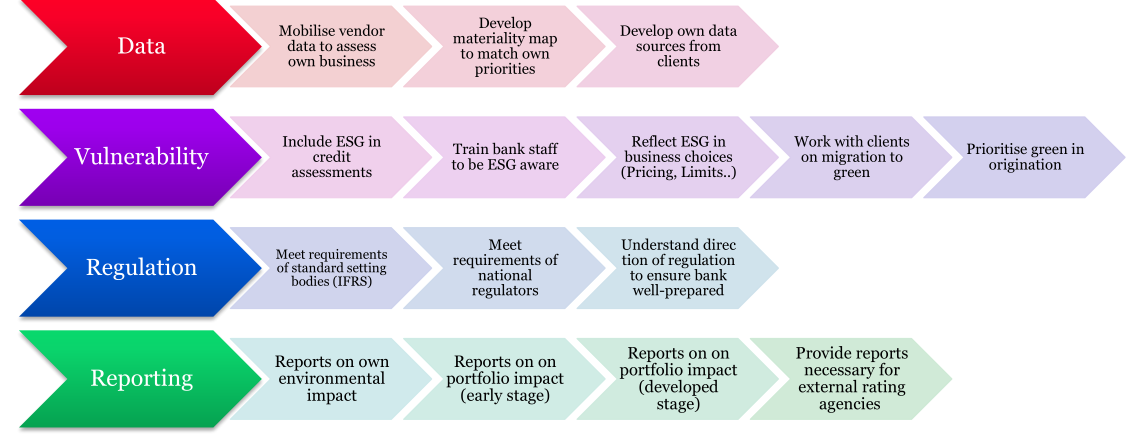
How should a bank develop its ESG strategy? Figure 1 shows the 4 key elements that banks must put in place. The first element is to tackle the data problem. The last three decades have witnessed a revolution in the use of data-driven, quantitative modelling within banks, to start with, inside their risk functions, but, increasingly, throughout banks’ business activities. ESG is a major challenge to banks in that it requires new ways of recording and analysing impact and then feeding information into appropriate business decision-making.
The three other elements are equally important: (i) analysing vulnerability, (ii) positioning the institution to be compliant with emerging regulations and (iii) instituting transparent and convincing reporting to the market, senior managers and regulators. But all of these rely on a resolution of the basic problem of collecting high quality data.
This note discusses the data strategy that banks should follow in implementing their broader ESG policies. Future notes will examine the three other aspects.
An industry of ESG rating providers has sprung up in recent years offering ratings, scores and a variety of raw data around the ESG performance of different companies, sectors and countries. Banks need to learn from what these providers offer, in some cases directly using the data they offer and in others devising their own data collection and analysis protocols.
Investment institutions were the first to employ ESG scores in their reporting and investment decisions and ESG vendor offerings were in most cases initially developed for the use of investors. Now banks are beginning to make extensive use of ESG indicators. What lessons in the use of ESG scores can banks draw from investment firms? What pitfalls should they seek to avoid? What open issues remain?
This note is organised as follows. Section 2 explains the state of development of the ESG ratings industry. Section 3 identifies key aspects of ESG data that banks should bear in mind. Section 4 considers open issues that remain for banks.
2. ESG Ratings and Investment Firms
The ESG characteristics of business models and portfolios are rapidly becoming a key consideration for financial institutions. The sponsorship of the United Nations, with its Principles for Responsible Investing (PRI), has helped enhance the profile of ESG, both with asset owners and investment managers. In its latest 2020 annual report, they were 2,701 investor signatories to UN PRI (a 29% annual growth), representing a total of US$103.4 trillion of collective Assets Under Management (AUM).
To help asset owners and investment managers to allocate institutional ESG-committed funds, an industry of ESG rating or scoring agencies has appeared offering ways to assess and quantify ESG characteristics. Unlike the credit rating industry which is dominated by just three organisations (Moody’s, S&P and Fitch) which offer highly correlated assessments, no dominant ESG rating agencies have so far emerged.
Consolidation has started as agencies race to maximise geographical and industry coverage but ESG ratings remain uncorrelated across agencies limited by the degree to which the ratings themselves are accepted. ESG ratings from third-party vendors are widely used for reporting purposes but they are kept at arm’s length by those making investment decisions. Leading investment firms have in several cases developed their own elaborate ESG evaluation frameworks that directly substitute for the ratings provided by external vendors.
The picture is evolving fast, however, with significant market pressure being placed on asset managers. If institutional investors adopt ‘Best-in-Class’ approaches, directing their investments only to companies ranked in the top 10% of ESG ratings, an investment manager may lose a significant part of its value added. But the emphasis on ESG can constrain investment decisions markedly. There is little freedom for an investment manager to make choices if they are constrained to invest only in a limited pool of high-ESG-rating companies and must maintain diversification as required in any mandate.
To avoid the trap of ‘buying-in’ into the views of third-party ESG ratings providers, large global asset managers have decided to disenfranchise themselves from outsourced ESG ratings, building their own ESG methodologies and relying instead on the underlying ESG data from a plurality of vendors rather than the ESG ratings themselves.
3. Bank Use of ESG Ratings
Where do the developments just described leave banks? Banks with a Corporate Social Responsibility (CSR) charter or an equivalent policy are increasingly looking at how to integrate ESG within those frameworks - not just for reporting purposes but more importantly for their risk management processes. How may they employ ESG ratings in what they do?
Unfortunately for banks, ESG ratings are designed for asset managers rather than lenders. Ratings tend to focus on performance (relevant to asset managers), not extreme downside risk (more relevant to banks’ credit risk departments). Also, they focus on immediate concerns rather than the long term developments. Some ESG rating agencies, such as S&P, have responded to the needs of banks by providing distinct products and clarifying the terminology between an “ESG ratings/score” (mainly for investment managers) and an “ESG Evaluation,” the latter applying rating best practice from the world of credit rating.
Reacting to the real and perceived deficiencies of ESG ratings and methodologies, five private banks have launched their own initiative and their own common tool (the Katowice Commitment), initially on climate issues but with the plan to branch out into ESG aspects.
The action of these banks in developing their own approach illustrates the choices that all banks face. Vendor datasets are not particularly designed for the banking market. How much should an institution seek to develop its own approaches and how much should it leverage external approaches? The complexity of ESG data and the relative lack of expertise and a convincing knowledge base in most banks would seem to argue in favour of adopting consensus or at least external approaches. But external approaches may prove fragile as market practices and regulations are still evolving.
Based on our experience advising bank clients on these issues, our advice to a bank CRO on developing an ESG data strategy would be:
1. Identify the Most Relevant ESG Dimensions and Coverage for your Institution
Start by considering your institution’s objectives in employing ESG indicators. Most banks give priority to climate issues and, to some extent to the wider ‘E’ factor. But large institutions need to ensure that their ESG integration answers the needs, not just of their own head-office, but of their subsidiaries and branches in other jurisdictions.
A bank with a major emerging markets business may place more emphasis on data that reflects the ‘S’ factor, for example. For Multilateral Development Banks (MDBs) the ‘S’ aspect is paramount. The ‘G’ is a more straightforward topic for bank risk departments as governance is already a key part of their credit risk appraisal.
Geographical and Sector coverage is also an important issue for banks. Leading ESG rating agencies are often the result of industry consolidation following mergers or the acquisition of local or specialised ESG rating agencies aimed at improving coverage. The initial coverage imbalances remain, however.
Some data vendors, for example, have extensive coverage in North America and China, while concentrating on only the major corporates in EMEA. Some focus on listed companies, while ignoring the large private corporates. These coverage biases reflect the origins of the ESG market in catering to the needs of fund managers.
To assess the coverage and general fit of the provider with your organisation’s objectives, it is essential to engage in detailed quantitative evaluation.
2. Understand the Biases Implicit in Data and Make Sure You Retain Flexibility
ESG ratings are plagued by more or less subtle and complex biases that reflect choices and assumptions made by the vendor. ESG ratings for a particular firm employ raw indicators weighted according to an assessment of which ESG aspects are most relevant for the firm’s sector. The way indicators are selected and the weights are referred to as a materiality map. Some vendors use internationally recognised maps such as SASB or GRI, but most leading ones have developed their own proprietary materiality map making direct comparisons of ESG ratings difficult. The use of proprietary maps creates a sticky data dependency between vendors and their users, once a user has selected a particular vendor.
If a bank wishes to integrate ESG data with its own operations it should keep control of its materiality map. Either it should adopt a transparent, widely employed approach such as SASB or it should develop its own map that matches the nature of the business and the ESG objectives of the organisation. What is not to be advised is to employ untransparent indicators reflecting particular choices that a vendor happens to have made. Where vendor data is used, it is important to be able to drill down to component indicators and even raw information.
A more intractable issue for banks is that a significant fraction of their exposure is to other banking counterparties. ESG metrics are most obviously applicable to industrials for which the climate impact, for example, is related to their real activities. For bank, however, the main impact of their activities in the climate relates to the carbon emissions of the corporates to which the bank lends. These costs are likely to dwarf those of the carbon emissions from the bank’s own operations. So far, no vendor has produced a convincing way of ‘looking through’ banks to the ESG nature of their lending books.
3. Understand Vendor Transparency
Bank risk departments have a long tradition of developing their own independent views which are expressed in elaborate internal rating systems. Few banks rely significantly on external credit rating agencies. Banks are able to proceed in this way because they have put in place stable flows of information about their counterparties in the form of credit review files. These are regularly produced, containing detailed information that is standardised within the institution. In integrating ESG data into its operations, a bank should aim to develop similar, high quality stable information flows.
Two ESG rating agencies have recognised this new trend, and provide full drilldown capacity from the top level ESG rating down to individual ESG indicators. One ESG rating agency with a growing market share has gone further in that, at the press of a button, one may ascertain the source of the data used, whether the data is explicitly mentioned in a public document, or the result of the vendor’s interpolation. Such transparency is likely to be a major factor in bank choices of which vendors to employ and how to use the data.
Transparency is likely to prized by regulators. What supervisors will require on ESG of the banks they oversee has yet to be established. But clarity and quality of data are likely to appeal to bank regulators who have for some years questioned the opacity of banks’ internal credit rating models.
4. Develop Data Inputs for Business Decisions and Train Business Colleagues
Finally, satisfactory ESG data development and integration is not just about technical aspects. This is the easy part that can be delegated to quantitative specialists. The long-term need is to embed ESG methodologies in the choices and actions of credit and lending officers by familiarising them with the data so that such data can contribute as inputs to appropriate business processes.
The true value added comes not from stopping business relationships that are in the left tail of the ESG score distribution but in helping clients to transform themselves to improve their ESG scores. Such an approach is better both for banks and for society in general. For this to happen, suitable ESG data must be developed that can serve as inputs to credit scores, limit systems and RAROC pricing routines.
These data should be convincing to business side colleagues. Early adopters of this kind of positive business behaviour may be observed among Multilateral Development Banks (MDBs) which have long sought to make lending decisions in line with Sustainable Development Goals (SDGs).
4. Open ESG Data Issues for Banks
There remain for banks numerous taxing and open ESG data issues. If banks wish to look through the complexity of their own balance sheets at the ultimate ESG impact, they have to address the fact that:
• Large portions of bank balance sheets are scarcely covered by external ESG data vendors in that no data is provided for retail and SME clients. What data fields are available and what new information should be required of counterparties in the bank’s various origination activities?
• Bank balance sheets contain many different investments and financing instruments. How should one view the ESG impact of portfolios containing different instruments debt vs equity or senior vs subordinated debt? Does the face value of financing matter alone or should issues of control, return or capital consumption figure in the calculation?
• Similar issues arise in the evaluation of the ESG contributions of securitisation tranches. How should a bank investor in a green CMBS evaluate the ESG impact of holding a senior versus a mezzanine tranche of a CMBS? Even less obvious is how should one consider an unfunded exposure such as a synthetic CDO tranche?
• How should a bank view the ESG impact of other banks? A bank (equity financed with deposits) may be compared to the junior tranche of a securitisation, so this is related to the last bullet point.
Contacts: Georges Duponcheele georges.duponcheele@riskcontrollimited.com William Perraudin william.perraudin@riskcontrollimited.com
Risk Control Limited 13-14 Dean Street London W1D 3RS +44 (0)203 307 0730 www.riskcontrollimited.com