

1. Introduction
Risk Control thanks the European Commission for the opportunity to address the issues raised in the Consultation Document on an EU framework for simple, transparent and standardised securitisation published on 18th February 2015 (the “Consultation”).
Risk Control is an independent advisory firm, specialised in securitisation markets, assisting major international institutions, including the world’s largest banks, in developing and implementing effective and rigorous risk management.
Securitisation provides an important source of funding for bank and non-bank lenders. This is particularly significant in Europe where banks, because of the wider economic environment, face significant challenges in meeting scheduled Basel III increases in regulatory capital and liquidity ratios.
As the EU consultation notes, securitisation activity in Europe remains depressed. This is in contrast to the current experience in the US where securitisation new issue volumes have recovered. Identifying and, if possible, rectifying impediments to the revival of European securitisation is an important policy objective, in the view of many.
We believe that the defining by regulators of a category of High Quality Securitisation (HQS) transactions could contribute to the revival of securitisation activity in Europe, but only if the definition selected by the authorities serves as the basis for differential regulatory rules on capital and liquidity.
The Basel proposals for securitisation capital rules published in the December 2014 paper BCBS 303 are designed to cover a very broad set of securitisations. These range from simple, transparent securitisations of well-understood assets originated by tightly regulated banks, on the one hand, to opaque transactions with pool assets originated by unregulated entities and about which little information is available.
The bulk of the European market consists of securitisation of prime mortgages, SME loans, auto loans and card receivables originated by regulated banks (or well-established manufacturers in the case of auto loans). The banks involved typically organise their securitisations in a vertically integrated way with an important objective being that of raising funds for stable loan businesses. This market proved very robust in the face of a GDP stress that matched or exceeded in magnitude the stress experienced in the US.
To facilitate differentiation between the wide variety of securitisations, it is entirely reasonable and desirable that the authorities devise an HQS definition and employ it as the basis for preferential capital and liquidity rules of the simpler, more transparent and better understood part of the market. In our responses below to the questions raised by the consultation, we explain how such differentiation should be accomplished.
Perraudin (2014) provides strong empirical justification for making such distinctions in capital rules as it shows that, holding the rating constant, a key risk measure, namely return volatility, is substantially lower for European securitisation tranches that may be regarded as HQS compared to others.
We focus in our comments on the questions on alternatives to credit ratings (Question 7) and the appropriate capital treatment of HQS (covered by Questions 9, 10, and 11). These are areas in which we have particular experience and expertise and have completed recent research papers and analysis.
2. Responses to the Questions
A. Question 7: Alternatives to current credit ratings A. What alternatives to credit ratings could be used, in order to mitigate the impact of the country ceilings employed in rating methodologies and to allow investors to make their own assessments of creditworthiness?
B. Would the publication by credit rating agencies of uncapped ratings (for securitisation instruments subject to sovereign ceilings) improve clarity for investors?
Credit ratings provide a valuable resource for investors wishing to supplement their own prudent due diligence with additional evaluations. However, they have a number of drawbacks most notably quasi-arbitrary treatments of sovereign transfer risk and default risk of swap counter-parties and excessive methodology volatility.
These features are documented by Duponcheele, Perraudin and Totouom-Tangho (2014). We believe that such problems somewhat reduce the value of agency ratings vis-à-vis investors. However, a lack of clarity in the meaning of ratings affecting investors is not sufficient reason for regulatory authorities to intervene by, for example, obliging ratings agencies to alter their approaches.
Investors may readily calculate other risk measures such as the return volatility of positions based on price quotes. Also, useful qualitative measures of transparency and simplicity are supplied within Europe by the industry bodies Prime Collateralised Securities and True Sale International. An advantage of these alternative risk measures is that they are not affected by the sovereign caps that obscure the informational content of agency ratings for securitisations.
The real problem caused by the opaqueness of agency ratings as a signal of risk stems from their use in regulatory capital calculations. Arbitrary triggers based on sovereign ratings and excessive volatility in ratings methodologies together imply that ratings are inappropriate as a basis for regulatory capital. (Again, this is documented and discussed in Duponcheele, Perraudin and Totouom-Tangho (2014)). The response by regulators should not be to tinker with ratings definitions. Instead, they should follow the policy set out by the G20 Summit in Toronto in June 2010 of removing the reliance on ratings of financial rules.[1]
B. Question 9: Prudential treatment for banks and investment firms With regard to the capital requirements for banks and investment firms, do you think that the existing provisions in the Capital Requirements Regulation adequately reflect the risks attached to securitised instruments?
The short answer is no. The reason is the heavy reliance placed on agency ratings in the current CRR treatment of securitisation capital. Agency ratings, as a basis for securitisation capital, suffer from the problems discussed in the response to Question 7. When one compares the risk weights implied by ratings-based and non-ratingsbased capital rules contained in the CRR one observes major inconsistencies. The ratings-based rules also appear excessively conservative if one benchmarks the capital they imply against the capital implied by rigorous risk modelling exercises.
To document these observations, we refer the reader to our study, Duponcheele, Linden and Perraudin (2014). That study presents a Quantitative Impact Study (QIS) for a large set of European securitisation tranches, comparing the capital levels implied by CRR rules with those generated using a rigorous capital model. The latter, the Conservative Monotone Approach (CMA) was developed as the preferred variant of a family of analytical models proposed, developed and calibrated by specialist risk quants from a group of major international banks. It may be regarded as the state of art in analytical securitisation capital modelling.[2]
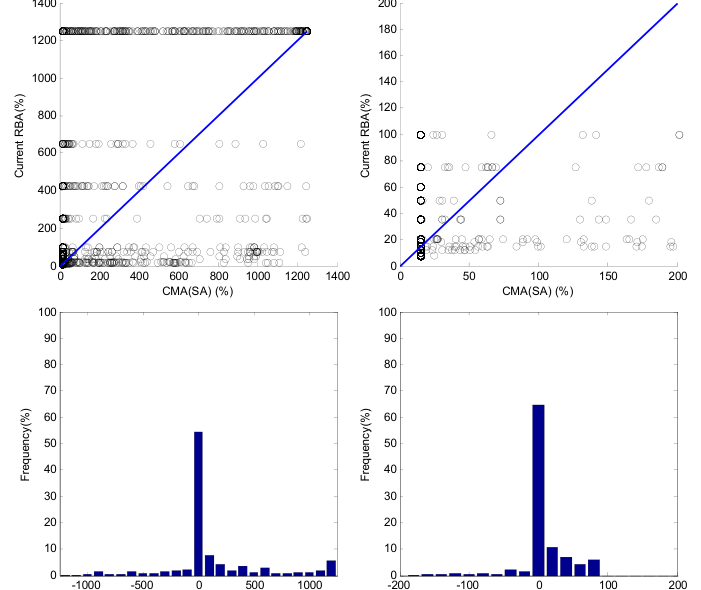
The upper two panels Figure 1 shows scatter plots of ratings-based capital implied by the CRR rules versus capital implied by the CMA for 1,771 European securitisation tranches. The lower panels show histograms of the differences between the capital levels for each tranche implied by the CRR ratings-based rules and the CMA. The left hand panels in the figure show results for all 1,771 securitisation tranches, whereas the right hand side panels present results only for tranches that have risk weights less than 200%, i.e., for the high quality part of the market.
The figure shows dramatically the weakness of the relation between risk (and hence capital) as measured by agency ratings and that implied by a model-based approach. The histograms show the conservative bias in capital that comes from the ratings-based rules compared to the model-based calculation.
Table 1 provides a systematic tabular version of the comparison. This covers a range of current approaches such as the Supervisory Formula Approach (SFA), the Standardised Approach (Ratings-Based), the CMA with IRBA inputs, the CMA with SA inputs, the Simplified Supervisory Formula Approach which has been developed and implemented domestically by the US authorities. In each case, we calculate average risk weights for the RMBS, SME-backed and Other Retail securitisations (mostly Auto Loans but with some Credit Cards) tranches in our sample of 1,771 securities.
The results in the table show that the RBA and the ratings-based SA are much more conservative for senior tranches than the Supervisory Formula Approach (SFA). All three approaches are contained within the CRR. Use of the SFA has been discouraged by some national authorities in Europe but permitted by other authorities in the case of bank originators. The SFA is currently allowed in the US for IRB banks (even when they are not originators) while US SA banks employ the Simplified Supervisory Formula Approach with a p-parameter of 0.5. The SFA and SSFA are much less conservative than the corresponding RBA and SA(RB) which are generally employed in Europe.
Securitisation tranches subject to risks other than pool credit performance merit extremely conservative capital treatment. But the capital of securitisations of well-understood stable markets like prime European bank loans may be calibrated, in our view, using prudently calibrated models like the CMA. The right weights implied by the ratings-based capital rules in the CRR may, hence, be regarded as disproportionate in the light of actual risk.
C. Question 10: Do current BCBS recommendations constitute a good baseline? If changes to EU bank capital requirements were made, do you think that the recent BCBS recommendations on the review of the securitisation framework constitute a good baseline? What would be the potential impacts on EU securitisation markets?
In our view, if the current BCBS proposals were implemented in Europe, the securitisation market would remain permanently in its current moribund state. The cost for the European economy would be further delay in the resumption of normal levels of bank lending and, hence, continued deflationary pressure on real investment and general economic activity.
To demonstrate this, we would point again to the Quantitative Impact Study (QIS) performed by Duponcheele, Linden and Perraudin (2014). That study presents calculations of capital for 1,771 European securitisation tranches, including calculations using the proposed BCBS approaches, the External Ratings Based Approach, the Internal Ratings Based Approach (IRBA) (which takes as its primary input an estimate of IRB pool capital) and the Standardised Approach (SA) (which uses SA pool capital as its main input).[3] (Both the IRBA and the SA are based on a simple, smoothing formula known as the Simplified Supervisory Formula Approach (SSFA)).
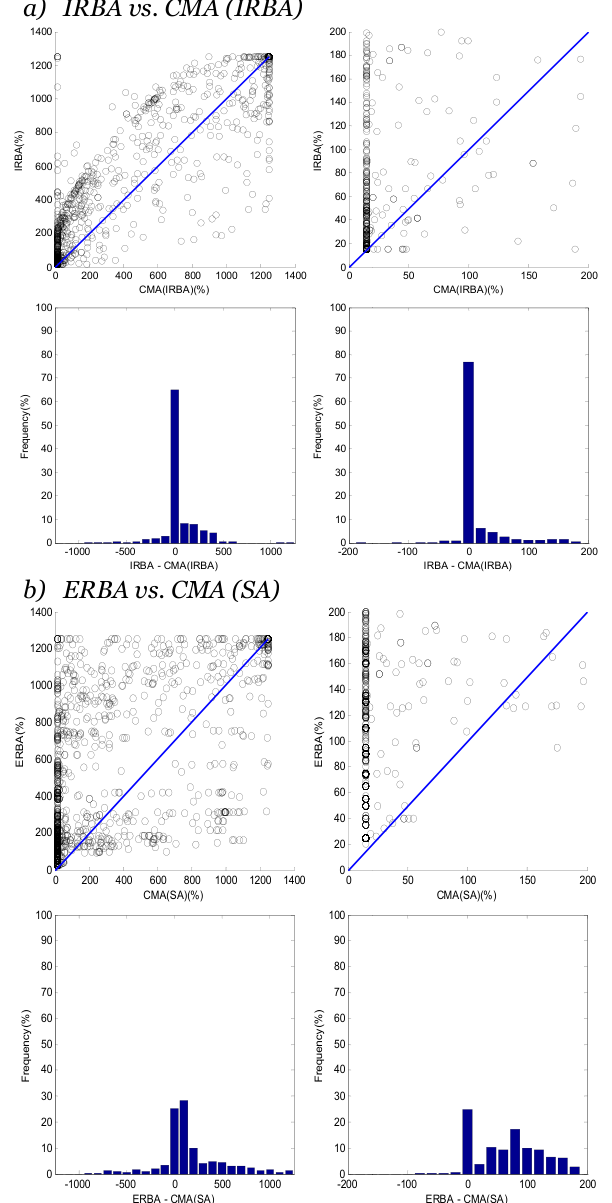
Figure 2 shows scatter plots and histograms comparing risk weights calculated using the three BCBS 269 approaches: IRBA, ERBA and SA and the benchmark capital model, the CMA. Table 2 presents the same data, comparing mean risk weights for the 1,771 tranches examined, broken down by (prime) RMBS, SME and Other Retail.
c) SA vs. CMA (SA)
1400 200
1000 140
SA(%) 600 SA(%) 80
0 0 0 200 400 600 800 1000 1200 1400 0 50 100 150 200 CMA(SA)(%) CMA(SA)(%)
100 100
90 90
80 80
70 70
60 60
50 50
40 40 Frequency(%) Frequency(%)
30 30
20 20
10 10
0 0 -1000 -500 0 500 1000 -200 -100 0 100 200 SA - CMA(SA) SA - CMA(SA) Source: Duponcheele, Linden and Perraudin (2014).
The figure and chart demonstrate the following:
1. “Most senior” tranches are treated much more conservatively by the ERBA than by the other BCBS 269 approaches,
2. CMA risk weights for “other” tranches (when IRBA and SA capital inputs are employed) are lower than the two corresponding SSFA approaches, IRBA and SA and substantially lower than the ERBA risk weights,
3. ERBA risk weights are substantially higher than the IRBA and SA risk weights.
Point 3 shows how incoherent the BCBS approaches are. Current regulatory practice in Europe prevents European banks from calculating IRB pool capital except if they adhere to strict informational requirements.
In effect, a European bank is only eligible to use the IRBA if it is the originator of the loans in the pool. This contrasts with the situation in the US where regulators permit banks to calculate IRB pool capital under much less stringent conditions.[4]
Some argue that allowing a deviation from BCBS rules for HQS within Europe would lead to market fragmentation. The reality is that the current proposals combined with regulator practices mean that regulatory capital is very clearly fragmented already.
In the light of the above points, we view the current BCBS proposals as highly conservative and incoherent in their treatment of European and US banks. The effect of adopting these rules in Europe for all securitisations (both HQS and non-HQS) would be to leave the market permanently in its current depressed state. The combination of such capital rules with Solvency II capital regulations that are highly conservative for securitisations would reduce the buy side for investors in European securitisations to non-European and, in particular, US-based investors.
D. Question 11: Differentiating qualifying and other securitisation How should rules on capital requirements for securitisation exposures differentiate between qualifying securitisations and other securitisation instruments?
The European Commission plans to create a framework for High Quality Securitisations. Qualifying securitisations will be simple, standardised and transparent. We believe that the regulatory treatment of such securitisations, especially the rules for calculating capital, should itself be simple, standardised and transparent.
To achieve this, we propose that the capital framework adhere to four principles:[5]
1. Risk measure should be based on the regulators’ view of pool risk
• In practice, this means that the main asset-dependent input should be the pool capital itself, KIRB in IRB and KSA in SA.
• We note that, currently in the US, following Dodd-Frank, in the Standardised Approach, the pool capital KSA is already the main input – it is only adjusted marginally with a delinquency ratio. We also note that the main input under the current CRR when the SFA
• A is employed is also KIRB.
2. Capital calibration (or capital surcharge) should be simple and transparent For qualifying securitisations, one could improve simplicity and transparency by designing capital charges that allocate a total capital to all tranches that equals the required capital of the underlying pool plus a non-neutrality capital surcharge.
• Simple to understand: we advocate that the capital surcharge in the IRB calculation be always less than the capital surcharge in the SA version of the calculation.
• Transparently set: we note that, currently in the US, following Dodd-Frank, for the Standardised Approach, the capital surcharge of the US SSFA (leaving aside the effect of the floor), is transparently set at p=50%.
• However, the BCBS IRBA rules fail in terms of transparency in that the value of “p” a bank must employ is based on an undisclosed calibration that yields counter-intuitive results such as the fact that lower quality pool assets (such as subprime mortgages) qualify for a lower capital surcharge and high quality retail pools (such as prime mortgages or consumer loans) are strongly disadvantaged.
• We oppose the suggestion of using for HQS the BCBS 269, simply scaled by a factor less than unity. The IRBA is already defective and the consequence would be a capital framework even more favourable to subprime mortgages than the current BCBS proposal.
3. Allocation of capital across junior, mezzanine & senior should be simple and transparent Simple allocation: we think that the capital allocation should be sensitive to the underlying risk
• in the pool and recognise the decreasing need for capital requirements as the tranche attachment point increases.[6] We note that the proposed Basel SA and IRBA rules fail in this respect, as the capital requirement is insensitive to the attachment point below KSA or KIRB.
• Transparent allocation: we note that the current SFA in the CRR fails in this respect in that the allocation is based on the notion of uncertainty in loss prioritisation which does not square with reality.
4. The capital framework itself should be standardised.
• It should employ the same underlying methods in both IRB and SA implementations.
• We note that the current CRR SFA in IRB is not standardised with any other approach.
• We note that the current CRR methods based on external ratings for IRB and SA are standardised in that they both rely on external ratings. The Basel ERBA is standardised with itself in the sense that it is valid for both IRB and SA banks. The Basel IRBA and SA are also standardised with each other as they employ the same underlying mathematical exponential allocation: the SSFA.
We see two possible methods of calculating capital requirements that would achieve simplicity, transparency and standardisation.
1. A formula-based approach building on the US SSFA (which is also employed in the Basel IRBA and SA) but adapted to European assets.
• We have described this approach, which we term the European SFA, in Duponcheele, Linden and Perraudin (2014).
• In this approach, the mathematical allocation of capital is the exponential function and starts at the attachment point corresponding to AF times pool capital, KIRB in IRB and KSA in SA.
• The adjustment factor AF is transparently set at 55% in IRB and 60% in SA. ponential function is transparently set at 60% in IRB and 80% in SA.
• The p-parameter of the exp
• This results in a transparent capital surcharge (excluding the floor effect) calculated at “AF+p-1”, i.e. at 15% in IRB and 40% in SA.
• The EBF has already provided to the EBA[7] its support for this formula-based approach, as it offers a more stable and fair prudential scheme for European originated securitisations than approaches calibrated on non-European assets.
2. A non-formula based approach, developed recently and inspired by the non-neutrality ratio of the October 2014 EBA discussion paper: the Pool Capital Multiplier Approach (PCMA). In this approach the current mapping based on external ratings would be replaced by a mapping
• based on the risk of the tranche as expressed by its attachment and detachment point relative to pool capital. We propose a simple and transparent PCMA calibration generating a capital surcharge of 15% in
• IRB and 40% in SA (excluding the additional surcharge linked to the risk weight floor).
• The risk weight floor would be 7% in IRB and 10% in SA.
• More details on the PCMA are provided in the Appendix to this document.
Source: Duponcheele, Linden and Perraudin (2014), Figure 6.
| RBA | SA (RB) | SFA A | CMA (IRBA) | CMA (SA) | US SSFA = 0.5) ( | Adjusted US SSFA ( = 0.5) | ||||||||
|---|---|---|---|---|---|---|---|---|---|---|---|---|---|---|
| Most Senior Tranches | ||||||||||||||
| RMBS | 67% | 90% | 7% % | 15% | 15% | 15% | 15% | |||||||
| SME | 21% | 51% | 7% % | 15% | 15% | 15% | 15% | |||||||
| Other Retail | 10% | 26% | 7% % | 15% | 15% | 15% | 15% | |||||||
| Other Tranches | ||||||||||||||
| RMBS | 502% | 499% | 182% | % | 331% | 345% | 396% | 358% | ||||||
| SME | 555% | 555% | 205% | % | 290% | 251% | 339% | 286% | ||||||
| Other Retail | 196% | 211% | 90% % | 159% | 236% | 309% | 272% |
Source: Duponcheele, Linden and Perraudin (2014).
| IRBA | ERBA | SA A | CMA (IRBA) | CMA (SA) | |||||
|---|---|---|---|---|---|---|---|---|---|
| Most Senior | Tranches | ||||||||
| RMBS | 16% | 79% | 16% % | 15% | 15% | ||||
| SME | 15% | 84% | 16% % | 15% | 15% | ||||
| Other Retail | 15% | 37% | 20% % | 15% | 15% | ||||
| Other Tra | anches | ||||||||
| RMBS | 412% | 564% | 497% | % | 331% | 345% | |||
| SME | 285% | 539% | 443% | % | 290% | 251% | |||
| Other Retail | 206% | 269% | 396% | % | 159% | 236% |
Source: Duponcheele, Linden and Perraudin (2014).
3. References
1. Basel Committee on Banking Supervision (2013a) “The regulatory framework: balancing risk sensitivity, simplicity and comparability,” Discussion Paper, Bank for International Settlements, July, (BCBS 258)
2. Basel Committee on Bank Supervision (2013b) “Revisions to the securitisation framework,” Consultative Document, Bank for International Settlements, December, (BCBS 269)
3. Basel Committee on Banking Supervision (2014) “Revisions to the securitisation framework,” Consultative Document, Bank for International Settlements, December, (BCBS 303).
4. Duponcheele, Georges, William Perraudin and Daniel Totouom-Tangho (2014) “Reducing the Reliance of Securitisation Capital on Agency Ratings,” BNP-Paribas mimeo, February. http://www.riskcontrollimited.com/public/Reducing_the_Reliance.pdf
5. Duponcheele, Georges, William Perraudin, Alexandre Linden and Daniel Totouom-Tangho (2014) “Calibration of the CMA and Regulatory Capital for Securitisations,” BNP Paribas mimeo, April. http://www.riskcontrollimited.com/public/Calibration_of_CMA.pdf
6. Duponcheele, Georges, Alexandre Linden and William Perraudin (2014) “How to Revive the European Securitisation Market: a Proposal for a European SSFA,” BNP-Paribas mimeo, November. http://www.riskcontrollimited.com/public/How_to_Revive_the_European_Securitisation_Market.pdf
7. Perraudin, William (2014) “High Quality Securitisation: An Empirical Analysis of the PCS Definition,” RCL mimeo, June. http://www.riskcontrollimited.com/public/High_Quality_Securitisation.pdf
4. Appendix: Pool Capital Multiplier Approach (PCMA)
The PCMA proposal overview
Qualifying securitisations should attract reasonably conservative capital surcharge and their capital should not be dependent on external ratings. We propose a practical solution that would achieve these goals: the capital would no longer be based on external ratings but on the pool capital multiplier approach (PCMA). The risk weight of a tranche would be simply read in a PCMA table. We propose the following PCMA tables:
PROPOSED PCMA APPROACH (IRB)[8]
Sensitivity Steps Mapping to Pool Capital Multiplier Sensitivity Step Risk Weight
1 (Floor) x4.00 and above 7% 2 x3.50 - x4.00 12% 3 x3.00 - x3.50 25% 4 x2.50 - x3.00 55% 5 x2.00 - x2.50 110% 6 x1.75 - x2.00 185% 7 x1.50 - x1.75 280% 8 x1.25 - x1.50 400% 9 x1.00 - x1.25 535% 10 x0.75 - x1.00 700% 11 x0.50 - x0.75 900% 12 x0.25 - x0.50 1100% 13 x0.00 - x0.25 1250% PROPOSED PCMA APPROACH (SA)[9]
Sensitivity Steps Mapping to Pool Capital Multiplier Sensitivity Step Risk Weight
1 (Floor) x4.00 and above 10% 2 x3.50 - x4.00 30% 3 x3.00 - x3.50 60% 4 x2.50 - x3.00 110% 5 x2.00 - x2.50 200% 6 x1.75 - x2.00 300% 7 x1.50 - x1.75 400% 8 x1.25 - x1.50 550% 9 x1.00 - x1.25 700% 10 x0.75 - x1.00 850% 11 x0.50 - x0.75 1000% 12 x0.25 - x0.50 1150% 13 x0.00 - x0.25 1250%
In IRB mode, the proposed PCMA results in an overall capital surcharge post-securitisation of 15% compared to pre-securitisation and a risk weight floor of 7% would apply. In SA mode, the proposed PCMA would result in an overall capital surcharge of 40% with a floor of 10%.
We propose that the PCMA approach be implemented as early as January 2016 for qualifying European securitisations. The proposed PCMA tables will replace the existing tables based on external ratings (see below).
For non-qualifying securitisations, the current rules from the CRR (RBA/SA(RB)/SFA/IAA) will continue to apply between 2016 and 2018 when the new Basel framework will be implemented.
CRR 575/2013, Article 261, IRB - Ratings Based Method Credit Mapping to Credit Quality Step Risk Weight Quality External Senior Non-Senior and Granular Non Granular Steps Ratings 1 AAA 7% 12% 20% AA+ / AA / 2 8% 15% 25% AA- 3 A+ 10% 18% 4 A 12% 20% 35% 5 A- 20% 35% 6 BBB+ 35% 50% 7 BBB 60% 75% 8 BBB- 100% 9 BB+ 250% 10 BB 425% 11 BB- 650% B+ / B / B- All other and Below B- or 1250% unrated unrated
CRR 575/2013, Article 251, Standardised Approach Credit Quality Mapping to External Credit Quality Step Risk Weight Steps Ratings
1 AAA / AA + / AA / AA- 20%
2 A+ / A / A- 50%
3 BBB+ / BBB / BBB- 100%
4 BB+ / BB / BB- 350%
B+ / B / B-
All other 1250% Below B- or unrated
The PCMA: removing reliance on ratings for qualifying securitisations
In this proposal, to reduce the reliance on ratings for qualifying securitisations, we replace the capital mapping based on ratings by a mapping based on the risk of the tranche. This is achieved by expressing the tranche attachment and detachment points as a pool capital multiple. In other words, the RBA table is replaced for qualifying securitisations by a table based on pool capital multiple. This is called the Pool Capital Multiplier Approach (PCMA). The PCMA table has 13 «sensitivity steps» which are different from the 12 «credit quality steps» of the RBA table.
Use of the PCMA removes reliance on ratings for capital purposes. It solves the key issue of high volatility of capital due to rating agencies changes in methodologies. Rating agencies would continue to play a role assisting investor decision making but will no longer be used for capital for qualifying securitisations.
The PCMA is calibrated so as to generate a smooth capital distribution in that there is a gradual capital increase between each step. This solves the issues of the sharp capital moves in the existing RBA table and of the cliff effect resulting from the capital deduction below the BB- rating.
The PCMA results in a capital framework for qualifying securitisation that is consistent with the capital framework before securitisation. This means that capital for qualifying securitisation would be comparable across European countries for a given asset class which is not the case with the current RBA approach.
The PCMA is simple to implement as it requires few inputs: the capital of the pool pre-securitisation, the attachment and detachment points of the tranches. Bank originators already know the pool capital. Investors can calculate the pool capital easily in standard mode based on information provided by originators. Investors may even be able to calculate the pool capital in IRB mode if they are authorised to do so by their regulators. Attachment and detachment points are easily calculated based on the securitisation structure.
A capital surcharge calibrated for Europe
To overcome a key obstacle identified by the EBA for the revival of the market, i.e. the disincentive for investors and originators, one must adopt an appropriate calibration for the PCMA. Such a calibration would attract back to the market both bank originators and institutional investors such as banks or their affiliates. Insurance companies could adopt a similar approach.
The key question in the calibration is that of the capital surcharge, i.e. by how much the capital post securitisation increases compared to the capital pre-securitisation. For qualifying European securitisations, there are strong reasons to have a commensurate surcharge in view of the quality of the structures and the satisfactory historical performance of the assets. Even taken into account the regulatory principle of prudence, surcharge levels for qualifying securitisations should remain reasonably conservative.
Duponcheele, Linden and Perraudin (2014) employs a sample of 1,771 European tranches to calibrate the appropriate capital surcharge for qualifying securitisations. That study suggests that for European HQS securitisations, a 15% surcharge is appropriate in IRB mode and 40% in SA mode.
Using such surcharge levels for qualifying securitisations in Europe would create the right incentives for originators and investors. The surcharge level for qualifying securitisations could be further refined by distinguishing between asset classes or by using the retail/wholesale distinction from the revised Basel framework. The lower the surcharge, the more incentive there will be for originators and investors to participate in the European securitisation market. This is illustrated in the case of a Spanish RMBS transaction in the graph above.
European legislators should decide on the appropriate level of capital surcharge by making a political decision that will enable the revival of the market and still have a prudent level of capital for qualifying securitisations. This decision will then drive the calibration of the PCMA as proposed in the following table[10]:
Mapping to Pool Sensitivity Capital Floor Target Steps Multiplier 1 (Floor) x4.0 and above 7% 7% 7% 10% 10% 10%
Mapping to Pool Capital Surcharge Target Sensitivity Capital +10% +20% +30% +40% +50% Steps No Surcharge Surcharge Surcharge Surcharge Surcharge Surcharge Multiplier 2 x3.50 - x4.00 8% 10% 15% 20% 30% 40% 3 x3.00 - x3.50 15% 20% 30% 40% 60% 80% 4 x2.50 - x3.00 35% 45% 65% 85% 110% 140% 5 x2.00 - x2.50 80% 100% 120% 160% 200% 240% 6 x1.75 - x2.00 140% 165% 205% 250% 300% 350% 7 x1.50 - x1.75 220% 260% 300% 350% 400% 450% 8 x1.25 - x1.50 310% 370% 430% 490% 550% 610% 9 x1.00 - x1.25 405% 495% 575% 645% 700% 750% 10 x0.75 - x1.00 560% 650% 730% 795% 850% 900% 11 x0.50 - x0.75 790% 870% 930% 970% 1000% 1030% 12 x0.25 - x0.50 1050% 1090% 1120% 1140% 1150% 1160% 13 x0.00 - x0.25 1250% 1250% 1250% 1250% 1250% 1250% Non-Neutrality Ratio 1.00 1.10 1.20 1.30 1.40 1.50 (excluding Floor)
January 2016 implementation is key
Another major impediment to the revival of the market in Europe identified by the EBA is the regulatory uncertainty. The key to unblock the uncertainty is for the EC to adopt rules for European qualifying securitisations that can be implemented as early as January 2016 for new transactions.
Starting in January 2016 would enable a truly European solution for qualifying securitisations without the need for ratings. The removal of ratings will only be for qualifying securitisations. Rating agencies will still offer a safeguard against non-qualifying structures
By adopting an approach adapted to European assets in January 2016, Europe will create a level playing field with the US that have already adopted an approach without external ratings calibrated for US assets.
Focusing on new production will clearly mean that the rules are designed for the revival of the market and not for legacy issues. Once the PCMA has been established in Europe for qualifying securitisations, it could be widened to STC securitisations globally. This would be similar to the US securitisation capital rules that have been subsequently adopted by Basel for global implementation in 2018.
Last but not least, implementation of the PCMA as of Jan 2016 will require only minor amendments to existing legislations keeping in mind that the current framework will change anyway by 2018.
Conclusion
To sum up, the PCMA is a simple proposal that can revive the European market for qualifying securitisations. Use of the PCMA would remove reliance on rating agencies for regulatory capital. If appropriately calibrated, the PCMA could incentivise both originators and institutional investors to participate in the market. If implemented as early as January 2016, it would provide the necessary certainty that is needed to revive the market.
Notes
[1] The summit declaration stated: “We committed to reduce reliance on external ratings in rules and regulations. We acknowledged the work underway at the BCBS to address adverse incentives arising from the use of external ratings in the regulatory capital framework, and atthe FSB to develop general principles to reduce authorities’ and financial institutions’ reliance on external ratings. [..]” (Appendix II, Paragraph 27). 2More information on the CMA and its calibrations may be found in Duponcheele, Linden, Perraudin and Totouom-Tangho (2014)
[3] Note that our study uses the versions of the ERBA, IRBA and SA in BCBS 269 published in December 2013. The most recent Basel proposals are contained in BCBS 303. The IRBA and SA are identical between the two Basel publications and the ERBA is only very slightly altered so our conclusions are, we believe, unaffected by which version is employed.
[4] BCBS 303 has slightly relaxed the rules in this regard compared to BCBS 269 but not enough for it to be practical for European banks to employ the IRBA in cases in which they are not originators.
[5] In seeking to establish relevant principles prior to making a regulatory choice, we follow the approach of BCBS 258.
[6] Interestingly, the future Basel SEC-ERBA exhibits this behaviour with full risk sensitivity at B+, B and B- ratings…
[7] EBF response to the EBA Discussion Paper on Simple Standard and Transparent Securitisations, 12 January 2015 8For instance, a senior tranche rated AA, because of the impact of sovereign caps in rating agencies methodologies, attaching at 24% is currently mapped to step 2 in the RBA and would attract a risk weight of 8% for a granular pool. Assuming pool capital of 6%, the attachment point of the tranche would be x4 pool capital; the tranche is mapped to sensitivity step 1 in the PCMA (IRB) and would attract a risk weight of 7%.
[9] For instance, in the PCMA (SA) a mezzanine tranche attaching at x1.75 and detaching at x2.75 pool capital would cover 100% of sensitivity step 6 with thickness of 0.25, 100% of step 5 with thickness of 0.5 and 50% of step 4 with thickness of 0.5. The PCMA (SA) tranche RW equals 202.5% RW calculated as follows: (100%*0.25)*300%RW+(100%*0.5)*200%RW+(50%*0.5)*110%RW 10Numbers can be slightly rounded up or down for the sake of clarity, without creating a material change to the calibration