

Front matter
As is well known, when considered as a function of attachment point, the Marginal VaR for thin tranches is an inverted S-shaped curve. For some models, this curve is steep in the region of the pool capital, KIRB. In particular, for a single risk factor model (also called the Asymptotic Single Risk Factor (ASRF) model), there is a cliff effect in that for thin tranches attaching below KIRB, tranche capital (based on the Marginal VaR) is 100% while for tranches attaching above KIRB, the thin tranche capital is zero.
Regulators and researchers in the industry have generally seen the cliff effect implied by the one risk factor model as a major deficiency and modelling efforts have focussed on improving the assumptions in ways that yield more reasonable results. The Supervisory Formula Approach (devised by Gordy and Jones (2003)) adopts the assumption of random attachment points to mitigate the problem. This approach has in turn been criticised because the capital it implies remains steep in the neighbourhood of KIRB encouraging capital arbitrage activity and inadequate capital for non-junior mezzanine tranches.
Another approach, more consistent with reality and which yields higher capital for non-junior mezzanine capital assumes that a second common risk factor affects pool asset defaults. Proposed by Pykhtin and Dev
(2002) and recently revisited by Duponcheele et al (2013a), the two-factor approach differs from the one factor model in the important respect that the cliff effect is removed and the S-shaped curve for capital is much flatter for attachment points in the region of KIRB[4]. Importantly, the two factor approach is employed in the Basel Committee’s recent calibration of the Simplified Supervisory Formula Approach (SSFA) (see BCBS (2013)).
This discussion of models is highly relevant to the propositions made by Antoniades and Tarashev because their finding of significant under-capitalisation for mezzanine tranches largely disappears in the two factor model as the sensitivity of capital in the neighbourhood of KIRB is substantially reduced.
Surprisingly, even though they present results for the one-factor and two factor models (and a version of the one-factor model that includes some idiosyncratic risk), Antoniades and Tarashev base their conclusions almost entirely on the one-factor model results. This is perplexing because the Basel Committee in its recent calibration of securitisation capital (BCBS (2013)) has adopted the two factor model, and most specialists would regard the one-factor model as inappropriate for risk analysis of securitisation tranches.
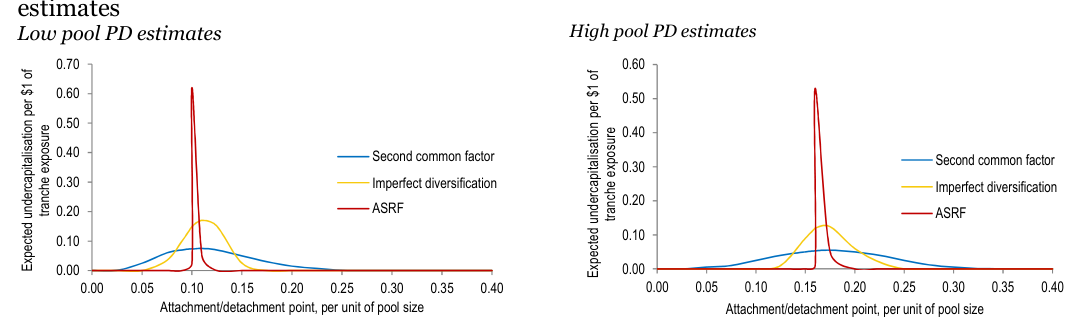
In the figure above, we reproduce results from the Antoniades and Tarashev paper. One may observe that the expected undercapitalisation while large (50-60%) for the one-factor model (that most specialists would regard as ill-suited for modelling securitisation capital) are quite minor for the two factor model (6-7%).
The expected under-capitalisation is likely to be still lower if one uses higher multi-period intra-pool correlations as do Duponcheele et al (2014b) in their calibration of the SSFA using a multi-period two factor model.
On the basis of the figure, one might well question the strong conclusions reached by Antoniades and Tarashev that mezzanine tranches, even in SST securitisations, require a major boost in capital. A more moderate capital premium like that suggested by Duponcheele et al (2014b) would appear to be better justified.
4 Duponcheele et al (2013b) show how the two factor approach can be extended, without losing analytical tractability, to multi-period securitisations, a major advantage. Duponcheele et al (2014a) present a detailed, asset-class-based calibration of the two factor model.
Note that several other aspects of the Antoniades and Tarashev study merit comment. For example, many mezzanine tranches are far from the neighbourhood of KIRB on which the authors focus, being much more senior[5]. In effect the Antoniades and Tarashev comments relate to junior mezzanines not to most of the securities that the market would regard as mezzanines. Another point is one may represent default probability uncertainty through adopting conservative correlation parameters. This is what Basel already does in that the asset correlations employed by Basel for loans (and hence for determining KIRB) are distinctly higher than one obtains by applying statistical methods to actual loan default data.
Also, the analyses of thick tranches performed by Antoniades and Tarashev for the two cases of low and high PDs are not directly comparable as tranches are considered a fixed percentage of the capital structure; to make results comparable, thickness ought to have been defined as a percentage of the underlying capital requirement. Last, it is natural to wonder what the sensitivity of the results is to the assumption the authors make on the prior distribution of the true pool default probability. Assuming a uniform distribution on points from 0.1% to 11% presumably implies very different results from assuming a more skewed distribution or a uniform distribution with possible values ranging up to less than 11%, for example.
Rather than discussing these additional aspects and issues at length, we have, in this note, focussed on the narrow but crucial issue of the numerical magnitude of under-capitalisation. Using an appropriate two factor model (rather than the one-factor model that is largely discredited as a way of understanding securitisation risk) leads, according to the paper, to under-capitalisation of 6-7%[6]. This figure is many times smaller than the capital premium implicit in the latest BCBS proposals. So, even if one accepts the technical nature of the analysis performed, one may argue that the paper’s conclusions are not a fair representation of the findings.
References
Antoniades, Adonis and Nikola Tarashev (2014) “Securitisations: tranching concentrates uncertainty,” BIS Quarterly Review, December. Available at: http://www.bis.org/publ/qtrpdf/r_qt1412f.htm.
Basel Committee on Bank Supervision (2013) “Revisions to the securitisation framework,” Consultative Document, Bank for International Settlements, December (BCBS 269).
Basel Committee on Bank Supervision (2014) “Revisions to the securitisation framework,” Basel III Document, Bank for International Settlements, December, (BCBS 303).
Duponcheele, Georges, William Perraudin and Daniel Totouom-Tangho (2013a) “A Principles-Based Approach to Regulatory Capital for Securitisations,” BNP Paribas mimeo, April, available at: http://www.riskcontrollimited.com/public/Regulatory_capital_for_securitisations.pdf.
Duponcheele, Georges, William Perraudin and Daniel Totouom-Tangho (2013b) “Maturity Effects in Securitisation Capital: Total Capital Levels and Dispersion Across Tranches,” BNP Paribas mimeo, September, available at: http://www.riskcontrollimited.com/public/Maturity_Effects_in_Securitisation_Capital.pdf.
Duponcheele, Georges, William Perraudin, Alexandre Linden and Daniel Totouom-Tangho (2014a) “Calibration of the CMA and Regulatory Capital for Securitisations,” BNP Paribas mimeo, April, available at: http://www.riskcontrollimited.com/public/Calibration_of_CMA.pdf.
Duponcheele, Georges, Alexandre Linden, and William Perraudin (2014b) “How to Revive the European Securitisation Market: a Proposal for a European SSFA,” BNP Paribas mimeo, November, available at: http://www.riskcontrollimited.com/public/How_to_Revive_the_European_Securitisation_Market.pdf.
Gordy, Michael and David Jones (2003) “Random tranches,” Risk, pp78-83, March Pykhtin, Michael and Ashish Dev (2002) “Credit Risk in Asset Securitisations: Analytical Model,” Risk, 15(5), S16-S20, May.
5 Many senior mezzanines attach at multiples of KIRB around 2.5, much higher than the multiplier of 1 on which the authors focus. 6 This is based on the method proposed by Antoniades and Tarashev
Notes
* * * * N * * * * * © Copyright Risk Control Limited 2015 © Copyright Risk Control Limited 2015 Risk Control Limited 13-14 Dean Street London W1D 3RS UK T: +44 (0)203 307 0730 www.riskcontrollimited.com © Copyright Risk Control Limited 2015